

5.12 - Introduction to Sustainability
Learning Objectives
Explain the concept of sustainability, meaning humans living on Earth in a way that does not deplete resources for future generations. Look at five environmental indicators that help assess whether humans are living sustainably. The skill is explaining what data illustrate about an environmental issue.
I. Sustainability and Maximum Sustainable Yield (MSY)
- Sustainability: Using a resource or a space in a way that does not degrade it for future generations.
- Example: Using compost (dead, broken-down, renewable organic matter) instead of synthetic fertilizer, which requires fossil fuel inputs and is unsustainable.
- Sustainable Yield: The amount of a renewable resource that can be taken without reducing the available supply. In other words, you only harvest what grows back.
- Example: If a forest grows 2,000 cubic meters of new wood each year, cutting 2,000 cubic meters or less per year is sustainable. Cutting more than that shrinks the forest a little more every year.
- Maximum Sustainable Yield (MSY): The largest amount that can be harvested every year without shrinking the population. For a population with logistic growth (3.5), this happens when the population is kept at about half of its carrying capacity (), because that's where it adds the most new individuals per year.
- Near , the population is crowded, so it adds very few new individuals each year. Far below , there are too few adults to reproduce quickly. In the middle, at , growth is fastest.
- Harvesting exactly that yearly growth keeps the population steady at . Harvesting more than that shrinks the population every year and can lead to collapse (5.8). Harvesting less is sustainable but gives a smaller catch.
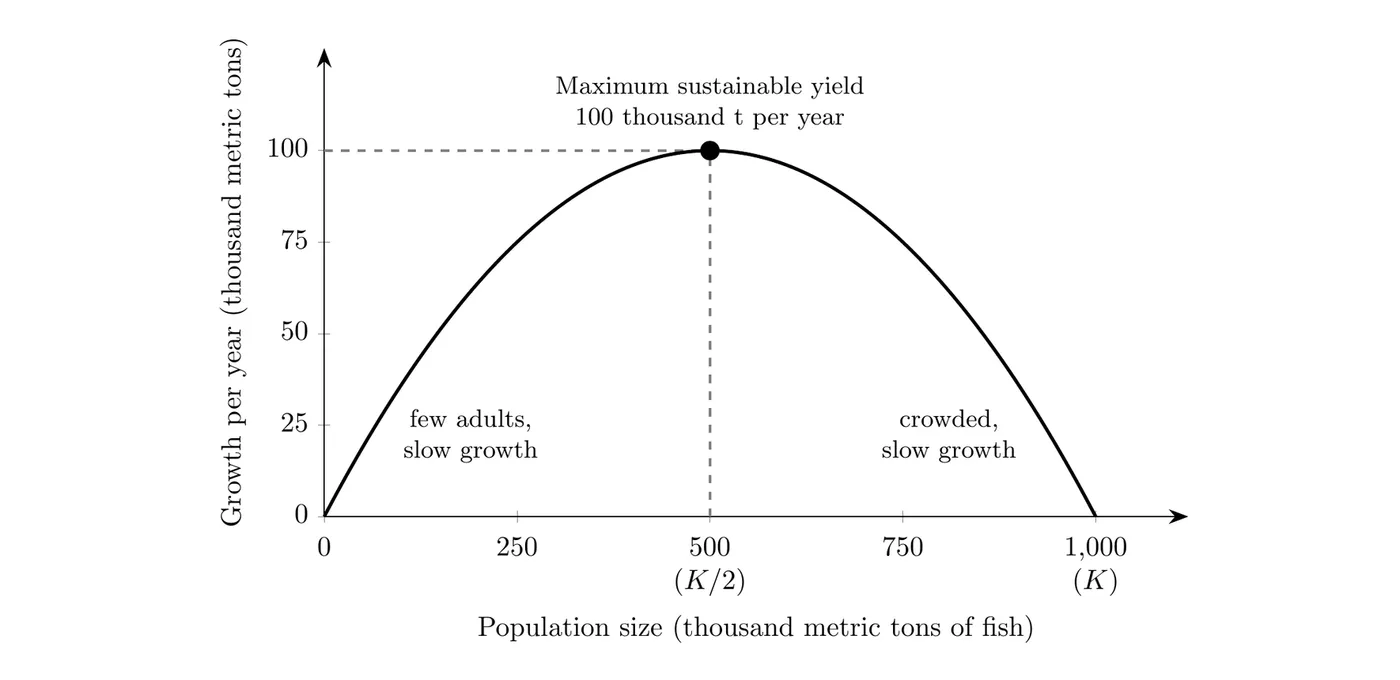
Reading the graph: This fish population's carrying capacity is thousand metric tons (1 million t). Growth is fastest at thousand t, where the population adds 100 thousand t of fish per year. So the maximum sustainable yield is about 100 thousand t per year, as long as the population is kept near 500 thousand t.
II. Environmental Indicators
An environmental indicator is something used to assess the health of ecosystems and figure out whether humans are living sustainably. Five key factors give strong clues:
- Biodiversity
- Food production
- Global temperature and carbon dioxide
- Human population growth
- Resource depletion
III. Analysis of Key Environmental Indicators
A. Biodiversity
- Biodiversity covers genetic, species, and ecosystem diversity. High biodiversity means a healthier ecosystem.
- Declining biodiversity, like high global extinction rates, points to pollution, habitat destruction, and climate change.
- The global extinction rate is currently far above the background extinction rate, the naturally expected rate, for most measured organisms. That strongly suggests human activity is not sustainable from a biodiversity standpoint.
- Example data: WWF's Living Planet Report 2026 found that monitored wildlife populations fell by an average of 73% between 1970 and 2022 (freshwater species fell 85%). This is the average drop in population size, not the share of species lost.
B. Food Production
- Food production reflects Earth’s ability to support agriculture based on its soil, water resources, and climate.
- Threats include climate change, soil degradation like desertification or topsoil erosion, and groundwater depletion.
- Projected climate change is expected to cause declines in agricultural yield across huge portions of the globe, especially near the equator, because warming dries out soil.
- Rising meat consumption is inefficient, requiring far more land and water than grain production, so it strains resources.
- Global grain production per person peaked in the mid-1980s and slipped through the 1990s, but since then harvests have grown faster than population. FAO estimates a record of about 3.0 billion metric tons of cereals in 2025, roughly 370 kg per person. The warning sign is how that food is produced: much of it depends on synthetic fertilizer, pesticides, and irrigation from aquifers that are being depleted (5.5), so today's high yields aren't necessarily sustainable.
C. Global Temperature and Carbon Dioxide
- This may be the most critical and immediate indicator.
- Carbon dioxide is the most prominent greenhouse gas. Greenhouse gases trap infrared radiation (heat) in Earth’s atmosphere, which warms the planet. The data shows a strong link between rising atmospheric and rising global temperature.
- Current numbers: At Mauna Loa, Hawaii, atmospheric averaged about 432 ppm in May 2026 (its yearly peak), compared with about 280 ppm before the Industrial Revolution. The World Meteorological Organization found that 2025 was about 1.44°C warmer than the 1850 to 1900 average, one of the three warmest years on record.
- Causes of increased : Deforestation (losing future carbon sequestration plus decomposition of cut trees) and combustion of fossil fuels like gasoline and coal.
- Consequences of rising temperature: Climate change dries out agricultural land, depletes groundwater, destroys habitats (eliminating biodiversity), and worsens storm intensity through more heat waves, stronger hurricanes, and more severe droughts.
D. Human Population Growth and Resource Depletion
- The human population has gone through an extreme case of exponential growth over the past few hundred years.
- The world population passed 8 billion in November 2022 (UN).
- Population growth leads to resource depletion because rising demand means harvesting resources far faster than natural ecosystem function can replenish them.
- Consequences of a larger population include:
- More demand for paper and lumber, which drives deforestation.
- More food production, which causes topsoil erosion from monoculture and groundwater depletion from irrigation.
- More affluence and travel, which drives fossil fuel mining and the land degradation and habitat destruction that come with it. The data shows that as human population rises, deforestation rates rise substantially too.
Big picture: Sustainability is about managing natural resources so they stay available for future generations, which requires that resource use never exceed the rate at which the resource replenishes itself. That is the core of sustainable yield. The key environmental indicators, including rapidly declining biodiversity, strained food production (record harvests that depend on depleting soil and groundwater), soaring global temperatures linked to , and unprecedented population growth driving resource depletion, all point to the same conclusion: global human activity is currently unsustainable.