

7.2 - Photochemical Smog
Learning Objectives
The main objective is explaining the causes and effects of photochemical smog, plus methods to reduce it. The associated skill is describing relationships between different variables in a set of data.
I. Precursors and Conditions for Smog Formation
A. Precursors (Ingredients) of Smog
Photochemical smog needs two main ingredients (precursors), plus sunlight and heat to drive the reactions. Ozone isn't an ingredient; it's the main thing they make.
- Nitrogen dioxide () / nitrogen oxides (NOx): Produced primarily by vehicle emissions during the morning commute. This is the key compound that sunlight breaks down to start ozone production. Power plants burning coal or natural gas also release NOx.
- Volatile organic compounds (VOCs): A catchall phrase for hydrocarbon compounds that are easily vaporized or volatilized, meaning they evaporate quickly at room temperature.
- Sources: Gasoline, formaldehyde, petrochemicals, and plastic production. Natural sources include coniferous trees like pines.
- Function: VOCs alter the smog reaction by binding with nitric oxide (NO).
- Evaporate or sublimate: VOCs turn into a gas at room temperature. Liquids like gasoline evaporate (that's the gas station smell), solids like mothballs sublimate straight into a gas, and formaldehyde is already a gas that seeps out of glues and pressed wood.
- Trees are a natural source: oaks and other broadleaf trees give off isoprene, and pines and other conifers give off terpenes. On hot, sunny days these natural VOCs can react with NOx from cities and add to ozone.
- What they make, ozone (): a secondary air pollutant formed when is broken down by sunlight and the resulting free oxygen atom binds with . Nobody emits ozone directly; it builds up when the two precursors meet sunlight.
B. Environmental Conditions
- Sunlight: Needed to break down nitrogen dioxide. Sunlight is the driving factor for ozone production.
- Warmth: Warmer temperatures make the reactions that create photochemical smog happen faster. Warmth also causes VOCs to evaporate faster, which speeds up smog production.
- Location: Urban areas are far more likely to experience smog than suburban or rural areas, thanks to more traffic (more ) and the urban heat island effect, meaning warmer temperatures that lead to increased VOC evaporation and faster reactions.
- Season: ozone is worst in summer, when sunlight is strongest, days are longest, and temperatures are highest.
- Weather and geography: calm winds and thermal inversions (7.3) keep smog from blowing away, and cities in basins surrounded by mountains trap it. Wind and rain clear it out.
- Example: Los Angeles has all of these factors at once: lots of cars, strong sunshine, warm weather, mountains around the basin, and frequent inversions. It was again ranked the most ozone-polluted metro area in the U.S. in the American Lung Association's 2026 State of the Air report, as it has been in almost every report since 2000.
II. The Smog Formation Process
The key difference between normal ozone formation and photochemical smog formation is the presence of VOCs.
- Morning NO production: The morning commute releases a lot of nitric oxide (NO), since most of the NOx that comes out of a tailpipe is NO. Within a few hours, much of it reacts with to become , so peaks a little after rush hour.
- Ozone formation: Sunlight breaks into nitric oxide (NO) and free oxygen (O). The free oxygen binds with to form ozone ().
- Normal reversal blocked: Normally, as the sun goes down, ozone would recombine with nitric oxide to reverse the reaction and break down the ozone.
- VOC intervention: In photochemical smog conditions, VOCs enter the atmosphere from things like petrochemical processes, gasoline, or evaporation from cleaning solutions.
- NO sequestration: The VOCs bind with the nitric oxide, forming compounds called photochemical oxidants.
- Ozone buildup (smog): Since the NO is now bound to the VOCs, it isn’t free to recombine with ozone. That lets ozone concentrations build up, which results in photochemical smog, the combination of ozone and photochemical oxidants.
The same steps as chemical equations:
- PANs: the best-known photochemical oxidants are peroxyacyl nitrates (PANs), which form when pieces of VOC molecules combine with . PANs are strong eye irritants.
The daily pattern: on a sunny day in a city, the pollutants peak in a set order.
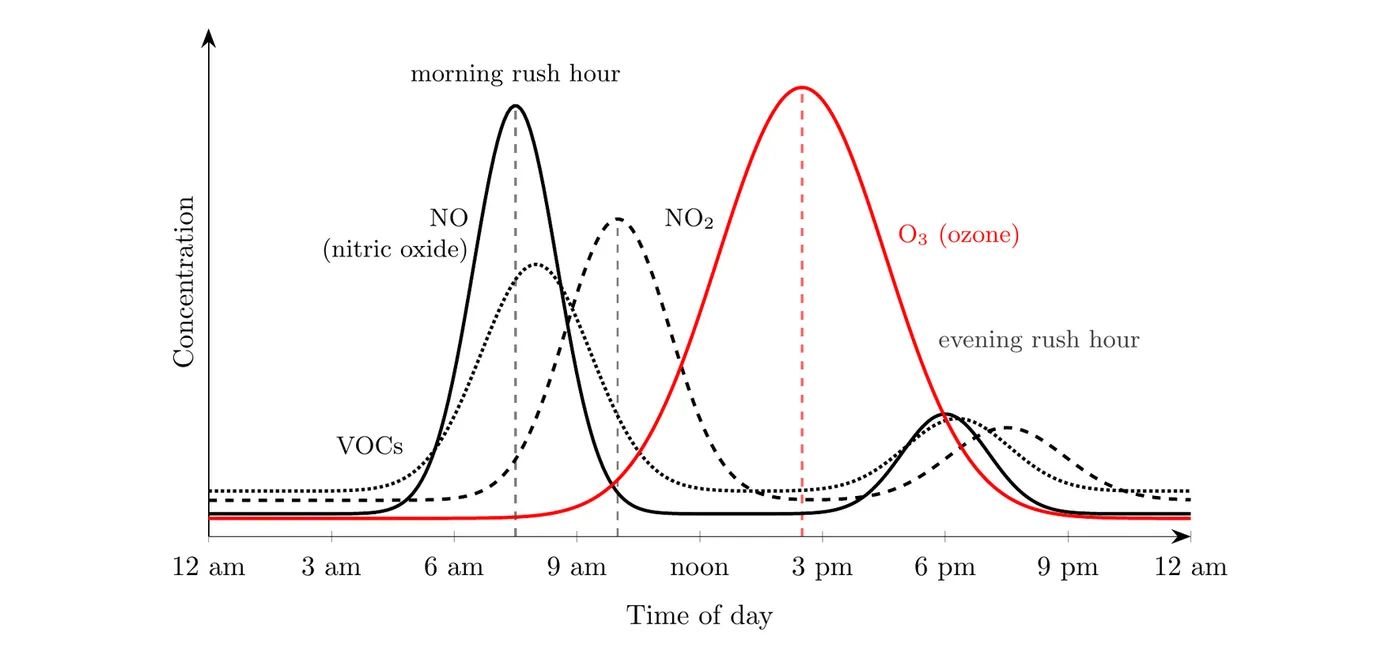
- Early morning (about 6 to 9 am): rush hour traffic releases NO and VOCs, so they peak first.
- Mid-morning (about 9 to 11 am): NO reacts with to form , so peaks next while NO drops.
- Afternoon (about noon to 4 pm): sunlight has been splitting for hours, so ozone peaks in the afternoon, after its precursors have already dropped.
- Evening and night: a smaller bump of NO and VOCs comes with the evening commute, but there's too little sunlight left to make much new ozone. Fresh NO uses up some of the ozone that's left, so ozone levels fall overnight.
- FRQ tip: if a question asks why ozone peaks hours after NO, say that ozone is a secondary pollutant. It has to be made from and sunlight, and that takes time.
III. Impacts of Photochemical Smog
- Human health effects (respiratory irritant): Smog irritates the respiratory tract. It worsens conditions like asthma, COPD, bronchitis, and emphysema. It’s also an eye irritant. Ground level ozone is linked to premature death.
- Why it irritates: ozone and PANs are strong oxidizers. They react with and damage the cells lining the airways and the eyes, which causes coughing, chest tightness, and stinging, watery eyes.
- Economic costs: Smog causes lost economic productivity because workers miss time from being sick, plus healthcare costs.
- Environmental and plant effects: Smog limits photosynthesis by blocking out sunlight. It also damages plant stomata, the pores used to take in , which can inhibit plant growth and decrease agricultural yields.
IV. Methods to Reduce Photochemical Smog
- Reduce vehicle use: Reducing the total number of vehicles on the road, or the distance they travel, directly decreases NOx emissions, the biggest source of NOx. Using less gasoline also means fewer VOCs evaporating from spilled fuel at gas stations.
- Use renewable energy: Switching electricity production to renewable sources that don’t produce nitrogen dioxide, like solar, wind, and hydroelectricity, is a great alternative.
- Fuel switching: If fossil fuels are still used, switching from coal to natural gas drastically reduces the amount of nitrogen oxides produced.
- Cut VOCs: vapor recovery nozzles at gas pumps, sealed fuel systems in cars, and low-VOC paints and cleaners keep VOCs out of the air (7.6).
- Catalytic converters: they turn NOx back into and burn up leftover hydrocarbons, so they cut both smog ingredients at once (7.6).
- Example: Southern California has far more cars now than in the 1970s but far fewer smoggy days, thanks to controls like catalytic converters, cleaner-burning gasoline, and vapor recovery.
Big picture: Photochemical smog forms when VOCs bind with nitric oxide (a breakdown product of from vehicle exhaust), which prevents the NO from naturally recombining with ozone. The result is an unhealthy buildup of ozone and photochemical oxidants, made worse by warm, sunny conditions. Smog causes severe human health issues, like worsening asthma and bronchitis, along with ecological damage by limiting photosynthesis and inhibiting plant growth. Reduction strategies focus on decreasing the primary pollutants by cutting vehicle emissions and switching electricity production to cleaner sources like solar, wind, and natural gas.