

7.3 - Thermal Inversion
Learning Objectives
The main objective is describing thermal inversions and how they relate to pollution. The associated skill is explaining an environmental process or concept represented visually.
I. The Urban Heat Island Effect (Background)
Cities are often warmer than the surrounding rural or suburban areas. This is the urban heat island effect. It doesn't cause thermal inversions, but it helps explain why city air is so bad: the extra heat speeds up the reactions that make photochemical smog (7.2).
- Lower albedo: Cities have lower albedo (reflectiveness) because surfaces like black top and asphalt are very prevalent. Those darker surfaces absorb more of the sun’s rays and then radiate that absorbed energy back out as infrared radiation, which humans perceive as heat. Rural areas have more vegetation, are lighter in color, and reflect more sunlight.
- Less evapotranspiration: In urban areas there are fewer trees, so there’s less transpiration. Increased runoff in cities also means less evaporation. Less evapotranspirational cooling means the urban area retains more heat.
II. The Formation of a Thermal Inversion
A. Normal Temperature Gradient (Dispersion)
- Normally, the Earth’s surface heats the atmosphere most closest to the surface, so you get warm air near the surface and cooler air as altitude increases.
- That normal gradient is beneficial because warm air rises, creating convection currents. Those currents carry air pollutants, like tropospheric ozone, smog, or particulate matter, up and away from urban areas.
B. Inverted Gradient (The Trap)
- A thermal inversion, also called a temperature inversion, inverts or alters this normal temperature gradient.
- Mechanism: an inversion forms whenever a layer of warmer air ends up sitting on top of cooler air near the ground. Two common ways:
- Clear, calm nights: the ground loses heat quickly by giving off infrared radiation, so it chills the air right above it while the air higher up stays warmer. These inversions are common in winter and in valleys, where cold, dense air also drains downhill and pools at the bottom.
- Sinking air over cool ocean air: in a high pressure system, air sinks and warms as it gets compressed, forming a warm layer aloft. In coastal cities like Los Angeles, cool, moist air off the Pacific slides in underneath it.
- The result: a layer of warm air (the inversion layer) sits like a lid over a layer of cool air at the surface.
- Result (pollution trap): The presence of the warm air layer shuts off convection. That prevents air pollutants from rising and being carried away from urban areas.
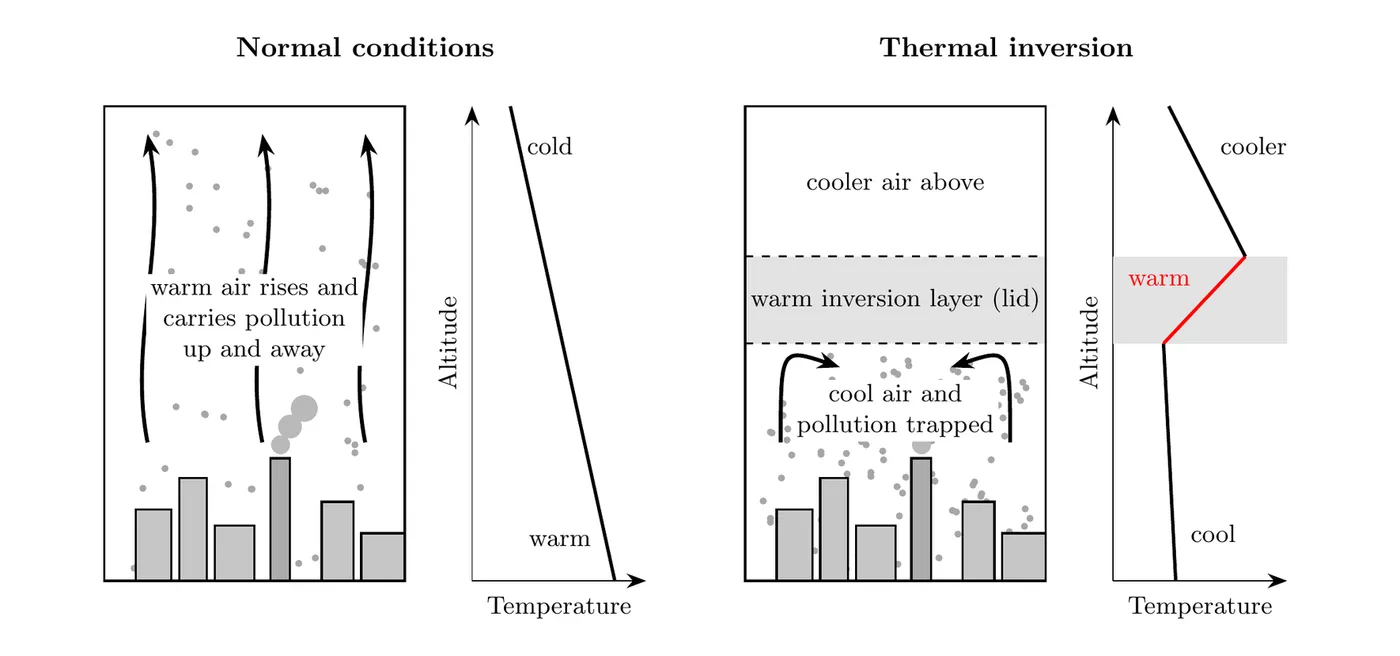
- Why the lid stops rising air: a bubble of polluted air keeps rising only while it's warmer (less dense) than the air around it. When it reaches the warm inversion layer, it's suddenly cooler and denser than its surroundings, so it stops rising and spreads out underneath.
- Reading the diagram: in normal conditions, temperature drops steadily as altitude goes up. In an inversion, the temperature line bends back toward warmer through the inversion layer, then drops again above it.
III. Conditions that Worsen Inversions
- Thermal inversions become more pronounced in geographical basins, meaning areas with mountains on either side.
- The surrounding mountains make it harder for wind to disperse the collected smog or particulate matter, and harder for the trapped warm air mass to move out of the way. That significantly worsens the trapped pollution.
- Winter and long nights: longer, colder nights make stronger inversions, and weak winter sun may not heat the ground enough to break them during the day. Salt Lake City's winter inversions can trap PM2.5 from cars and wood stoves for days at a time.
- How it ends: an inversion breaks up when the sun heats the ground enough to restart convection, or when a storm or strong wind mixes the air.
IV. Effects of Thermal Inversions
- Worsened respiratory health: The major problem is that air pollutants get trapped closer to Earth’s surface. That significantly worsens respiratory irritation in humans.
- It leads to asthma flare-ups and increased emergency room visits.
- It exacerbates conditions like COPD (chronic obstructive pulmonary disorder) or emphysema.
- Economic costs: The worsening health issues lead to economic problems, including a tax on the healthcare system, lost income from workers missing time, and decreased productivity.
- Decreased revenue: Extreme thermal inversion events can cost cities tourism revenue, for example if potential tourists see pictures of the smog.
- Decreased photosynthesis: The thick blanket of smog trapped near the surface makes it harder for sunlight to penetrate, which reduces photosynthetic activity in plants.
- Deadly examples:
- Donora, Pennsylvania (October 1948): an inversion trapped smoke from the town's zinc and steel mills in a river valley for five days. 20 people died and thousands got sick. The disaster helped lead to the first U.S. federal air pollution law in 1955.
- London (December 1952): cold, still air under an inversion trapped coal smoke for about five days. The "Great Smog" killed about 4,000 people right away, and later estimates put the total near 12,000. It led to Britain's Clean Air Act of 1956.
Big picture: A thermal inversion is a condition where a layer of warm air settles above a layer of cool air near the Earth’s surface, inverting the normal temperature gradient and shutting off the convection that usually lifts air pollutants away from cities. That trap concentrates pollutants near the ground, which drastically worsens human respiratory irritation like asthma and causes economic costs from lost productivity, while also decreasing photosynthetic activity in plants by blocking sunlight.