

4.4 - Strategic Frameworks: Porter’s Five Forces and SWOT Analysis
Michael Porter's Five Forces Framework
Porter's Five Forces is a framework used to evaluate how intense competition is in a given environment, how attractive that environment looks, and how profitable it might be. It's commonly used for decisions like which new market to enter or which pricing strategy to adopt. The five forces each reflect a different way a group's power could threaten a business's ability to compete: existing competitive rivalry, the threat of new entrants, the threat of substitute products, customer power, and supplier power.
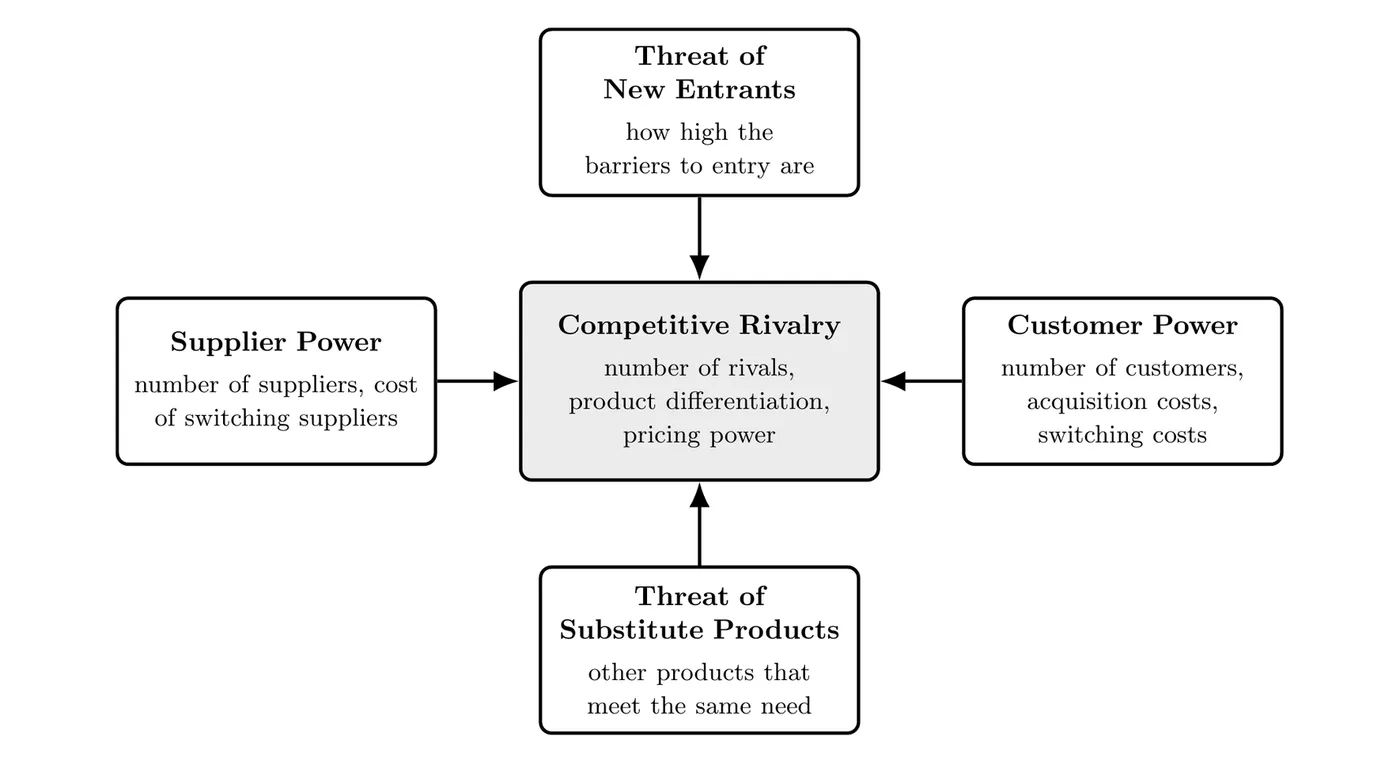
Existing competitive rivalry describes the current level of competition among businesses already in the market, shaped by the number of rivals, how differentiated their products are, and how much pricing power exists. This is generally considered the strongest of the five forces in determining overall competition.
Pricing power (see 2.5) is a business's ability to raise prices without losing many customers. Fast-food burger chains face intense rivalry: there are many chains, their burgers are fairly similar, and constant deals and value menus keep any one chain from raising prices much. A business with a patented product and only a couple of rivals faces much weaker rivalry.
Threat of new entrants describes how easy or hard it is for new businesses to break into the market, largely determined by barriers to entry like capital requirements, regulations, or brand loyalty. The threat is strong when barriers are low and new firms can easily grab market share.
For example, starting a new car company takes billions of dollars for factories, years of safety testing, and a network of dealers and repair shops, so the threat of new entrants is weak. Starting an online T-shirt shop takes little money and no special license, so the threat is strong. (See 1.2 for the main barriers to entry.)
Threat of substitute products describes how available substitutes are, meaning products that meet the same customer need without being direct competitors. This threat is strong when customers have plenty of alternatives that are cheaper, more convenient, or better quality.
For a movie theater, other theaters are direct competitors, while streaming services, video games, and concerts are substitutes, since they all meet the same need for entertainment. For an airline flying a short route, trains, buses, and driving are substitutes.
Customer power describes how much power buyers have to push prices down, shaped by the number and significance of customers, how much it costs to acquire them, and how easily they can switch to a competitor. This threat is strong when there are few customers, each representing a large share of sales, when acquisition costs are high, and when switching costs are low.
Switching costs are the monetary and psychological costs a customer faces when changing to a different product or brand. Monetary costs include cancellation fees, buying new equipment, or losing loyalty rewards. Psychological costs include the time and hassle of learning something new, or the worry that the new brand won't be as good. Switching from an iPhone to an Android phone, for example, means rebuying paid apps and some accessories (monetary) and learning a new system and moving your data over (psychological). High switching costs keep customers from leaving, which weakens customer power. Low switching costs make it easy to walk away, which strengthens it.
The number and size of customers matter too. A parts maker that sells most of its output to one carmaker is in a weak spot: losing that one customer would be a disaster, so the carmaker can push for lower prices. High customer acquisition costs add to this, since every lost customer is expensive to replace.
Supplier power describes suppliers' ability to raise the cost of inputs, shaped by how competitive the supplier market is, how many potential suppliers exist, and how costly it is to switch between them. This threat is strong when there are few suppliers and switching is costly or difficult.
Input costs are the prices a business pays for raw materials and component parts. When the resource market is competitive, with many suppliers selling similar inputs, suppliers have little power, since the business can just buy elsewhere. A bakery can buy flour from many suppliers, so flour suppliers have weak power. A smartphone maker that depends on one company for its most advanced chips faces strong supplier power, since that supplier can raise prices and switching would mean redesigning the phone.
Using Porter's Five Forces to Evaluate a Market
Generally speaking, an environment looks less attractive, meaning less profitable, when these competitive forces are strong, and more attractive when they're weak. So businesses run through each force: they look at how many direct competitors exist and how differentiated the offerings are for rivalry, assess barriers to entry for new entrants, look at how easily customers could turn to alternatives for substitutes, examine the number and size of customers along with acquisition and switching costs for customer power, and check the number of suppliers and switching costs for supplier power.
Force | Strong (bad for the business) when... | Weak (good for the business) when... |
Competitive rivalry | Many direct competitors, similar products, little pricing power | Few competitors, differentiated products, strong pricing power |
Threat of new entrants | Low barriers to entry, so new businesses can easily enter and take market share | High barriers, like high startup costs, patents, licenses, or strong brands |
Threat of substitutes | Many alternatives, especially ones that are cheaper, easier to get, or higher quality | Few good alternatives |
Customer power | Few customers, each a large share of sales; high acquisition costs; low switching costs | Many small customers; low acquisition costs; high switching costs |
Supplier power | Few suppliers to choose from; high cost to switch suppliers | Many suppliers; easy to switch |
Example: should a business open a new coffee shop next to a college campus?
Force | Evidence | Strength |
Competitive rivalry | Six coffee shops within a few blocks, all selling similar drinks at similar prices | Strong |
Threat of new entrants | A café needs a lease, equipment, and permits, but no patents or rare resources, and new cafés open often | Strong |
Threat of substitutes | Energy drinks, the dining hall's coffee, and brewing at home all meet the same need | Strong |
Customer power | Thousands of students who each spend a few dollars, so losing any one customer barely matters (switching shops is free, which gives customers a little power) | Weak |
Supplier power | Many coffee bean, milk, and cup suppliers to choose from | Weak |
With three strong forces, this market looks unattractive, and profits would likely be thin. If the business still wants in, it needs a clear way to stand out (like staying open late when every other shop is closed) to weaken the rivalry it faces.
SWOT Analysis Factors
SWOT analysis looks at both internal and external factors that affect a business's ability to reach its goals and stay competitive. It covers four categories: strengths, weaknesses, opportunities, and threats.
Where it comes from | Helpful | Harmful |
Internal (inside the business) | Strengths | Weaknesses |
External (outside the business, beyond its control) | Opportunities | Threats |
To sort any factor, ask two questions: is it inside the business or outside it, and does it help or hurt? A skilled design team is internal and helpful (a strength). A new competitor moving in is external and harmful (a threat).
Strengths are internal advantages, like strong core competencies, brand recognition, intellectual property, high product quality, ample funding, skilled employees, or an efficient supply chain.
Weaknesses are internal disadvantages, like missing core competencies, weak brand recognition, product flaws, limited funds, difficulty hiring skilled employees, poor customer service, outdated technology, or supply chain risks.
Opportunities are external factors outside the business's control that could help it succeed, like market growth, reduced competition, technological advances, or favorable regulatory changes.
Threats are external factors outside the business's control that could hurt it, like rising input costs, natural disasters, unfavorable regulation, or disruptive innovation that changes how customers meet their needs.
Applying SWOT Analysis
When looking inward, SWOT examines a business's financial resources, physical resources like equipment and locations, human resources like skills and team structure, and intangible assets like brand recognition and intellectual property, comparing all of this against rivals, industry benchmarks, and past performance to decide whether each factor counts as a strength or a weakness.
Whether something counts as a strength or a weakness depends on the comparison. A 4.4-star average review is a strength if rivals average 3.9 stars, but a weakness if the industry benchmark is 4.7. A 12% profit margin looks like a strength if it was 8% last year, but not if it was 20%.
When looking outward, SWOT considers things like potential market size, customer preferences, PESTEL factors, and Porter's Five Forces, to judge whether the external climate looks favorable or unfavorable.
Results from other frameworks feed into this step. A new law raising the minimum wage (a PESTEL factor) would be a threat for a restaurant. Strong supplier power from a Five Forces analysis, like depending on a single supplier, would also show up as a threat, while a fast-growing group of potential customers would be an opportunity.
Businesses then use their SWOT results to guide strategic decisions, whether that's building on strengths, shoring up weaknesses, seizing opportunities, or preparing responses to threats.
Example: Peak Gear is a small online outdoor-clothing brand.
Factor | Peak Gear's findings |
Strengths | Loyal customers (85% retention vs. a 75% industry average), a patented waterproof fabric, a skilled design team |
Weaknesses | Low brand recognition outside its home region, high delivery cost per order, a small marketing budget |
Opportunities | Growing interest in hiking and camping, a new trade deal that lowers tariffs on its imported fabric |
Threats | Rising fabric prices, large rivals with lower prices, warmer winters cutting demand for winter jackets |
Peak Gear can turn each finding into a strategic decision:
- Build on strengths: make the patented waterproof fabric the centerpiece of its marketing.
- Address weaknesses: negotiate lower shipping rates with a delivery partner, and spend its small marketing budget on targeted online ads instead of broad campaigns.
- Capitalize on opportunities: launch a line of affordable gear for new hikers.
- Respond to threats: sign a long-term contract with its fabric supplier to lock in prices, and shift its product mix toward rain and hiking gear that sells year-round.