

5.3 - Saving and Investing for Education, Housing, and Retirement Goals
How Financial Planning Supports Major Life Goals
Long-term financial goals for individuals and households usually center around paying for postsecondary education, buying a home, and saving for retirement.
Financial planning turns each goal into numbers: estimate how much the goal will cost, decide when the money is needed (the time horizon), and work backward to how much to save each month. For example, a household that wants a $30,000 down payment in 5 years needs to save $30,000 ÷ 60 months = $500 a month if the money earns nothing. If it sits in an account earning 4% a year, about $452 a month is enough, because interest covers the rest. Laying out goals this way shows whether they're realistic and which ones need to be delayed or changed when there isn't enough money for all of them at once.
For education, decisions about where to attend and what to study depend on career goals and available funding, and it's usually paid for through some mix of savings, student loans, scholarships, grants, and work-study programs. Federal student loans often come with lower interest rates and more favorable repayment terms than many private loans, and some are even government-subsidized.
To get federal aid in the U.S., students fill out the FAFSA (Free Application for Federal Student Aid), which is used to award federal grants, work-study, and federal student loans. Grants (like the federal Pell Grant) and scholarships don't have to be repaid. Work-study is a part-time job, often on campus, that helps cover school costs. Loans have to be repaid with interest. With subsidized federal loans, which go to undergraduates with financial need, the government pays the interest while the student is in school at least half-time. With unsubsidized loans, interest builds up from the start. Private student loans come from banks and other lenders, usually require a credit check or a cosigner, may have variable rates, and offer fewer repayment options. Families can also save ahead of time in a 529 plan, a tax-advantaged account where the money grows tax free as long as it's spent on qualified education costs.
Example: a school's cost of attendance (tuition, fees, housing, food, books, and transportation) is $28,000 a year. A student might cover it with an $8,000 grant, a $5,000 scholarship, $3,000 from work-study, $7,000 from family savings, and $5,000 in federal loans. The net price, which is the cost of attendance minus grants and scholarships, is $15,000, and only the $5,000 loan has to be paid back.
For housing, decisions about where to live and whether to rent or buy depend on personal preferences and available funding. Buying a home usually involves a down payment from savings plus a mortgage loan, which requires qualifying with a lender. Monthly mortgage payments depend on the size of the loan, the length of the repayment period, and the interest rate, which can be either fixed (stays the same) or adjustable (can change over time).
Renting offers flexibility, a smaller upfront cost (usually a security deposit), and a landlord who handles major repairs, but rent doesn't build ownership. Buying builds equity, the part of the home's value the owner actually owns, and a fixed-rate mortgage keeps the loan payment steady, but it takes a down payment and closing costs up front, plus property taxes, insurance, and repairs. To qualify for a mortgage, lenders look at credit score, income, existing debt, and the size of the down payment (3.2). A down payment of at least 20% on a conventional loan avoids private mortgage insurance (PMI), an extra monthly cost that protects the lender.
Here's how the three factors change the monthly payment (principal and interest only) on a $300,000 home with a 20% down payment, so a $240,000 loan:
Loan | Rate | Repayment period | Monthly payment | Total interest paid |
$240,000 | 6.5% fixed | 30 years | $1,516.96 | $306,107 |
$240,000 | 6.5% fixed | 15 years | $2,090.66 | $136,318 |
$240,000 | 7.5% fixed | 30 years | $1,678.11 | $364,121 |
$270,000 (10% down) | 6.5% fixed | 30 years | $1,706.58 | $344,370 |
A shorter repayment period raises the monthly payment but cuts total interest by more than half. A higher rate or a bigger loan raises both. (In real life, 15-year loans usually have somewhat lower rates than 30-year loans.) With an adjustable-rate mortgage, the rate usually starts lower for a few years and then resets based on market rates, so the payment could rise later. The monthly housing cost also includes property taxes and homeowner's insurance, which are often paid through the mortgage (5.1). A common guideline is to keep total housing costs under about 30% of income.
For retirement, decisions about when to retire and where to live depend on personal preferences, health, and available funding. Retirement income typically comes from a combination of Social Security, employer-sponsored retirement plans, personal investments, and sometimes continued earnings from part-time work or consulting.
In the U.S., people can start Social Security retirement benefits at 62, but the monthly check is permanently smaller than if they wait until full retirement age (67 for anyone born in 1960 or later), and waiting longer, up to 70, makes it bigger. Social Security replaces only part of a worker's old income, so most people also save in employer-sponsored plans like a 401(k) (or a 403(b) at schools and nonprofits) and in individual retirement accounts (IRAs). With traditional accounts, contributions are pretax and withdrawals in retirement are taxed. With Roth accounts, contributions are made after tax and qualified withdrawals in retirement are tax free.
Many employers match part of what workers put in. With a 50% match on contributions up to 6% of salary, a worker earning $50,000 who contributes $3,000 (6%) gets another $1,500 from the employer, an instant 50% return before any investment growth. Contributing less than it takes to get the full match leaves free money on the table.
Families sharing finances, like a married couple with two incomes, can reduce conflict by openly discussing long-term goals and coordinating their savings and investment decisions. Financial technology tools, like automated savings plans or payroll deductions into retirement accounts, can also help make consistent saving easier by taking some of the manual effort out of it.
These tools work because they get around the barriers to saving from 3.1. When money moves into savings automatically before it can be spent (often called "pay yourself first"), impulse buying and lifestyle inflation have less to work with. Many employers now enroll new workers in the 401(k) automatically, and far more people end up saving when saving is the default.
Charitable giving is another long-term goal for many households. Deciding which organizations to support usually comes down to personal values and how well an organization's mission and impact line up with them. Before giving, people often check what a charity does, how it spends its money, and what results it gets, using its annual reports or charity rating websites. Giving can take different forms: one-time gifts (like donating after a natural disaster), recurring donations (like $25 a month), and legacy contributions (like leaving money to a charity in a will or naming it as the beneficiary of a retirement account or life insurance policy).
Giving has financial benefits too. Donations to qualified charities (in the U.S., registered nonprofits like 501(c)(3) organizations) can be tax deductible (5.1). How much a donation saves depends on the giver's tax bracket and that year's tax rules. Many households build a set amount or percentage of income for giving into their budget so it fits alongside their other goals.
Factors That Impact Returns on Financial Assets
For these long-term goals, people typically hold their money in savings vehicles like savings accounts or CDs, individual stocks and bonds, or mutual funds that pool money into a mix of stocks and bonds.
A quick refresher from 3.1 and 3.5: savings accounts and CDs are federally insured deposits, a stock is a share of ownership in a corporation, and a bond is a loan to a company or government that pays interest. A mutual fund pools money from many investors, and a professional manager uses it to buy a mix of stocks and/or bonds, so even a small investment owns a slice of dozens or hundreds of companies. Index funds are mutual funds that simply copy a market index (like the S&P 500) instead of picking investments, which keeps their fees low.
Starting to save or invest younger and holding onto assets longer generally leads to greater total returns, thanks to compounding, where earnings generate their own earnings over time.
Compounding means you earn returns on your past returns, not just on the money you put in. With simple interest (3.1), $1,000 earning 7% a year gains $70 every year, so after 30 years it's worth $1,000 + (30 × $70) = $3,100. With compounding, each year's growth is added to the balance and starts earning returns too (the balance is multiplied by 1.07 every year), so the same $1,000 grows to about $1,967 after 10 years, $3,870 after 20, and $7,612 after 30. A shortcut called the Rule of 72 estimates how long it takes money to double: divide 72 by the yearly return. At 7%, that's 72 ÷ 7, or about 10 years.
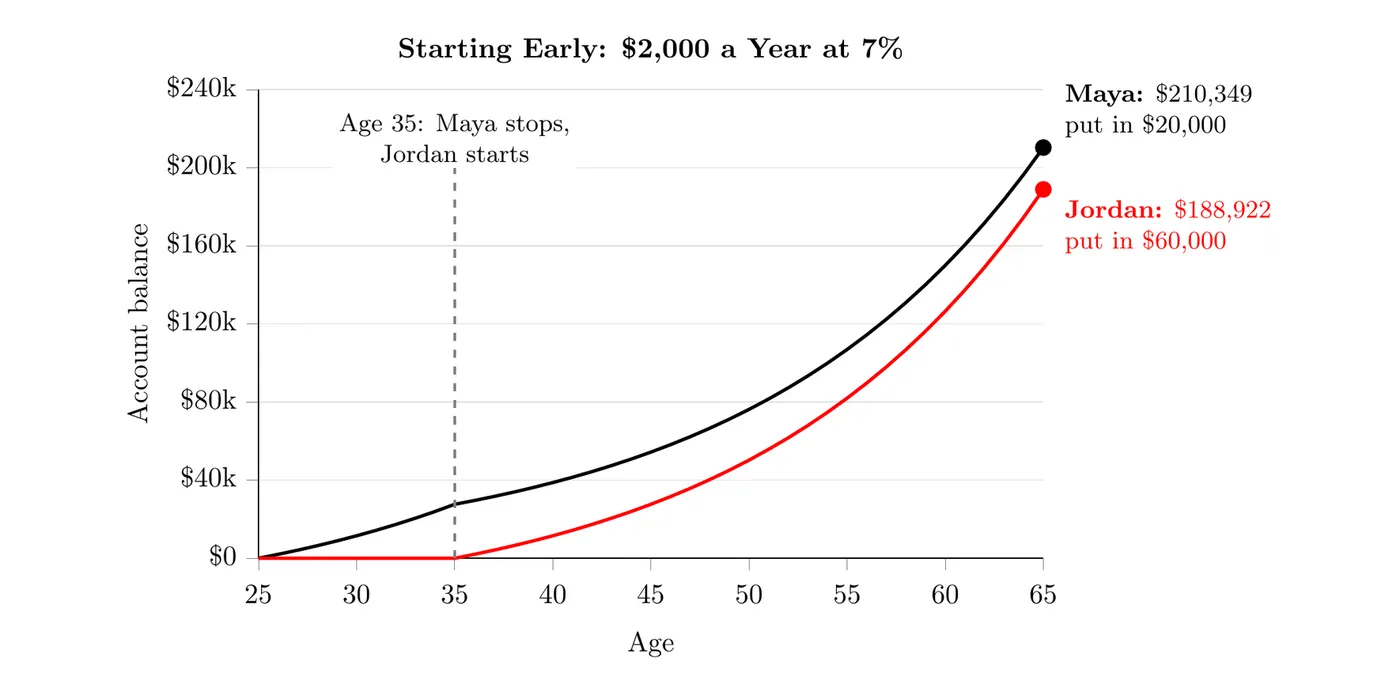
Starting early matters even more than putting in more money. Maya invests $2,000 a year from age 25 to 35, then stops and never adds another dollar. Jordan waits until 35, then invests $2,000 a year for 30 years, until 65. Both earn 7% a year. Maya puts in only $20,000 and Jordan puts in $60,000, but at 65 Maya has $210,349 and Jordan has $188,922, because Maya's money had 10 extra years to compound.
Different financial assets carry different levels of risk and expected return. Lower-risk assets, often government-insured or offering a guaranteed income, typically come with lower expected returns. Higher-risk assets, like individual stocks or stock funds, depend on business and market performance and carry more risk, but also the potential for higher returns.
Here's roughly how common financial assets line up, from safest to riskiest:
Financial asset | Risk of loss | Expected return |
Savings accounts, money market accounts, CDs | Very low (federally insured up to the limit) | Lowest |
U.S. government bonds | Low (backed by the federal government) | Low |
Corporate bonds | Low to moderate (the company could fail to pay) | Moderate |
Stock mutual funds | High (prices rise and fall with the market) | High over long periods |
Individual stocks | Highest (value depends on one business) | High, with the widest range of outcomes |
Over long periods, stocks have earned higher average returns than bonds or savings accounts, which is the reward for taking on more risk. But they can drop sharply in a single year. For example, the S&P 500 lost about 37% in 2008.
Fees and costs matter too, since transaction fees, management fees, and advisory fees all eat into an investment's overall return, meaning net return equals gross return minus fees and costs. Most people buy stocks and bonds through a broker by opening a brokerage account, and many investors choose discount brokers, which charge lower fees but offer less personalized advice, over full-service firms. (One exception: in the U.S., Treasury bonds and savings bonds can be bought directly from the government at TreasuryDirect.gov.)
Fees come in a few forms. Transaction fees (commissions) are charged when you buy or sell, though many online brokers now charge no commission for stock trades. Management fees on mutual funds are charged every year as a percentage of your balance, called the expense ratio. Advisory fees pay for professional advice, often around 1% of the money managed each year, or a flat or hourly fee. Small percentages add up because they compound too. Example: $10,000 invested for 30 years at a 7% return grows to $74,017 with a 0.1% yearly fee but only $57,435 with a 1% yearly fee, a difference of $16,582.
Taxes on interest, dividends, and capital gains also reduce someone's after-tax return, so investors have to think about whether their returns will be taxed, at what rate, and whether any tax-advantaged accounts are available to help.
Interest from savings accounts, CDs, and most bonds is taxed as ordinary income, while qualified dividends and long-term capital gains get lower rates (5.1). For someone in the 22% bracket, $1,000 of interest leaves $780 after federal tax, while $1,000 of long-term capital gains taxed at 15% leaves $850. Tax-advantaged accounts like 401(k)s, IRAs, Roth IRAs, 529 plans, and health savings accounts let investments grow without yearly taxes, and some (like Roth accounts) are never taxed if the rules are followed. Interest from most municipal bonds (bonds issued by states and cities) is also free from federal income tax.
Inflation is another factor, since it erodes the purchasing power of money over time, meaning the real return on an investment is roughly the nominal return minus the inflation rate. Investors look at both the raw, nominal return and the inflation-adjusted, real return to get a true sense of their gains.
Example: a CD pays 5% (the nominal return) in a year when inflation is 3%, so the real return is about 5% minus 3% = 2%. If the return is lower than inflation, the real return is negative, like the savings account example in 3.1. Over time this adds up: after 10 years of 3% inflation, $100 buys only about what $74 buys today.
Finally, behavioral biases can quietly hurt investment returns. Overconfidence can lead people to take on unnecessary risk or trade too often, while loss aversion, meaning a strong dislike of losses, can push people to sell during a downturn at a loss or avoid otherwise sound investments just because they occasionally dip in value.
Loss aversion is strong: research suggests losses feel roughly twice as painful as gains of the same size feel good. In early 2020, the S&P 500 fell about 34% in just over a month as COVID-19 spread, then climbed back to its old high by August 2020. Investors who panic-sold near the bottom locked in their losses and missed the recovery. Overconfidence often shows up after a few winning trades, when an investor decides they can pick winners, puts too much money in one stock, or trades constantly, which adds fees and taxes. A written plan, automatic investing, diversification, and a good advisor can all help investors stick to their strategy instead of reacting emotionally.
Recommending a Saving and Investment Plan
When planning for goals like education, housing, and retirement, people need to decide how to allocate their money across different assets, weighing the total funding each goal requires, how much they can save each pay period, their time horizon, their risk tolerance, and the expected return of each type of asset.
The mix of assets in a portfolio is called its asset allocation, like 80% stock funds and 20% bond funds. Most advisors suggest building an emergency fund first (often three to six months of expenses in a savings account, see 3.1) so a surprise bill doesn't force you to sell investments at a bad time. Then each goal gets assets that fit its time horizon. Here's how a household might match its goals to financial assets:
Goal | Time horizon | Where the money might go |
Emergency fund | Could be needed any time | Savings or money market account |
Down payment on a home | About 3 years | High-yield savings account or CDs |
Child's college | About 12 years | 529 plan in a mix of stock and bond funds, shifting safer as college gets closer |
Retirement | About 30 years | 401(k) and IRA, mostly in diversified stock funds |
Time horizon matters a lot here. With a longer time horizon, people are more likely to invest in higher-risk, higher-return assets like stocks or stock mutual funds, since they have time to ride out downturns and recover. With a shorter time horizon, people tend to lean toward safer assets like CDs or high-quality bonds, since they may need to access that money soon and can't afford to sell at a loss during a downturn.
For example, a 25-year-old saving for retirement can ride out a market crash, since there are decades for prices to recover. A family that needs tuition money next fall can't, because a 30% drop right before the bill is due would be a real loss. Target-date funds handle this shift automatically, moving from mostly stocks toward more bonds and cash as the target year (like the year someone plans to retire) gets closer.
Risk tolerance plays a role too. People with low risk tolerance tend to prefer safer options like federally insured savings accounts or CDs, accepting lower returns in exchange for stability. People with higher risk tolerance are more willing to invest in stocks or stock mutual funds, aiming for higher long-term returns despite short-term ups and downs.
Many people turn to financial professionals for help evaluating their saving and investment options, and when choosing one, they typically look at licensing, certifications, education, experience, and cost, including fees and commission structures.
One well-known credential is the Certified Financial Planner (CFP) designation, which requires coursework, an exam, work experience, and following ethics rules. People who sell investments or give investment advice for pay generally have to pass licensing exams and register with regulators, and in the U.S. anyone can look up an advisor's licenses and any disciplinary history for free on FINRA's BrokerCheck. It also helps to ask whether the advisor is a fiduciary, meaning they're legally required to act in the client's best interest. Advisors are paid in different ways: fee-only advisors charge a flat fee, an hourly rate, or a percentage of the money they manage, while commission-based advisors earn money when clients buy certain products, which can create a conflict of interest.
A lot of advisors recommend diversification, meaning spreading money across multiple types of assets with different risk and return profiles, aiming for solid long-term returns without taking on too much risk from any single investment.
The idea is to avoid putting all your eggs in one basket. A diversified portfolio spreads money across asset types (stocks, bonds, and cash), across many companies and industries, and often across countries, so one bad investment can't sink the whole plan. Mutual funds and index funds make this easy, since one fund can hold hundreds of companies. Holding too much of one stock is especially risky when it's your own employer's: when Enron collapsed in 2001 (3.9), many of its employees lost both their jobs and most of their retirement savings, which were heavily invested in Enron stock.
Finally, investors often compare how their assets are performing against a benchmark, like a stock index for stock investments or a bond index for bond investments, to see whether their portfolio is doing better, worse, or about the same as the broader market.
The S&P 500, which tracks 500 large U.S. companies, is the most common benchmark for U.S. stock investments, and the Bloomberg U.S. Aggregate Bond Index is a common benchmark for bonds. For example, if a stock fund earned 8% in a year when the S&P 500 earned 10%, it underperformed its benchmark by 2 percentage points. Compare like with like (a bond fund against a bond index, not a stock index), and compare returns after fees, since that shows whether paying for a fund manager or advisor is actually worth it.