

9.4 - Two Super Powers Emerge
NATO and Economic Institutions
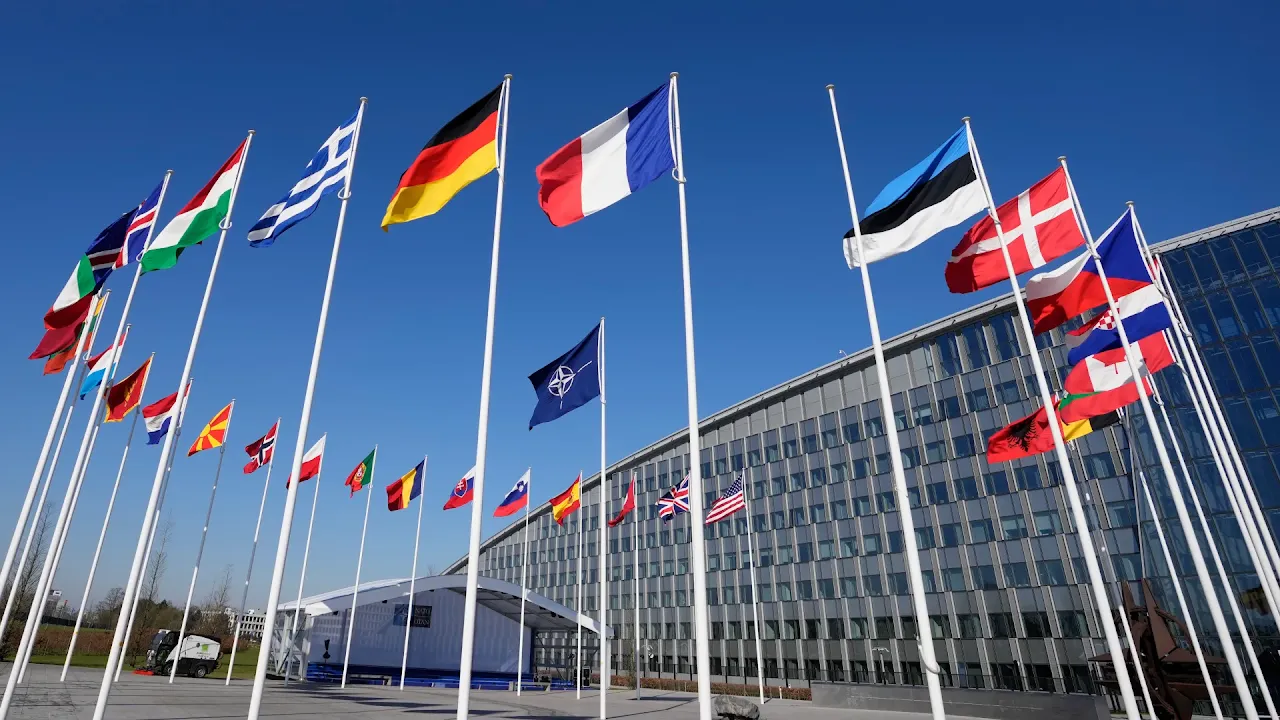
NATO (North Atlantic Treaty Organization):
- During the Cold War, the United States exerted significant military, economic, and political influence in Western Europe.
- One of the major initiatives led by the U.S. was the establishment of NATO in 1949.
- NATO is a military defense pact involving the United States and several Western European nations.
- The primary purpose of NATO was to provide collective security against the Soviet Union, which was perceived as a major threat to Western Europe.
- According to the NATO agreement, an attack on one member state would be considered an attack on all, leading to a united military response from all member nations.
- NATO was founded by 12 countries: the U.S., Canada, and 10 Western European states, including Britain, France, and Italy. West Germany joined in 1955. NATO kept U.S. troops stationed in Western Europe for the rest of the Cold War, and it was the first peacetime alliance the U.S. had joined outside the Americas.
- After the Cold War, NATO expanded east into the former Soviet bloc. After Russia's full-scale invasion of Ukraine in 2022, Finland (2023) and Sweden (2024) joined, bringing NATO to 32 members (as of 2026).
World Bank and Other Economic Institutions:
- Alongside military alliances, the United States also played a crucial role in establishing international economic institutions during and after World War II.
- Bretton Woods System: At the 1944 Bretton Woods Conference in New Hampshire, the Allies set up the IMF and the World Bank and built the postwar money system around the U.S. dollar. Other currencies had fixed exchange rates with the dollar, and the dollar could be exchanged for gold at $35 an ounce. This made the dollar the world's main currency, a sign of U.S. economic power. The system broke down in the early 1970s, after the U.S. stopped exchanging dollars for gold in 1971.
- World Bank:
- Established in 1944, the World Bank’s initial mission was to provide loans to countries needing to rebuild after the devastation of World War II.
- Over time, the World Bank shifted its focus to providing financial support to developing nations to foster economic growth and stability.
- One of the World Bank's primary goals was to prevent a global economic crisis like the Great Depression by promoting economic development and stability worldwide.
- International Monetary Fund (IMF):
- Also established in 1944, the IMF's role was to facilitate international currency exchange and encourage global trade.
- The IMF aimed to stabilize exchange rates and provide short-term financial assistance to countries facing economic difficulties, thereby promoting international economic cooperation.
- World Trade Organization (WTO):
- Founded in 1995, the WTO succeeded the General Agreement on Tariffs and Trade (GATT) and became the primary international body overseeing global trade rules.
- The WTO’s mission was to reduce trade barriers, such as tariffs, and ensure that trade between member nations flowed as freely and fairly as possible.
- GATT (the General Agreement on Tariffs and Trade), signed in 1947 by 23 countries, came first. Through rounds of negotiations, its members cut tariffs on manufactured goods sharply, which helped world trade grow fast after the war.
Soviet Bloc Nations and the Planned Economy
Eastern Europe and the Soviet Union:
- Unlike the West, which experienced economic prosperity, Eastern Europe and the Soviet Union faced significant challenges under Soviet control.
- Countries in Eastern Europe, known as the Soviet Bloc, came under the military, political, and economic dominance of the Soviet Union.
Soviet Responses to Western Institutions:
- In response to Western initiatives like the IMF, World Bank, and Marshall Plan, the Soviet Union established the Council for Mutual Economic Assistance (Comecon).
- The goal of Comecon was to bind Soviet Bloc states into a mutually reinforcing economic system, making them heavily dependent on the Soviet Union.
- Comecon was founded in 1949 by the Soviet Union, Poland, Czechoslovakia, Hungary, Romania, and Bulgaria (East Germany joined in 1950). It organized trade inside the bloc and tied each member's economy to the Soviet Union's.
- The Soviet Union also formed the Warsaw Pact as a counterpart to NATO, creating a military alliance with its satellite states to ensure their dependence on the Soviet Union.
- The Warsaw Pact was founded in 1955, days after West Germany joined NATO. It kept Soviet troops stationed in the bloc, and the Soviets used force to keep members in line: Soviet troops crushed Hungary's 1956 uprising, and Warsaw Pact armies ended the 1968 Prague Spring.
Economic Challenges in the Soviet Bloc:
- The Soviet Bloc nations did not experience the same economic growth as Western Europe due to the Soviet model of a planned economy.
- All the Soviet Bloc states were ruled by Communist parties, and they all copied the Soviet model of a planned economy (also called a command economy):
- Government planning offices, not markets, decided what each factory and farm would produce, how much, and at what price. Each country had its own planners, but they followed the Soviet model and Soviet priorities.
- Through Comecon, members were assigned specialized production for the whole bloc. For example, East Germany and Czechoslovakia focused on machinery and other industrial goods, Hungary built buses, and the Soviet Union supplied oil and raw materials.
- Plans favored heavy industry and weapons over consumer goods, so people faced shortages, long lines, and poor-quality products. In the early years, the Soviets also took reparations and resources from East Germany and other states, so states often produced for Soviet needs rather than their own.
Impact of Planned Economies:
- The Soviet Union implemented a series of Five-Year Plans aimed at rapid industrialization and economic growth.
- While some of these plans were successful, they often came at a significant cost to the citizens.
- For example, Stalin's forced collectivization of agriculture in the early 1930s met resistance from farmers, especially in Ukraine. The government seized grain, blacklisted villages that missed their quotas (cutting them off from food and goods), and stopped starving peasants from leaving. The famine of 1932 to 1933 (the Holodomor) killed an estimated 3.5 to 5 million people in Ukraine.
Social Welfare and Civil Liberties:
- The Soviet Union extended social welfare benefits, including housing and healthcare, to its citizens as part of its Communist agenda.
- However, these state-run services were often poorly implemented.
- State-sponsored housing, for instance, consisted of hastily built apartment complexes that were often shoddily constructed, with multiple families sometimes forced to live in a single small apartment.
- Universal education was provided, although it included significant Communist indoctrination.
Suppression of Civil Liberties:
- To maintain control, the Soviet Union systematically removed civil liberties and individual rights from the population.
- The Soviet government created extensive networks of secret police, both within the Soviet Union and the Soviet Bloc, to suppress dissent and enforce Communist policies.
- The secret police were authorized to use violence and subversion to maintain order and ensure compliance with the Communist party's agenda.
- Examples include the Soviet KGB and East Germany's Stasi, which built a huge network of informers who spied on neighbors, coworkers, and even family members.
- Writers and scientists who criticized the system were jailed, exiled, or locked in psychiatric hospitals. Aleksandr Solzhenitsyn, who exposed the Soviet labor camps (the gulag), was expelled in 1974, and physicist Andrei Sakharov was sent into internal exile in 1980.
Restrictions on Emigration:
- Emigration from the Soviet Union was severely restricted to prevent citizens from fleeing to the more prosperous and freer West.
- The most famous example of this restriction was the construction of the Berlin Wall, which was built to stop the flow of Eastern Berliners fleeing to the democratic and economically thriving West Berlin.
- East Germany's Communist government built the wall with Soviet approval in August 1961. Since 1949, more than 2.5 million East Germans, many of them young and skilled, had escaped to the West, mostly through the open border in Berlin. East German guards shot people trying to cross the wall.
Nikita Khrushchev and Destalinization
Transition from Stalin to Khrushchev:
- Most of the harsh policies established under Stalin remained in place until the fall of the Soviet Union in 1991.
- However, after Stalin's death, his successor, Nikita Khrushchev, initiated significant changes in the Soviet Union, starting in 1956.
- Stalin died in 1953, and Khrushchev won the power struggle to succeed him. In February 1956, in a "Secret Speech" to the 20th Communist Party Congress, he denounced Stalin's purges and "cult of personality."
Destalinization:
- Khrushchev publicly denounced Stalin’s authoritarian rule and began a process of destalinization, aimed at reducing the oppressive control that had defined Stalin’s regime.
- Under Khrushchev's leadership, more freedom was granted to artists, who were previously forced to create works that glorified the Soviet Union.
- He released many of Stalin's political prisoners and reduced the power and scope of the secret police.
- Khrushchev also tried to improve the lives of average Soviet citizens. He shortened the work week, raised pensions, let workers change jobs without permission, and launched a huge program of cheap, quickly built apartment blocks (the shoddy housing described above). He promised that the Soviet Union would soon overtake the U.S. in producing food and consumer goods.
Impact on Soviet Bloc Nations:
- Part of Khrushchev's destalinization program included easing the heavy Soviet influence in the Soviet Bloc states.
- He said there could be "different roads to socialism" and let satellite governments make some changes of their own. In practice, this freedom was limited: they still had to stay Communist and stay in the Warsaw Pact.
- Initially, these changes were welcomed by the people in these countries, who hoped for a reduction in Soviet oppression.
Economic Recession and Revolts:
- Unfortunately, de-Stalinization did not deliver the economic results Khrushchev promised. His Virgin Lands campaign plowed up huge areas of Kazakhstan and Siberia for wheat and did well at first, but poor soil and droughts led to crop failures by the early 1960s. In 1962 the government raised meat and butter prices (troops killed protesting workers at Novocherkassk), and after a bad harvest in 1963 the Soviet Union had to buy grain from abroad. These failures, plus the Cuban Missile Crisis, led party leaders to remove Khrushchev in 1964.
- In the satellite states, the Secret Speech raised hopes for change, while low wages, food shortages, and the lack of basic freedoms remained. In 1956 this mix set off revolts: Polish workers in Poznań rioted over wages and food prices in June, and Hungary rose up in October.
Poland (1956):
- After the Poznań riots, the Polish Communist Party brought back Władysław Gomułka, a Communist who had been jailed under Stalin. Khrushchev flew to Warsaw and threatened to intervene, but he backed down once Gomułka promised that Poland would stay Communist and stay in the Warsaw Pact.
- Gomułka allowed limited reforms: most collective farms were broken up, and the Catholic Church got more freedom. Poland shows the pattern of the bloc, which swung between limited reform and repression depending on how far a country tried to go.
Hungarian Revolution (1956):
- In Hungary, a reform-minded leader named Imre Nagy demanded free and open elections, along with Hungarian independence from Soviet control.
- The revolt began in October 1956 with student and worker protests in Budapest, which brought Nagy back as prime minister.
- Although Nagy was a Communist, he believed that Hungary's future required a break from Soviet dominance.
- Upon declaring Hungary's intention to leave the Warsaw Pact and seek UN protection, the Soviets responded by sending troops to Budapest, killing nearly 3,000 people and crushing the revolution.
- The Soviet invasion began on November 4. About 200,000 Hungarians fled to the West. The U.S. and its allies protested but did not intervene, to avoid a war with the Soviet Union.
- The Soviet grip on Hungary tightened, resulting in even more oppressive control.
- The Soviets installed János Kádár, and Nagy was secretly tried and executed in 1958. After years of harsh repression, Kádár allowed limited economic reforms in the 1960s (called "goulash communism") as long as Hungary stayed loyal to Moscow.
Invasion of Czechoslovakia (1968):
- A similar situation occurred in Czechoslovakia in 1968 when another reform-minded Communist leader enacted liberal reforms that were outside the bounds of Soviet policy.
- That leader was Alexander Dubček, who wanted "socialism with a human face." During the Prague Spring, he ended press censorship and allowed more open debate, though he did not plan to leave the Warsaw Pact.
- The Warsaw Pact troops invaded Czechoslovakia, halted the reforms, and strengthened the more oppressive wing of the Communist party.
- Soviet leader Leonid Brezhnev ordered the invasion in August 1968, with hundreds of thousands of troops (mostly Soviet). He justified it with the Brezhnev Doctrine: the Soviet bloc had the right to intervene in any member state where socialism was threatened.
End of Soviet Influence and the Fall of the Soviet Union:
- Peaceful revolutions, primarily in 1989, were spurred by Soviet leader Mikhail Gorbachev’s announcement that the Soviet Union would no longer intervene militarily in the Soviet Bloc to support Communist governments.
- With Soviet military support removed, countries like Hungary successfully instituted Western economic reforms and, by 1990, elected governments committed to democracy and free-market economics.
- Gorbachev’s policies of glasnost (openness) and perestroika (economic restructuring) in the Soviet Union ultimately led to the collapse of the Soviet Union by 1991.
- As Soviet control lifted, the Eastern European satellites threw out their Communist governments, mostly peacefully, in 1989. Nationalism also surged inside the Soviet Union itself, and its 15 republics, from the Baltic states to Ukraine and Georgia, declared independence, completing the breakup of the Soviet Union in 1991 (see 9.7).
Instability in Former Soviet Republics:
- The peaceful revolutions of 1989 in Central and Eastern Europe were not repeated everywhere. In several former Soviet republics, the breakup left ethnic minorities on the wrong side of new borders, and Russia often backed separatists to keep its influence.
- Armenia and Azerbaijan fought over Nagorno-Karabakh, an Armenian-majority region inside Azerbaijan, from the late 1980s to 1994 and again in 2020. In 2023, Azerbaijan took the whole region, and more than 100,000 Armenians fled.
- Moldova and Georgia each lost control of breakaway regions backed by Russia (Transnistria in Moldova, and Abkhazia and South Ossetia in Georgia), and Russia fought a short war with Georgia in 2008.
- Ukraine: In 2014, after protests drove out Ukraine's pro-Russian president, Russia seized and annexed Crimea and backed separatists in eastern Ukraine. In February 2022, Russia launched a full-scale invasion. As of October 2026, the war was still going on, with no general ceasefire.