Explicit equations give you one variable directly in terms of another:
f(t)=t2−3t
y=2x+5
g(x)=sin(x2)
Implicit equations have multiple variables mixed together:
x2+y2=9 (a circle)
x3+y3=6xy (folium of Descartes)
sin(xy)=x+y
Not every graph is a function, so we need implicit equations to describe curves like circles and ellipses. Implicit differentiation is how we get derivatives for those.
Understanding the Notation
Leibniz notation makes this click. Technically dxdy isn’t a fraction, but it behaves like one.
With respect to x:
dxd[x]=dxdx=1dxd[y]=dxdy
Power rule with chain rule:
dxd[x2]=2x⋅dxdx=2xdxd[y2]=2y⋅dxdy
Exponentials:
dxd[e5x]=5e5xdxd[e5y]=5e5y⋅dxdy
Key principle: whenever you differentiate a term containing y with respect to x, you have to multiply by dxdy. That’s the chain rule doing its thing.
Why the chain rule? In an implicit equation, y is still a function of x, even when you can’t solve for it. So y2 is really [y(x)]2, a composite function: the outer function is u2 and the inner function is y(x). The chain rule says take the derivative of the outside, 2y, and multiply by the derivative of the inside, dxdy. That’s where every dxdy comes from. An x term gets the same treatment, but the derivative of the inside is dxdx=1, so nothing extra shows up.
The Four-Step Process
Differentiate both sides with respect to x. Tack on dxdy every time you differentiate a y term.
Collect all dxdy terms on one side. Move everything else to the other side.
Factor out dxdy.
Solve for dxdy by dividing by whatever’s left.
Example 1: Basic Implicit Differentiation
Find dxdy for y2−5x3=3y.
Step 1: Differentiate both sides.
2ydxdy−15x2=3dxdy
Step 2: Collect the dxdy terms on the left.
2ydxdy−3dxdy=15x2
Step 3: Factor.
dxdy(2y−3)=15x2
Step 4: Solve.
dxdy=2y−315x2
Example 2: Implicit Differentiation with Trig and Product Rule
Find dxdy for sin(xy)=10x.
Step 1: Differentiate both sides. The left side needs the chain rule and the product rule, since xy is a product.
cos(xy)⋅dxd[xy]=10
For dxd[xy], use the product rule:
dxd[xy]=1⋅y+x⋅dxdy=y+xdxdy
So:
cos(xy)(y+xdxdy)=10
Step 2: Divide both sides by cos(xy).
y+xdxdy=cos(xy)10=10sec(xy)
Step 3: Isolate the dxdy term.
xdxdy=10sec(xy)−y
Step 4: Solve.
dxdy=x10sec(xy)−y
You can write dxdy as y′ to save time, just don’t confuse y and y′.
Finding Equations of Tangent Lines
dxdy gives you the slope at any point (x,y) on the curve. Unlike explicit functions where an x-value is enough, implicit derivatives need both the x and y coordinates.
Example: Tangent Lines to a Circle
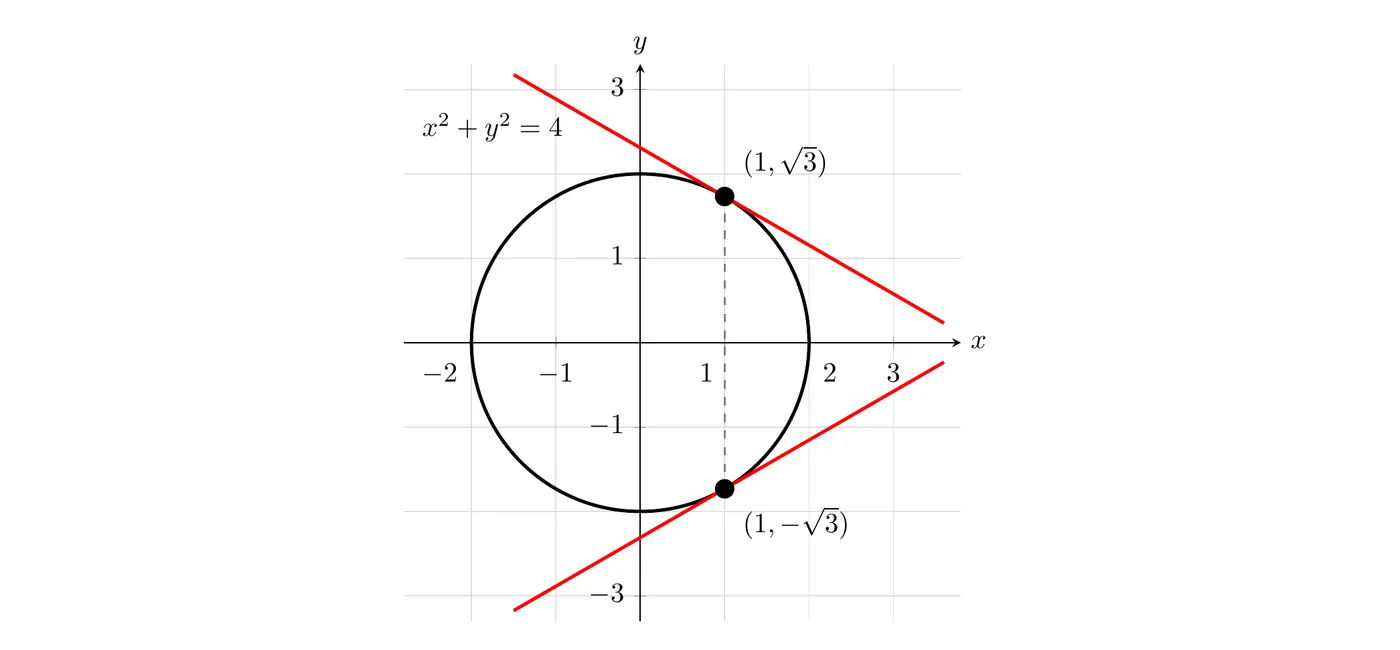
Find the equations of the tangent lines to x2+y2=4 at x=1.
Find the y-coordinates. Substitute x=1:
1+y2=4⇒y2=3⇒y=±3
So the points are (1,3) and (1,−3).
Find dxdy:
2x+2ydxdy=0⇒dxdy=−yx
Find the slopes:
At (1,3): m1=−31
At (1,−3): m2=31
Write the tangent lines using point-slope form:
At (1,3): y−3=−31(x−1)
At (1,−3): y+3=31(x−1)
Horizontal and Vertical Tangent Lines
Horizontal tangent lines happen where the slope is zero: dxdy=0
Vertical tangent lines happen where the slope is undefined.
So for a fraction dxdy=D(x,y)N(x,y):
Horizontal tangents: set the numerator equal to 0
Vertical tangents: set the denominator equal to 0
Then check each point. It has to actually be on the curve (plug it into the original equation), and the other part of the fraction can’t also be 0 there. If the numerator and denominator are both 0 at the same point, dxdy comes out as 00, which tells you nothing yet. You can’t call that a horizontal or vertical tangent without more work.
Example: Finding Horizontal and Vertical Tangents
Given 3x2+2y2=16.
Find dxdy:
6x+4ydxdy=0⇒dxdy=−4y6x=−2y3x
Horizontal tangents. Set the numerator to 0:
−3x=0⇒x=0
Find y when x=0:
2y2=16⇒y2=8⇒y=±22
Horizontal tangent lines: y=22 and y=−22
Vertical tangents. Set the denominator to 0:
2y=0⇒y=0
Find x when y=0:
3x2=16⇒x2=316⇒x=±343
Vertical tangent lines: x=343 and x=−343
Important note: for now, whenever the derivative is undefined we’re treating it as a vertical tangent. Later in Unit 5 you’ll learn how to tell vertical tangents, cusps, and corners apart.
Practice Problem
Find dxdy for x3+y3=4xy.
Step 1: Differentiate both sides. The right side needs the product rule.
3x2+3y2dxdy=4(y+xdxdy)=4y+4xdxdy
Step 2: Collect the dxdy terms.
3y2dxdy−4xdxdy=4y−3x2
Step 3: Factor.
dxdy(3y2−4x)=4y−3x2
Step 4: Solve.
dxdy=3y2−4x4y−3x2
Key Takeaways
Explicit equations isolate one variable (y=f(x)); implicit equations mix them (x2+y2=9)
Every time you differentiate a y term, multiply by dxdy
Four-step process: differentiate both sides, collect dxdy terms, factor out dxdy, solve
To find a slope at a point, you need both the x and y values
Horizontal tangents: set the numerator of dxdy to 0, answer is y=k
Vertical tangents: set the denominator of dxdy to 0, answer is x=k