An inverse function swaps input and output. If a function takes x to y, its inverse takes y back to x.
Finding an inverse algebraically
To find the inverse of y=2x+5:
Swap x and y: x=2y+5
Solve for y: y=2x−5
That’s the inverse function.
Inverse Function Notation
Important distinction:
x−1=x1(reciprocal of a number)f−1(x)(inverse function, NOT a reciprocal)
When you see f−1(x), read it as “f inverse of x.” It means the inverse function, not f(x)1.
Three Equivalent Ways to Say the Same Thing
If h(x) is the inverse of f(x), you can write it three ways:
h(x) is the inverse of f(x)
h(x)=f−1(x)
f(h(x))=x and h(f(x))=x (the composition property)
That third one is especially useful. When two functions are inverses, composing them in either order gives you back the original input.
The Derivative of an Inverse Function
If g(x)=f−1(x), then:
g′(x)=f′(f−1(x))1
Or equivalently:
dxd[f−1(x)]=f′(f−1(x))1
Read it as: the derivative of the inverse equals one divided by the derivative of the original function, evaluated at the inverse.
Where the formula comes from
Start with the composition property. If g(x)=f−1(x), then
f(g(x))=x
Differentiate both sides with respect to x. The left side is a composite function, so it needs the chain rule:
f′(g(x))⋅g′(x)=1
Divide both sides by f′(g(x)):
g′(x)=f′(g(x))1=f′(f−1(x))1
So the formula is just the chain rule applied to f(f−1(x))=x. If you blank on it during a test, you can rebuild it in three lines.
When the inverse has no derivative
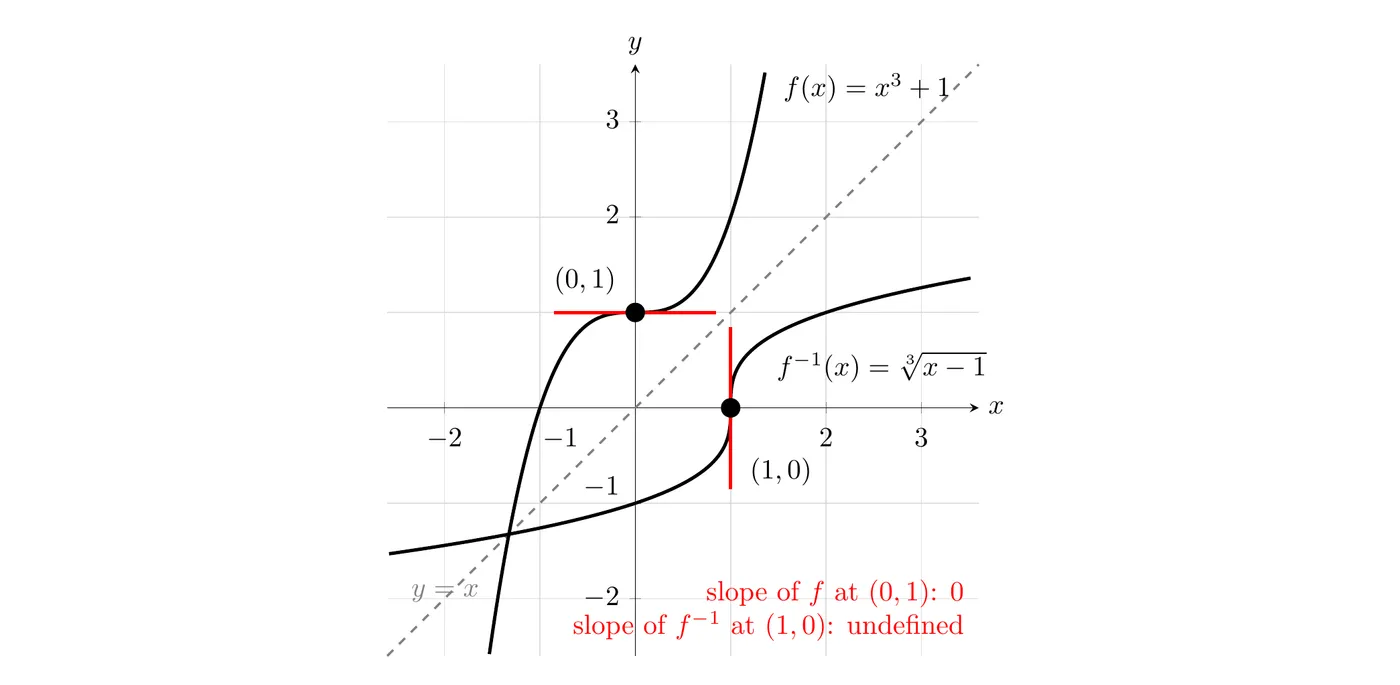
You can’t divide by zero, so the formula only works when f′(f−1(x))=0. If f(a)=b and f′(a)=0, then f has a horizontal tangent at (a,b). Reflect that over y=x and you get a vertical tangent on f−1 at (b,a). A vertical line has an undefined slope, so f−1 is not differentiable at x=b.
For example, f(x)=x3+1 has f(0)=1 and f′(0)=3(0)2=0. Then:
(f−1)′(1)=f′(f−1(1))1=f′(0)1=01(undefined)
So (f−1)′(1) does not exist. The graph shows why: f is flat at (0,1), so its inverse, f−1(x)=3x−1, is vertical at (1,0).
Memorization tip: write this formula at the top of every problem until it’s automatic.
Example 1: Using a Table of Values
Suppose h(x)=f−1(x) and we have:
x
f(x)
f′(x)
1
5
3
2
8
4
3
10
1
4
13
6
Find h′(5).
Since h(x)=f−1(x):
h′(5)=f′(f−1(5))1
Step 1: find f−1(5)
Inverse functions swap the x and y coordinates, so we need the x value that produces f(x)=5. From the table, f(1)=5, so f−1(5)=1.
Step 2: evaluate
h′(5)=f′(1)1=31
Example 2: Finding a Tangent Line
Using the same table, write the equation of the tangent line to h(x)=f−1(x) at x=5.
We need a point and a slope.
Point:h(5)=f−1(5)=1, so the point is (5,1).
Slope:h′(5)=31
Equation:
y−1=31(x−5)
Common mistake: don’t mix up which coordinate is x and which is y with inverse functions. The point (5,1) means you plug in x=5 to get y=1 for the inverse function.
Example 3: Given Function Information
Let p(x) be a differentiable function with:
- p(4)=−1
- p(9)=2
- p′(4)=3
- p′(9)=5
Let r(x) be the inverse of p(x). Find r′(2).
r′(2)=p′(p−1(2))1
Step 1: find p−1(2). Which input gives p(x)=2? We’re told p(9)=2, so p−1(2)=9.
Step 2: evaluate
r′(2)=p′(9)1=51
Example 4: Finding Everything from Scratch
Let f(x)=2x3−6. If g(x)=f−1(x), find g′(16).
g′(16)=f′(f−1(16))1
We need two things: f−1(16) and the formula for f′(x).
Step 1:f′(x)=6x2
Step 2: find f−1(16) by solving f(x)=16:
2x3−6=162x3=22x3=11x=311
So f−1(16)=311.
Step 3: evaluate
g′(16)=f′(311)1=6(311)21=631211
Which can also be written as:
g′(16)=6⋅112/31
Example 5: Numerical Answer
Let f(x)=x3+2x+1. If g(x)=f−1(x), find g′(4).
g′(4)=f′(f−1(4))1
Step 1:f′(x)=3x2+2
Step 2: find f−1(4) by solving f(x)=4:
x3+2x+1=4⇒x3+2x−3=0
By inspection, x=1 works. Check: 13+2(1)+1=4 ✓
So f−1(4)=1.
Step 3: evaluate
g′(4)=f′(1)1=3(1)2+21=51
Visual Understanding
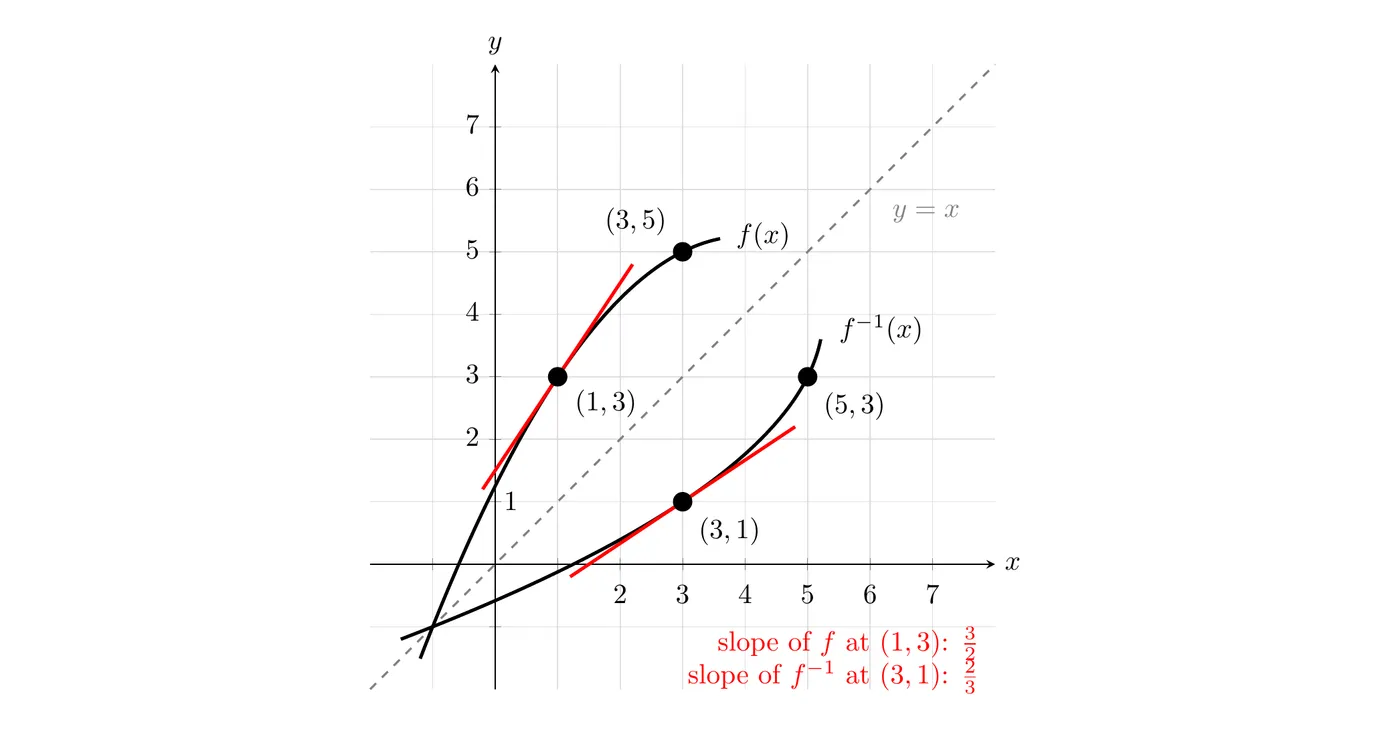
Key observation: the tangent lines to a function and its inverse at corresponding points are reflections across y=x, and their slopes are reciprocals of each other.
Strategy for These Problems
Step 1: Write the formula.
dxd[f−1(x)]=f′(f−1(x))1
Step 2: Find f−1 of the given value.
- Given a table: look for where the output equals your input
- Given a function: solve f(x)=value
Step 3: Find f′(x) if you need it (differentiate the original function).
Step 4: Substitute and simplify. Plug the inverse value into f′, then take the reciprocal.
Key Takeaways
Notation:f−1(x) means the inverse function, NOT f(x)1
Composition property: if g=f−1, then f(g(x))=x and g(f(x))=x
Derivative formula:(f−1)′(x)=f′(f−1(x))1
Where it comes from: differentiate f(f−1(x))=x with the chain rule and solve for the derivative of f−1
When it fails: if f′(f−1(a))=0, the inverse has a vertical tangent at x=a, so its derivative doesn’t exist there
Finding inverse values: swap x and y coordinates. If f(a)=b, then f−1(b)=a
Write the formula every time until you’ve got it memorized, repetition builds retention
Two-step evaluation: first find f−1(x), then evaluate f′ at that result