Again, sin−1(x) does not mean sinx1. It means the inverse function of sine.
The Three Primary Formulas
These are organized by pattern, which makes memorizing them easier.
Sine inverse:
dxd[sin−1(x)]=1−x21
Secant inverse:
dxd[sec−1(x)]=∣x∣x2−11
Tangent inverse:
dxd[tan−1(x)]=1+x21
Memorization Strategy
Rule 1: “S” means Subtraction and Square root. Functions starting with S (sine, secant) have subtraction in the expression and a square root.
Rule 2: the “i” in sine. The “i” in sine looks like a “1,” so the 1 comes first: 1−x2. Secant has no “i,” so the 1 comes last: x2−1.
Rule 3: secant’s “C” stands for “Oh Crap!” The “c” in secant reminds you: “oh crap, there’s an absolute value!” That gives you ∣x∣.
Rule 4: tangent has no “S.” No subtraction, no square root. Just addition: 1+x2.
The Three Complementary Formulas
Functions starting with “co” are just the negatives of their counterparts.
Cosine inverse:
dxd[cos−1(x)]=−1−x21
Cosecant inverse:
dxd[csc−1(x)]=−∣x∣x2−11
Cotangent inverse:
dxd[cot−1(x)]=−1+x21
Pattern: cosine inverse is the negative of sine inverse, and so on down the line.
Examples with the Chain Rule
Example 1: sine inverse
Find dxd[sin−1(3x)].
Starts with S, so square root and subtraction, with the 1 first:
dxd[sin−1(3x)]=1−(3x)21⋅3=1−9x23
Common error: do NOT simplify 1−9x2 to 1−3x. The square root applies to the entire expression(1−9x2), not to each term separately.
Example 2: tangent inverse
Find dxd[tan−1(2x2)].
No “S,” so no square root, just addition:
dxd[tan−1(2x2)]=1+(2x2)21⋅4x=1+4x44x
Common error: don’t try to “cancel” the 4 and the x:
WRONG: 1+4x44x=1+x31
You can’t split a denominator like that. The whole expression 1+4x4 is grouped together.
Example 3: secant inverse
Find dxd[sec−1(5x)].
Starts with S, so square root and subtraction (1 comes last). Has a C, so absolute value around x:
dxd[sec−1(5x)]=∣5x∣(5x)2−11⋅5=∣5x∣25x2−15
Cancel the 5’s:
=∣x∣25x2−11
Simplifying Secant Inverse Derivatives
These need careful handling of absolute values.
Strategy: check the sign before simplifying
Test with a negative number (like x=−1) to see if the result should be positive or negative
Simplify algebraically
Decide whether the final answer needs an absolute value
Example
Simplify 3∣x∣9x6−19x2.
Test with x=−1:
3∣−1∣9(−1)6−19(−1)2=3(1)89=83>0
The result is positive even when we plug in a negative number.
Now simplify:
3∣x∣9x6−19x2=∣x∣9x6−13x2
The useful fact here is that ∣x∣x2=∣x∣, since x2=∣x∣2. So:
=9x6−13∣x∣
Since we determined the answer has to be positive, and ∣x∣ guarantees that, we keep the absolute value.
Another example
Simplify 2∣x∣4x2−14x2.
Test with x=−1:
2∣−1∣4(−1)2−14(−1)2=234>0
Positive, good. Now simplify:
2∣x∣4x2−14x2=∣x∣4x2−12x2
Check the ∣x∣x2 piece both ways:
- If x<0: ∣x∣x2=−xx2=−x, which is positive
- If x>0: ∣x∣x2=xx2=x, which is positive
Either way ∣x∣x2=∣x∣, so:
=4x2−12∣x∣
The key is to test whether the original expression comes out positive or negative, then make sure your simplified form behaves the same way.
Domain and Range of Inverse Trig Functions
These matter a lot when you’re evaluating inverse trig expressions.
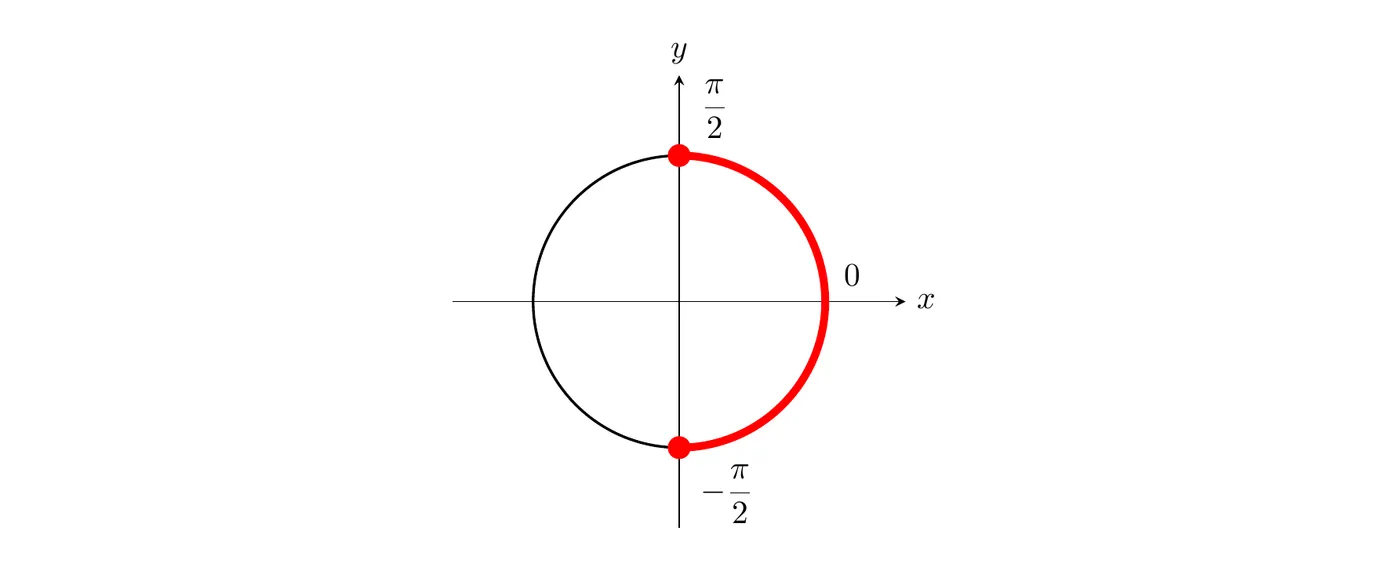
Arcsine: y=sin−1(x)
Domain: −1≤x≤1
Range: −2π≤y≤2π
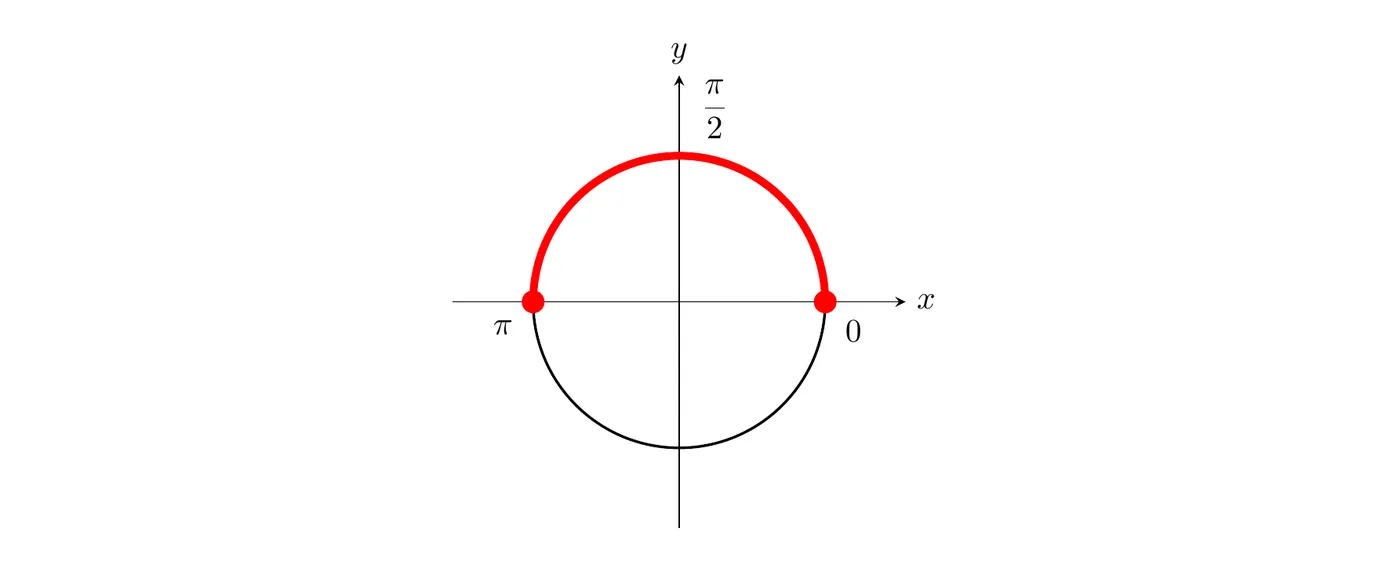
Arccosine: y=cos−1(x)
Domain: −1≤x≤1
Range: 0≤y≤π
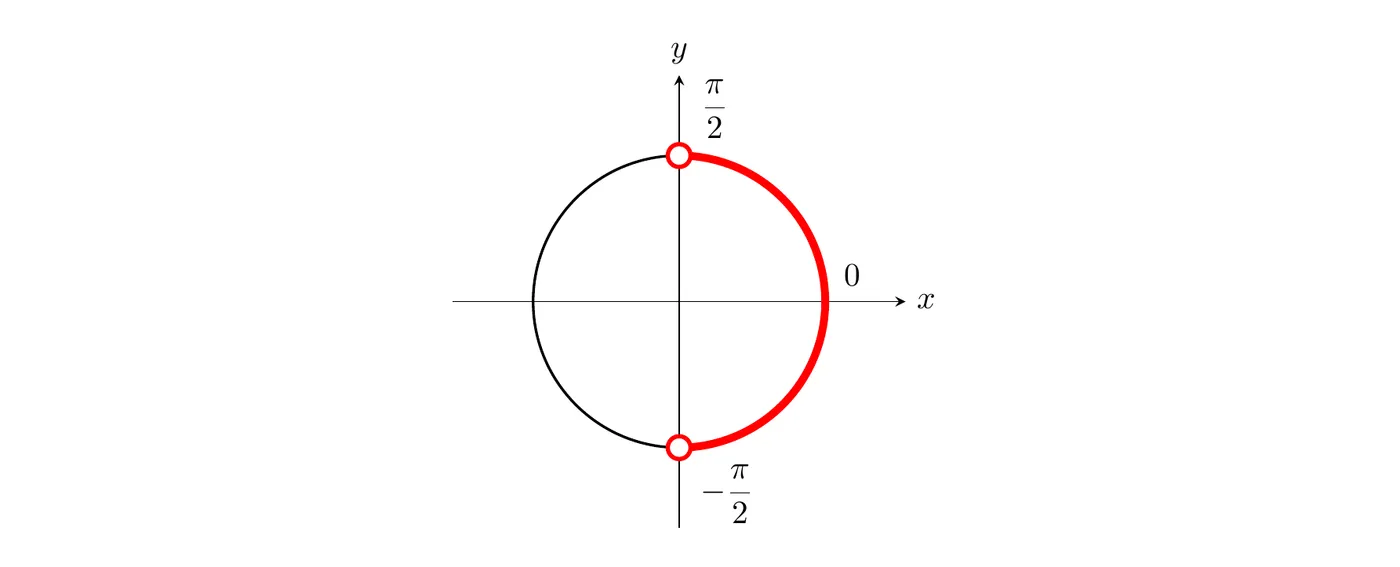
Arctangent: y=tan−1(x)
Domain: −∞<x<∞ (all real numbers)
Range: −2π<y<2π (open interval)
Why an open interval? Because tanθ=cosθsinθ, and cos(±2π)=0, which means dividing by zero.
Evaluating Inverse Trig Functions
Example 1: evaluate sin−1(23)
Translation: what angle has a sine value of 23?
From the unit circle, sin(3π)=23, and 3π is in the range [−2π,2π].
sin−1(23)=3π
Example 2: evaluate cos−1(−21)
Translation: what angle has a cosine value of −21?
From the unit circle, cos(32π)=−21, and 32π is in the range [0,π].
cos−1(−21)=32π
Example 3: evaluate tan−1(31)
Translation: what angle has a tangent value of 31?
Recall tanθ=cosθsinθ. At θ=6π, we have sin(6π)=21 and cos(6π)=23, so:
tan(6π)=3/21/2=31
Since 6π is in the range (−2π,2π):
tan−1(31)=6π
Where the Formulas Come From
You don’t have to take these formulas on faith. Each one comes from the chain rule plus the definition of an inverse function, the same way as the formula in 3.3.
Arcsine. Let y=sin−1(x). By definition, that means
sin(y)=x
Differentiate both sides with respect to x. The left side needs the chain rule, just like implicit differentiation:
cos(y)⋅dxdy=1⇒dxdy=cos(y)1
Now write cos(y) in terms of x. From sin2(y)+cos2(y)=1, we get cos(y)=±1−sin2(y)=±1−x2. The range of arcsine is −2π≤y≤2π, and cosine is never negative there, so we keep the positive root:
dxd[sin−1(x)]=1−x21
This is one reason the range matters: it decides the sign. Also, at x=±1 we get cos(y)=0, so the derivative doesn’t exist at the ends of the domain.
Arccosine works the same way. Starting from cos(y)=x gives −sin(y)⋅dxdy=1, and that minus sign from the derivative of cosine is why the “co” formulas are negative.
Arctangent. Let y=tan−1(x), so tan(y)=x. Differentiate both sides:
sec2(y)⋅dxdy=1⇒dxdy=sec2(y)1
Use the identity sec2(y)=1+tan2(y)=1+x2:
dxd[tan−1(x)]=1+x21
Using the inverse function formula instead. The formula from 3.3 works at a single point too. Find the derivative of sin−1(x) at x=21. Here f(x)=sinx (restricted to −2π≤x≤2π), so f′(x)=cosx, and f−1(21)=sin−1(21)=6π:
(f−1)′(21)=f′(6π)1=cos(6π)1=231=32
Check with the arcsine formula: 1−(21)21=431=32 ✓
Key Takeaways
Notation:sin−1(x)=arcsin(x), an inverse function, not a reciprocal
“S” rule: functions starting with S (sine, secant) have subtraction and a square root
“i” in sine: the 1 comes first: 1−x2
“C” in secant: “oh crap!” means add an absolute value: ∣x∣x2−11
“Co” means negative: cosine, cosecant, and cotangent derivatives are the negatives of their counterparts
Tangent is simple: no S, so no subtraction and no square root: 1+x21
Chain rule always applies: multiply by the derivative of the inside function
Where they come from: rewrite y=sin−1(x) as sin(y)=x and differentiate implicitly, or use f′(f−1(x))1 from 3.3
Don’t split denominators:1−x2 and 1+x2 are single grouped expressions
Domain matters: arcsine and arccosine only accept inputs in [−1,1]
Range matters: know which quadrants each inverse function outputs to