

2.3 - Island Biogeography
Learning Objectives
The objectives are describing the theory of island biogeography and explaining the crucial role it plays in evolution. The associated skill is describing an environmental concept or process.
Introduction to Island Biogeography
Island biogeography is the field of study focused on the ecological relationships and community structure found on islands.
What Counts as an “Island”?
Islands can be understood two ways.
- Actual islands: Land masses naturally surrounded by water.
- Figurative or habitat islands: A patch of natural habitat entirely surrounded by an urban or developed human environment. Central Park in New York City works as a habitat island because it’s completely encompassed by space that’s uninhabitable for most of the species living within the park.
Factors Determining Species Richness
Island biogeography theory rests on two main observations that determine the species richness, meaning the total number of different species, found on an island.
1. Island Size (Positive Correlation)
Larger islands support a higher total number of species.
- Ecosystem diversity: A larger island tends to have greater ecosystem diversity, meaning more micro-habitats, which means a wider variety of food and habitat resources. That provides more ecological roles, or niches, for different species.
- Population stability: Larger spaces enable larger population sizes. Larger populations are generally more genetically diverse and therefore more resistant to environmental disturbance like drought or hurricanes.
- Lower extinction rate: Because they’re more stable, larger islands have a lower rate of regional extinction, which preserves the species present and keeps overall species richness high.
- Trend: There’s a positive correlation between island size and species richness. As island size increases, the number of species found there also increases.
2. Distance to Mainland (Inverse Relationship)
Islands closer to the mainland have higher species richness.
- Colonization ease: It’s easier for colonizers, meaning organisms moving from the mainland to establish new populations, to reach closer islands. Species have to swim or fly shorter distances to get there.
- Migration and diversity: Continual migration from the mainland brings in different genes, which increases the genetic diversity of island populations and supports larger overall population sizes.
- Established populations: Populations with high genetic diversity and large size are more likely to stay established and not go extinct when minor disturbances happen.
- Trend: There’s an inverse relationship between distance and species richness. As the distance from the island to the mainland increases, the total number of species supported decreases.
Putting It Together: The Equilibrium Model
The number of species on an island settles where two rates balance: the immigration rate (new species arriving) and the extinction rate (species dying out on the island).
- Immigration falls as the island fills up: More of the species that arrive from the mainland are already on the island, so fewer arrivals count as new species.
- Extinction rises as the island fills up: There are more species that could die out, and they split the same limited space and food, so each population is smaller and easier to wipe out.
- Equilibrium: The number of species where the two curves cross. Species keep arriving and dying out, but the total stays about the same.
- Island size shifts the extinction curve: Larger islands have lower extinction rates, so they settle at more species.
- Distance shifts the immigration curve: Closer islands have higher immigration rates, so they settle at more species.
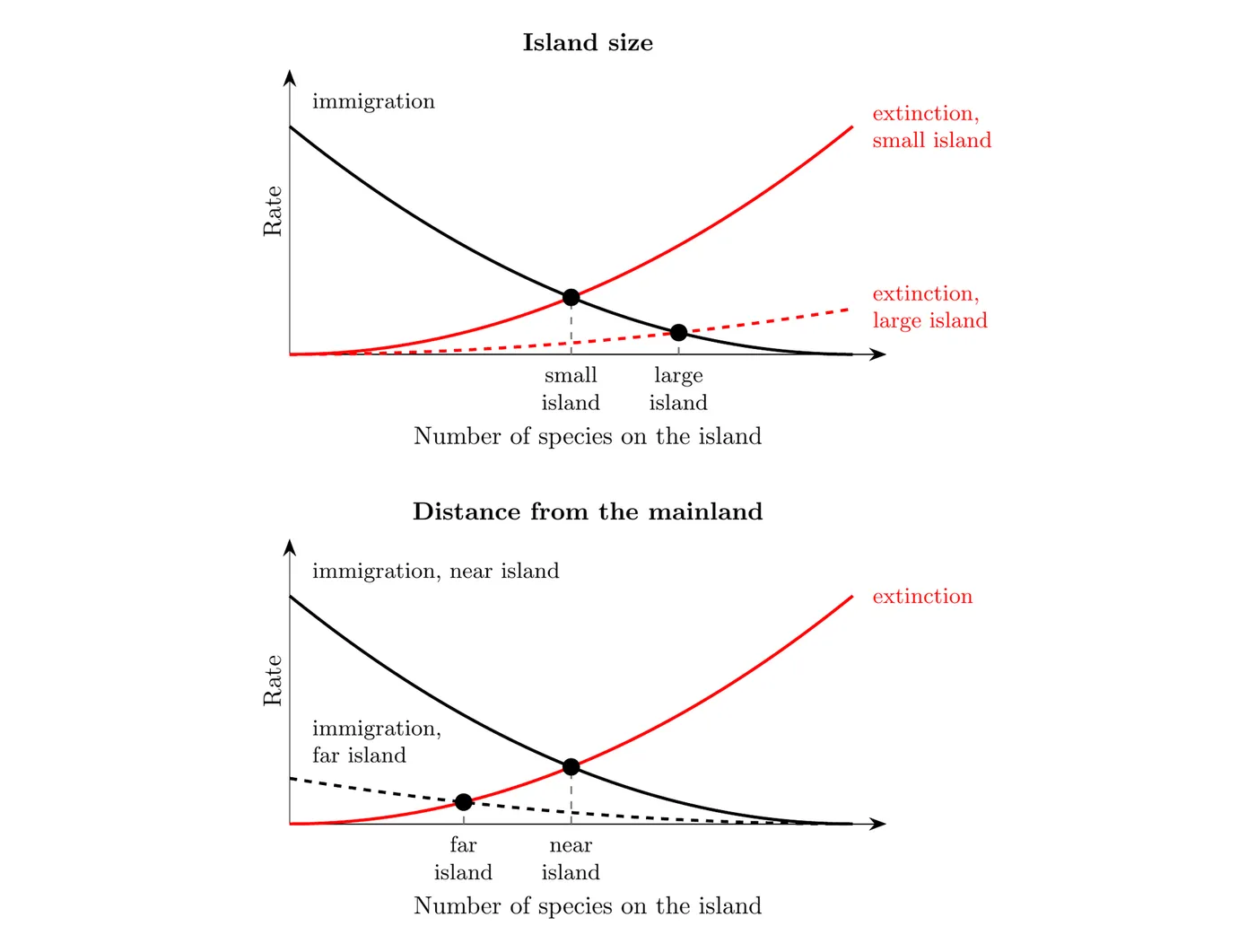
So a large island close to the mainland has the most species, and a small island far from the mainland has the fewest.
How Islands Get Colonized
Every species on an island that rose out of the ocean, like a volcanic island, descends from ancestors that arrived from somewhere else. Organisms reach islands in a few ways:
- Flying: Birds, bats, and flying insects. Hawaii's only native land mammal is a bat, the Hawaiian hoary bat, whose ancestors flew there from North America.
- Wind: Fern and moss spores, light seeds, and tiny spiders can drift long distances.
- Floating or rafting: Some seeds, like coconuts, float in seawater. Small animals like lizards and insects can ride mats of vegetation that storms wash out to sea.
- Riding on other animals: Seeds stick to birds' feathers or feet, or get eaten and dropped later in their waste.
- Humans: People now bring species to islands on purpose (crops, livestock, pets) and by accident (rats, insects, snakes in cargo). Many of these become invasive.
That's why remote islands have lots of birds, insects, and plants but few or no native land mammals, frogs, or other animals that can't fly or survive a long trip in salt water.
- Real example (Krakatau): In 1883 the volcano Krakatau in Indonesia exploded and buried what was left of the island in hot ash, wiping out its life. Within three years, ferns and grasses were growing there, and by the 1930s young forest covered much of the island. Every one of those species had to cross about 40 km (25 miles) of ocean from Java or Sumatra.
Evolutionary Role: Adaptive Radiation
Islands create unique conditions that accelerate evolution. Limited space and resources put greater selective pressure on species to adapt to narrower, more specific conditions than they needed on the vast mainland.
- Adaptive radiation definition: The process where a single species rapidly evolves into several distinct new species.
- Purpose: This rapid diversification lets the new species use different food resources or habitats, which reduces direct competition among them.
- The Galapagos finches: The finches that colonized the Galapagos Islands are the classic example. Diverse micro-climates and micro-habitats on the islands led to the evolution of many different beak sizes and shapes suited to various food resources like seeds, insects, and cactus flowers.
- Outcome: By radiating out to different food sources, the island can support far more individual birds than if they all stayed one species competing for the same primary food source.
Island Specialists and Invasive Species
Most islands have limited food and territory, so many island species evolved to be specialists that each use a narrow set of resources (like each Galapagos finch species and its particular food). Many also evolved without large predators or strong competitors, so they lost defenses they didn't need, like the ability to fly.
- The problem: When humans bring in invasive species, which are usually generalists with broad diets and fast reproduction, they can outcompete or eat the island specialists. The specialists can't switch to new resources and have nowhere else to go, so their long-term survival is at risk.
- Example (Guam): The brown tree snake reached Guam as a stowaway in cargo, probably in the late 1940s or early 1950s. It eats birds, eggs, lizards, and small mammals, and nothing on Guam eats it. It wiped out most of the island's native forest birds: about 10 of Guam's 12 native forest bird species disappeared from the wild.
- Example (Galapagos goats): Goats brought by sailors and settlers ate the same plants that giant tortoises and other native species depend on, stripping some areas nearly bare. Removing the goats from northern Isabela Island (finished in 2006) let the vegetation recover.
Big picture: The theory of island biogeography works like a natural real estate formula. The desirability of an island habitat depends on two variables: its size (a larger lot supports a bigger, more resilient population) and its proximity to the “city center” (the mainland, which acts as a constant source of new colonists and genetic reinforcements).