

2.7 - Ecological Succession
Learning Objectives
The central objectives are describing what ecological succession is and describing the different effects it has on an ecosystem’s structure. The associated skill is analyzing data sets to draw conclusions based on observed trends.
Introduction to Ecological Succession
Ecological succession refers to a series of predictable changes in which species live in an area, which naturally occur over time after a disturbance or on newly formed land. The classic example is bare ground slowly turning into a forest, but succession also happens in grasslands, ponds, and other ecosystems. The process falls into two main types, distinguished by the starting conditions.
The only difference between the two types is the initial stage, specifically whether established soil already exists. After the starting stage, the process is relatively the same.
1. Primary Succession (Starting from Scratch)
Primary succession occurs in an area where only bare, exposed rock is present. There’s no previously formed soil.
- Occurrences: This typically follows a volcanic eruption, where lava cools to form rock, or a glacial retreat, which scrapes the soil away.
- Pioneer species: The first species to colonize are moss and lichen.
- Adaptation and soil formation: Moss and lichen are uniquely adapted to grow directly on rock.
- They secrete acids into the rock.
- Those acids chemically break down, or weather, the rock, releasing nutrients like potassium, phosphorus, and calcium. (Nitrogen mostly doesn't come from rock. It's fixed from the air by bacteria, including the cyanobacteria that live in some lichens.)
- The smaller bits of rock mix with the dead biomass of the moss and lichen as they die.
- That mixture slowly forms the initial rocky, shallow soil.
- Importance: Without this chemical weathering by moss and lichen, the soil necessary for later growth would never form.
2. Secondary Succession (Starting with Soil)
Secondary succession occurs in an area that already has established soil, but where the plant community has been cleared away by some kind of large disturbance.
- Disturbance examples: Natural events like a wildfire or a wind storm, or human disturbances like clearing land for agriculture.
- Pioneer species: The first species to arrive are wildflowers, grasses, and sedges. They’re fast growing and sun tolerant.
- Impact of fire: If the disturbance was a forest fire, the soil is often highly nutrient rich, because the fire burned the previous plants and returned their stored nutrients to the soil. That can significantly jump start the process.
- Speed: Secondary succession is faster than primary succession, but it can still take upwards of 150 years to reach the final community stage.
The Stages of Succession (Common to Both)
The whole process of succession is defined by the types of plant species that dominate during each phase. Different species are adapted to the specific conditions of each stage.
A. Pioneer / Early Successional Species
- The first species to appear.
- Established either on bare rock (primary succession) or recently disturbed soil (secondary succession).
- Shared characteristics: Typically dispersed by wind (seeds and spores) or carried by animals (in waste or stuck to fur). They’re fast growing and tolerant of full sunlight.
- Pioneers can become new species: Pioneer populations that colonize brand-new, empty land (like a fresh lava flow or a new volcanic island) are often small and cut off from the rest of their species. Over many generations, natural selection adapts them to the local conditions, and they can become new species. Example: About 30 species of Hawaiian silverswords and their relatives all descend from a single ancestor, related to California tarweeds, that reached the Hawaiian Islands roughly 5 million years ago and spread into habitats from bare lava and cinder to wet forests and bogs.
B. Mid-Successional Species
- These appear after the pioneer species have grown and died, building up soil depth and richness.
- Shared characteristics: Fast growing and slightly larger than pioneers. They need deeper, more nutrient rich soil, and they’re tolerant of full sunlight because the ecosystem doesn’t yet have an established tree canopy.
- Examples: Shrubs, bushes, and fast growing trees like pine and cherry.
C. Late Successional Species (Climax Community)
- The last species to colonize the area, sometimes called members of a climax community.
- Soil requirement: They need soil that has been deepened and enriched over time by the death and decomposition of early and mid-successional species. The soil has to be deep enough to anchor their large roots.
- Shared characteristics: Large, slow growing trees. Crucially, they’re tolerant of shade, which lets them grow beneath the canopy established by the mid-successional species.
- Examples: Large, long-lived trees like sugar maple, American beech, oaks, and hickories, which often grow 50 to 100 feet (about 15 to 30 m) tall. Which species form the climax community depends on the local climate and soil, so in a dry grassland biome, the climax community is grassland, not forest.
How Succession Changes an Ecosystem Over Time
As succession moves from pioneer species to a climax community, three things change in predictable ways. This happens whether succession started on bare rock or after a disturbance like a fire.
- Total biomass increases, then levels off: Each stage brings bigger, longer-lived plants (moss and lichen, then grasses, then shrubs, then trees) that store more living matter. Biomass is highest in the climax community, where it levels off because the biomass lost as old trees die and decompose roughly balances the new growth.
- Species richness increases, often peaking in mid-succession: Deeper soil and more layers of vegetation (ground cover, shrubs, a tree canopy) create more niches, so more species move in. Richness is often highest in mid-succession, when early, middle, and late species overlap. It can dip a little in the climax community as shade-tolerant trees crowd out sun-loving species.
- Net primary productivity rises fast, peaks, then levels off lower: NPP is the new biomass plants add each year (NPP = GPP minus respiration). It climbs quickly in early and mid-succession, when lots of fast-growing plants are adding new tissue in full sun. In a mature climax forest, NPP levels off or drops somewhat, because big old trees grow more slowly and use more of the energy they capture to keep their existing tissue alive.
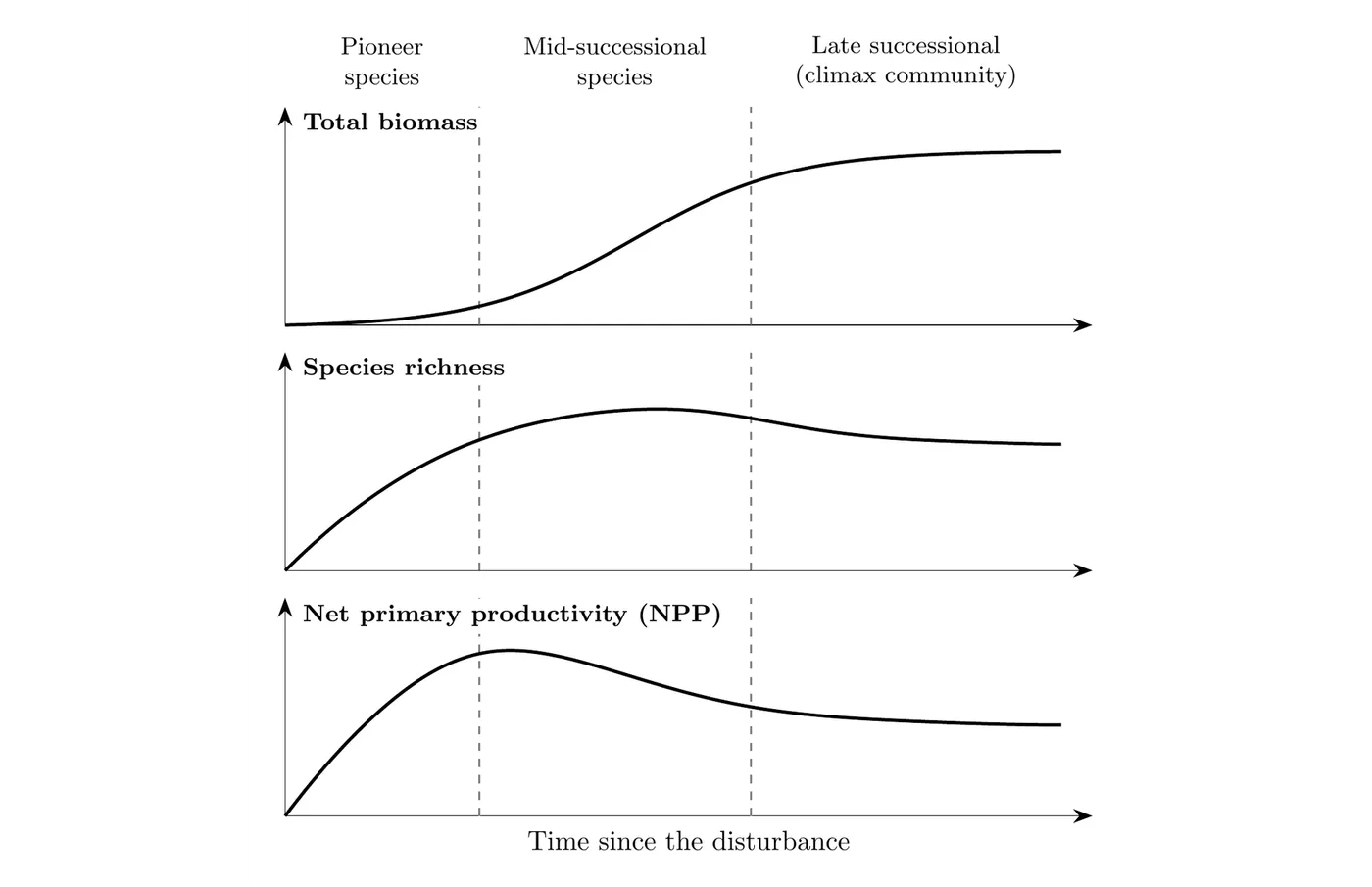
- Key distinction: Biomass is the total amount of living matter stored. NPP is the yearly rate of new growth. That's why biomass can keep rising in a maturing forest even while NPP is falling.
- After a new disturbance: A fire, hurricane, or clearcut knocks biomass, species richness, and NPP back down, and succession starts over from an earlier stage (usually secondary succession, since the soil is still there).
Keystone Species
A keystone species is a species whose activities play an especially large role in shaping the community, meaning which species live there and how many of each. Its effect is much bigger than you'd expect from how many of them there are. Like the keystone at the top of a stone arch, if you remove it, the structure falls apart.
- How it works: Keystone species are often predators that keep one prey species from taking over, or ecosystem engineers that build habitat other species use. Removing one sets off a chain reaction through the community (for a predator, a trophic cascade), and species richness usually drops.
- Example (ochre sea star): The term comes from ecologist Robert Paine's experiments on the rocky shore of Washington State in the 1960s. When he kept removing the ochre sea star, which eats mussels, the mussels spread over the rocks and crowded out other species. The number of species in his study area dropped from 15 to 8.
- Percent change: , so species richness fell by about 47%.
- Example (sea otters): Sea otters eat sea urchins, which graze on kelp. Where fur traders hunted otters nearly to extinction, urchin populations exploded and ate the kelp forests down to bare rock (urchin barrens), wiping out habitat for fish and many other species. Where otters have come back, the kelp forests have grown back too.
- Example (beavers, an ecosystem engineer): Beaver dams turn streams into ponds and wetlands, which create habitat for fish, frogs, waterfowl, and wetland plants that couldn't live in the fast-flowing stream.
- Example (gray wolves): After wolves were reintroduced to Yellowstone National Park in 1995 and 1996, they reduced elk numbers and changed where elk grazed, which let willows and aspens regrow in some areas. It's a common keystone predator example, though scientists still debate how big the effect is (see 1.11).
Indicator Species
An indicator species is a plant or animal whose presence, abundance, scarcity, or chemical makeup shows something about the quality or condition of an ecosystem. Scientists use them as a living test of things like water quality or air pollution.
- Presence or abundance: Mayfly, stonefly, and caddisfly larvae need cold, clean, well-oxygenated water. Finding lots of them in a stream means the water quality is good.
- Scarcity: When those sensitive insects are missing and a stream is full of pollution-tolerant organisms like aquatic worms, leeches, and midge larvae, it's a sign of low dissolved oxygen or pollution.
- Air quality: Many lichens are very sensitive to sulfur dioxide air pollution. Finding few lichens on the trees and rocks in an area signals polluted air, and lichens coming back signals cleaner air.
- Chemical composition: Testing an organism's tissues shows which pollutants are in the ecosystem. High mercury levels in fish reveal mercury pollution, and in the 1960s, DDT residues measured in the thin-shelled eggs of bald eagles and peregrine falcons showed that DDT was building up in food webs.
Big picture: Think of ecological succession like renovating a piece of property. Primary succession is like starting on a completely cleared concrete lot (bare rock), where the first task is chemically breaking down the concrete to create a foundation. Secondary succession is like starting on a neglected garden plot (established soil), where you just need to clear out the weeds and debris before planting new seeds.