

2.4 - Ecological Tolerance
Learning Objectives
The main objective is describing what ecological tolerance refers to. The associated skill is reading a passage and identifying the author’s claim.
Ecological Range of Tolerance
Ecological range of tolerance is the spectrum of conditions an organism can withstand before experiencing injury or death. These essential environmental conditions include:
- Temperature
- Salinity
- pH
- Sunlight
- Flow rate (how fast the water moves in a stream or river)
- Dissolved oxygen
Remember that the species as a whole has a tolerance range, but individual organisms within that species also have their own specific tolerance ranges for the various conditions in their habitat.
- Salinity example: Most freshwater fish die in seawater, and most ocean fish die in fresh water, because water moves into or out of their cells by osmosis faster than their bodies can handle. Estuary species like oysters tolerate a wide range of salinity, because the water there shifts between fresh and salty.
- Flow rate example: Trout and mayfly larvae need fast-moving, cold, well-oxygenated streams. If a dam slows a river into a still, warm reservoir, they can't survive there, while species that tolerate slow water, like carp, can.
- Temperature example: Reef-building corals live within a narrow temperature range. If the water stays about 1°C above the usual summer maximum for several weeks, the corals expel the algae living in their tissues (coral bleaching) and can starve.
The Role of Genetic Diversity
Differences in tolerance among individuals are directly linked to genetic diversity.
- Example (salmon): Salmon generally have a basic temperature tolerance range of about 6 to 22 degrees Celsius. But specific individual salmon may have genetic adaptations that let them endure conditions slightly outside those average boundaries.
- Benefit of diversity: That genetic variability makes the entire population more resistant to change. If global warming heats up the body of water, individual salmon with higher temperature tolerances may survive in the warmer waters, which keeps the population from being wiped out entirely.
Zones within the Range of Tolerance
The overall range of tolerance can be divided into three zones that dictate the health and size of a population.
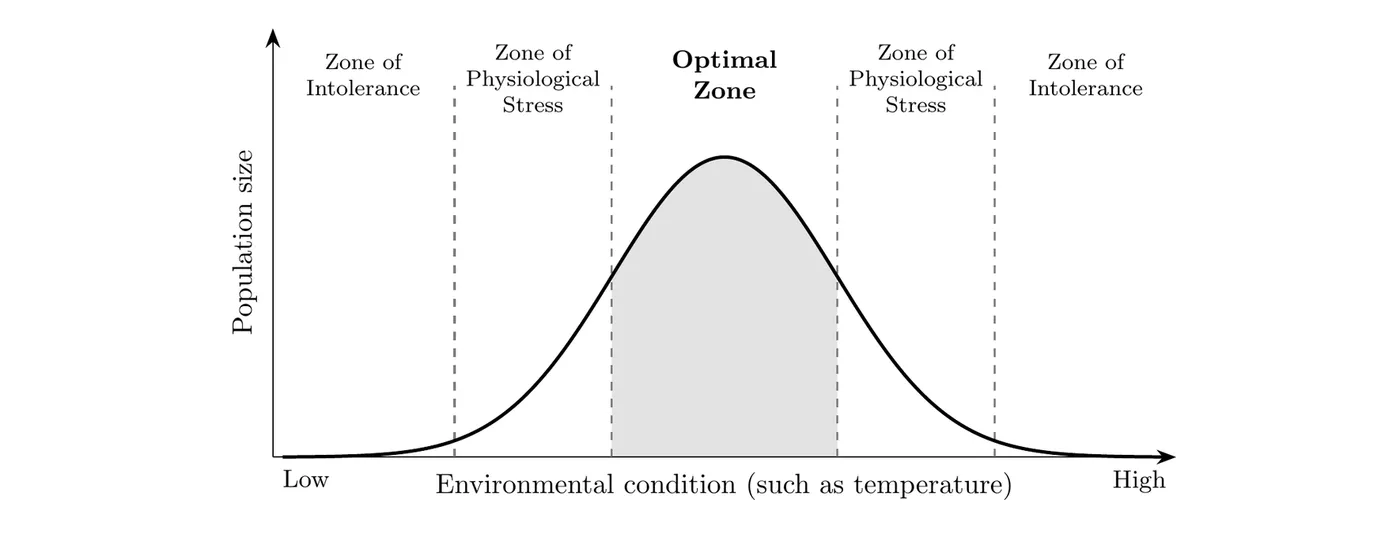
Zone | Condition and Effect on Organism | Population Outcome |
Optimal Zone | The ideal range where the organism can survive, grow, and reproduce. Organisms thrive here. | The habitat supports the largest population size and the highest number of surviving individuals. |
Range of Physiological Stress | The zone where the organism can survive but experiences some form of physiological stress. | Individuals may show decreased activity, a lack of growth, or infertility. That means fewer organisms, because the population can’t reproduce or develop effectively. |
Zone of Intolerance | The range where the organism actually dies. This happens if the condition, like pH or temperature, shifts too far outside the range of physiological stress. | The organism will not survive. |
FRQ Writing Tips: Explaining Die-offs
When writing about ecological tolerance, especially on an FRQ, be as specific as possible.
- Don’t be vague: Avoid just saying the organism “died” or the “population collapsed” because the environment “got too warm.”
- Cite a specific physiological stressor: Name the specific cause of death or decline.
General Condition | Specific Physiological Stressors to Cite |
Temperature extremes | Thermal shock, if the temperature changed too rapidly. |
Drought or dry conditions | Lack of access to water. A plant’s roots are unable to take in enough water to survive. |
Water pollution / global warming | Suffocation due to lack of oxygen. For fish, warmer water holds less oxygen, so they suffocate. |
Lack of resources | Lack of access to food or nutrients. |
Connecting Tolerance to Human Activity
Human activities like electricity generation, transportation, and agriculture release carbon dioxide. That drives climate change and global warming, which produces warmer temperatures.
- Ocean impact example: Global warming causes ocean temperatures to rise, which shifts temperature outside the tolerance range for many fish species. Since warm water holds less oxygen, the resulting physiological stress is that fish end up suffocating.
Big picture: Ecological tolerance is like a thermostat setting for a living organism. The optimal zone is where the temperature is set perfectly for maximum comfort and full functioning (growth and reproduction). The zone of physiological stress is when the temperature drifts too far. It’s still survivable, but the organism is sweating or shivering (decreased activity). The zone of intolerance is reached when the temperature becomes lethal, triggering a fatal physiological stress like thermal shock or oxygen deprivation.