

1.1 - Kinetic Theory of Temperature and Pressure
Gas Pressure from Atomic Motion
Atoms in a gas are always bumping into each other and into the walls of their container, pushing on everything they hit.
Collisions
When two atoms collide, or when an atom hits a fixed object, you can describe what happens using conservation of momentum. A few things to keep in mind:
- Gas atoms are in constant random motion.
- The collisions are elastic, meaning kinetic energy is conserved.
- Atoms bounce off both the walls and each other.
- Every collision transfers some momentum.
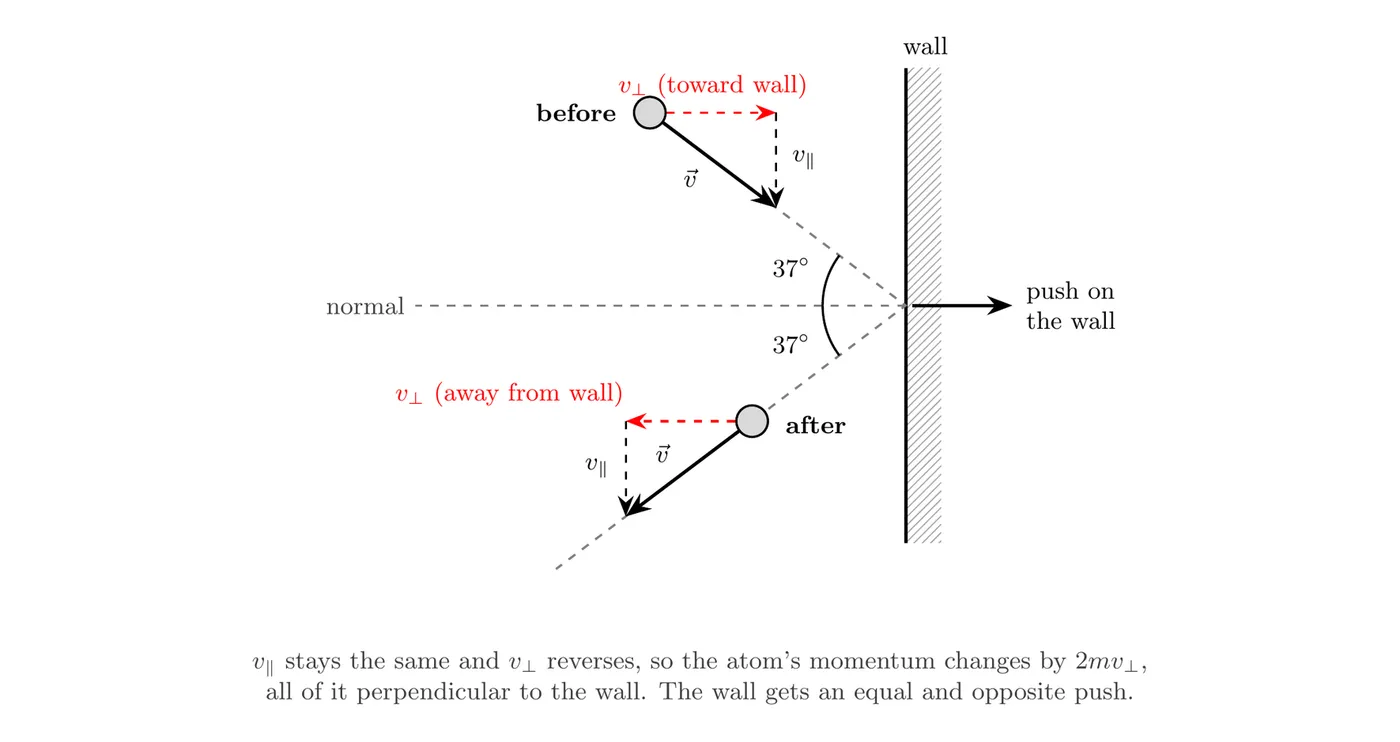
An atom hitting a wall. Treat the wall as a fixed object. The wall can only push straight out from its surface, so in an elastic bounce the atom's velocity component perpendicular to the wall () flips direction, and the component parallel to the wall () doesn't change at all. The atom's whole momentum change is perpendicular to the wall:
By Newton's third law, the atom pushes on the wall just as hard, directed into the wall. Huge numbers of these pushes every second add up to a steady outward force on every part of the container.
Worked Example: From One Bounce to Pressure
A helium atom ( kg) moving at m/s hits a container wall at from the normal (the line perpendicular to the wall) and bounces off elastically.
Step 1: components. The equation sheet's trig table gives and :
Step 2: momentum change. Only the perpendicular part changes:
(Keep the extra digit until the end.) The parallel component is the same before and after, so the wall gets no sideways push. That's why pressure only counts the perpendicular parts of the forces.
Step 3: pressure. Suppose atoms hit each square meter of the wall every second, each with this same momentum change. Force is momentum change per unit time, so on 1.0 m² of wall:
That's about half of atmospheric pressure ( Pa), produced entirely by tiny atoms bouncing.
What Pressure Actually Is
The pressure a gas puts on a surface is the total of all the perpendicular force components from the gas atoms hitting that surface, divided by the area of the surface.
where:
- = pressure (Pa)
- = perpendicular force component (N)
- = surface area (m²)
At the microscopic level, pressure is just the result of a huge number of atomic collisions hitting the container walls every second.
Pressure Exists Everywhere in the Gas
Pressure isn’t only at the boundary where the gas meets the container. It exists throughout the gas itself. If you imagine any surface floating inside the gas, it feels pressure from collisions on both sides.
What Changes the Pressure
Pressure depends on two things: how often atoms hit a surface, and how much momentum each hit delivers. So there are three ways to raise it:
- More atoms in the same space: more hits on each square meter every second.
- Smaller volume (same atoms, same temperature): the atoms are more crowded, so each square meter of wall gets hit more often. Each hit is just as hard as before.
- Higher temperature (same volume): the atoms move faster, so each hit delivers more momentum and hits happen more often. Both effects push the pressure up.
The equations say the same thing. Combine (Topic 1.2) with (below), and you get
Pressure is proportional to the number of atoms per unit volume and to the average kinetic energy of each atom.
Temperature and Kinetic Energy
The temperature of a system tells you the average kinetic energy of the atoms inside it.
where:
- = average kinetic energy per atom (J)
- = Boltzmann constant = J/K
- = absolute temperature (K)
The key idea here: temperature measures the average molecular kinetic energy, not the total energy of the whole system.
Root-Mean-Square Speed
The root-mean-square speed is the speed that lines up with the average kinetic energy for an ideal gas:
Solving for :
where:
- = root-mean-square speed (m/s)
- = mass of one atom or molecule (kg)
- = temperature (K)
Basically, gives you a typical molecular speed at temperature . Two relationships worth remembering:
- Higher temperature means a higher .
- Lighter molecules have a higher at the same temperature.
Getting the mass of one atom. The in the rms formula is the mass of one atom in kg. If you're given a molar mass instead, convert it to kg/mol and divide by Avogadro's number. For helium (4.00 g/mol):
At 27°C (300 K) that gives m/s. Argon (40.0 g/mol) at the same temperature has the same , but its atoms are 10 times heavier, so its rms speed is times smaller: 432 m/s.
Maxwell-Boltzmann Distribution
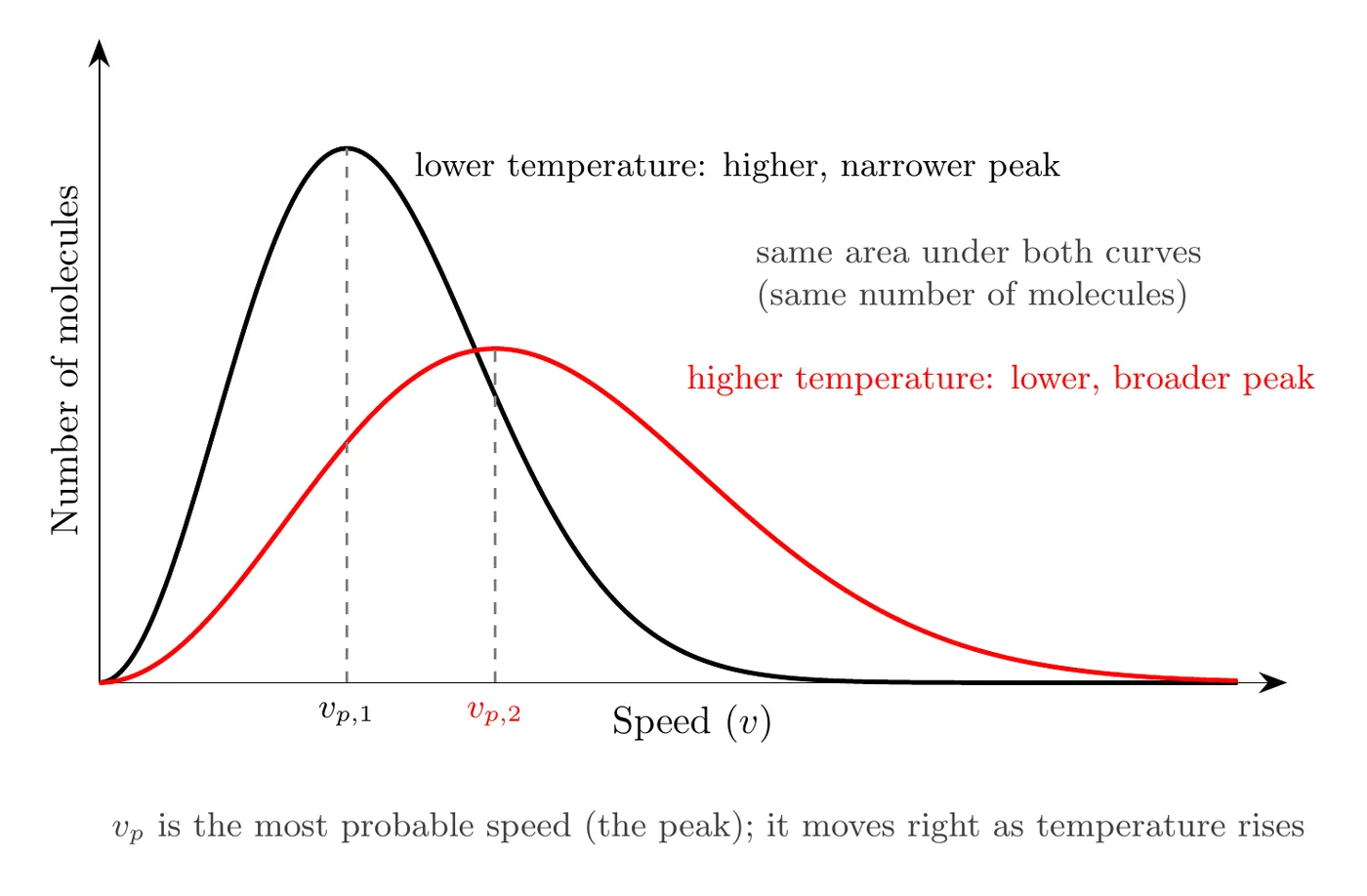
The Maxwell-Boltzmann distribution is a graph that shows you the range of energies and speeds atoms have at a given temperature.
Horizontal axis: speed (v)
Vertical axis: number of molecules
Curve starts at zero, rises to a peak (most probable speed), then gradually decreases with a long tail toward high speeds.
Features:
- Peak shifts right (higher speeds) as temperature increases
- Curve becomes flatter and broader at higher temperatures
- Area under curve represents total number of molecules (constant)
- No molecules at v = 0
- Asymptotic approach to zero at high speeds
Draw two curves:
- Lower temperature: higher, narrower peak at lower speed
- Higher temperature: lower, broader peak at higher speed
Here’s what to understand about it qualitatively:
- The peak is the most probable speed, not the average.
- The average speed and the rms speed both sit to the right of the peak.
- Raising the temperature shifts the whole distribution toward higher speeds.
- Raising the temperature also spreads the distribution out more.
- There are always some molecules moving much faster or much slower than average.
- The curve depends only on the temperature (and on the mass of the atoms). If a gas is compressed at constant temperature, its pressure goes up but its speed distribution doesn't change at all.
- Two different gases at the same temperature have the same average kinetic energy, but the gas with lighter atoms has its curve shifted to higher speeds and spread out more.
- You won't need the equation for this curve. You do need to explain how its peak, spread, and area change with temperature.
Practice Problems
1. A gas pushes on a container wall with a total perpendicular force of 600 N, and the wall has an area of 2.0 m². What is the pressure?
2. The average kinetic energy of the molecules in a gas is J. What is the temperature?
3. Find the rms speed of nitrogen molecules (mass = kg) at 300 K.
4. If a gas’s temperature doubles from 300 K to 600 K, how does the rms speed change?
5. Two gases at the same temperature have molecules with masses and , where . Compare their rms speeds.
Solutions
1.
2.
3.
4.
The rms speed goes up by a factor of .
5.
At the same temperature, is equal for both:
So the lighter molecules move twice as fast.
Common Mistakes
- Mixing up temperature and total energy. Temperature measures the average kinetic energy per particle, not the total energy of the system.
- Using Celsius instead of Kelvin. You have to use absolute temperature (K) in every kinetic theory equation.
- Assuming all molecules move at the same speed. The Maxwell-Boltzmann distribution shows a wide spread of speeds at any temperature.
- Forgetting the perpendicular component. Pressure only depends on the force component perpendicular to the surface.
- Confusing rms, average, and most probable speeds. These are three different numbers, and rms is the one used in energy calculations.
- Using the wrong mass in the rms speed formula. Use the mass of one molecule, not the molar mass. Convert if you need to.
- Assuming pressure only exists at the walls. Pressure exists throughout the whole gas volume.