

1.4 - The First Law of Thermodynamics
Internal Energy
The internal energy of a system is the kinetic energy of all the objects making up the system plus the potential energy stored in how those objects are arranged.
Internal Energy of an Ideal Gas
For an ideal gas:
- The atoms don’t interact through conservative forces, so there are no intermolecular forces.
- That means there’s no internal potential energy.
- So the internal energy is just the sum of all the kinetic energies.
For an ideal monatomic gas:
where:
- = internal energy (J)
- = number of moles
- = 8.31 J/(mol·K)
- = number of molecules
- = 1.38 × 10⁻²³ J/K
- = temperature (K)
The big takeaway: for an ideal gas, depends only on temperature.
Internal vs. External Energy
Changing a system’s internal energy can change its internal structure and behavior without moving the system’s center of mass at all.
- Internal energy is about microscopic motion and configuration.
- External energy is about macroscopic motion, like the kinetic energy of the center of mass or potential energy in an external field.
Example: a sealed box of gas rides on a train moving at 30 m/s. The box's center of mass has kinetic energy, but that's external energy, so the gas inside isn't any hotter than in an identical box sitting on the platform. Now heat the box on the platform: its internal energy and temperature go up (the atoms move faster), but the box itself doesn't start moving.
The First Law of Thermodynamics
The first law is really just conservation of energy, rewritten to include energy transferred by work, heating, or cooling.
where:
- = change in internal energy (J)
- = energy transferred by heating or cooling (J)
- = work done on the system (J)
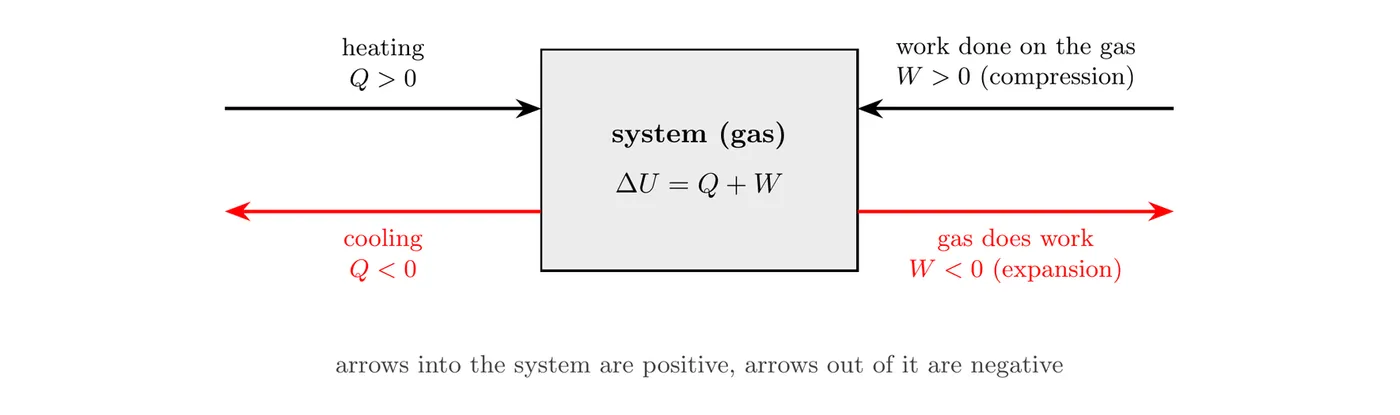
The sign conventions are:
- : heat added to the system (heating)
- : heat removed from the system (cooling)
- : work done on the system (compression)
- : work done by the system (expansion)
An energy flow diagram shows the same rules as a picture. Draw the system as a box and draw an arrow for each energy transfer across its boundary. Arrows into the box are positive and arrows out are negative.
Isolated System
For an isolated system, where no energy goes in or out:
The total energy stays constant.
Closed System
For a closed system, the change in internal energy equals the heat transferred plus the work done on the system. Energy can come and go through heat and work, but mass can’t enter or leave.
Work Done On or By a Gas
The work done on a system by external pressure that changes its volume is:
where:
- = work done on the system (J)
- = external pressure (Pa)
- = change in volume (m³)
Reading the signs:
- Compression () gives , so work is done on the system.
- Expansion () gives , so work is done by the system.
Keep in mind that is the work on the system. The work by the system is .
uses a constant pressure, or the average pressure if it changes during the process. When the pressure changes, you can also get the work from the area under the PV graph (next section).
Worked Example: Gas Under a Piston
A vertical cylinder holds an ideal monatomic gas under a frictionless piston with a mass of 4.0 kg and an area of m². The air above the piston is at atmospheric pressure, Pa. The gas is heated slowly and the piston rises 5.0 cm. Use m/s² (the value on the AP Physics 2 equation sheet).
Step 1: pressure of the gas. The piston isn't accelerating, so the gas pushes up exactly as hard as the atmosphere and gravity push down:
Nothing in that equation changes as the piston slowly rises, so the process is isobaric.
Step 2: work done on the gas.
It's negative because the gas expands and does 12 J of work on its surroundings. Check: lifting the piston takes J, and pushing back the atmosphere takes J, for a total of about 12 J.
Step 3: internal energy and heating. For a monatomic ideal gas, , so at constant pressure :
Of the 30 J added by heating, 18 J stays in the gas as internal energy and 12 J leaves as work.
PV Diagrams
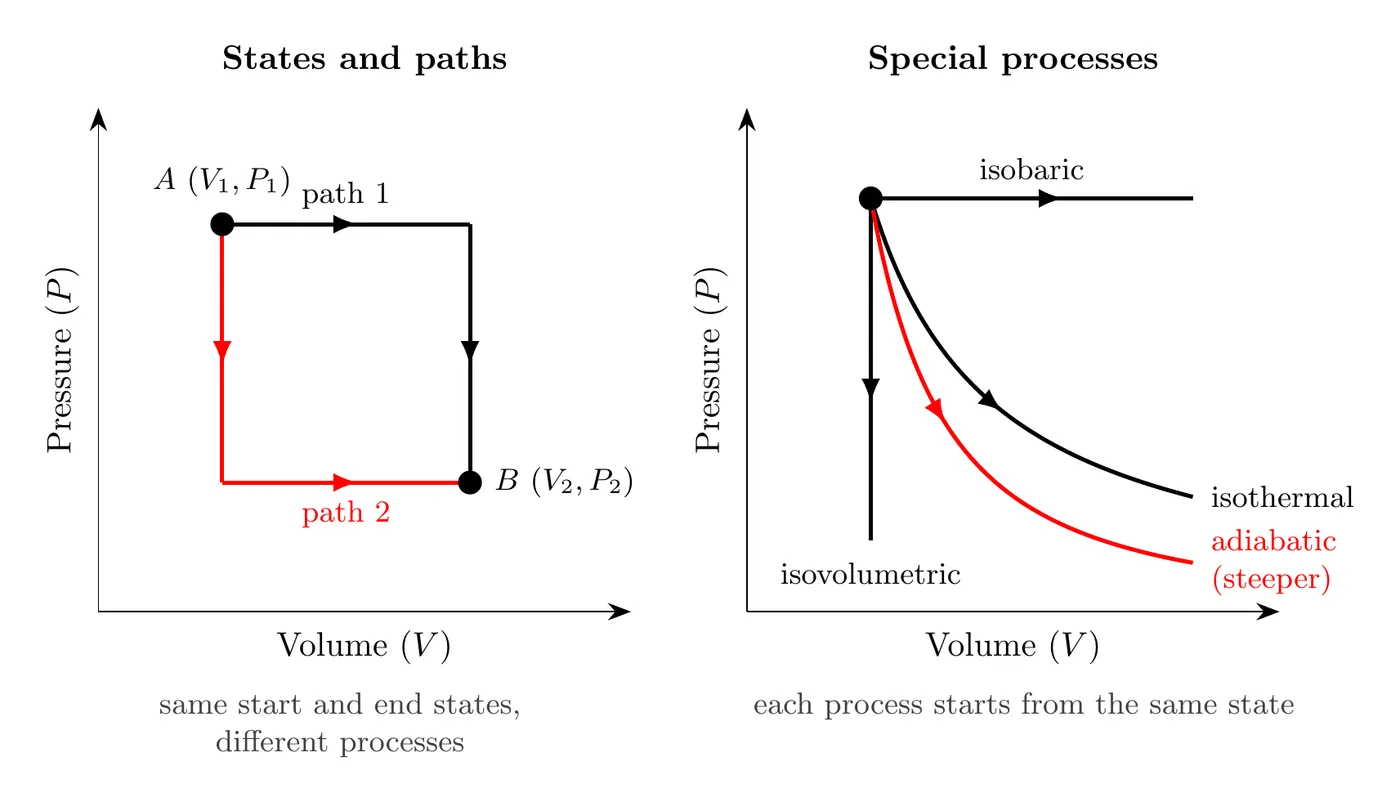
Pressure-volume graphs, or PV diagrams, are how we picture thermodynamic processes.
Axes: Pressure (vertical) vs. Volume (horizontal)
Show process as curve/line connecting initial and final states.
Key features:
- State represented by point (P, V)
- Process represented by path between states
- Different paths between same endpoints represent different processes
Isotherms
Lines of constant temperature on a PV diagram are called isotherms.
For an ideal gas, , which gives:
- Hyperbolic curves.
- Higher temperature curves that sit farther from the origin.
Work on a PV Diagram
The absolute value of the work done on a gas equals the area underneath the pressure-versus-volume curve.
The direction tells you the sign:
- If the volume decreases (moving right to left), , so work is done on the system.
- If the volume increases (moving left to right), , so work is done by the system.
Worked Example: Work as Area
An ideal monatomic gas is taken around the cycle A → B → C → D → A shown on the right. The left graph shows only the first step. A handy unit fact: 1 kPa·L = = 1 J.
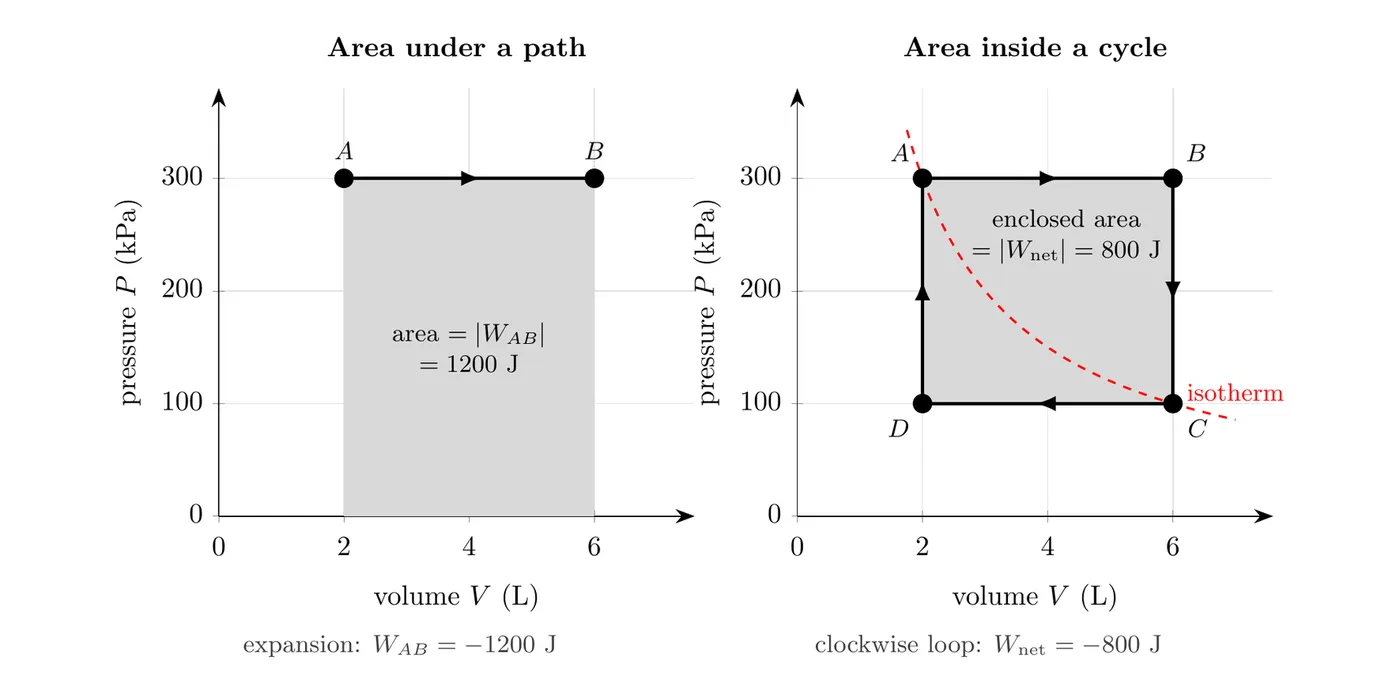
A → B (isobaric expansion). The work is the shaded rectangle under the path:
The volume increases, so the gas does the work: J.
B → C and D → A (isovolumetric). A vertical line has no area under it, so for both.
C → D (isobaric compression).
The whole cycle. Add the steps: J. That matches the area enclosed by the loop, J, with a negative sign because the loop runs clockwise.
- Clockwise loop: the gas does net work on its surroundings, so . This is how an engine works.
- Counterclockwise loop: the surroundings do net work on the gas, so .
First law for the cycle. The gas ends in the same state it started in, so it's back at the same temperature and . That means J: over one cycle, the gas takes in 800 J more by heating than it gives off by cooling.
Temperatures from the graph. Since , the temperature is proportional to . A and C both have J, so they're at the same temperature and sit on the same isotherm (the dashed curve). B has the largest (1800 J), so it's the hottest state, and D (200 J) is the coldest. If K, then K and K.
Special Thermodynamic Processes
1. Isovolumetric (Constant Volume)
- , so all the heat goes into changing internal energy.
- Shows up as a vertical line on a PV diagram.
2. Isobaric (Constant Pressure)
- Shows up as a horizontal line on a PV diagram.
3. Isothermal (Constant Temperature)
- , since for an ideal gas only depends on .
- , so the heat added equals the work done by the system.
- Shows up as a hyperbolic curve on a PV diagram.
4. Adiabatic (No Heat Transfer)
- , since the system is thermally isolated.
- Work changes the internal energy directly.
- Shows up as a steeper curve than an isotherm on a PV diagram.
Recognizing the Process
The physical setup tells you which special case you have:
- Rigid, sealed container: the volume can't change, so the process is isovolumetric.
- Piston that slides freely with the same load on it (its weight plus the atmosphere): the pressure stays constant, so the process is isobaric.
- Slow process with the gas touching a large reservoir (like a big water bath): energy has time to flow in or out by heating or cooling, so the temperature stays constant. The process is isothermal.
- Insulated container, or a process so fast there's no time for heating or cooling: , so the process is adiabatic.
Example (adiabatic compression): a piston is pushed quickly into an insulated cylinder holding 0.500 mol of ideal monatomic gas, doing 250 J of work on the gas. Since , J. For a monatomic ideal gas , so the temperature rises by
No energy was added by heating, but the gas still got hotter, because work alone raised its internal energy. This is how a fire syringe works: pushing the plunger in fast heats the trapped air enough to light a small piece of cotton. Run the process the other way (a fast adiabatic expansion) and the gas cools.
Practice Problems
1. An ideal monatomic gas at 300 K has 2.0 mol. What is its internal energy?
2. A gas absorbs 500 J of heat and does 300 J of work. What is the change in internal energy?
3. A gas is compressed from 3.0 L to 1.0 L at a constant pressure of 200 kPa. How much work is done on the gas?
4. In the isothermal expansion of an ideal gas, the gas does 400 J of work. How much heat gets absorbed?
5. Which produces the bigger temperature increase: (a) adding 100 J at constant volume, or (b) adding 100 J at constant pressure? Assume it’s the same gas.
Solutions
1.
2.
The gas does 300 J of work, so the work done on the gas is J.
3.
Convert first:
L m³.
The work done on the gas is 400 J, positive because it’s a compression.
4.
Isothermal for an ideal gas means .
The heat absorbed matches the work done by the gas.
5.(a) Constant volume: , so J.
(b) Constant pressure: because the gas expands, so J.
At constant volume, all the heat goes into internal energy, which raises the temperature. At constant pressure, some of the heat gets spent doing work, so less goes into internal energy.
Answer: constant volume gives the bigger temperature increase.
Common Mistakes
- Getting the sign of work wrong. is the work on the system, so an expansion () gives a negative .
- Confusing work done on the system versus by it. Watch the signs, because some textbooks use the opposite convention.
- Thinking isothermal means no energy change. , but and are both nonzero. They just cancel.
- Forgetting the ideal gas assumption. only holds for an ideal monatomic gas.
- Using the wrong units. Pressure in Pa, volume in m³. Convert L to m³ by multiplying by 10⁻³.
- Confusing internal energy with heat. is a state function, while is an energy transfer. The link is .
- Forgetting the exam's monatomic convention. On the AP exam, ideal gases are monatomic unless a problem says otherwise, so use . (Gases made of molecules, like and , also store energy in rotation, so their internal energy is larger, but that's beyond this course.)
- Forgetting how to read the area. The magnitude of work is the area under the PV curve, but the sign depends on the direction.