

4.2 - Straight-Line Motion: Connecting Position, Velocity, and Acceleration
The Big Picture
Position, velocity, and acceleration are all connected through calculus. Understanding how they relate matters for the rest of the course and shows up constantly on AP exams.
Picture throwing a ball straight up:
- Position : the height of the ball at time (starts at some height, rises, peaks, comes back down)
- Velocity : how fast the ball is rising or falling (starts positive and fast, slows to zero at the peak, becomes negative and fast on the way down)
- Acceleration : a constant m/s², gravity pulling down the whole time
The Fundamental Relationships
If represents position at time :
In words:
- Velocity is the first derivative of position
- Acceleration is the derivative of velocity, which is the second derivative of position
Critical note: the second derivative is only acceleration when it’s the second derivative of position. If you start with velocity, then is a first derivative that gives acceleration.
Velocity: Direction and Motion
Sign of velocity determines direction
For motion along the x-axis (horizontal):
For motion along the y-axis (vertical):
Rectilinear motion means motion along a straight line, either horizontal or vertical.
Changing direction
A particle changes direction when changes sign, from positive to negative or from negative to positive. A velocity of zero by itself isn’t enough: means the particle is at rest for an instant, but it only turns around if has opposite signs on the two sides of that time.
For example, if , then , but on both sides of . The particle stops for an instant and keeps moving right, so it does not change direction at .
Average Velocity
Average velocity is just the average rate of change of position, which is the slope between two points:
This gives the overall rate of position change over an interval, not the instantaneous velocity at a specific moment.
Speed vs. Velocity
Velocity has direction (positive or negative sign).
Speed is just how fast you’re going, never negative (it’s 0 when you’re at rest).
Example:
- Driving forward at 60 mph: velocity is mph, speed is 60 mph
- Backing up at 5 mph: velocity is mph, speed is 5 mph
Speeding Up vs. Slowing Down
This comes down to comparing the signs of velocity and acceleration.
Speeding up
- Both positive: moving right/up and accelerating right/up, so speeding up
- Both negative: moving left/down and accelerating left/down, so speeding up
Slowing down
- Positive velocity, negative acceleration: moving right/up but accelerating left/down, so slowing down
- Negative velocity, positive acceleration: moving left/down but accelerating right/up, so slowing down
Sign analysis examples
Velocity | Acceleration | Conclusion |
Different signs → slowing down | ||
Different signs → slowing down | ||
Same sign (both +) → speeding up | ||
Same sign (both −) → speeding up |
You only need the signs, not the actual values.
Displacement
Displacement is the net change in position, where you end up relative to where you started.
Distance vs. displacement
Running one lap around a 400-meter track:
- Distance traveled: 400 meters
- Displacement: 0 meters (you end where you started)
A particle moves 100 cm right, then 75 cm back left:
- Distance traveled: cm
- Displacement: cm to the right
Practice Problem: Using Equations
A particle moves along the x-axis with position function , where is in meters and is in seconds.
Part A: displacement from to
The particle came right back to where it started.
Part B: average velocity on
Part C: velocity at
Velocity is the first derivative of position:
At seconds, the particle is at rest.
Part D: acceleration at
Acceleration is the derivative of velocity:
Part E: is the particle speeding up or slowing down at ?
At , velocity is negative () and acceleration is zero. When acceleration is zero, the particle is neither speeding up nor slowing down. It’s moving at constant velocity at that instant.
A more interesting check:
The particle is speeding up, because and have the same sign (both negative) at .
Justification: “The particle is speeding up because velocity and acceleration have the same sign at .”
Part F: when does the particle change direction?
Set the velocity equal to zero:
Check the sign of on each side of :
- On : , so the particle moves left
- On : , so the particle moves right
The velocity changes from negative to positive at , so the particle changes direction at seconds. ( is just the starting time, so it doesn’t count.)
Justification: “The particle changes direction at because changes sign there.”
Part G: total distance traveled from to
The displacement was 0 (Part A), but the particle definitely moved. Since it turns around at , find the distance for each part of the trip and add them:
The particle moves 8 m left (from to ), then 8 m right (back to ).
Analyzing Velocity Graphs
When you’re given a velocity graph (not a position graph), you read it differently.
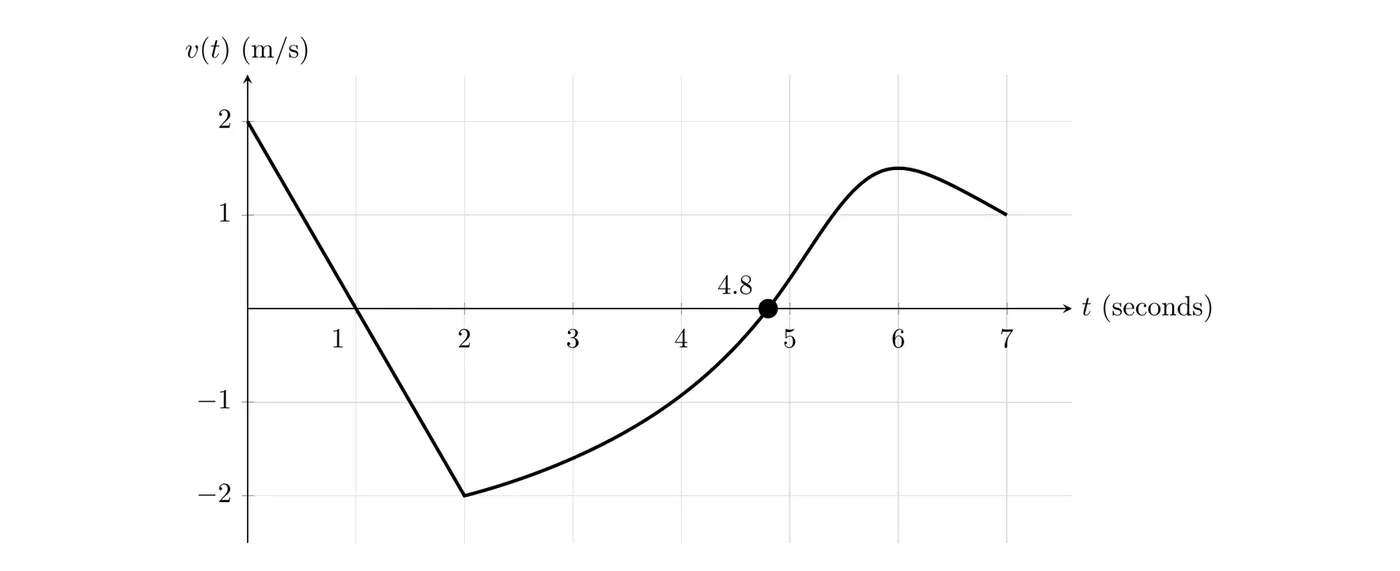
Key features: crosses t-axis at t=1 and t≈4.8, has minimum at t=2, has maximum slope (steepest positive) between t=2 and t=6, has negative slope from t=0 to t=2 and from t=6 to t=7.
Question 1: when is the particle moving right?
Justification: the particle moves right when .
Answer: on the intervals and , where velocity is above the t-axis.
Question 2: when is the particle moving left?
Justification: the particle moves left when .
Answer: on the interval , where velocity is below the t-axis.
Question 3: when is acceleration positive, negative, or zero?
Key insight: acceleration is the derivative of velocity, so look at the slope of the velocity graph.
- Acceleration positive (slope positive):
- Acceleration negative (slope negative): and
- Acceleration zero (slope horizontal): at , where the velocity graph has a horizontal tangent at its peak. At the graph has a sharp corner, so does not exist
Question 4: when does the particle have the greatest speed?
Key insight: speed is , so find the point farthest from the t-axis, above or below.
Answer: the greatest speed is 2 m/s, at and .
At , (speed 2). At , (speed 2). Same speed, opposite directions.
Question 5: when is the particle speeding up?
Justification: the particle speeds up when and have the same sign.
- Both positive: and slope positive, which happens on
- Both negative: and slope negative, which happens on
Answer: on and .
Question 6: when is the particle slowing down?
Justification: the particle slows down when and have different signs.
- but slope negative: and
- but slope positive:
Answer: on , , and .
Key Justifications for AP Exams
Always justify your answers.
For direction:
- “The particle moves right/up when ”
- “The particle moves left/down when ”
For speeding up or slowing down:
- “The particle is speeding up because and have the same sign at ”
- “The particle is slowing down because and have different signs at ”
For acceleration from a velocity graph:
- “Acceleration is positive when the slope of is positive”
- “Acceleration is negative when the slope of is negative”
Key Takeaways
- Derivative relationships: and
- Velocity sign determines direction: positive is right/up, negative is left/down, zero is at rest
- Changing direction: happens where changes sign, not just anywhere
- Speed vs. velocity: speed is , never negative (0 at rest)
- Speeding up: and have the same sign
- Slowing down: and have different signs
- Displacement: net change,
- Average velocity: , the slope between two points
- Reading velocity graphs: acceleration is the slope of the velocity graph
- Units matter: velocity in m/s, acceleration in m/s²
- Always justify: say why your conclusion follows from the signs of and