

4.5 - Solving Related Rates Problems
From Setup to Solution
Last lesson we learned to set up related rates problems. Now we’ll solve them by substituting known values and finding the unknown rates.
Example: Pure Algebra Problem
Given the relationship , find when and .
Step 1: Differentiate with respect to time
Step 2: Identify what we’re looking for
We want . That’s our unknown.
Step 3: Find the missing value
We know and , but we don’t know . Use the original equation:
Note on signs: in context problems, you’ll know whether the quantity is positive or negative based on the situation. For abstract problems with no context, the problem should tell you which sign to use. This one doesn’t, so we’ll assume , which gives .
Step 4: Substitute all known values
The Five-Step Process for Related Rates
Step 1: Draw a Picture
Sketch the situation and label all the changing quantities with variables.
Step 2: Make a List ⭐ NEW
List all the known and unknown quantities and rates:
- Known rates: given derivatives like
- Unknown rates: what you’re solving for, so circle this
- Known quantities: given values like
- Unknown quantities: you may need to find these using the original equation
Step 3: Relate the Variables in an Equation
Write an equation connecting all the variables, using geometry formulas, physics principles, or whatever fits.
Step 4: Differentiate with Respect to Time
Apply to both sides, using the chain rule and the product or quotient rules as needed.
Step 5: Substitute and Solve ⭐ NEW
Plug in all the known values and solve for the unknown rate.
Critical Rule: When to Substitute
⚠️ Important: only substitute constants before differentiating.
Constants (substitute before differentiating):
- “The ladder is 15 feet long,” since the length doesn’t change
- “Flying at a constant altitude of 10,000 feet,” since the height doesn’t change
- Fixed dimensions or unchanging quantities
Variables (substitute after differentiating):
- Distances that change as objects move
- Dimensions that grow or shrink
- Any quantity that has a rate of change
Why this matters: if you substitute a changing value before differentiating, you’re treating it as a constant. That eliminates its derivative term and gives you a wrong answer.
Example 1: Expanding Rectangle
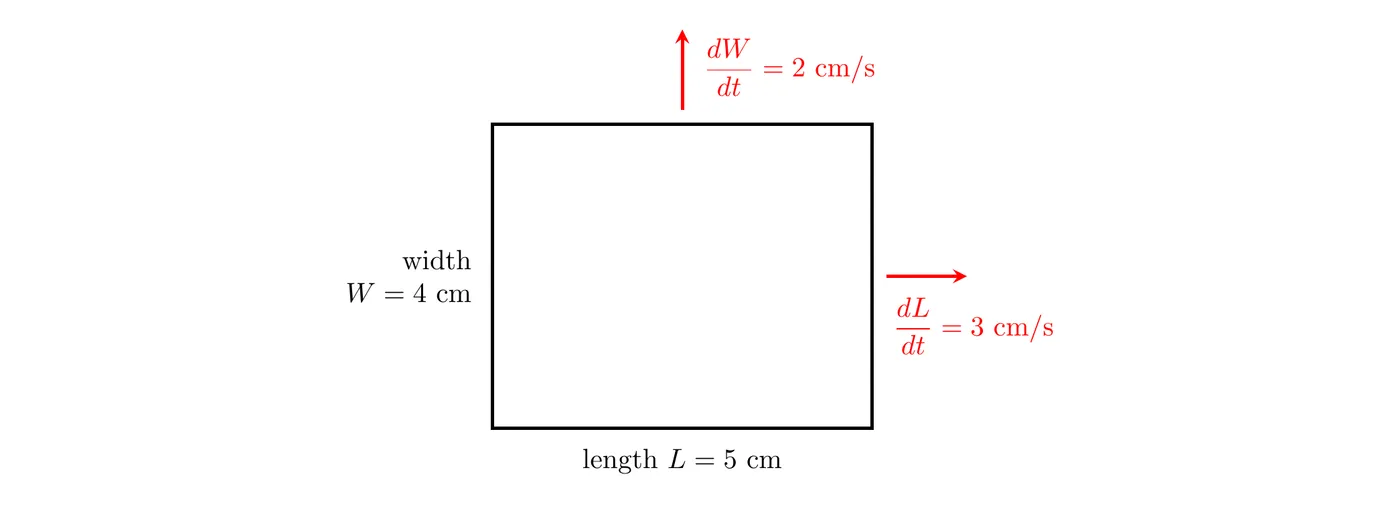
Problem: The width of a rectangle is increasing at 2 cm/s and the length is increasing at 3 cm/s. At what rate is the area increasing when the width is 4 cm and the length is 5 cm?
Step 1: Draw and Label
Step 2: Make a List
Known rates:
- cm/s, the width is increasing
- cm/s, the length is increasing
Unknown rate:
- ← FIND THIS
Known quantities:
- cm
- cm
Step 3: Relate the Variables
Area of a rectangle:
Step 4: Differentiate with Respect to Time
⚠️ Product rule required, since we have two variables multiplied together.
Common mistake: writing is wrong. You have to use the product rule properly.
Step 5: Substitute and Solve
Units: area is in cm² and time is in seconds, so:
Interpretation: the area is increasing at 22 square centimeters per second.
Common unit mistake: writing “22 cm/s²” is wrong, since that would be acceleration. The correct units are cm²/s, which is area per time.
Example 2: Police Chase Continued
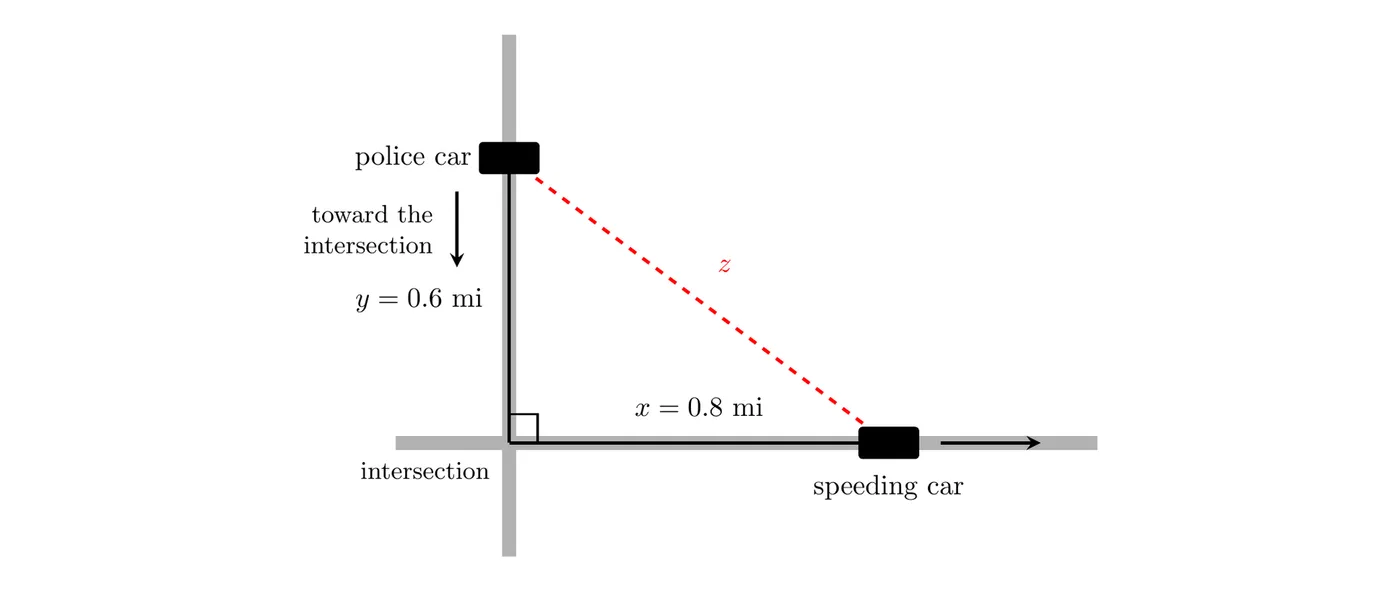
Problem: A police car is 0.6 miles north of an intersection, traveling toward it at 60 mph. A speeding car is 0.8 miles east of the intersection. At that instant, radar shows the distance between the cars is increasing at 20 mph. How fast is the speeding car traveling?
Step 1: Draw and Label
Step 2: Make a List
Known quantities:
- miles, the police car’s distance
- miles, the speeding car’s distance
- , we need to find this
Known rates:
- mph, negative because it’s moving toward the intersection
- mph, the distance between the cars is increasing
Unknown rate:
- ← FIND THIS, the speeding car’s speed
Step 3: Relate the Variables
Pythagorean theorem:
Step 4: Differentiate with Respect to Time
Step 5: Substitute and Solve
First, find the missing value :
Now substitute everything:
Interpretation: the speeding car is going 70 miles per hour at that moment.
Example 3: Inflating Balloon
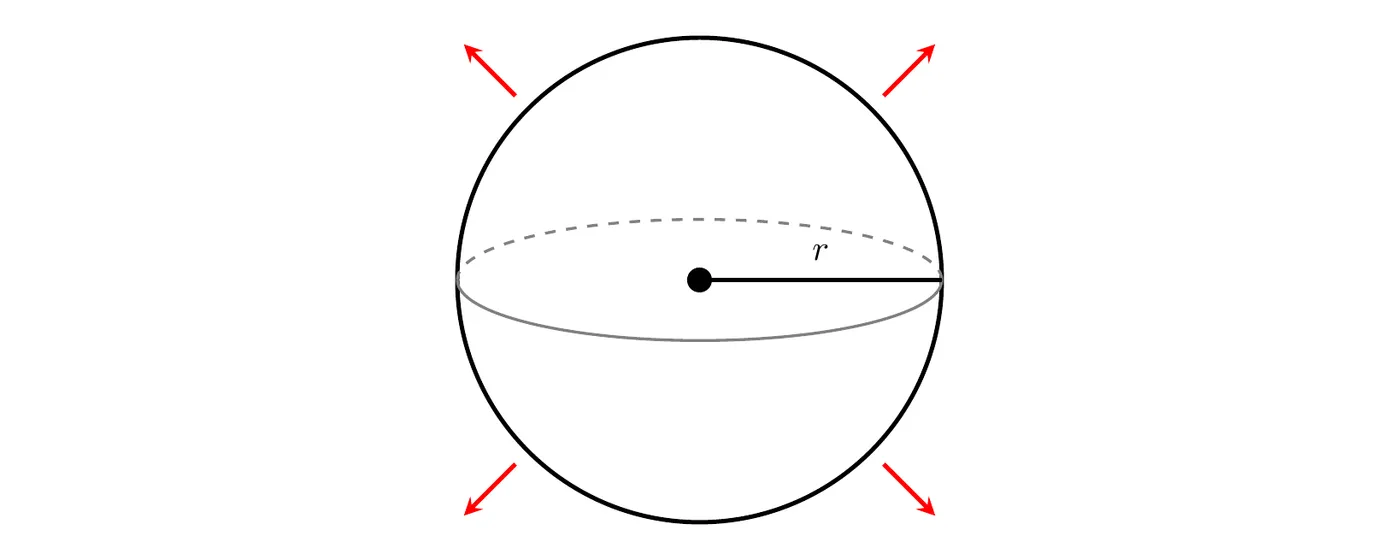
Problem: A spherical balloon is being inflated. When the radius is 6 cm, the radius is increasing at 0.5 cm/s. How fast is the volume increasing at that moment?
Step 1: Draw and Label
Step 2: Make a List
Known quantities: cm
Known rates: cm/s
Unknown rate: ← FIND THIS
Step 3: Relate the Variables
Volume of a sphere:
Step 4: Differentiate with Respect to Time
Step 5: Substitute and Solve
Interpretation: the volume is increasing at about 226.2 cubic centimeters per second at that moment.
Example 4: Draining Cone
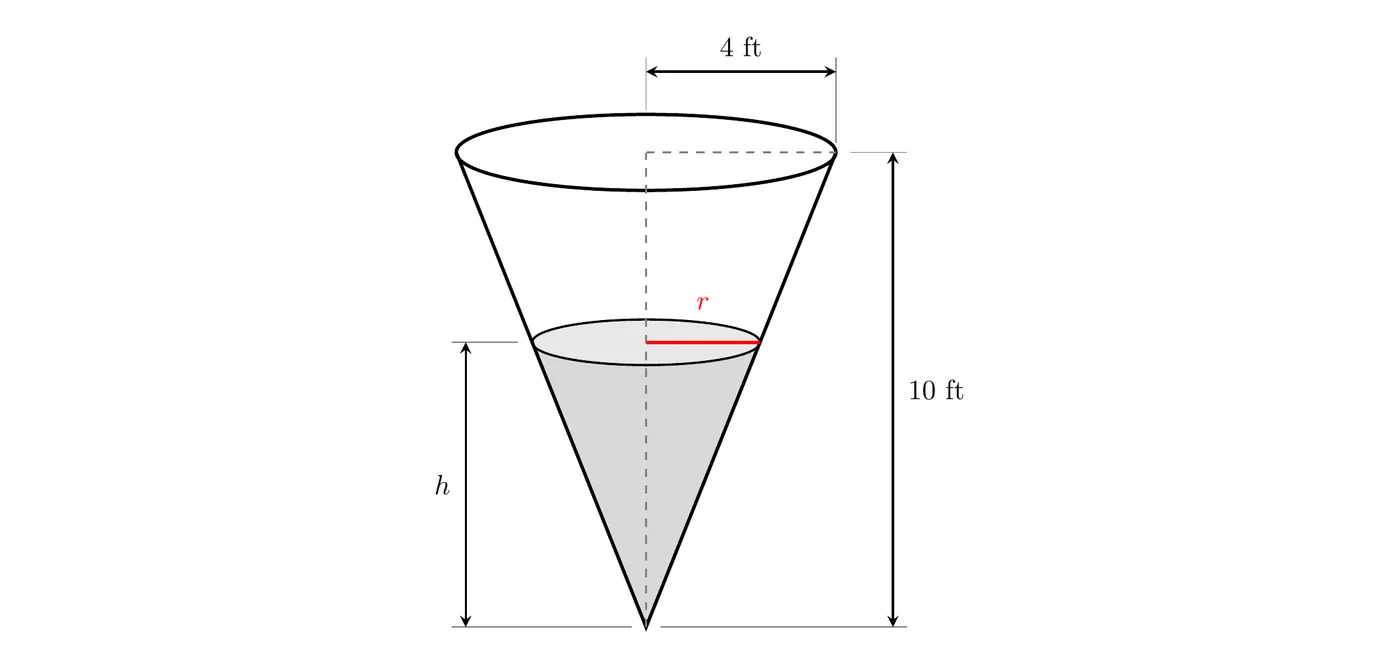
Problem: Water is draining from a conical tank at a rate of 5 ft³/min. The cone has a height of 10 ft and a radius of 4 ft. How fast is the water level dropping when the water is 6 ft deep?
Note: this one needs similar triangles to relate and .
Step 1: Draw and Label
Step 2: Make a List
Known quantities:
- Tank dimensions: height = 10 ft, radius = 4 ft, both constants
- ft, the current water depth
Known rates:
- ft³/min, negative because it’s draining
Unknown rate:
- ← FIND THIS
Step 3: Relate the Variables
Volume of a cone:
Problem: we have two variables, and , but only one rate in the problem.
Solution: use similar triangles to get rid of one variable. From the tank dimensions, the ratio stays constant:
Substitute into the volume formula:
Step 4: Differentiate with Respect to Time
Step 5: Substitute and Solve
The water level is dropping at about 0.276 feet per minute, and the negative sign confirms it’s decreasing.
Example 5: Drone Continued
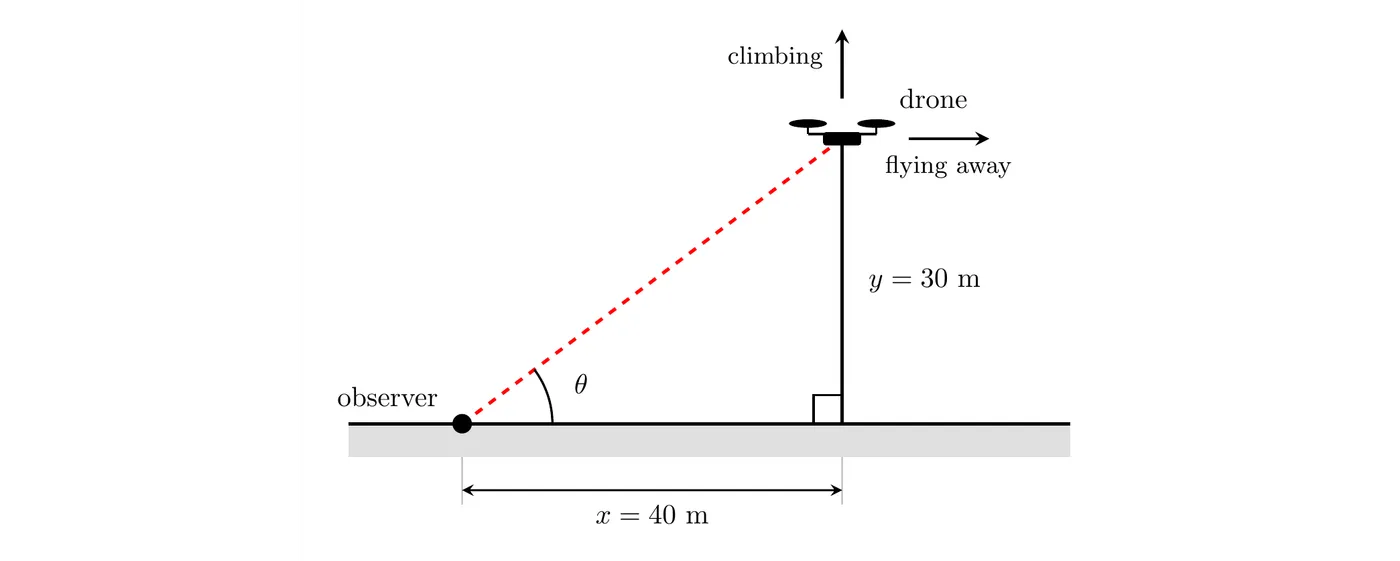
Problem: An observer on the ground is watching a drone. At the moment the drone is 40 m away horizontally and 30 m above the ground, it is flying away from the observer at 5 m/s and climbing at 2 m/s. At what rate is the angle of elevation from the observer to the drone changing at that moment?
Step 1: Draw and Label
Step 2: Make a List
Known quantities:
- m, the horizontal distance
- m, the height of the drone
Known rates:
- m/s, positive because the drone is moving away
- m/s, positive because the drone is climbing
Unknown rate:
- ← FIND THIS
Step 3: Relate the Variables
The side opposite is and the side adjacent to is :
Step 4: Differentiate with Respect to Time
⚠️ Quotient rule required, since and are both changing. The left side needs the chain rule because changes with time.
Step 5: Substitute and Solve
First, find the missing value :
The line of sight is the hypotenuse:
Now substitute everything:
Interpretation: the angle of elevation is decreasing at 0.028 radians per second at that moment. The drone is climbing, but it’s also moving away, and right now that makes (which is ) smaller. So the observer has to look a little lower, and the negative sign tells you the angle is decreasing.
Common Mistakes to Avoid
- ❌ Forgetting the product rule. differentiates to , not
- ❌ Substituting variables before differentiating. Only substitute constants before taking
- ❌ Wrong sign on rates. If a distance is decreasing, its rate should be negative
- ❌ Incorrect units. For area rates, use units like cm²/s, not cm/s², since that’s acceleration
- ❌ Forgetting to find missing values. If you need a quantity that isn’t given, use the original equation to find it
- ❌ Not using the original equation. When you’re missing a quantity like or , go back to the original relationship
- ❌ Mixing up what you’re solving for. Always circle or clearly mark the unknown you’re finding
- ❌ Using degrees for angles. Rates of change of angles come out in radians per unit of time, so keep your calculator in radian mode
Strategy Summary
- Read carefully. Identify what’s given and what you’re finding
- Draw and label. A visual keeps you from getting confused
- List everything. Known and unknown quantities and rates
- Write the relationship. Geometry, physics, or other formulas
- Differentiate correctly. Chain rule, product rule, quotient rule as needed
- Find missing values. Use the original equation if you need to
- Substitute after differentiation. Plug in all the known values
- Solve for the unknown. Algebra to isolate the rate you want
- Check units. Make sure they make sense for the context
- Interpret. State the answer in context
Key Takeaways
- Five-step process: draw, list, relate, differentiate, substitute and solve
- Make a list: write down all the known and unknown rates and quantities, and circle what you’re finding
- Constants only: substitute constants before differentiating, and variables after
- Product rule matters. Don’t forget it when variables are multiplied
- Find missing values using the original equation
- Sign conventions: negative rates mean decreasing, positive mean increasing
- Units matter. Area rates are (length)²/time, not length/time²
- Similar triangles help. Use proportions to eliminate extra variables
- Angles: relate them with right triangle trig (like ), and give angle rates in radians
- Work systematically. Follow the steps in order to avoid mistakes
- Practice makes perfect. The more problems you do, the more patterns you’ll recognize