

4.4 - Introduction to Related Rates
What Are Related Rates?
Related rates problems involve multiple quantities that are changing over time, where the rates of change are connected through a relationship between the variables.
The Core Concept
When variables have a relationship, like through an equation, their rates of change are also related to each other.
Example: Consider a right triangle where the base is getting longer, the height stays the same, and so the hypotenuse has to be changing too.
The rate at which the base changes and the rate at which the hypotenuse changes are related rates. They’re different rates, but they’re connected through the Pythagorean theorem.
From Variable Relationships to Rate Relationships
Step 1: The Variable Relationship
A lot of variables have familiar relationships. Take the Pythagorean theorem:
That relates the sides of a right triangle.
Step 2: The Rate Relationship
When those variables change with respect to time, we take the derivative with respect to time :
Applying the chain rule, which is basically implicit differentiation:
Interpretation:
- is the rate of change of side
- is the rate of change of side
- is the rate of change of the hypotenuse
These rates are related through this equation.
Why the chain rule? Each side is really a function of time, like . So is a composite function, and the chain rule gives : the derivative of the outside times the derivative of the inside. That’s why every changing variable picks up its own rate, and why all of them have to be differentiated with respect to the same variable, .
Connection to Implicit Differentiation
Related rates problems use the same technique as implicit differentiation, with one key difference.
Implicit differentiation: differentiate with respect to , and include terms.
Related rates: differentiate with respect to (time), and include , , and so on.
Common pattern: almost every related rates problem involves derivatives with respect to time.
The Related Rates Process (Setup Phase)
This lesson is about setting up related rates problems. Solving them comes in the next lesson.
The Three-Step Setup
Step 1: Draw and label a diagram. Sketch the situation and assign variables to the changing quantities.
Step 2: Write an equation relating the variables. Use geometry formulas, physics principles, or whatever relationship applies.
Step 3: Differentiate with respect to time. Apply to both sides, using the chain rule for each variable.
Example 1: Police Chase
Scenario: A police car is driving toward an intersection. A speeding car is driving away from the intersection at a perpendicular angle.
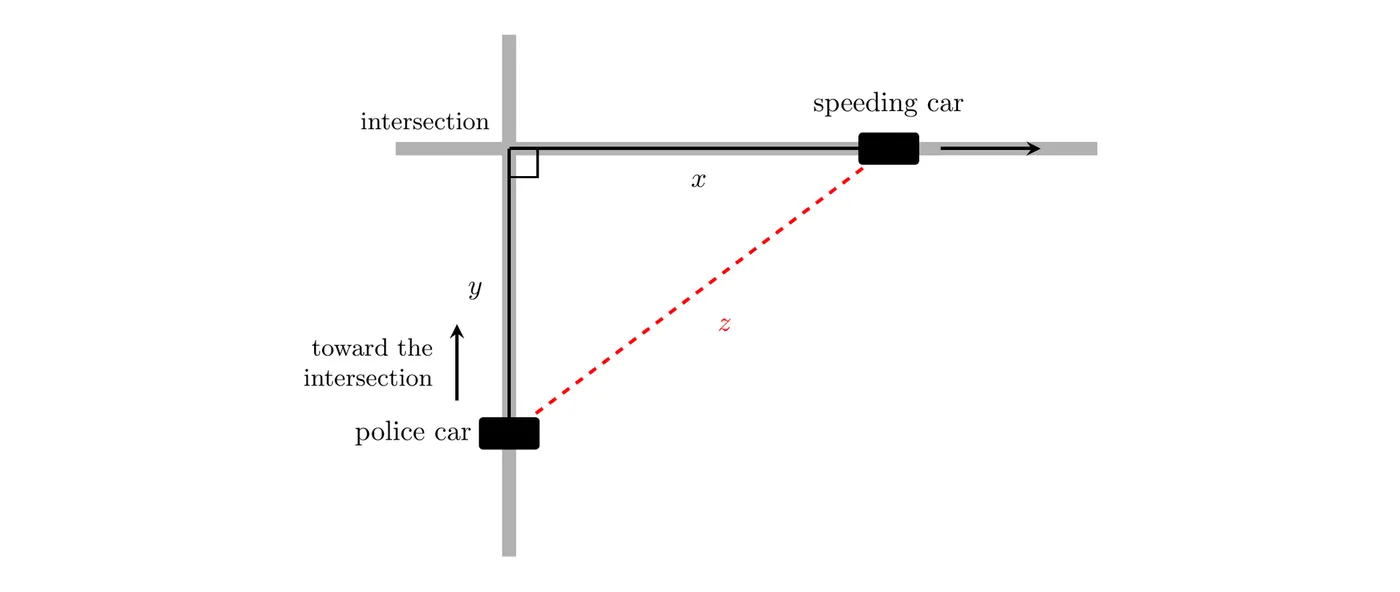
Step 1: Assign variables
- = horizontal distance of the speeding car from the intersection
- = vertical distance of the police car from the intersection
- = straight-line distance between the two cars
Step 2: Relate the variables
By the Pythagorean theorem:
Step 3: Differentiate with respect to time
Interpretation of the rates:
- = speed of the speeding car, positive since it’s moving away from the intersection
- = speed of the police car, negative since it’s moving toward the intersection
- = the rate at which the distance between the cars is changing
If , they’re getting farther apart. If , they’re getting closer.
Example 2: Airplane and Observer
Scenario: An airplane flies horizontally at constant altitude toward a point directly above an observer on the ground.
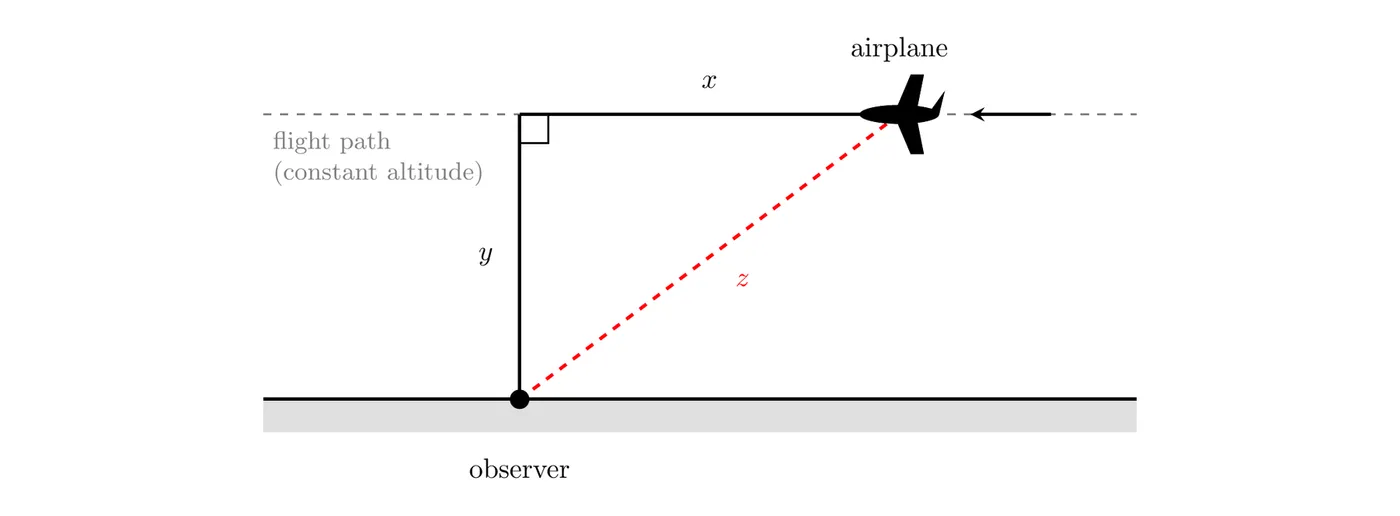
Step 1: Assign variables
- = horizontal distance of the airplane from the point directly above the observer
- = altitude of the airplane
- = line-of-sight distance from the observer to the airplane
Step 2: Relate the variables
Step 3: Differentiate with respect to time
Key insight: constant altitude
The problem says the airplane maintains constant altitude, which means doesn’t change:
That simplifies the equation to:
Or, dividing by 2:
Interpretation:
- = speed of the airplane, its horizontal velocity
- , since the altitude is constant
- = the rate at which the line-of-sight distance is changing
Recognizing Constants vs. Variables
Critical skill: figure out which quantities are changing and which are constant.
If a quantity is constant
Example phrases:
- “The ladder is 10 feet long” → the ladder length is constant
- “The balloon maintains altitude” → the height is constant
- “Water flows at a constant rate” → the flow rate is constant, but the volume is still changing
If a quantity is changing
Include its derivative when you differentiate.
Common changing quantities:
- Distances as objects move
- Volumes as containers fill or empty
- Angles as objects rotate
- Areas as shapes expand or contract
Practice Setup: Expanding Circle
Scenario: A circular oil spill is expanding outward, so the radius is increasing.
Step 1: Assign variables
- = radius of the oil spill
- = area of the oil spill
Step 2: Relate the variables
The area of a circle:
Step 3: Differentiate with respect to time
Interpretation:
- = the rate at which the radius is increasing, usually given in the problem
- = the rate at which the area is increasing, often what you’re solving for
Practice Setup: Sliding Ladder
Scenario: A 15-foot ladder leans against a wall, and the bottom slides away from the wall.
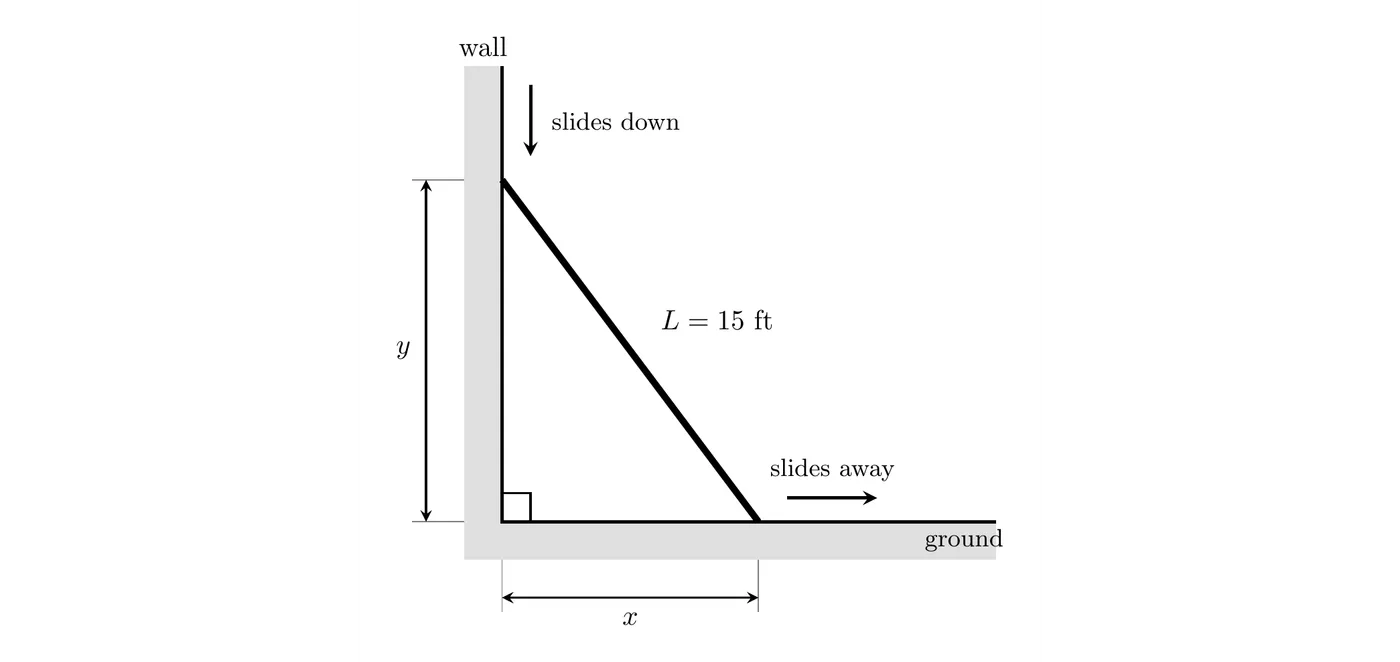
Step 1: Assign variables
- = horizontal distance from the wall to the bottom of the ladder
- = vertical distance from the ground to the top of the ladder
- = length of the ladder, which is constant
Step 2: Relate the variables
Step 3: Differentiate with respect to time
Notice the right side is 0, because is constant. Simplified:
Interpretation:
- = rate the bottom of the ladder moves away from the wall, which is positive
- = rate the top of the ladder slides down the wall, which is negative
Practice Setup: Rolling Clay (Product Rule)
When two changing quantities are multiplied in your equation, you need the product rule along with the chain rule.
Scenario: A cylinder of clay is rolled on a table so it gets longer and thinner. No clay is added or removed, so the volume stays the same.
Step 1: Assign variables
- = radius of the cylinder
- = length (height) of the cylinder
- = volume of the clay, which is constant
Step 2: Relate the variables
Volume of a cylinder:
Step 3: Differentiate with respect to time
Both and change, and they’re multiplied together, so use the product rule (plus the chain rule on ):
The volume is constant, so . Dividing both sides by :
Interpretation:
- = rate the radius changes, which is negative since the clay gets thinner
- = rate the length changes, which is positive since the clay gets longer
Practice Setup: Drone and Angle of Elevation (Quotient Rule)
When one changing quantity is divided by another, you need the quotient rule along with the chain rule. This one also has a changing angle.
Scenario: An observer on the ground watches a drone that is flying away and climbing at the same time, so the angle of elevation from the observer to the drone is changing.
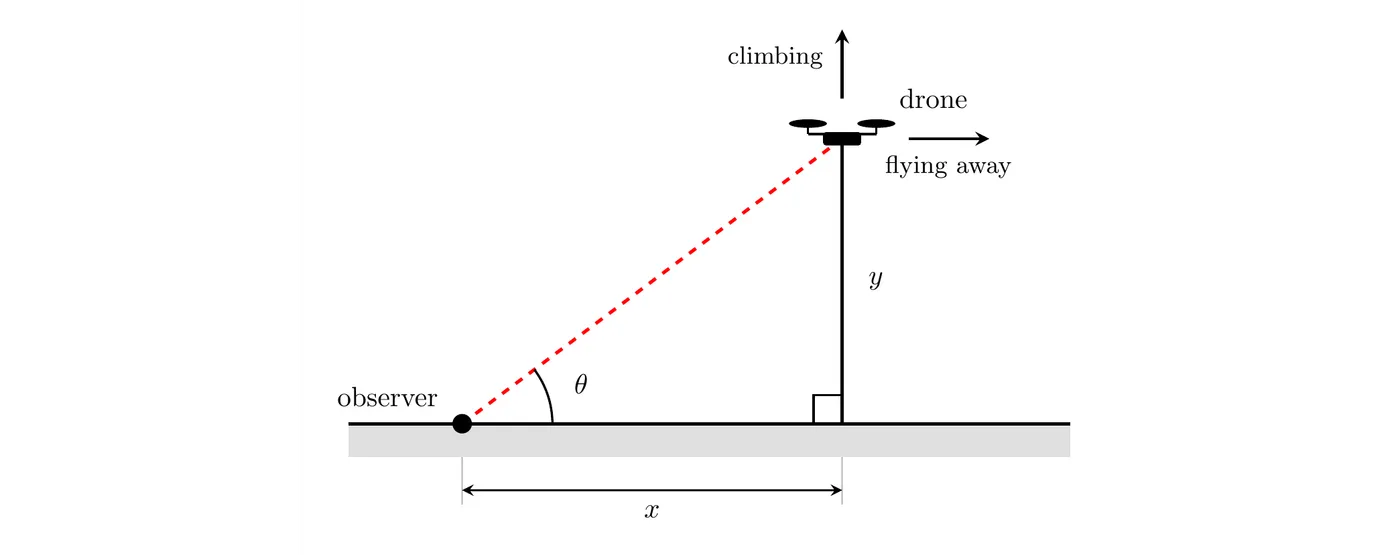
Step 1: Assign variables
- = horizontal distance from the observer to the point on the ground directly below the drone
- = height of the drone
- = angle of elevation from the observer to the drone
Step 2: Relate the variables
Use right triangle trig. The side opposite is , and the side adjacent to is :
Step 3: Differentiate with respect to time
The left side needs the chain rule, since changes with time. The right side is one changing variable divided by another, so it needs the quotient rule:
Interpretation:
- = rate the drone moves away horizontally, positive since it’s moving away
- = rate the drone climbs, positive since it’s rising
- = rate the angle of elevation changes, in radians per unit of time
Note: angles in calculus are measured in radians. The rule only works in radians.
Common Geometric Relationships
Keep these handy when setting up related rates problems.
Right triangle:
Circle:
Sphere:
Cylinder:
Cone:
Rectangular box:
Similar triangles:
Right triangle trig (for angles):
What’s Next?
This lesson covered setting up related rates problems:
- Drawing diagrams
- Relating variables with equations
- Differentiating with respect to time
The next lesson covers solving them by plugging in values and finding unknown rates.
Key Takeaways
- Related rates: rates of change of different quantities that are connected through a relationship
- Almost always with respect to time: differentiate using
- Similar to implicit differentiation: use the chain rule for each variable when differentiating
- Product and quotient rules: when changing variables are multiplied or divided, use them along with the chain rule
- Setup process: (1) draw and label, (2) write an equation relating the variables, (3) differentiate both sides with respect to time
- Constants have zero derivative. If a quantity doesn’t change,
- Sign matters. Positive rate means increasing, negative rate means decreasing
- Common relationships: Pythagorean theorem, area formulas, volume formulas, similar triangles
- Next step: after setup, plug in known values to solve for unknown rates