

6.3 - Fuel Types and Uses
Learning Objectives
Identify the different types of fuel sources and their major uses. The skill is describing an environmental concept or process.
I. Subsistence Fuels (Biomass)
- Definition: Biomass fuels that are easily available, found, and gathered. They are used primarily for heating a home or cooking.
- Wood and charcoal: The two most common subsistence fuels globally, easily accessible and often free or very cheap.
- Charcoal formation: Charcoal is made from wood by burning or heating it for a long time under low oxygen conditions. It is light and easy to transport.
- Peat: Partially decomposed organic matter (mostly dead moss and other plants) that builds up in waterlogged, acidic wetlands like bogs, marshes, and moors. The water keeps oxygen out, which slows decomposers, so dead plants pile up faster than they rot and get compressed into peat. Peat is soaking wet in the bog, so it is cut into bricks and dried before it is burned. Ireland and Finland have long burned peat for heat and electricity, though both are now cutting back. Peat is also the first stage of coal formation.
II. Coal Formation and Use
- Formation: Coal formation starts with peat being compressed by overlying rock layers and sediments over long periods. The heat and pressure squeeze out excess water and air, leaving behind hydrocarbons.
- Energy density: The longer a coal deposit is pressurized and the deeper it is buried, the more energy dense it becomes.
- Coal types (least to most dense): Lignite (least dense), Bituminous, and Anthracite (most dense).
- Value: Anthracite is the most valuable coal because it releases far more energy per unit when burned. It is also cleaner with fewer impurities, since the compression process squeezed them out.
Coal type | Carbon content | Energy content | U.S. example |
Lignite | 25% to 35% | Lowest (lots of moisture) | About 8% of U.S. coal, mostly from North Dakota and Texas. Usually burned in power plants right next to the mine. |
Subbituminous | 35% to 45% | Low to medium | About 46% of U.S. coal, mostly from Wyoming. Used for electricity. |
Bituminous | 45% to 86% | High | About 46% of U.S. coal, mostly from West Virginia, Illinois, Pennsylvania, and Kentucky. Used for electricity and to make coke for steel. |
Anthracite | 86% to 97% | Highest | Less than 1% of U.S. coal, all from northeastern Pennsylvania. Used mostly by the metals industry. |
Source: U.S. Energy Information Administration (production shares for 2022). Subbituminous coal sits between lignite and bituminous; the CED names only the other three.
- Major use: The energy released from burning coal is mostly used to heat water into steam, which turns a turbine and generates electricity. The number one use of coal globally is electricity production.
III. Natural Gas
- Formation: Natural gas forms from the decaying remains of mostly marine organisms (tiny plankton) trapped under rock layers and compressed over millions of years.
- Composition and location: Natural gas is mostly methane () and is found sitting on top of trapped oil deposits. It gets trapped when an oil deposit sits in porous sedimentary rock like sandstone and is sealed by a hard, impermeable cap rock.
- Environmental benefits compared to coal and oil: Natural gas is considered the cleanest fossil fuel because it releases the fewest air pollutants when burned.
- It produces about half as much as coal, so it warms the atmosphere far less.
- It releases virtually no particulate matter (soot or ash), which matters for human respiratory health since particulates worsen asthma and bronchitis.
- It contains almost no sulfur, so burning it releases very little sulfur dioxide, and it makes less nitrogen oxides than coal. Sulfur dioxide and nitrogen oxides are the key pollutants behind acid rain.
- It releases no mercury.
IV. Crude Oil (Petroleum) and End Products
- Formation and extraction: Crude oil, also called petroleum, is the fossilized, decaying remains of marine organic matter compressed over millions of years. It is extracted by drilling through the impermeable rock layer to pump oil out of the permeable layer below.
- Tar sands extraction (high environmental cost): As other reserves run low, oil is increasingly pulled from tar sands.
- Tar sands are a mixture of sand, clay, water, and bitumen, a thick, sticky, semi-solid petroleum.
- Extraction is energy and water intensive. Water has to be turned into steam and piped into the ground to melt the bitumen into a free-flowing liquid, and much more water is needed at the refinery to separate out impurities.
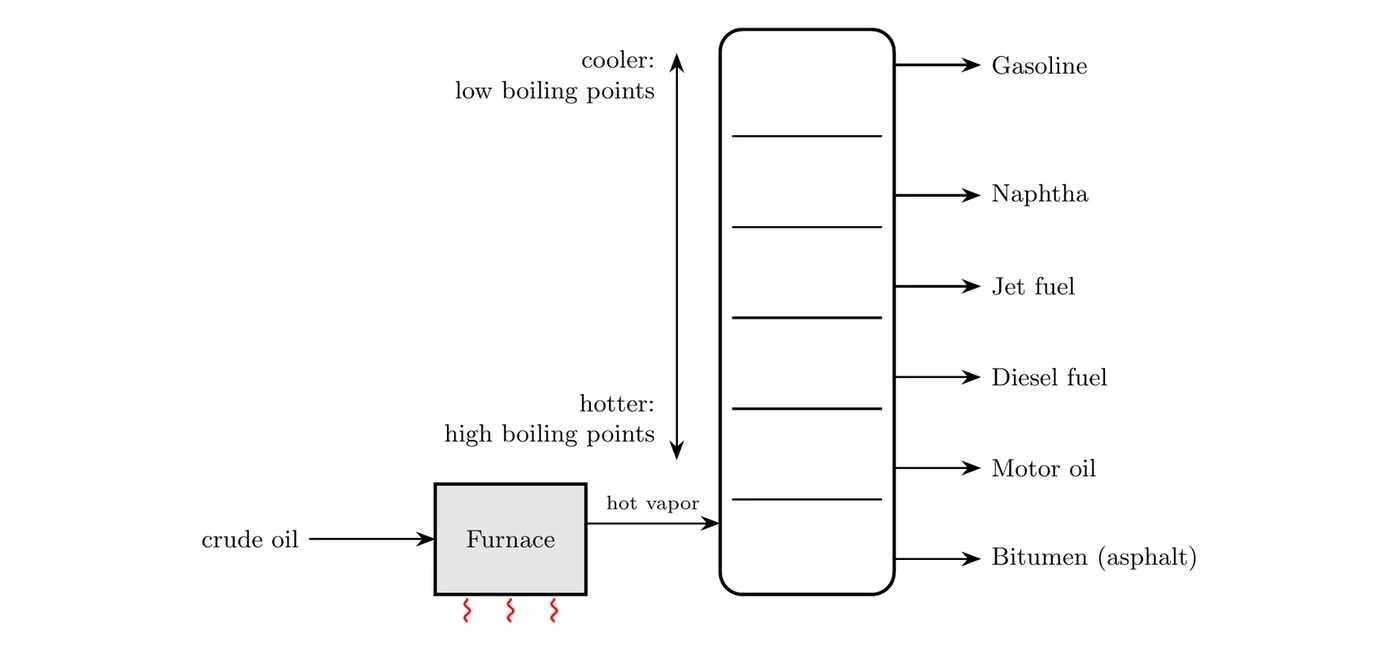
- Fractional distillation (refining): Crude oil gets converted into many different products through fractional distillation.
- Petroleum is heated into a vapor in a furnace and passed into a column. Different hydrocarbons separate out based on their distinct boiling points.
- Hydrocarbons with a high boiling point settle at the bottom (bitumen, used for asphalt), while those with low boiling points rise to the top (gasoline).
- Major end products: Gasoline, jet fuel, diesel fuel, motor oil, and naphtha, which is used to make plastics. Almost all plastics are made from fossil fuels: naphtha from crude oil, or ethane and propane separated out of natural gas.
- Specialized fuels for specialized uses: gasoline lights easily, so it runs car engines; diesel packs more energy per gallon, so it powers trucks, trains, tractors, and ships; jet fuel (a kind of kerosene) stays liquid in the cold at high altitude; and propane, a gas that turns liquid under pressure, is used for grills and rural home heating.
V. Cogeneration
- Cogeneration (combined heat and power, or CHP): Using one fuel source to make both electricity and useful heat. A normal power plant throws away most of its fuel's energy as waste heat. A cogeneration system captures that heat and uses it to warm buildings, heat water, or run factory processes.
- Example: Many college campuses, hospitals, and factories run their own natural gas CHP plants. One fuel input provides the electricity plus the steam or hot water for heating, so the total efficiency reaches about 65% to 80%, instead of about 50% to 55% when electricity and heat are made separately (EPA). More detail is in 6.5.
Big picture: Global energy sources run from easily gathered subsistence fuels like wood and peat up to highly compressed fossil fuels formed from ancient biomass. Coal, categorized by energy density from lignite up to the superior anthracite, is the leading source of electricity generation. Natural gas (methane) is the cleanest fossil fuel thanks to its minimal release of , particulate matter, and mercury compared to coal. Refining crude oil yields everything from gasoline to plastics, though its extraction, especially from tar sands, is heavily water and energy intensive.