

6.5 - Fossil Fuels
Learning Objectives
Describe the uses and methods of energy production from fossil fuels, and describe the environmental impacts fossil fuels have. The skill is describing an environmental problem related to fossil fuels.
I. Fossil Fuel Combustion Reaction
- Reaction components: Fossil fuels are hydrocarbons, molecules made of carbon and hydrogen. Combustion is a reaction between these hydrocarbons and oxygen.
- Products: The reaction releases a lot of energy as heat (the valuable part) and produces carbon dioxide and water as byproducts.
For example, burning methane (natural gas):
- formation: The carbon in the hydrocarbons combines with oxygen in the air, which creates the that gets released.
- Universal process: This works the same way for any fossil fuel, whether it is gasoline, methane (), butane, propane, or coal. Even biomass fuels like wood work similarly.
- Carbon cycle step: Fossil fuel combustion is a key step in the carbon cycle.
II. Electricity Generation from Fossil Fuels
- Dominant sources: Globally, coal is still the single largest source of electricity (about 33% in 2025), followed by natural gas (about 22%). In the U.S., natural gas has been the top source since 2016.
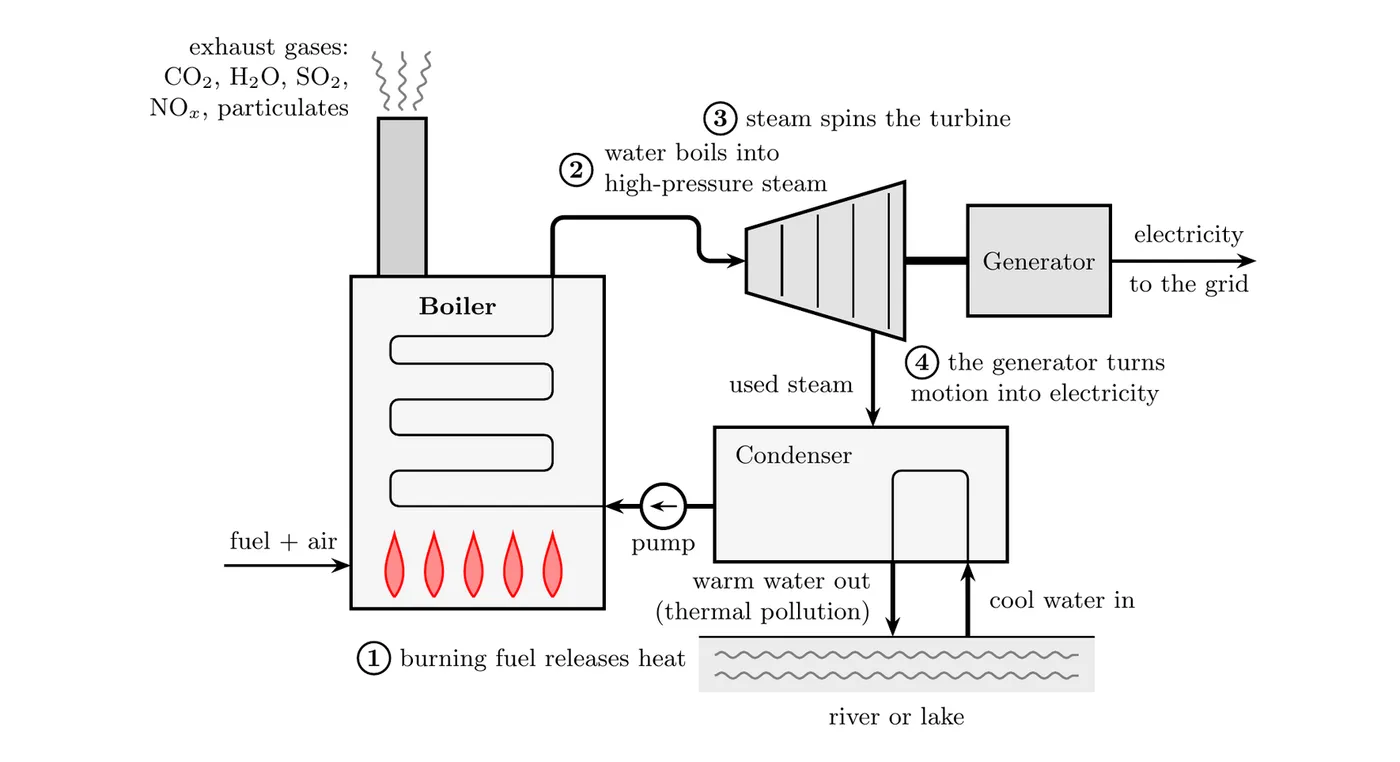
- Consistent steps: Electricity generation from fossil fuels always follows the same sequence, no matter which fuel gets burned:
- Heat generation: Heat comes from burning the fuel, for example coal burned in a boiler.
- Steam production: The heat turns water into highly pressurized steam.
- Turbine spin: The steam gets forced through a pipe to turn a turbine, a device with blades similar to a jet engine.
- Electricity production: The kinetic motion of the turbine powers a generator, which uses spinning magnets to produce an electrical current.
III. Efficiency and Cogeneration
- Efficiency rates:
- Coal plants turn only about 32% of the fuel's energy into electricity (U.S. average in 2024).
- Natural gas plants average about 44% in the U.S. The newest combined-cycle plants reach about 60%, because they send the hot exhaust from a gas turbine through a second, steam-driven turbine.
- How it's measured: efficiency = useful energy out ÷ energy in × 100. U.S. power plants report a heat rate, the BTUs of fuel burned to make 1 kWh. Since 1 kWh = 3,412 BTU, the average U.S. coal plant in 2024 had a heat rate of about 10,780 BTU/kWh, so it was 3,412 ÷ 10,780 ≈ 32% efficient (EIA).
- Lost energy: Most of the energy that does not become electricity escapes as heat. This loss, much like the trophic pyramid, happens when energy is converted from chemical energy in hydrocarbon bonds into electricity.
- Cogeneration (Combined Heat and Power, or CHP): A system designed to limit that heat loss.
- The heat generated while producing electricity is captured and used to heat a building or heat the building’s water.
- CHP systems typically reach 65% to 80% total efficiency, and some approach 90% (EPA). Making electricity at a power plant and heat with a separate boiler or furnace is only about 50% to 55% efficient overall.
IV. Environmental Consequences of Coal Use
- Habitat destruction: Clearing land to mine coal removes forest ecosystems and destroys habitat.
- Air pollution and climate change: Burning coal releases both air pollutants (chemicals that lower air quality and harm health) and carbon dioxide (a greenhouse gas driving global warming).
- Carbon dioxide (): Coal releases the most per unit of energy of any fossil fuel: about 206 pounds per million BTU for bituminous coal, compared with about 157 for gasoline and 117 for natural gas (EIA).
- Air pollutants: Includes NOx, SOx, and VOCs, plus particulate matter (soot or ash) which irritates the respiratory systems of humans and animals.
- SOx and NOx: Sulfur and nitrogen oxides are respiratory irritants and drive acid rain.
- Toxic ash: Coal combustion produces toxic ash containing lead, mercury, and arsenic.
- This ash usually goes to landfills or gets stored in ash ponds.
- If the ash leaks, it contaminates surrounding soil, groundwater, and surface water. Lead and arsenic can cause poisoning or cancer, and mercury is a neurotoxin.
V. Environmental Consequences of Petroleum Extraction
- Spills: Spills can come from tankers transporting petroleum or from pipelines running across land.
- Ocean spills: Cover the water surface, blocking sun (which decreases photosynthesis), clogging fish gills, suffocating organisms, and sticking to bird feathers.
- Land spills: The hydrocarbons in petroleum are toxic to plant roots and to soil microbes like decomposers and nitrogen-fixing bacteria.
- Habitat destruction and fragmentation: Roads built to access drilling sites, transport oil, or lay pipelines cause habitat destruction and fragmentation. Fragmentation breaks apart forest ecosystems and cuts populations off from one another.
VI. Environmental Consequences of Tar Sands Extraction
- Habitat destruction and fragmentation: Clearing land for roads, digging equipment, and the extraction site destroys and fragments habitat, for example cutting apart sections of boreal forest.
- Water depletion: Getting petroleum out of bitumen requires a huge amount of water for generating steam and for the washing process, which depletes nearby ground and surface waters.
- Water contamination: Used water gets stored in tailing ponds. These ponds hold water mixed with leftover bitumen and can overflow or leach into groundwater.
- The water is contaminated with toxic chemicals like benzene (a carcinogen), salt, acid, and leftover hydrocarbons.
- release: The mining process and the machinery release carbon dioxide.
VII. Environmental Consequences of Fracking
- Method: Fracking extracts natural gas (and oil) from tight sedimentary rock like shale. A vertical well is drilled down and then turned horizontal through the shale. Fracking fluid, roughly 90% water, 8% to 9% sand, and 0.5% to 2% chemicals (acids, friction reducers, and biocides), is pumped in at very high pressure to crack the rock. The sand props the cracks open so the gas can flow out. The fluid that flows back up also picks up salty brine from deep underground.
- Methane release: Fracking is natural gas extraction, so methane leaks from wells, pipes, and equipment. Methane is a potent greenhouse gas: over 20 years it traps about 80 times as much heat as the same mass of , and about 30 times over 100 years (IPCC, 2021).
- Water contamination: The well itself can leak, releasing contaminated fracking fluid (salt, detergent, acids, hydrocarbons) into groundwater.
- Ponds used to temporarily store the fluid can overflow from rain and leak into surrounding groundwater or surface water. Those contaminants are toxic to plants and animals that depend on those water sources.
- Real example: In Dimock, Pennsylvania, faulty gas wells let methane leak into residents' drinking water wells. In 2022 the driller (Coterra Energy, formerly Cabot Oil & Gas) pleaded no contest to a state water pollution charge and agreed to pay about $16.3 million to build a public water line.
- Release of volatile organic compounds (VOCs): VOCs are carbon-based chemicals that evaporate easily, like benzene, toluene, and xylene. They escape from wells, storage tanks, and pits or ponds of flowback water at fracking sites.
- Some VOCs, like benzene, cause cancer, and they irritate the eyes and lungs of people living nearby.
- In sunlight, VOCs react with nitrogen oxides to form ground-level ozone, the main ingredient of photochemical smog (7.2). Gas fields in rural western Wyoming have had winter ozone levels above the federal limit.
- Groundwater depletion: Fracking fluid is mostly water, and a single well needs tons of it. This can make local water sources run dry.
- Increased seismic activity: Recent studies suggest that injecting wastewater (used fracking fluid) into deep wells for storage can shift tectonic formations and lead to increased seismic activity, specifically earthquakes.
- Real example: Oklahoma went from about one or two magnitude 3+ earthquakes a year before 2009 to hundreds a year in the mid-2010s, as wastewater injection from oil and gas wells soared. The magnitude 5.8 Pawnee earthquake in 2016 is the largest in the state's recorded history. Earthquakes dropped after regulators limited injection.
VIII. How Fossil Fuels Are Extracted
- Coal: surface mining (strip mining and mountaintop removal) for seams near the surface, and subsurface (underground) mining for deep seams. The methods and their impacts are covered in 5.9.
- Conventional oil and gas: drill a well into porous rock sealed under a cap rock. Underground pressure pushes the oil or gas up, and pumps take over when the pressure drops. Wells are drilled on land and offshore from platforms. Offshore drilling risks huge spills: the 2010 Deepwater Horizon blowout in the Gulf of Mexico killed 11 workers and leaked oil for 87 days, the largest marine oil spill in U.S. history.
- Fracking: for natural gas and oil locked in shale (section VII).
- Tar sands (oil sands): shallow deposits are dug up in huge open-pit mines and washed with hot water to separate the bitumen. About 80% of Alberta's oil sands are too deep to mine, so steam is injected underground to melt the bitumen so it can be pumped up (called in situ extraction).
IX. Practice Calculation: Power Plant Efficiency
Question: A coal power plant makes kWh of electricity in a year and is 32% efficient. Coal contains about BTU per ton, and 1 kWh = 3,412 BTU. How many tons of coal does the plant burn in a year?
Step 1: Find the energy that has to come from the coal. Only 32% of the coal's energy becomes electricity, so divide by 0.32.
Step 2: Convert kWh to BTU.
Step 3: Convert BTU to tons of coal.
Answer: about 2.1 million tons of coal per year. The other 68% of the coal's energy is lost as waste heat, most of it carried away by cooling water (which is how power plants cause thermal pollution).
Big picture: Fossil fuel combustion, a universal chemical process across all hydrocarbon fuels, converts chemical energy into heat that drives electricity generation via steam-powered turbines, with coal leading globally. Natural gas is more efficient, but all fossil fuels release , and coal releases the most, along with toxic ash and the air pollutants that cause acid rain. On top of that, extraction methods like water-hungry tar sands mining and high-pressure fracking introduce their own hazards: massive water depletion, groundwater contamination with toxic chemicals like benzene and methane, and increased seismic activity.