

6.6 - Nuclear Power
Learning Objectives
Describe the use of nuclear energy as an electricity source and describe its environmental effects. The skill is explaining relationships between different characteristics of environmental processes in a visual setting.
I. Nuclear Fission and Radioactivity
- Nuclear fission: The process used to generate heat in a nuclear power plant.
- A neutron gets fired at the nucleus of a radioactive isotope, an element with an unstable nucleus like uranium or plutonium.
- The nucleus breaks apart, releasing tons of energy as heat.
- It also releases more neutrons, which hit more nuclei and keep the process going in a chain reaction that generates enormous amounts of energy.
- Radioactivity: The energy given off by the natural breakdown (decay) of the nucleus of unstable isotopes.
- Half-life: The time it takes for half of a sample of a radioactive element, like uranium or cobalt-60, to decay. You can use this to calculate how much of the isotope is left at any given point.
- Types of radiation: alpha particles (2 protons and 2 neutrons, stopped by paper or skin), beta particles (fast electrons, stopped by a thin sheet of aluminum), and gamma rays (high-energy electromagnetic waves, stopped only by thick lead or concrete). All three are ionizing radiation: they knock electrons off atoms and can damage DNA, which is why exposure raises cancer risk.
- Half-lives vary a lot: iodine-131 about 8 days, cesium-137 about 30 years, plutonium-239 about 24,000 years, and uranium-235 about 704 million years. Spent fuel holds a mix of isotopes, some with very long half-lives, which is why nuclear waste stays dangerous for so long.
II. Generating Electricity
The steps look a lot like fossil fuels, except uranium fission generates the heat instead of combustion.
- Heat generation: Nuclear fission inside the reactor core produces heat.
- Steam production: That heat turns water into highly pressurized steam.
- Turbine spin: The steam is forced past a turbine, making it spin.
- Electricity production: The turbine powers an electric generator that converts kinetic energy into electricity.
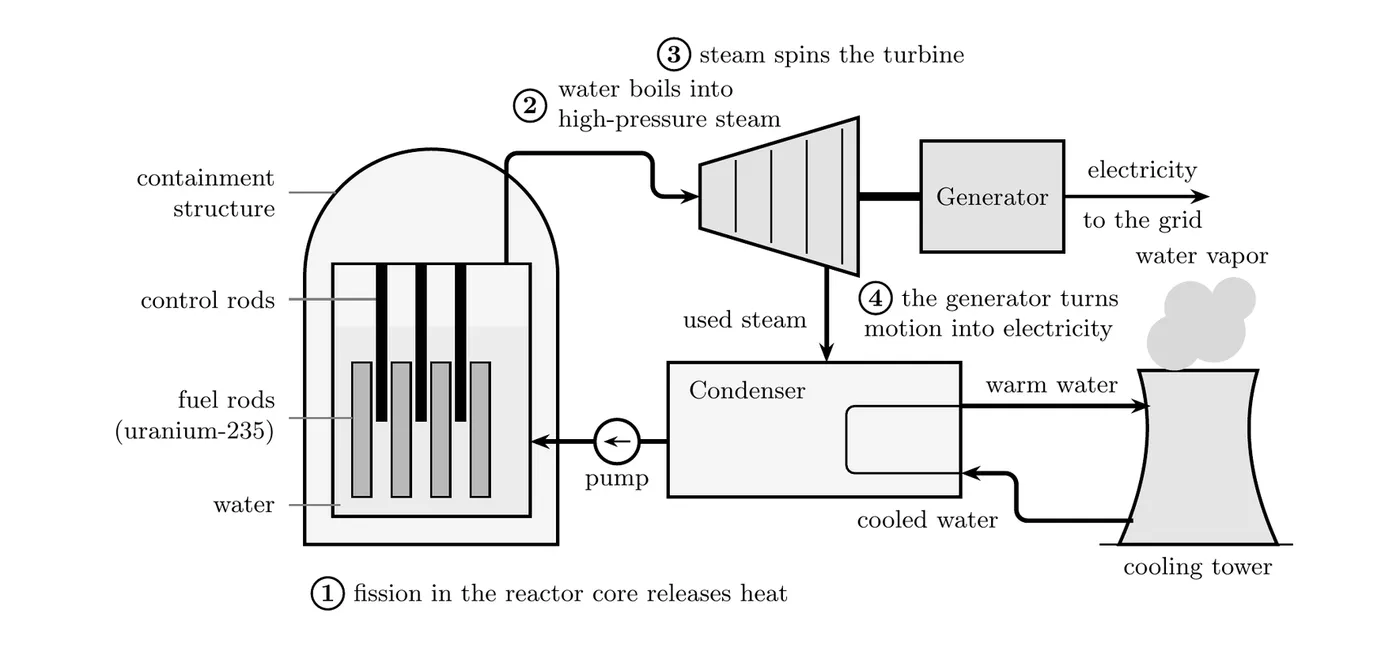
This diagram is simplified: the water boils right inside the reactor, as in a boiling-water reactor. Most U.S. reactors are pressurized-water reactors, where the reactor water stays under high pressure and heats a separate loop of water into steam. Either way, the energy path is the same: fission, heat, steam, turbine, generator.
- Fuel rods: Uranium-235 is the isotope that splits in most reactors. Natural uranium is only about 0.7% U-235 (almost all the rest is U-238, which doesn't split easily), so it is enriched to about 3% to 5% U-235, pressed into ceramic pellets, and stacked inside long metal fuel rods. Bundles of fuel rods sit in water in the reactor core, where fission takes place.
- Water use: After the steam spins the turbine, it is cooled back into liquid water in a condenser so it can be reused. The condenser is cooled with water from a river, lake, or ocean, or with water that cycles through a cooling tower. In a cooling tower some of that water evaporates (the white cloud is water vapor, not smoke), and the rest cycles back.
III. Safety Measures
Safety measures exist because of the highly radioactive materials and the enormous energy production.
- Control rods: These can be lowered into the core to absorb excess neutrons, which controls and slows the chain reaction.
- Cooling systems: Pumps keep cool water flowing through the core to carry heat away. Even after the control rods stop the chain reaction, the fuel keeps giving off heat from radioactive decay, so the water has to keep flowing for days. If cooling fails, the core can overheat and melt (this is what happened at Fukushima).
- Containment: The reactor sits inside a giant, usually concrete structure with super thick walls designed to contain any radioactivity that gets released.
IV. Environmental Benefits and Drawbacks
A. Benefits (Cleaner Than Fossil Fuels)
- Non-polluting at the point of generation: No air pollutants are released when the electricity is actually generated.
- Specifically, no particulate matter, no SOx, no NOx, no carbon dioxide, and no methane get released during the reaction.
- Only gas released is water vapor: Water vapor is a greenhouse gas, but it cycles quickly and its presence is temperature-dependent, which makes it less critical than or methane.
- Note that the initial mining and construction processes do release carbon dioxide.
B. Non-Renewable (Drawback)
Nuclear energy is non-renewable because the fuel source, radioactive elements like uranium or plutonium, exists in finite quantities and will eventually run out.
C. Other Environmental Risks
- Radioactive contamination: Radiation releases can cause genetic mutations and cancer in humans, animals, and plants. Widespread radiation can travel long distances on the wind, as it did at Chernobyl.
- Spent fuel rods: Used fuel rods stay dangerously radioactive for tens of thousands of years, and some isotopes in them stay radioactive for millions. They are first cooled for several years in deep pools of water at the plant, then sealed in steel and concrete dry casks stored on site. The U.S. picked Yucca Mountain, Nevada, as its permanent underground site in 1987, but the project was stopped around 2010, and as of 2026 the U.S. still has no permanent disposal site. In October 2026, Finland's government granted an operating license to Onkalo, the world's first permanent repository for spent fuel, dug about 400 to 450 meters down into ancient bedrock. Disposal starts once final testing is done.
- Radioactive mine tailings: Leftover rock and soil from mining still contains radioactive material and gets stored in tailing ponds. These pools risk flooding and releasing radiation into the environment.
- Water depletion and thermal pollution:
- Nuclear plants need lots of water for steam generation and for cooling the reactor.
- The extremely hot wastewater released into local water bodies causes thermal pollution.
- Thermal pollution causes thermal shock and lowers oxygen levels, since warm water holds less oxygen, which can lead to fish die-offs.
V. Nuclear Meltdowns
A meltdown happens when cooling fails and the fuel in the reactor core gets hot enough to melt. If radioactive material gets past the containment structure, it escapes into the environment. These are the three accidents to know, with their short- and long-term impacts.
- Three Mile Island (Pennsylvania, U.S., March 1979): A partial meltdown (about half the core melted). A relief valve stuck open and let cooling water escape, and operators misread their instruments and cut back the emergency cooling water.
- Impacts: The containment building held in almost all the radioactivity. Small amounts of radioactive gas escaped, and studies have found no clear health effects on nearby residents. The biggest effect was public fear: new reactor orders in the U.S. dried up for decades. The next U.S. reactors started from scratch, Vogtle Units 3 and 4 in Georgia, didn't begin running until 2023 and 2024.
- Fukushima Daiichi (Japan, March 11, 2011): A magnitude 9.0 earthquake set off a tsunami that flooded the plant and knocked out both the main power and the backup generators, so the cooling pumps stopped. The fuel in three reactors melted, and hydrogen explosions damaged the reactor buildings.
- Short-term impacts: Radioactive iodine and cesium spread over land and into the Pacific Ocean. More than 150,000 people evacuated, and nearby farming and fishing were restricted.
- Long-term impacts: Cesium-137 (half-life about 30 years) still keeps some areas near the plant closed. Water used to cool the melted fuel is treated to remove most radioactive elements (tritium can't be removed) and has been slowly released into the ocean since August 2023, a process planned to last until about 2051. China and local fishing groups objected to the release.
- Chernobyl (Soviet Union, now Ukraine, April 26, 1986): The worst nuclear accident in history. During a badly run safety test, operators broke safety rules on a reactor with a dangerous design flaw. Power surged out of control, a steam explosion blew the reactor open, and the graphite inside it burned for about 10 days. The reactor had no strong containment building, so huge amounts of radioactive material escaped.
- Short-term impacts: Two workers died in the explosion and 28 more died of acute radiation sickness within a few months. A radioactive cloud drifted across much of Europe. About 116,000 people were evacuated in 1986 (and more later), and a 30 km exclusion zone was set up. Nearby pine trees were killed by radiation and turned reddish brown (the "Red Forest").
- Long-term impacts: Thousands of thyroid cancer cases appeared in people who were children at the time, mostly from radioactive iodine-131 in milk. Cesium-137 and strontium-90 (half-lives about 30 years) still contaminate the soil, so the exclusion zone stays closed to living there. With people gone, wildlife like wolves, elk, and wild horses has increased inside the zone.
VI. Half-Life Calculations
Half-life questions usually ask how much of an isotope (or how much radioactivity) is left after some time, or how long it takes to drop to a certain level. Always count the half-lives first.
Step 1: number of half-lives = time passed ÷ half-life
Step 2: cut the starting amount in half that many times, or use the formula above: , where is the number of half-lives.
Example 1 (how much is left): Soil contaminated in 1986 measured 800 Bq/kg of cesium-137. (A becquerel, Bq, is one radioactive decay per second, so this is the soil's radioactivity level.) Cesium-137's half-life is about 30 years. What will the level be in 2106?
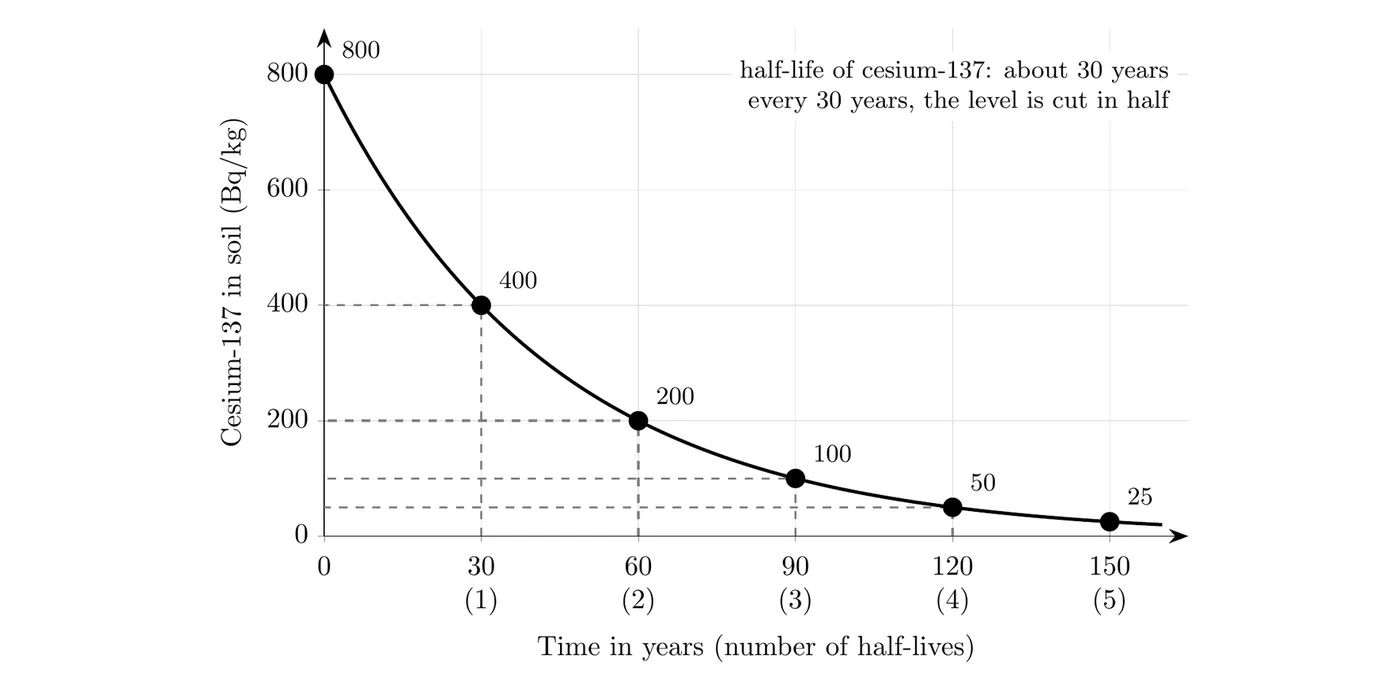
- Rate of decay: in each half-life, half of what is left decays. So the level drops by 400 Bq/kg in the first 30 years but only by 25 Bq/kg between years 120 and 150. The curve keeps getting flatter and never quite reaches zero.
Example 2 (how long): A lab sample has 200 mg of iodine-131, which has a half-life of about 8 days. How long until only 12.5 mg remain?
Big picture: Nuclear energy produces electricity through controlled fission, releasing vast heat without the air pollutants (, SOx, particulate matter) that come with fossil fuels. But it depends on finite, non-renewable uranium, and it creates serious long-term risks: spent fuel that stays radioactive for thousands to millions of years, with very few permanent disposal sites (Finland's Onkalo, licensed in 2026, is the first), contamination of water and soil through thermal pollution and radioactive mine tailings, and the potential for meltdowns like Three Mile Island, Chernobyl, and Fukushima.