

6.8 - Solar Energy
Learning Objectives
Describe how solar energy generates power and describe the environmental effects of generating solar electricity. The skill is explaining trends in data.
I. Passive Versus Active Solar
- Passive solar: Absorbing or blocking the sun’s heat without any mechanical or electronic equipment.
- Examples: A solar oven, where reflective material concentrates heat.
- Sustainable building design: Orienting a building to block the sun’s rays in warmer seasons and let more in during cooler seasons. This includes double-paned windows to trap heat, southern-facing windows to capture the low winter sun, and roof overhangs to block the high summer sun.
- Deciduous shade trees keep a house cooler in summer by absorbing rays, then drop their leaves in winter to let sunlight through for natural heating.
- Key difference: passive solar uses no pumps, fans, or panels, so the sun's heat is used right where it lands. It can't be collected and stored for later the way active systems can.
- Active solar: Uses mechanical or electric equipment to capture the sun’s energy. That energy can heat water into steam to create electricity, or turn the sun’s rays directly into electricity.
- Examples: A solar water heater, which circulates liquid heated by the sun to provide hot water or heat the home, and photovoltaic (PV) cells, meaning solar panels.
- Active systems can collect and store the energy: a solar water heater pumps a heated liquid from roof collectors to an insulated storage tank, and PV systems can charge batteries.
II. Photovoltaic (PV) Cells and Electricity Generation
- Mechanism: PV cells are made of a semiconductor, usually silicon (a metalloid, not a metal). Two layers of silicon are treated with tiny amounts of other elements so that an electric field forms where the layers meet. When photons (packets of light energy from the sun) hit the cell, they knock electrons loose, and the electric field pushes the electrons one way and the positive "holes" they leave behind the other way.
- Those electrons get diverted through a circuit, an alternate path, to a load, meaning the device being powered, which directly generates electricity.
- PV cells make direct current (DC). An inverter changes it to alternating current (AC), the kind homes and the grid use.
- Excess power: Solar panels on a building can push excess electricity back onto the grid. The utility company may send a rebate or a check for electricity produced beyond what was consumed.
- Limited by sunlight: PV only works when light hits it, so output drops at night, on cloudy days, in winter, and farther from the equator. U.S. utility solar averaged a capacity factor of about 24% in 2025 (it made 24% of what it would running at full power all year), compared with about 91% for nuclear (EIA).
III. Concentrating Solar Thermal (CST) and Intermittency
- Concentrating Solar Thermal: An active solar method where heliostats (mirrors) reflect and concentrate sunlight onto a central tower.
- The concentrated energy superheats a liquid like molten salt. That hot liquid runs through a heat exchanger to create steam, which spins a turbine and powers a generator.
- CST drawback: Bird mortality, since birds get zapped or fried out of midair by the super concentrated light beams.
- Intermittency (the main drawback): Solar power isn't available 24/7 because the sun goes down. Storing large amounts of daytime electricity for use at night is still expensive, but grid batteries are growing fast: California went from about 500 MW of battery storage in 2018 to about 21,000 MW by mid-2026, counting a few plants in nearby states that serve California (California Energy Commission). Most of these batteries hold only a few hours of power, enough to shift solar power into the evening but not through a long cloudy stretch.
- The Duck Curve: This graph illustrates the intermittency challenge.
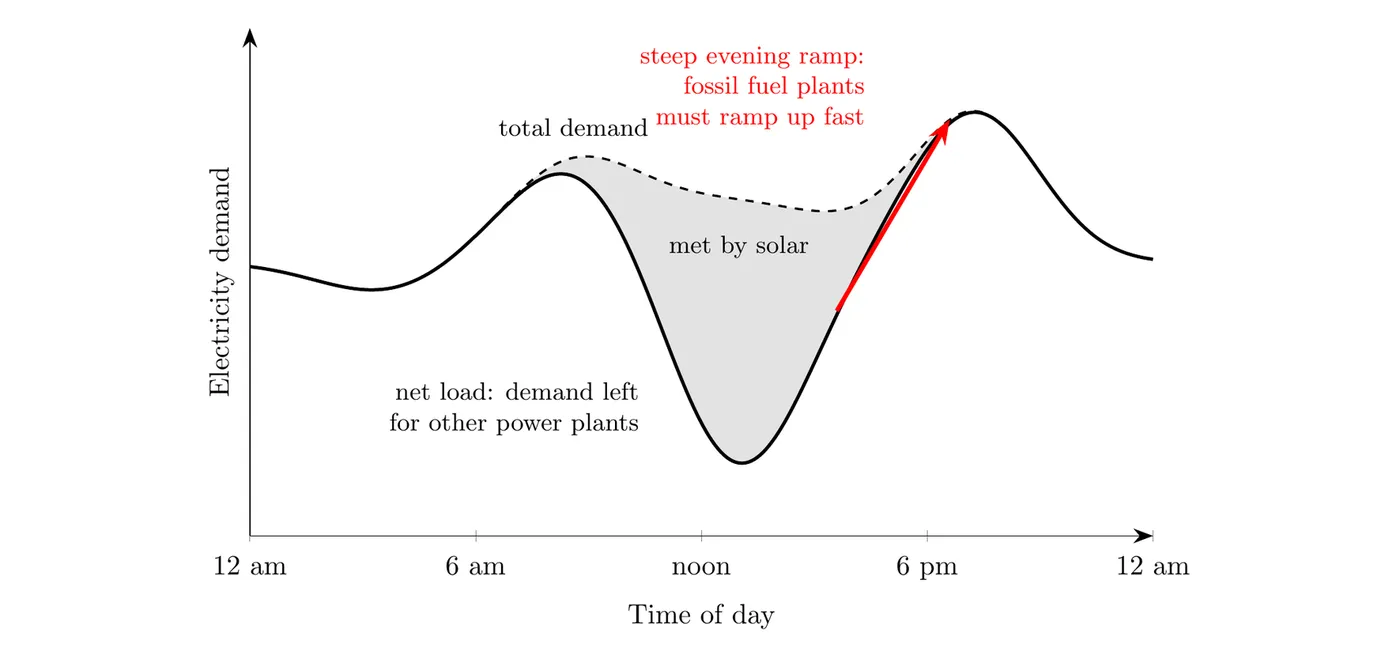
During the day, massive solar production causes the net load required from fossil fuels to drop sharply. When solar goes offline at night, that drop-off coincides with high evening electricity demand, forcing fossil fuel sources to ramp up production fast to meet the sudden spike.
IV. Environmental Pros and Cons of Solar
Advantages | Disadvantages |
No air pollutants (no particulate matter, SOx, NOx) released when generating electricity. | Habitat loss from large solar farms, community solar, and CST arrays. Big solar farms are often built in deserts, which can harm desert ecosystems: building the Ivanpah solar plant in California's Mojave Desert meant relocating threatened desert tortoises. |
No carbon dioxide released during electricity generation, so no contribution to greenhouse gas emissions. | High upfront cost. Panels, inverters, and installation cost a homeowner thousands of dollars, even though large solar farms are now one of the cheapest sources of new electricity (their average cost fell about 90% from 2010 to 2024, IRENA). |
Renewable resource, since the sun does not run out. | Panels use mined materials: quartz (to make high-purity silicon), plus silver, copper, and aluminum. Mining them brings habitat destruction and water pollution from mine tailings. |
No fossil fuel mining required for electricity production. | Making pure silicon takes a lot of energy, and old panels are hard to recycle, so panel waste is a growing problem. |
V. Practice Calculation: Payback Period
Question: A family pays $15,000 to install a 6 kW rooftop solar system. It makes 8,400 kWh of electricity per year, and electricity costs $0.15 per kWh. How many years until the panels pay for themselves?
Step 1: Yearly savings.
Step 2: Payback period = cost ÷ yearly savings.
After about 12 years, the electricity is basically free for the rest of the panels' life (often 25 years or more).
Follow-up (capacity factor): Running at full power all year, the system would make 6 kW × 8,760 h = 52,560 kWh. It actually makes 8,400 kWh, so its capacity factor is 8,400 ÷ 52,560 ≈ 0.16, or 16%.
Big picture: Solar energy is a clean, renewable alternative to fossil fuels, generating electricity with no or air pollutant emissions at the point of use, using everything from simple passive solar building design to active PV cells and concentrating mirror arrays. Its expansion faces real challenges: intermittency, which creates the operational stress known as the duck curve; high upfront costs; habitat loss when large solar farms cover deserts; and the impacts of mining materials like quartz, silver, and copper for PV cells, which cause habitat destruction and water pollution from mine tailings.