

8.8 - Bioaccumulation and Biomagnification
Learning Objectives
The main objective is describing both biomagnification and bioaccumulation and their effects on ecosystems. The associated skill is designing a testable hypothesis or a scientific investigation.
I. Bioaccumulation: Buildup in One Organism
- Definition: Bioaccumulation is the buildup of persistent organic pollutants (POPs) or other fat soluble contaminants in the bodies of individual organisms over time.
- Mechanism (why it happens): These compounds are fat soluble and don’t dissolve easily in water. The body gets rid of most wastes by dissolving them in water and flushing them out in urine, so fat soluble compounds are very hard to excrete. They get into the body easily (through food, water, gills, or skin), but they leave it very slowly.
- Storage: Instead of being excreted, these contaminants build up in the fat tissues of the organism and reach higher and higher levels over the lifetime of that single organism.
- Examples: Contaminants that bioaccumulate include POPs, methylmercury, and PCBs.
- Note on mercury: Methylmercury builds up a little differently. Instead of dissolving in fat, it binds tightly to proteins in muscle, which is why it’s found in the fish fillets people eat. The result is the same: the body excretes it slowly, so it bioaccumulates and biomagnifies.
II. Biomagnification: Concentration Across Trophic Levels
- Relationship to bioaccumulation: Biomagnification happens because of bioaccumulation. It’s a larger, macro level effect that occurs over a whole trophic system or food web.
- Definition: Biomagnification is the idea that fat soluble compounds build up and accumulate at higher and higher concentrations in organisms at successively higher trophic levels.
- Mechanism (the 10% rule): This occurs because of the 10% rule. Organisms at higher trophic levels, like secondary or tertiary consumers, have to consume far more biomass to get the equivalent amount of energy compared to the levels beneath them.
- As these higher level organisms eat increasingly large amounts of contaminated biomass, they accumulate the POPs or methylmercury at higher levels in their bodies.
- The highest level consumers (quaternary consumers) will have by far the highest levels of the pollutant.
III. Case Study: DDT and Thin Eggshells
- DDT source: DDT was a wide, broad spectrum insecticide. It was phased out of use because it’s carcinogenic and harmful, but it’s a persistent organic pollutant that doesn’t degrade easily, so it stays in ecosystems for decades.
- Trophic accumulation: DDT remains in the sediments of many aquatic ecosystems. Zooplankton (primary consumers) absorb it, and although levels may be low in the water, it becomes biomagnified in the food web.
- For example, if zooplankton reach 0.04 PPM, the small fish eating them might reach 0.5 PPM, large fish 2 PPM, and the top consumer, like an osprey, may reach levels as high as 25 PPM.
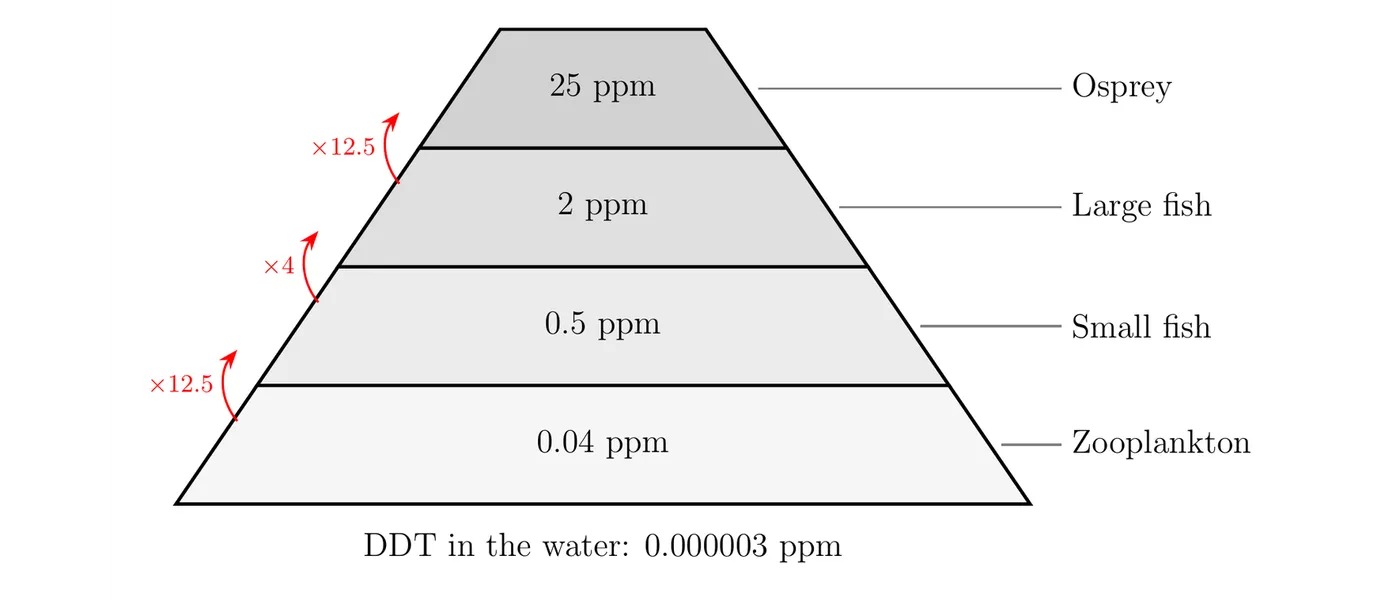
- Calculating the increase: Divide the concentration at one level by the concentration at the level below it. From zooplankton to small fish: times. From small fish to large fish: times. From large fish to osprey: times. Overall, the osprey has times the zooplankton’s concentration. The water itself might hold only 0.000003 ppm of DDT, so the osprey’s concentration is about 8 million times the water’s ().
- Ecological effect: These high levels of DDT at the top of the food chain cause the thinning of eggshells. This issue affected the bald eagle and was one of the causes for the passage of the Endangered Species Act in 1973. The thin eggshells killed the hatchlings before they could hatch.
- How the eggshells thin: DDE, the chemical DDT breaks down into, keeps female birds from putting enough calcium into their eggshells. The thin eggs cracked under the weight of the parents sitting on them, so the chicks died before hatching. Bald eagles, ospreys, peregrine falcons, and brown pelicans all crashed. After the US banned DDT in 1972, their populations recovered, and the bald eagle was taken off the endangered species list in 2007.
- Developmental deformities: Top carnivores can also show birth defects. In the 1980s and 1990s, PCBs and dioxins biomagnified in fish-eating birds around the Great Lakes, and many double-crested cormorant chicks hatched with crossed bills and deformed feet.
IV. Case Study: Mercury and Human Exposure
- Mercury source: Mercury is released into the atmosphere mainly by burning coal and by small-scale gold mining, which uses mercury to pull gold out of ore (worldwide, small-scale gold mining is actually the largest human source). It’s also released naturally by volcanoes.
- Mercury can be carried by the wind attached to particulate matter (ash) released from coal fired power plants, and deposited into aquatic ecosystems far away.
- Methylmercury: In aquatic ecosystems, bacteria convert elemental mercury into the highly toxic form known as methylmercury.
- Human exposure: Humans can be exposed to methylmercury through seafood. When humans eat large predatory fish like swordfish, shark, king mackerel, and bigeye tuna that have accumulated high levels of methylmercury, the humans become high level consumers (quaternary consumers) exposed to high levels of the pollutant. Salmon, shrimp, and canned light tuna are much lower in mercury, which is why the FDA and EPA tell pregnant women and young children to pick those and avoid the high-mercury fish.
- Health impact: Methylmercury is a neurotoxicant, meaning it can damage the nervous systems of top predators, including humans.
- Health effects in humans: Biomagnified chemicals can harm the nervous system (methylmercury damages the brain, especially in developing fetuses and young children), the reproductive system (PCBs and DDT can lower fertility and affect fetal development), and the circulatory system (high methylmercury exposure is linked to higher blood pressure and heart disease).
- Example (Minamata disease): From the 1930s to 1968, a chemical factory in Minamata, Japan, released methylmercury into Minamata Bay. The mercury biomagnified in fish and shellfish, and thousands of people who ate a lot of seafood developed severe nerve damage (numbness, loss of coordination, and trouble seeing, hearing, and speaking). Some babies were born with brain damage even though their mothers had mild or no symptoms. The Minamata Convention on Mercury, a treaty adopted in 2013, is named after the disaster.
V. Skill Application (Testable Hypothesis)
- Scenario: Scientists suspect that the compound smedium, released from worn down tires, is biomagnifying in the tissues of aquatic organisms in a nearby lake.
- Testable hypothesis: “If smedium is biomagnifying in the tissues of aquatic organisms in the lake, then the concentration of smedium will be significantly higher in the top predators (like fish) than in the primary consumers (like zooplankton) or the water itself.”
Big picture: Bioaccumulation describes the buildup of persistent pollutants, like DDT and methylmercury, within a single organism’s tissues over its lifetime, since they can’t be easily excreted. Biomagnification is the consequence of that process, where concentrations of these pollutants get successively higher at each trophic level of the food web, mostly because top consumers have to eat far more contaminated biomass to survive, thanks to the 10% rule. The result is dangerous levels for apex predators like eagles (DDT causing thin eggshells) and humans consuming large predatory fish (exposure to methylmercury, a neurotoxicant).