

8.15 - Pathogens and Infectious Diseases
Learning Objectives
The main objective is to explain human pathogens and their cycling through the environment. The associated skill is explaining an environmental concept in a visual context.
I. Pathogens and Vectors
- Pathogens are living organisms like viruses, bacteria, fungi, protists, and some types of worms that can cause an infectious disease.
- An infectious disease is one caused by a pathogen that can be caught or transmitted, unlike non-infectious diseases like cancer or diabetes.
- Pathogens evolve to take advantage of their host, which in APES usually means humans. For example, SARS-CoV-2, the coronavirus that causes COVID-19, has a spike protein that binds tightly to receptors on human cells, and new variants like Omicron (2021) evolved to spread even more easily from person to person.
- Vectors are organisms that transmit or pass pathogens from one organism to another. Mosquitoes and rodents, especially rats, are two primary examples.
- Clean-looking places can still hold pathogens: Specific pathogens can thrive in places that look perfectly sanitary. Legionella bacteria grow in the warm water of plumbing systems, hot tubs, and air conditioning cooling towers in modern buildings, and people catch Legionnaires’ disease (a severe pneumonia) by breathing in tiny water droplets. The disease is named after a 1976 outbreak at an American Legion convention in a Philadelphia hotel. Hospitals are another example: drug-resistant bacteria like MRSA can spread there even though everything looks clean.
II. Climate Change and Disease Spread
- Climate change is expanding tropical climates away from the equator.
- That expands the habitat range of disease vectors like mosquitoes, which means a rise in infectious diseases in areas that used to be too cold for those vectors to survive.
- Some pathogenic bacteria replicate better in warmer conditions, which leads to longer residence times on surfaces or in hosts.
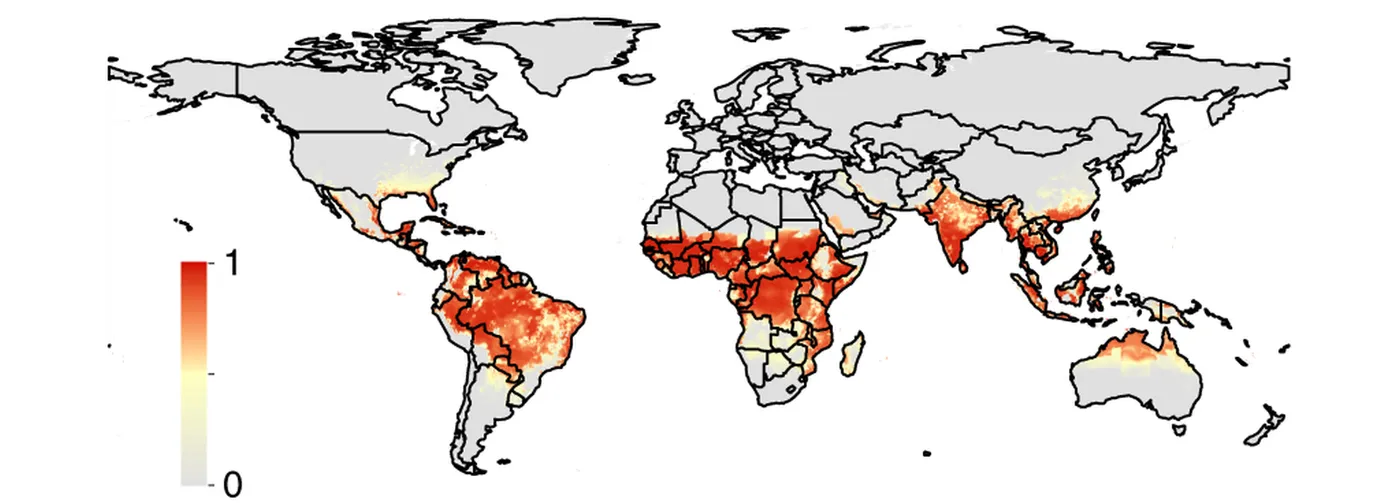
- The range of the Aedes aegypti mosquito, the vector for dengue fever, zika virus, and yellow fever, is projected to gradually expand away from the equator between 2019 and 2080.
III. Development Status and Disease Prevalence
Less developed nations generally have a higher rate of infectious disease, for several reasons:
- Less sanitary waste disposal allows open dumping or dumping into rivers, which gives pathogens opportunities to breed and be transmitted.
- Lower access to health care facilities and medicines. Antibiotics are medications that kill bacteria (they don’t work on viruses), and viral diseases need vaccines or antiviral drugs instead.
- Lack of access to clean, improved water sources, including no water filtration and no sewage treatment plants to remove pathogens. That raises the odds that drinking water is contaminated with sewage.
- Many are in tropical climates, which create a persistent breeding ground for disease vectors.
IV. Specific Infectious Diseases
Disease | Pathogen | Vector / Transmission | Health Impacts |
The Plague | Bacteria (Yersinia pestis) | Bites from infected fleas, which live on rats and other rodents. Also spread by touching the fluids or tissues of an infected animal, or by breathing in droplets from a person with plague pneumonia. | Modern antibiotics can handle it if it’s treated early. Historically known as the bubonic or black plague, which killed tens of millions of people in the 1300s. It still occurs in parts of Africa, Asia, and the western US. |
Tuberculosis (TB) | Bacterial infection | Spread through the air: an infected person coughs or sneezes out bacteria in tiny droplets, and others breathe them in. | Impairs lung function, causing severe cough (sometimes with blood), night sweats, and fever. Powerful antibiotics treat it in developed nations. |
Malaria | Parasitic protist (Plasmodium) | Bites from infected female Anopheles mosquitoes pass the parasite to humans. | Most common in sub-Saharan Africa. In 2024 there were about 282 million cases and 610,000 deaths worldwide, and about 95% of both were in the WHO African Region (WHO World Malaria Report 2025). Most deaths happen in children under the age of five. |
West Nile Virus | Virus | A mosquito bites an infected bird, gets infected, and then transmits it to a human. | Can cause brain inflammation, which can potentially be fatal. It was first found in the US in New York City in 1999. |
Zika Virus | Virus | Infected mosquito bite. Also transmissible through sexual contact and from mother to developing fetus. | Leads to babies born with abnormally small heads (microcephaly), from damaged brains and abnormal development. A 2015 to 2016 outbreak in Brazil left thousands of babies with these birth defects. |
SARS | Coronavirus (SARS-CoV) | Inhaling droplets from an infected person’s coughs or sneezes, or touching contaminated fluids or surfaces. It jumped to humans from animals (likely bats, through civets sold in markets). | A severe form of pneumonia. The 2002 to 2003 outbreak began in southern China and spread to more than two dozen countries, sickening about 8,000 people and killing 774. COVID-19 is caused by SARS-CoV-2, a closely related coronavirus. |
MERS | Coronavirus (MERS-CoV) | Spreads from animals to humans, mainly through close contact with infected dromedary camels. It passes between people only through close contact, like caring for a sick patient. | A severe viral respiratory illness first identified in Saudi Arabia in 2012. About a third of reported patients have died. |
Cholera | Bacteria in infected water | Human feces in water is the primary route. Also undercooked seafood. | Induces vomiting, muscle cramps, and extreme diarrhea as the body tries to flush the bacteria out, leading to severe dehydration and death. After cholera reached Haiti in 2010, the year of a major earthquake, it spread through contaminated water and killed nearly 10,000 people. |