

9.7 - Ocean Acidification
Learning Objectives
The main objective is to explain the causes and effects of ocean acidification. The associated skill is explaining an environmental process or concept.
I. Causes and Chemical Mechanism
- Primary Cause: Ocean acidification comes mostly from increased atmospheric levels. gas molecules dissolve directly into the ocean from the atmosphere.
- The Ocean as a Carbon Sink: The ocean absorbs about a quarter of the humans release each year (Global Carbon Budget). That slows climate change, but the more the ocean takes in, the more acidic it gets.
- Carbonic Acid Formation: When atmospheric dissolves into the ocean, it combines with ocean water () to form carbonic acid ().
- Dissociation and Ions: That carbonic acid then dissociates, or breaks apart, readily giving off hydrogen ions (). The pH scale measures the concentration of ions.
- Carbonate Ion Theft: The problem is that these extra ions are highly reactive. They bind with the available carbonate ion () to form bicarbonate (). That process steals carbonate ions, reducing how many are available.
- As Chemical Equations:
- (carbonic acid forms)
- (hydrogen ions are released, so pH drops)
- (the extra ties up carbonate ions)
- Net: , so every extra that dissolves uses up a carbonate ion.
- Minor Drivers: A smaller cause of ocean acidification comes from NOx and SOx forming nitric acid and sulfuric acid in the atmosphere. But the process is primarily driven by emissions.
II. Effects on Marine Organisms (Calcification)
- Shell Building: The carbonate ion is extremely important for marine life that builds shells, like coral and mollusks.
- Shell building is called calcification, where organisms take in both the carbonate ion and calcium from the water to build their calcium carbonate shells.
- (calcium carbonate shell or skeleton)
- Deterioration: As acidification decreases the available carbonate ions, organisms end up with less calcification. That means their shells break down and deteriorate more easily, because they can’t do the necessary repair and re-fortification.
- Experimental Evidence: A calcium carbonate shell placed in a solution matching the projected ocean pH of 7.8 by 2100 largely deteriorated in just 45 days.
- Why Shells Dissolve: with fewer carbonate ions in the water, calcium carbonate is harder to build, and in water that's corrosive enough, existing shells start to dissolve. Baby shellfish and young corals are hit hardest, because they're building shell or skeleton the fastest.
- Real Example (Pacific Northwest oysters): in 2007 and 2008, oyster hatcheries in Oregon and Washington lost most of their larvae to corrosive, low-pH water rising up from the deep ocean. The Whiskey Creek hatchery in Oregon recovered by monitoring its water and adding carbonate to buffer it when it turned corrosive.
- Coral Reefs: reef-building corals need carbonate to build their skeletons. Less carbonate slows reef growth, so reefs can wear away faster than they grow, which threatens habitat for about a quarter of all marine species.
III. Data and Scale of Change
- Anthropogenic Drivers: The key drivers are anthropogenic emissions, mainly from combustion of fossil fuels used in vehicles, transport, electricity generation, and industrial processes.
- Deforestation: Cutting and burning forests releases the carbon stored in trees as and removes trees that would have absorbed , so more stays in the air, and much of it ends up in the ocean.
- Inverse Correlation: Historical data shows a clear inverse relationship. As atmospheric concentrations steadily increase, the pH of the ocean steadily decreases, meaning it gets more acidic.
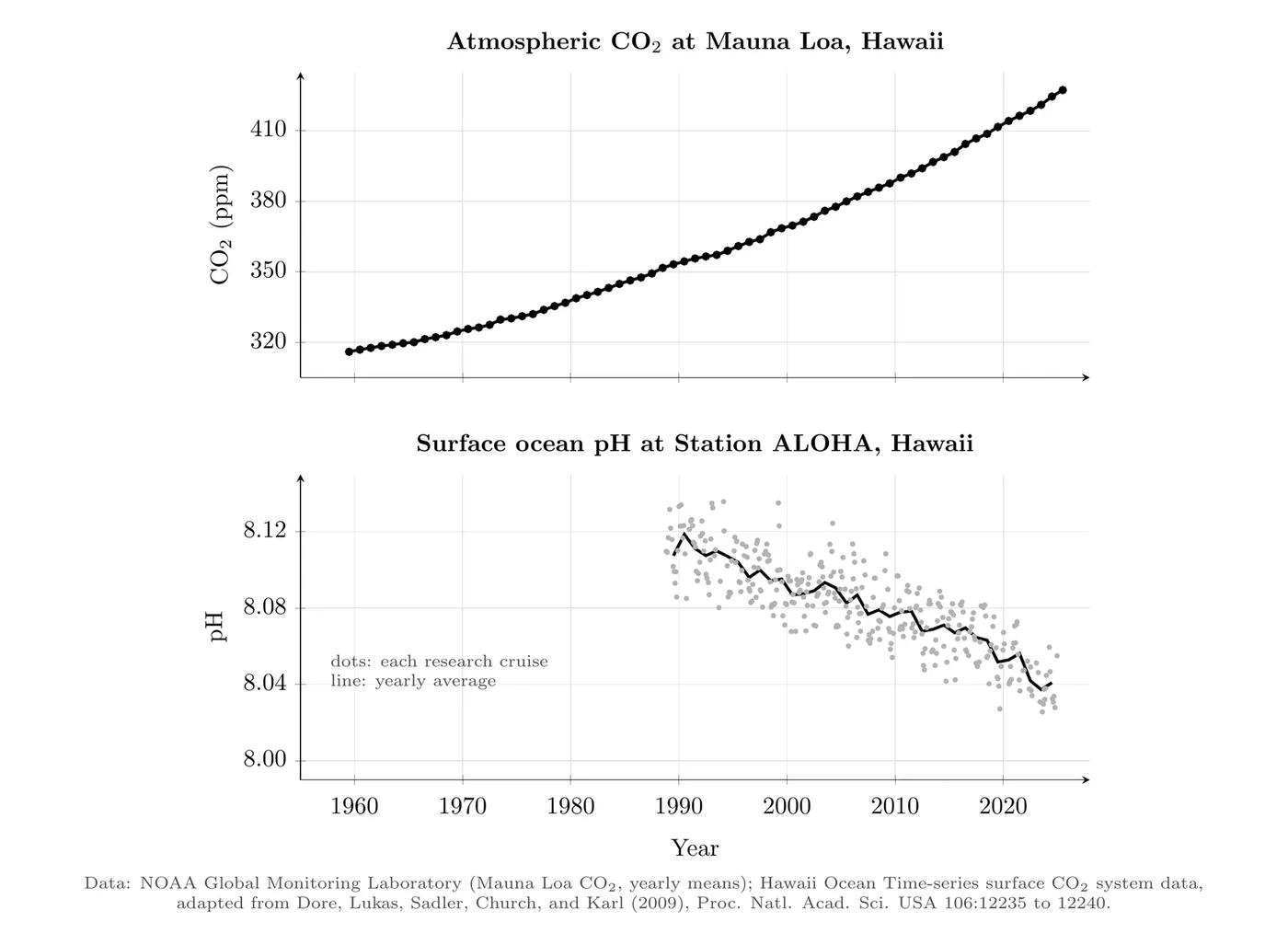
- Logarithmic Scale: Over the past 150 years, the ocean’s average pH has dropped from 8.2 to 8.1. Since the pH scale is logarithmic, that small shift actually represents a roughly 30% increase in hydrogen ion concentration, meaning the ocean is currently 30% more acidic than it was 150 years ago.
- Check the math: pH is , so each 1-unit drop means 10 times more . A 0.1 drop means times as much (about 26% more). Measured more precisely, surface pH fell from about 8.25 to 8.14, a 0.11 drop, and , which is where the roughly 30% comes from.
- Practice: if pH falls from 8.1 to 7.8 by 2100, goes up by a factor of . The ocean would have about twice as many hydrogen ions as today (a 100% increase).
- Projections: Ocean pH is projected to potentially fall as low as 7.8 by 2100.
Big picture
Ocean acidification works like this: anthropogenic forms carbonic acid in seawater, which releases hydrogen ions () that effectively steal the carbonate ions crucial for the calcification that shell-building organisms like coral and mollusks depend on.