

9.1 - Stratospheric Ozone Depletion
Learning Objectives
The main objective is to describe the importance of stratospheric ozone to life on Earth and discuss its depletion. The associated skill is describing an environmental concept or process.
I. Importance of Stratospheric Ozone
- UV Absorption: Stratospheric ozone absorbs UVB and all of the UVC radiation coming from the sun.
- Protection of Life: That matters because those are the wavelengths of UV radiation capable of mutating the DNA of organisms.
- Expansion onto Land: Without the stratospheric ozone layer, which emerged roughly 600 million years ago, life would never have been able to expand out of the oceans onto land. The radiation exposure would have been too high.
- Human Health Benefits: For humans, stratospheric ozone protects cells, especially in the skin, from mutation caused by the high energy of these waves. That prevents skin cancer and an eye disease called cataracts.
- More UV at the surface: when stratospheric ozone thins, more UVB gets through to the ground. That's the link to health: the damage goes up with how much UV reaches us.
- Skin cancer: UVB damages the DNA in skin cells. If the damage isn't repaired, it causes mutations that can lead to skin cancers, including melanoma, the deadliest type.
- Cataracts: UV also damages proteins in the lens of the eye, which makes the lens cloudy (a cataract) and blurs vision. Cataracts are the leading cause of blindness worldwide.
- Real numbers: an EPA-funded study (2021) estimated that the Montreal Protocol (9.2) will prevent about 443 million skin cancer cases, 2.3 million skin cancer deaths, and 63 million cataract cases among people born in the US between 1890 and 2100.
- Beyond humans: extra UV also slows the growth of phytoplankton, the base of ocean food webs, and can damage crops.
- Tropospheric Contrast: Remember that while stratospheric ozone (high up) is beneficial and essential for life, tropospheric ozone (near Earth’s surface) is a negative respiratory irritant that can worsen asthma, bronchitis, and COPD, and it contributes to photochemical smog.
II. Ozone Formation and Protection Mechanism
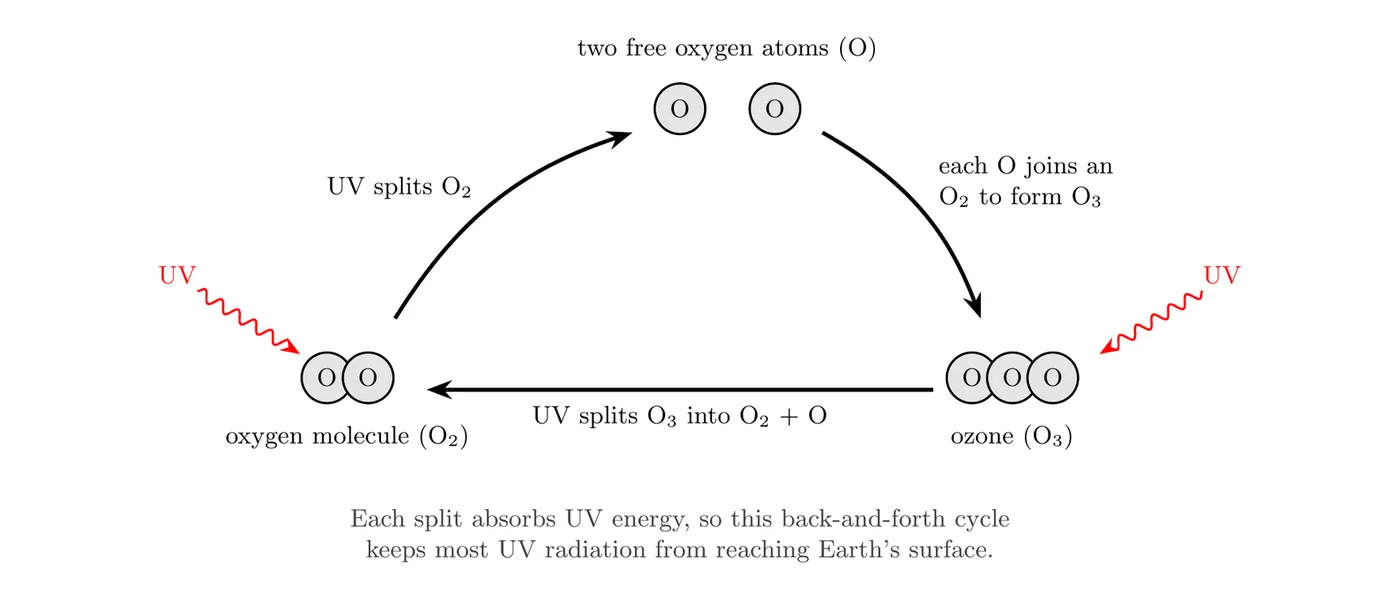
- Ozone Formation: Ozone () forms from oxygen. UVC radiation strikes an oxygen molecule () and splits it, giving two free oxygen atoms. Those free oxygen atoms then combine with in the atmosphere to form .
- Absorption Cycle: The reaction goes back and forth. UV radiation can also strike an ozone molecule, breaking it down into a free oxygen atom and an molecule.
- Protective Layer: That continuous back-and-forth reaction, where oxygen molecules, free oxygen atoms, and ozone molecules absorb UV rays and get broken apart, is what keeps the radiation from reaching Earth’s surface.
III. Anthropogenic Ozone Depletion (CFCs)
- The main way humans break down stratospheric ozone is through CFCs (chlorofluorocarbons).
- CFC Sources: CFCs are a broad group of compounds that were used as coolants (refrigerants) in refrigerators and air conditioners, as propellants in aerosol spray cans like hairspray and deodorant, as blowing agents for foam like Styrofoam, and as cleaning solvents for electronics. The US banned CFCs in most aerosol cans in 1978, and the Montreal Protocol later phased them out worldwide (9.2). They're no longer made, but CFCs leaking from old equipment and the CFCs already in the air still release chlorine.
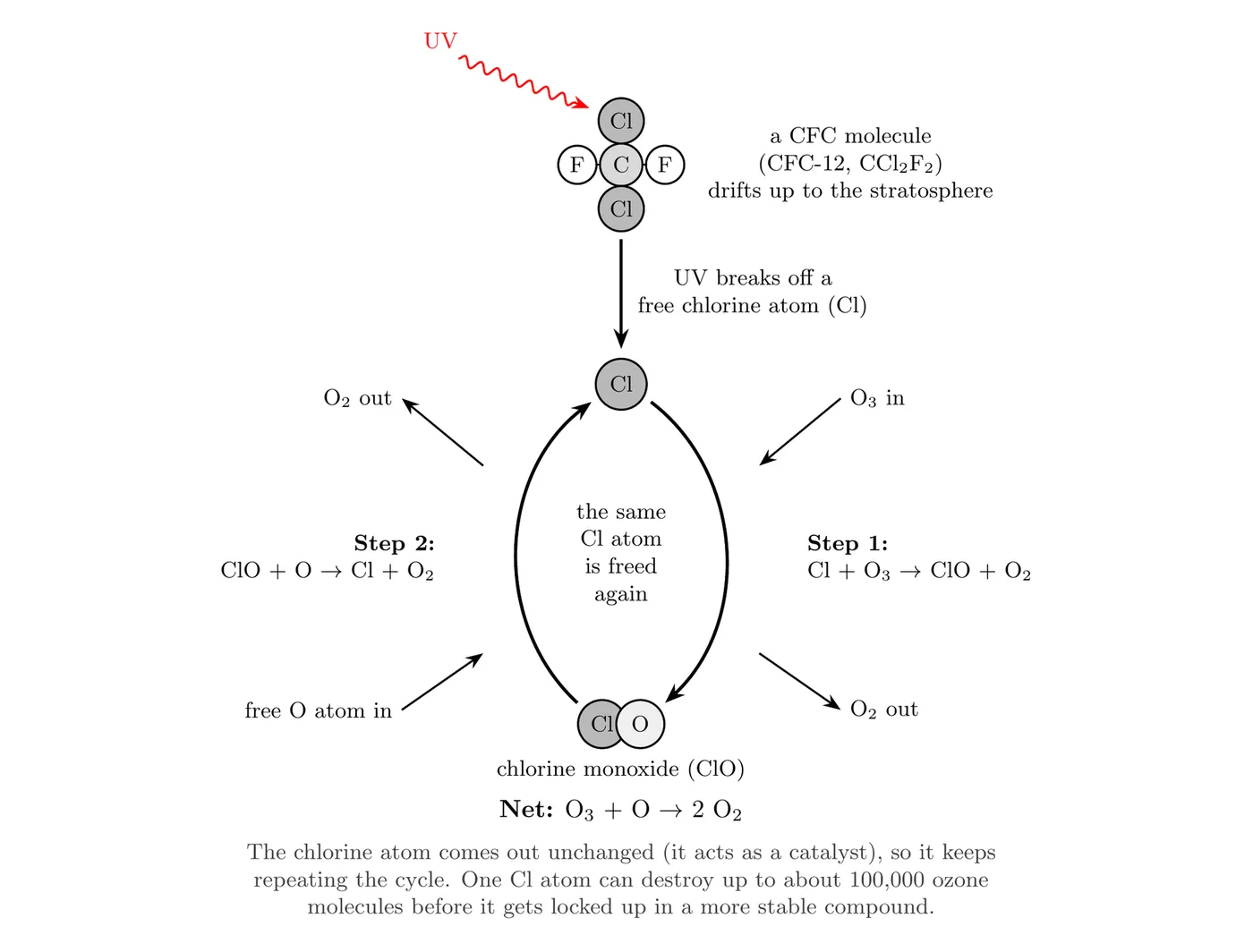
- Mechanism: When CFCs are emitted, UV radiation strikes them and breaks off a chlorine atom.
- Catalytic Cycle: The free chlorine atom is extremely electronegative, and it bonds with one of the oxygen atoms of an ozone molecule, converting the into .
- That chlorine atom then gets released again when another free oxygen atom bonds with the chlorine monoxide (ClO) that was formed.
- So the chlorine atom is free again to bind to and break down another ozone molecule, which drives a large net process converting ozone into .
- As equations: , then . Add them up and the Cl cancels out, so the net reaction is . Something that speeds up a reaction and comes out unchanged is a catalyst, which is why this is called a catalytic cycle.
- Persistence: The chlorine atom has a long residence time in the atmosphere, meaning it hangs around for a long time. CFCs themselves can stay in the atmosphere for hundreds of years.
- Ozone Destruction Potential: A single chlorine atom, before it finally bonds with something else like or methane, can break down up to 100,000 molecules of ozone.
IV. Natural Ozone Depletion
- Natural ozone depletion typically happens over Antarctica during the springtime.
- Polar Stratospheric Clouds (PSCs): These clouds are made of tiny ice crystals (frozen water and nitric acid). They only form when the stratosphere gets colder than about (), which happens almost every winter over Antarctica but much less often over the warmer Arctic.
- Natural Process: In the presence of PSCs, chlorine nitrate and hydrochloric acid (HCl) react, giving off elemental chlorine (). The sun then breaks down, or photolyzes, those molecules into free chlorine atoms, and those chlorine atoms break down the ozone. This natural depletion is usually limited to the Antarctic region.
- Why Spring? During the dark Antarctic winter (June to August), a ring of strong winds called the polar vortex traps very cold air over the continent, so PSCs form. Chlorine compounds react on the surfaces of the ice crystals and are turned into , which builds up in the dark. At the beginning of the Antarctic spring (September), sunlight returns and splits the into free chlorine atoms all at once, so ozone is destroyed fast. As the stratosphere keeps warming, the ice crystals melt and evaporate and the vortex breaks up, so the ozone hole closes by about late November or December.
- The Ozone Hole: this is why the Antarctic ozone hole shows up every September to November and is deepest in late September and early October. It isn't a true hole: it's the area where ozone drops below 220 Dobson units, the measure of how much ozone is in a column of air.
- Natural and Human Factors Together: the cold and the ice clouds are natural, but most of the chlorine they set free comes from CFCs. Scientists with the British Antarctic Survey (Farman, Gardiner, and Shanklin) first reported the ozone hole in 1985, after CFC use had grown for decades.
- Volcanoes: big eruptions can add sulfate particles to the stratosphere that act like PSC ice, giving chlorine a surface to react on. After Mount Pinatubo in the Philippines erupted in 1991, ozone around the world dropped for about two years.
Big picture
The stratospheric ozone layer is essential for life on Earth, acting as a shield that absorbs harmful UVB and UVC radiation that would otherwise cause DNA mutation, and preventing diseases like skin cancer. The main anthropogenic cause of ozone depletion is CFCs, which release chlorine atoms into the atmosphere. Those atoms have a long residence time and act catalytically, so each one can break down up to 100,000 ozone molecules, converting into .