

4.3 - Conservation of Linear Momentum
Momentum as a Conservation Law
Conservation of momentum is one of the fundamental conservation laws in physics, right alongside conservation of energy and conservation of charge. In the absence of net external forces, the total momentum of a system stays constant.
The single most important equation to write on free-response questions:
This means total momentum before an interaction equals total momentum after. Equivalent forms include , , and .
Always write one of these at the very start of a momentum conservation problem. It demonstrates understanding and typically earns points even if the algebra afterward runs into trouble.
Center of Mass Velocity, Revisited
Recall that a collection of objects can be described by the velocity of its center of mass:
Notice the numerator, , is exactly the total momentum, . So we can write:
The center of mass moves as though all the system’s mass were concentrated at that point, carrying the total momentum. Here’s the important implication: if the system’s total momentum stays constant (no net external force), the center of mass velocity stays constant too.
When Momentum is Conserved
The total momentum of a system stays constant in every kind of interaction (explosions, elastic collisions, inelastic collisions, any interaction at all) as long as there’s no net external force on the system, or the external forces are negligible compared to the internal forces during the interaction.
What counts as “no external forces” in practice? Usually it means the collision happens very quickly (so friction is negligible during the brief impact), the objects are isolated in space (far from other objects, so outside forces like gravity are negligible), or the system is defined broadly enough to include all interacting objects.
Momentum is conserved for cases like two hockey pucks colliding on ice (friction negligible during the brief collision), astronauts pushing off each other in space (no external forces), and a gun firing a bullet (system = gun plus bullet, external forces negligible during firing).
An individual object’s momentum is not constant in cases like a ball bouncing on the ground (Earth exerts an external force), a car braking (road friction is external), or a falling object (gravity is external). But here’s the key distinction: momentum is still conserved in these cases. It’s transferred between the object and Earth, so the total momentum of the bigger system (object plus Earth) stays constant, just not the momentum of the individual object alone.
Conserved vs. Constant: Choosing the System
AP questions use two words carefully. Momentum is conserved in all interactions: it’s never created or destroyed, only transferred from one object to another. Whether a system’s momentum is constant depends on which objects you put in the system.
Zero net external force on the system: the system’s total momentum is constant. Any external forces cancel each other out (like gravity and the normal force on a cart on a level track), so the only forces that change the objects’ momenta are internal ones between objects in the system, and their impulses cancel in pairs.
Nonzero net external force on the system: momentum is transferred between the system and its environment, and the system’s momentum changes by exactly the impulse the environment delivers (the impulse-momentum theorem from 4.2, applied to a whole system):
So you get to choose a system whose momentum is constant: include both objects in every interaction you care about. Leave one of them out, and its push becomes an external force that changes the system’s momentum.
Example: a 0.50 kg ball is dropped and falls for 1.2 s. Compare two choices of system. (Earth’s mass is kg.)
System = ball only: Earth’s gravitational pull is an external force, so the ball’s momentum changes by the impulse gravity delivers:
Check: after 1.2 s the ball moves at m/s, and kg·m/s. The ball’s momentum clearly isn’t constant.
System = ball plus Earth: now gravity is an internal force. The ball pulls up on Earth exactly as hard as Earth pulls down on the ball, for the same 1.2 s, so Earth gains 6.0 kg·m/s of momentum upward and the system’s total momentum stays at zero. Earth’s change in velocity is far too small to notice:
Momentum was conserved both times. With the ball alone as the system, momentum flowed in from outside (from Earth), so the system’s momentum changed. With Earth included, the same transfer happened inside the system, so the total stayed constant.
Momentum Transfer Inside a System
When two objects in a system interact, whatever momentum one gains, the other loses. Newton’s third law is the reason: object A pushes on object B with some force, and B pushes back on A with a force of the same size in the opposite direction. Both forces act for exactly the same time (the time the objects are touching), so the impulses are equal and opposite too:
Add the two changes and you get . That’s exactly why the total momentum of a system stays constant when there’s no net external force, and why any change to the system’s momentum has to come from outside, as an impulse from the environment.
Worked Example: Two Carts Trading Momentum
A 0.60 kg cart (A) rolls at 2.0 m/s toward a 0.40 kg cart (B) at rest on a level, low-friction track. The carts are in contact for 0.012 s, and right after the collision cart A is still moving forward at 0.40 m/s. Find cart B’s velocity, each cart’s change in momentum, the average force between the carts, and the center of mass velocity before and after.
Cart B’s velocity: write the conservation statement first, , with forward as positive:
Each cart’s change in momentum:
Equal and opposite: cart A lost exactly the momentum cart B gained.
Average force between the carts: N. Cart A pushes cart B forward with an average of 80 N, and cart B pushes cart A backward with an average of 80 N. On a force vs. time graph the two forces are mirror images, so their areas (the impulses) are N·s and N·s:
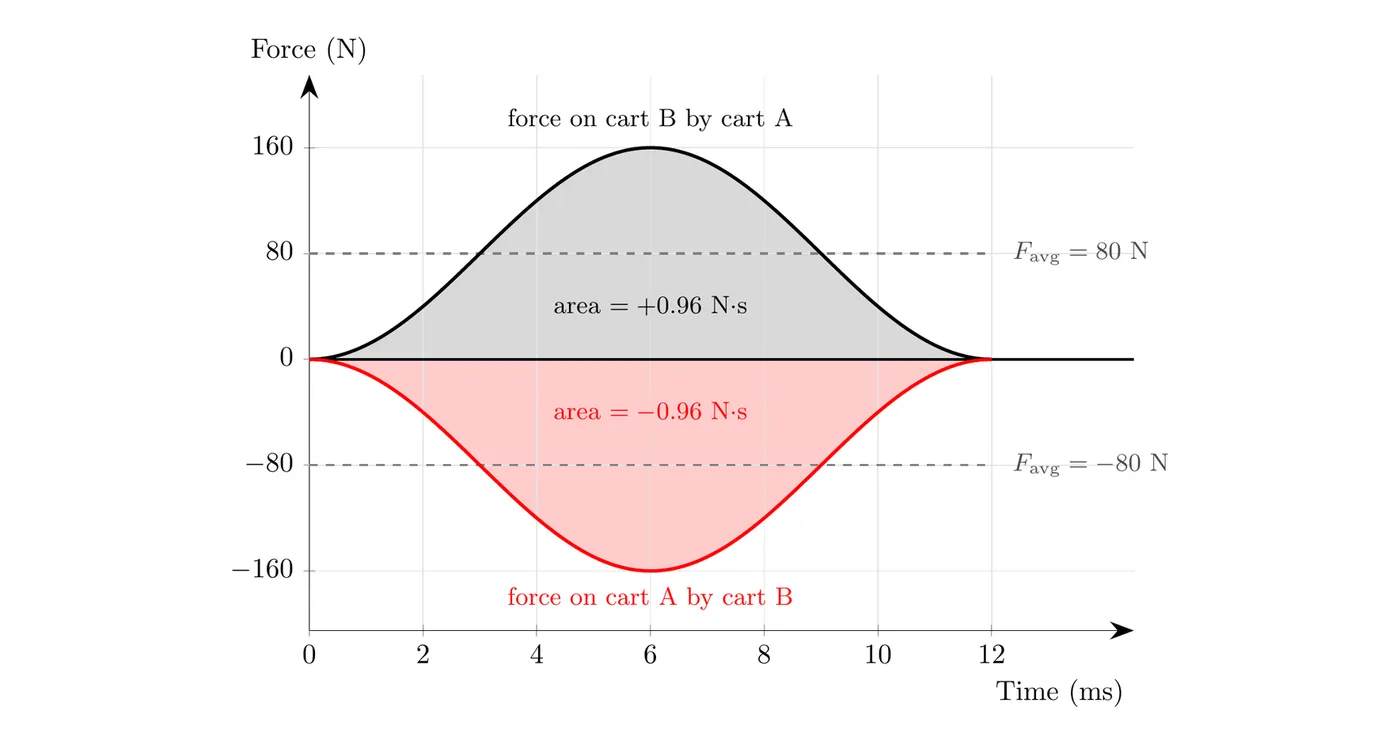
Center of mass velocity: before the collision, m/s. After, m/s. No change.
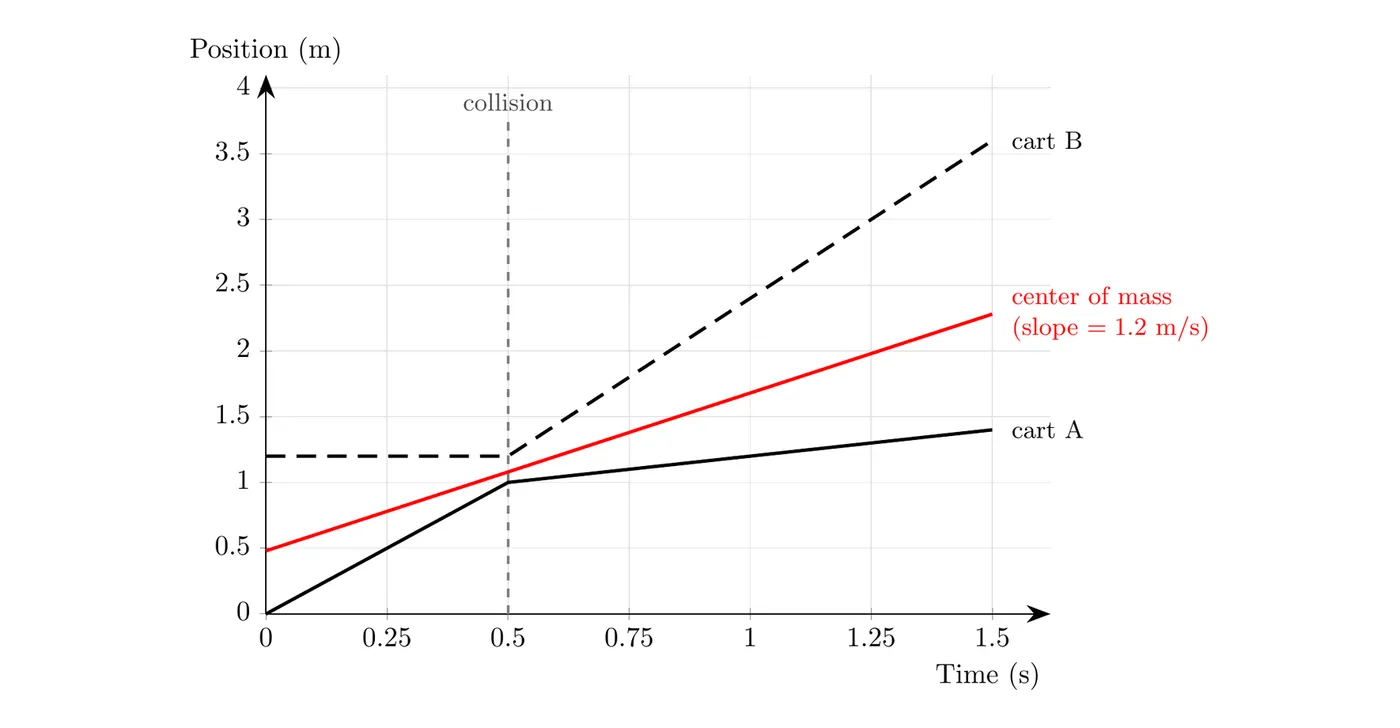
The position vs. time graph (tracking the center of each 0.20 m long cart) shows the same thing. Each cart’s line bends sharply at the collision, at s, but the center of mass line stays perfectly straight with a slope of 1.2 m/s. With no net external force, the center of mass keeps moving at constant velocity no matter what happens inside the system.
Immediately before and immediately after: conservation of momentum connects the velocities just before and just after a collision or explosion, because the interaction is so short that external forces don’t have time to deliver much impulse. Over longer times they do. If this track had noticeable friction, cart B would gradually slow down after the collision, so you’d use momentum conservation for the instant after the collision, then switch to forces or energy (Units 2 and 3) for the motion that follows.
Explosions
An explosion happens when internal forces push initially stationary (or moving-together) objects apart.
In the initial state, objects are together or at rest, so total momentum is often zero if starting from rest. During the explosion, internal forces (chemical, spring, muscle) act between the objects, and by Newton’s Third Law, these internal forces are equal and opposite, meaning there’s no net external force. In the final state, the objects move apart, but total momentum still equals the initial momentum.
Explosion from rest, the most common scenario, has two objects initially at rest pushed apart. Initial momentum is , and final momentum is . Conservation of momentum gives:
The negative sign shows the two objects move in opposite directions.
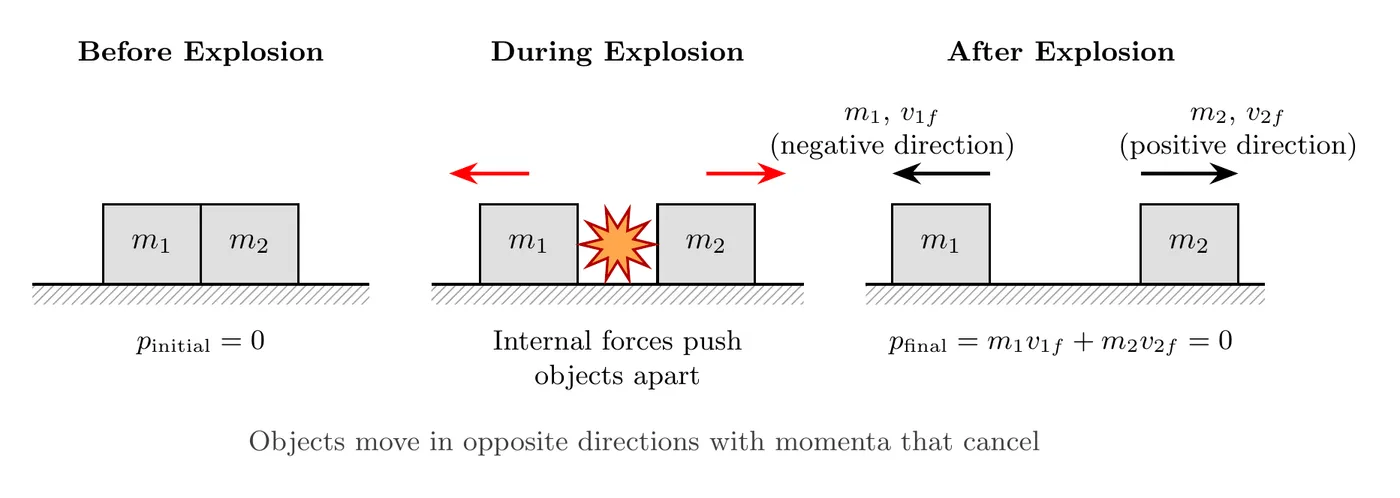
From , we get , meaning the lighter object moves faster, the heavier object moves slower, and their momentum magnitudes end up equal. For example, a 5 kg cannonball fired at 200 m/s has kg·m/s, and a 500 kg cannon recoiling at 2 m/s backward has kg·m/s, with the total momentum staying zero, just as it started.
Recoil
Recoil is the backward motion of the larger object in an explosion. The classic example is firing a gun: the bullet (small mass) moves forward at high speed, while the gun (large mass) moves backward at low speed, keeping total momentum at zero. That’s exactly why guns need to be held firmly, to control the recoil motion and keep your aim steady.
Historically, early cannons without recoil mechanisms would jump backward violently, dangerous to any crew standing behind them. The fix was mounting them on wheels, allowing a controlled backward roll, while modern artillery uses recoil mechanisms to absorb the energy gradually. Wheels help by letting the cannon roll back smoothly, spreading the recoil over a longer time and distance, which reduces the peak forces on the crew and the mounting.
Worked Example: Person Stepping from Canoe
A 60 kg woman steps out of a 40 kg canoe with a velocity of 2 m/s relative to the water. Find the canoe’s recoil speed, and show that the center of mass velocity is the same before and after.
Finding the canoe’s recoil speed: first, write the conservation statement, , or .
Before stepping off, the woman and canoe move together (or are at rest), so total initial momentum (assuming they start at rest relative to the water).
After stepping off, . Setting this equal to the initial momentum:
Substituting values:
The canoe recoils at 3 m/s, opposite to the woman’s direction. Checking reasonableness: the canoe is lighter (40 kg vs 60 kg), so it should move faster, and indeed matches . ✓
Center of mass velocity before and after: before stepping off, both are at rest (or moving together at zero relative to the water), so m/s.
After stepping off:
So m/s, the center of mass velocity is unchanged. Physically, the center of mass of the woman-plus-canoe system never moves at all, they move in opposite directions in exactly the right proportion to keep their combined center of mass fixed relative to the water. This demonstrates a fundamental principle: for a system with no external forces, the center of mass moves at constant velocity, here, zero.
Momentum in Two Dimensions
Momentum is a vector, so in two dimensions it’s conserved separately in each direction. Break every momentum into - and -components and write one conservation equation for each direction:
AP Physics 1 handles two-dimensional collisions semiquantitatively. You need to set up these component equations correctly and reason about how changing a mass, speed, or angle affects the other quantities. You won’t be asked to solve two equations at the same time (full two-dimensional solving comes in AP Physics 2).
Worked example: a hockey puck (A) slides at 4.0 m/s in the direction and strikes an identical puck (B) at rest. Afterward, puck A moves at 30° above the -axis and puck B moves at 60° below it. Set up the conservation equations and decide which puck moves faster after the collision.
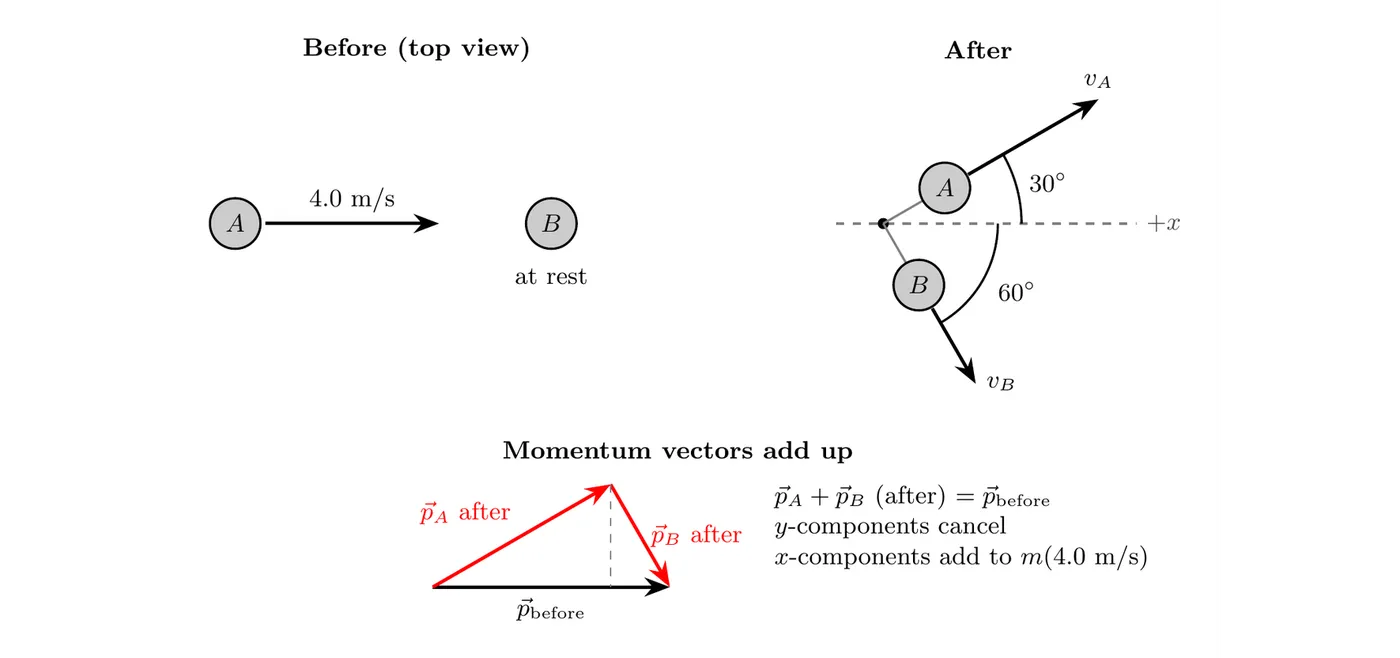
-direction (all of the momentum starts here):
-direction (no -momentum before, so the -components after must cancel):
Reasoning: the -equation says . Since (0.87) is bigger than (0.50), puck A has to be faster: the puck that’s deflected by the smaller angle keeps more of the speed. The mass cancels out of every term, so the result only depends on the pucks having equal masses, not on how heavy they are. And if puck A came in twice as fast with the same angles, every term would double, so both final speeds would double too.
For the record, solving the pair gives m/s and m/s, so puck A is faster, as the reasoning predicted. The bottom of the diagram shows the same result as vectors: the two momenta after the collision add tip to tail to give the momentum before.
Key Physics Insights
Negative signs and direction: in momentum problems, negative signs indicate direction. With the usual convention (positive is right or forward, negative is left or backward), an explosion problem starting from rest guarantees opposite directions: forces one object positive and the other negative.
Conservation always holds in explosions: even though explosions involve big internal forces, momentum is conserved because those internal forces are equal and opposite (Newton’s Third Law). When a woman pushes off a canoe, she pushes the canoe backward with force , and the canoe pushes her forward with force , giving a net external force of zero, so momentum is conserved. Same story with a gun firing a bullet: expanding gases push the bullet forward with force and push the gun backward with force , again zero net external force on the gun-plus-bullet system.
Why the center of mass doesn’t move: mathematically, . If before, and momentum is conserved, then after too, so the whole time. Physically, with no external forces, there’s nothing to push the system’s center of mass anywhere, internal forces just redistribute the objects within the system.
Real-World Applications
Rocket propulsion: rockets work on the explosion principle, expelled gases move backward at high speed while the rocket moves forward, and total momentum (rocket plus gases) stays conserved. This is exactly why rockets work in space, there’s no air needed to “push against.”
Ice skating push-off: two skaters pushing off each other start with zero momentum (both at rest), then move apart in opposite directions after the push, with the lighter skater moving faster and the heavier one moving slower, keeping total momentum at zero.
Spacecraft maneuvering: astronauts on spacewalks find that throwing a tool one direction moves them the opposite direction, and with no friction in space, this effect is very noticeable, so movements have to be planned carefully.
Firearms: understanding recoil explains why a small bullet with a large muzzle velocity pairs with a large gun that has a small recoil velocity, why heavier guns have less recoil for the same bullet, and why recoil pads increase the stopping time to soften the impact (impulse-momentum theorem again).
Common Mistakes
Forgetting the initial state: don’t set if the objects actually start at rest, in that case .
Sign errors: don’t give both velocities the same sign after an explosion from rest, they should be opposite (one positive, one negative).
Skipping the conservation statement: don’t jump straight into algebra, write or first, since it earns points on exams.
Neglecting the mass ratio: don’t write and forget the mass ratio, it should be , including the masses.
Leaving an interacting partner out of the system: if one of the two objects that push on each other is outside your system, its push is an external force and the system’s momentum is not constant. Put both interacting objects in the system before you write .