

4.4 - Elastic and Inelastic Collisions
Types of Collisions
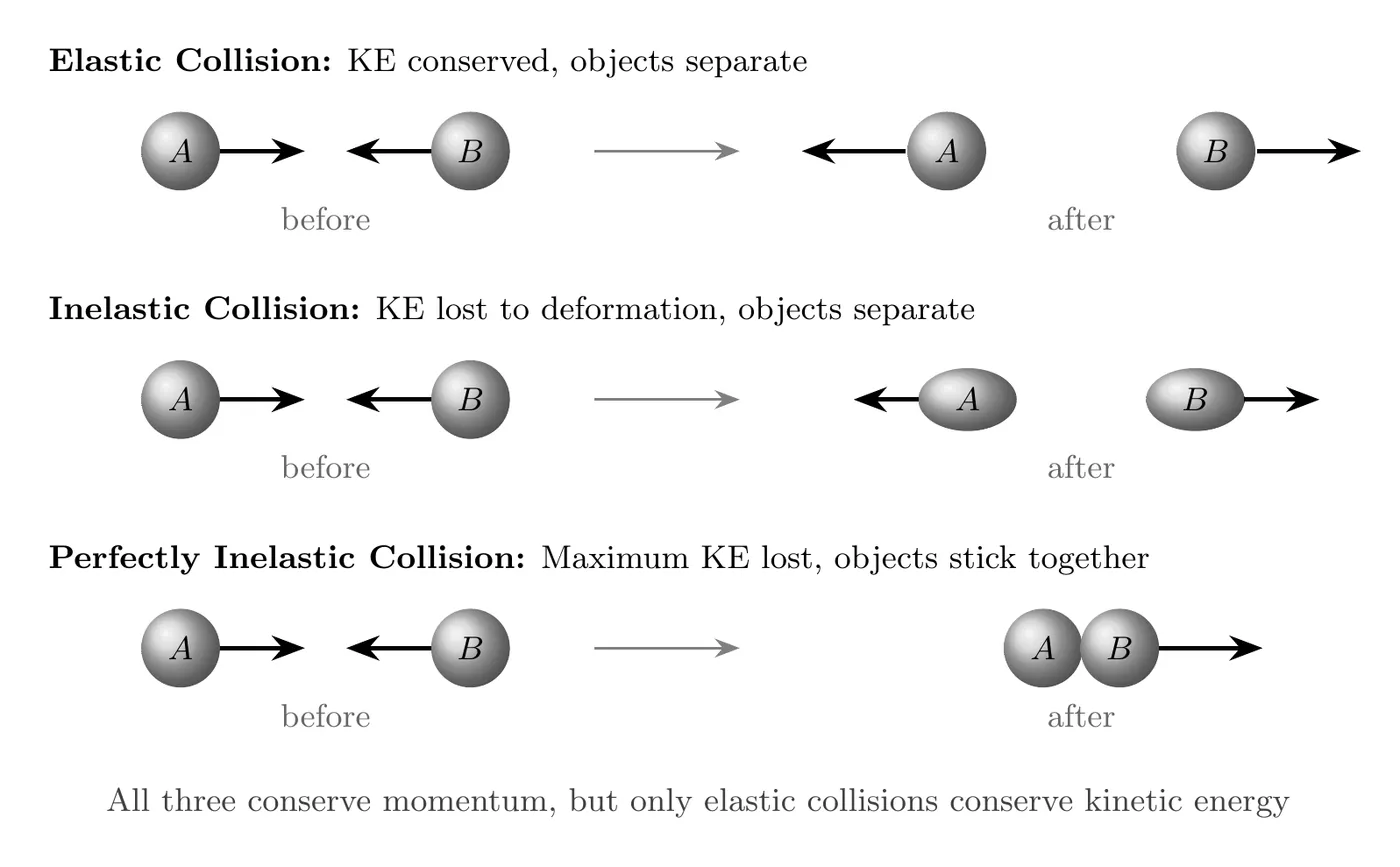
Collisions are categorized by what happens to kinetic energy during the interaction. Momentum is always conserved in every type, the distinguishing factor is what happens to kinetic energy.
Elastic Collisions
An elastic collision is one where both momentum and kinetic energy are conserved. Momentum is conserved, , kinetic energy is conserved, , objects bounce off each other, there’s no permanent deformation, and no energy converts into heat, sound, or other forms.
Expanded:
Total kinetic energy stays the same, but individual kinetic energies still change, energy transfers between the objects. Real-world approximations include billiard balls colliding, steel ball bearings, and atomic or molecular collisions (which are truly elastic). Most real-world collisions are only nearly elastic, losing a little energy to sound, heat, and deformation.
Inelastic Collisions
An inelastic collision is one where momentum is conserved but kinetic energy isn’t. Momentum is conserved, , but kinetic energy decreases, , with some of it converting into other forms, and objects may or may not stick together.
Where does the missing energy go? Through non-conservative forces, into thermal energy (friction generates heat), sound energy (the collision makes noise), deformation energy (permanent bending or crumpling), and internal energy (molecular vibrations). The energy isn’t destroyed, it transforms into non-mechanical forms that are hard to recover as kinetic energy again. Real-world examples include car crashes (with extensive deformation), hitting a baseball (the ball compresses), tackling in football, and dropping clay on the floor.
Perfectly Inelastic Collisions
A perfectly inelastic collision is a special case where the objects stick together afterward, moving with the same final velocity. This gives the maximum possible kinetic energy loss: for the same starting velocities, no collision that conserves momentum can lose more kinetic energy.
Conservation of momentum becomes:
And if object 2 starts at rest ():
Real-world examples include car crashes where vehicles crumple together, catching a ball (the ball and hand move together afterward), a bullet embedding in a wood block, and a football tackle where both players fall together.
Worked Example: Blocks That Stick Together
A 1.2 kg block slides across a frictionless surface at 3.0 m/s and hits a 0.80 kg block at rest. A pad of putty on the front of the moving block makes them stick together. Find their velocity right after the collision and the kinetic energy lost. Then find how far they slide after moving onto a rough patch of floor where .
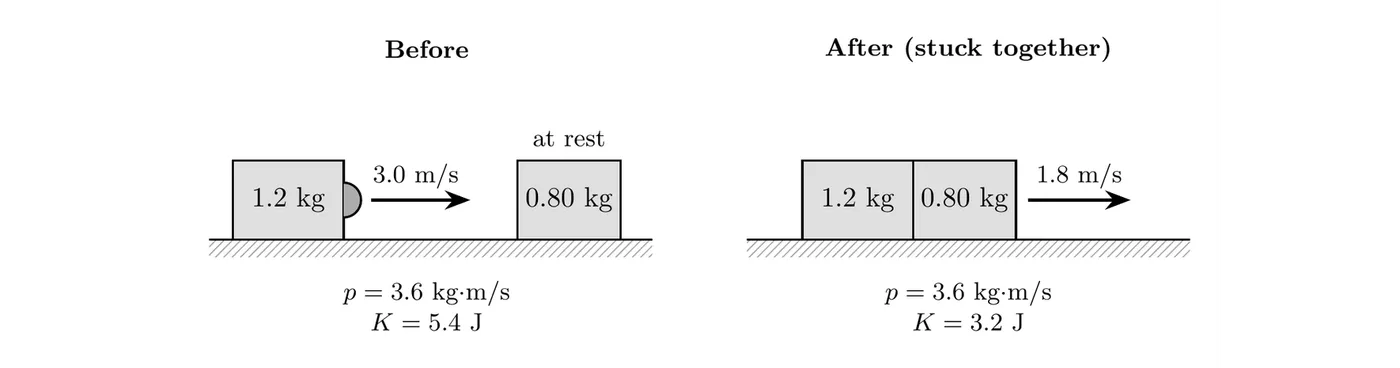
Velocity after (perfectly inelastic): the blocks share one final velocity, so
Kinetic energy before and after:
The system lost J, which is 40% of its kinetic energy. Momentum stayed the same (3.6 kg·m/s before and after), but kinetic energy went down, so the collision is inelastic. The missing 2.2 J was transformed by nonconservative forces during the collision into other forms: deforming the putty, warming the blocks, and the sound of the hit.
Sliding to a stop: on the rough patch, friction is an external force that acts for a long time, so momentum conservation no longer applies. Switch to energy: friction’s work removes the kinetic energy the blocks had right after the collision.
This two-step pattern shows up often on AP free-response questions: use momentum conservation for the instant of the collision, then use energy or forces for the motion afterward.
A Useful Shortcut for Elastic Collisions
For elastic collisions in one dimension (head-on) only, there’s a special relationship between the velocities:
Rearranged:
In words, the relative velocity of approach equals the negative of the relative velocity of separation, objects approach at the same speed they separate, just in the opposite direction.
This only applies to elastic collisions, and it provides a second equation (momentum conservation gives the first), letting you solve for two unknowns at once. Just remember, this formula does not work for inelastic collisions. It comes from solving momentum conservation and kinetic energy conservation together, which takes a page or two of algebra, but the shortcut saves you that work.
Problem-Solving Strategy for Collisions
- Identify the collision type: are objects bouncing apart or sticking together? Bouncing apart suggests elastic (check kinetic energy to confirm), sticking together guarantees perfectly inelastic, and if a problem explicitly states “elastic,” use the elastic collision formulas directly.
- Define a positive direction: pick one direction as positive (usually right or forward), and mark all velocities accordingly.
- Write the conservation of momentum statement: always start with , or , this is worth points on exams even if the rest goes wrong.
- Set up your equations: for all collisions, momentum, . For elastic collisions, add kinetic energy, . For perfectly inelastic, .
- Solve algebraically, substituting known values to find the unknowns.
- Check kinetic energy if asked: calculate and . If they’re equal, it’s elastic, if is smaller, it’s inelastic.
Table Method for Organizing Work
Before | After | |
Object 1 | ||
Object 2 | ||
Total |
Conservation requires . This method organizes all the information clearly, makes sign errors easy to spot, shows the conservation visually, and helps track multiple objects at once.
Worked Example: Two-Marble Collision
A small marble (0.015 kg) moves right at 0.225 m/s, and a large marble (0.030 kg) moves left at 0.180 m/s. They collide head-on, and afterward the small marble moves left at 0.315 m/s. Assume a frictionless surface with no rotation. Find the large marble’s final velocity, determine whether the collision is elastic, and check whether the center of mass velocity is unchanged.
Setup: let rightward be positive, leftward negative. Small marble: kg, m/s, m/s. Large marble: kg, m/s,
Finding the large marble’s final velocity: calculating initial momenta,
Total initial momentum: kg·m/s.
Final momentum of small marble: kg·m/s.
Applying conservation, :
Finding velocity: m/s. The large marble ends up moving to the right at 0.09 m/s, having reversed direction.
Checking whether it’s elastic: before the collision,
After the collision:
Since , the collision is elastic.
Checking the center of mass velocity: before,
After (since by conservation),
Yes, , the center of mass velocity is unchanged, moving steadily leftward at 0.045 m/s throughout, since internal forces during the collision don’t affect the system’s overall center of mass motion. (Use the unrounded total momentum, kg·m/s, here. Dividing the rounded instead gives m/s, a rounding error.)
A couple of insights from this example: both marbles reversed direction, the small one going from right to left, the large one going from left to right, typical of head-on elastic collisions. The total momentum stayed at kg·m/s the whole way through, negative because the large marble started with more momentum ( vs. kg·m/s): it has twice the mass, even though it was moving a bit slower. And even though total kinetic energy stayed constant, the individual energies shifted: the small marble gained energy (0.00038 J to 0.00074 J, speeding up), while the large marble lost energy (0.00049 J to 0.00012 J, slowing down), transferred from the large marble to the small one.
Sports Applications
Billiards (pool): an elastic collision approximation, since the cue ball and object ball are both hard spheres with minimal energy loss, letting players predict final velocities using elastic collision formulas, even if just intuitively.
Baseball bat and ball: an inelastic collision, since the ball compresses significantly against the bat, and some energy converts to sound (the crack of the bat), heat (the ball and bat warm slightly), and vibration in the bat and the player’s hands, so not all kinetic energy is conserved.
Football tackling: an inelastic collision, often perfectly inelastic, since players frequently move together after a tackle. There’s a large energy loss to deformation, sound, and heat, but momentum for the system of two players is still conserved, which is how you’d analyze the tackle’s dynamics.
Hockey checking: inelastic, even though players often bounce apart. Bodies and pads deform and the hit makes noise, so kinetic energy drops. Bouncing apart doesn’t make a collision elastic, only a kinetic energy check does. The ice keeps friction small, so the momentum of the two-player system stays nearly constant during the hit, which makes it a good momentum problem.
Common Mistakes
Forgetting signs for direction: don’t make both velocities positive when the objects move in opposite directions, choose a positive direction and assign negative to the opposite one.
Assuming all collisions are elastic: don’t automatically set , check whether the problem states it’s elastic, or calculate to verify.
Using the elastic shortcut for inelastic collisions: don’t use outside of elastic collisions, it only works there.
Skipping the conservation statement: don’t jump straight into calculations, write or first, it earns exam points.
Confusing momentum and kinetic energy conservation: inelastic doesn’t mean momentum isn’t conserved, momentum is always conserved, it’s kinetic energy that’s only conserved in the elastic case.