

4.1 - Linear Momentum
Introduction to Unit 4
Unit 4 covers linear momentum, a powerful alternative approach to analyzing motion, especially useful for collisions and explosions.
The word “linear” distinguishes this from angular momentum (rotational motion), covered later. Most of the time it’s just called “momentum,” but the full term is a reminder that we’re talking about motion along a line, not rotation.
Definition of Linear Momentum
Linear momentum is the product of an object’s mass and velocity.
where is momentum (a vector), is mass in kg, and is velocity in m/s (also a vector). The SI unit of momentum is kg·m/s.
Momentum is written as , not , which is reserved for mass. This symbol traces back to the Latin petere (to go toward) or impetus (force of motion).
Momentum as “Inertia in Motion”
Momentum represents inertia in motion: inertia (mass) is resistance to changes in motion, and motion (velocity) is how fast and in what direction something’s moving. Combined, momentum describes how hard it is to stop or redirect a moving object.
High momentum objects are hard to stop. Consider mass: an empty shopping cart (10 kg) rolling at 2 m/s has kg·m/s, easy to stop, while a loaded one (50 kg) at the same 2 m/s has kg·m/s, much harder to stop. Or consider velocity: a baseball (0.15 kg) rolling slowly at 1 m/s has kg·m/s, easy to catch, but a baseball pitched at 40 m/s has kg·m/s, which really stings to catch. Both mass and velocity matter, a massive object moving slowly can carry the same momentum as a light object moving quickly.
Momentum as a Vector Quantity
Momentum is a vector, with both magnitude and direction, and its direction matches the direction of velocity. That’s because mass is a scalar with no direction, so multiplying it by a velocity vector just carries that vector’s direction along.
Object Motion | Velocity | Momentum |
Car moving east at 20 m/s | m/s (east) | kg·m/s (east) |
Car moving west at 20 m/s | m/s (west) | kg·m/s (west) |
Same speed, opposite directions, opposite momentum vectors.
For systems of multiple objects, total momentum is found through vector addition:
In one dimension, watch your signs: rightward is positive, leftward is negative, and net momentum is the algebraic sum. For example, if Object A (5 kg, moving right at 4 m/s) has kg·m/s and Object B (3 kg, moving left at 2 m/s) has kg·m/s, the total momentum is kg·m/s, net rightward.
Collisions and Explosions
Momentum is especially powerful for analyzing collisions and explosions.
A collision happens when objects come together and the forces between them during contact are much larger than any external forces. Objects approach each other, brief but intense forces act during contact, external forces like friction are negligible compared to the collision forces, and momentum is conserved (more on this next). We’ll study elastic collisions, where objects bounce off each other and kinetic energy is also conserved, and inelastic collisions, where objects stick together or deform and kinetic energy isn’t conserved.
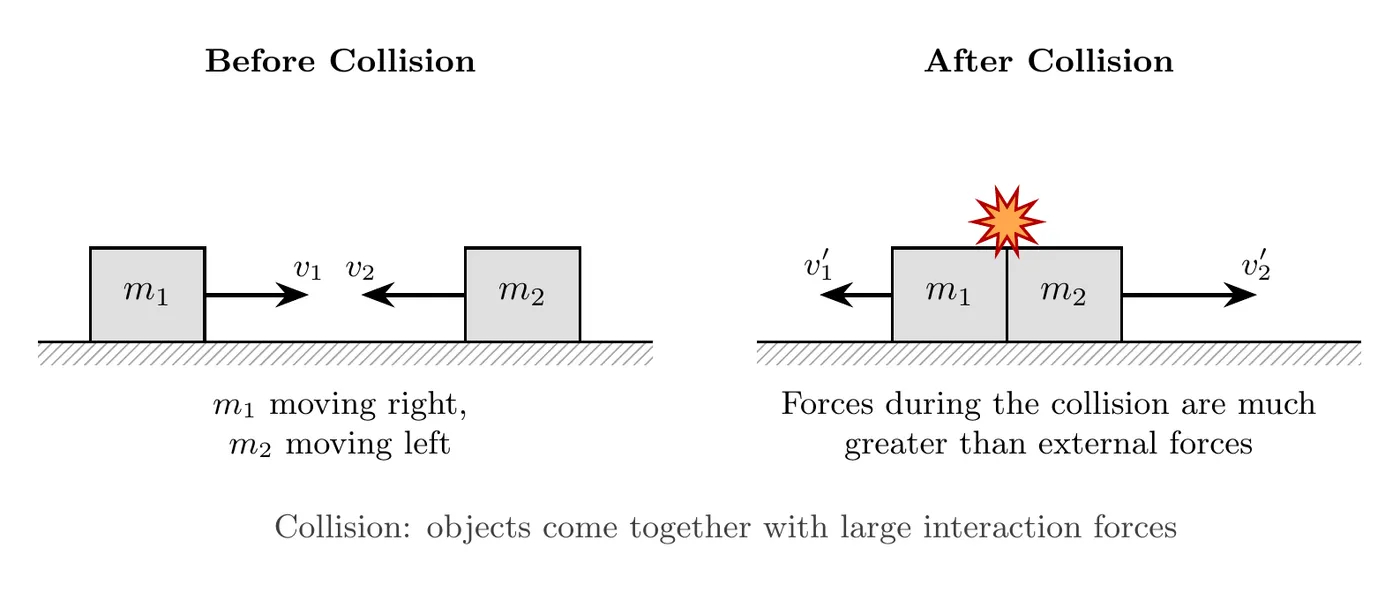
Examples include billiard balls striking each other, a car crash, a baseball bat hitting a ball, and two ice skaters colliding.
Why the collision model works: during a collision, the objects push on each other with very large forces for a very short time. External forces like friction and gravity are still acting, but they’re much smaller, and they only get that same short time to act, so the impulse they deliver (force times time, covered in 4.2) is tiny. That’s the whole idea behind the collision model: the forces between the colliding objects are much larger than the net external force on them during the interaction, so the system’s momentum just before the collision equals its momentum just after.
Treating colliding objects as points (the object model): while they’re in contact, real objects squash, vibrate, warm up, and spring back. Collision problems skip all of that and only compare the state just before contact with the state just after. Since nothing inside each object matters at those two moments, each one can be modeled as an object: a single point with one mass and one velocity, with no internal structure. That’s why a collision can be written using only , , , and .
Example: a 0.50 kg block slides at 2.0 m/s across a table where the coefficient of kinetic friction is 0.20, and hits an identical block at rest. The first block stops, and the blocks are in contact for 0.010 s. Is it fair to ignore friction during the collision? Compare the average collision force (using from 4.2) with the friction force:
The blocks push on each other about 100 times harder than friction pushes on either one. Over the 0.010 s collision, friction delivers an impulse of only N·s, about 1% of the block’s 1.0 kg·m/s of momentum. So yes, friction can be ignored during the collision. It can’t be ignored afterward, when the second block slides across the table for much longer and friction has time to slow it down.
An explosion happens when internal forces push objects within a system apart. Objects start together (or very close), internal forces push them apart, they end up moving away from each other, and momentum is still conserved. Types include literal explosions from chemical reactions, spring-loaded mechanisms, recoil scenarios (a gun and bullet), and astronauts pushing off each other in space.
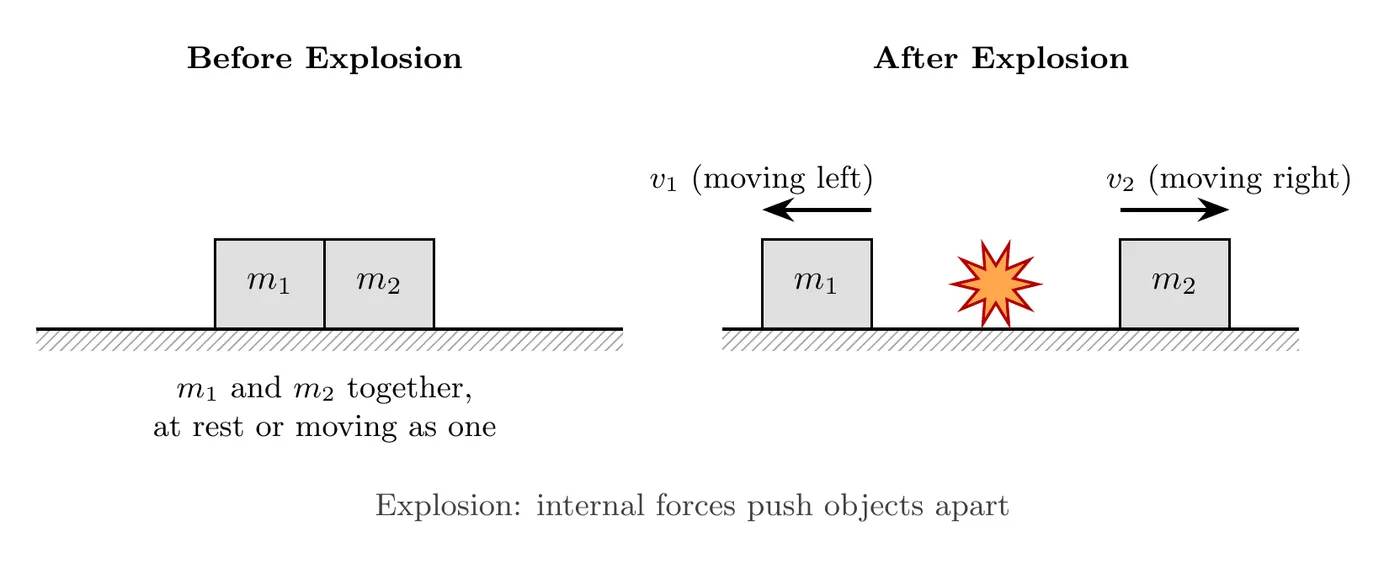
Examples include a firecracker exploding, firing a rifle (bullet forward, gun recoils backward), a person jumping off a boat (person forward, boat backward), and rocket propulsion (exhaust backward, rocket forward).
Relationship Between Momentum and Kinetic Energy
Momentum () and kinetic energy () are related but distinct, and it’s useful to express one in terms of the other.
Starting from , solving for velocity gives . Substituting into :
This can also be rearranged to give or , useful when kinetic energy is known and you need momentum.
Standard Form | Momentum Form |
Useful when velocity known | Useful when momentum known |
Emphasizes velocity’s quadratic effect | Emphasizes momentum’s quadratic effect |
Both forms show a quadratic relationship, doubling velocity quadruples , and doubling momentum also quadruples for a fixed mass.
Here’s a useful insight: if two objects have the same momentum but different masses, tells us the lighter object has more kinetic energy, since kinetic energy is inversely proportional to mass at fixed momentum. For example, a 2000 kg truck at 10 m/s has kg·m/s and J, while a 200 kg motorcycle at 100 m/s also has kg·m/s but J, ten times more kinetic energy despite identical momentum. This matters because in collisions, momentum is conserved but kinetic energy might not be, so understanding both quantities is essential.
Checking units: , with no special name, just kilogram-meters per second. And checking : , confirming the units work out to energy.
Proportionality Relationships
At constant velocity, , directly proportional, double the mass and you double the momentum. At constant mass, , also directly proportional, double the velocity and you double the momentum. Compare that to kinetic energy, which goes as (quadratic) rather than linear, meaning velocity has a much bigger effect on kinetic energy than it does on momentum.
Real-World Examples
Stopping distance: heavy trucks take longer to stop than cars at the same speed because higher mass means higher momentum at the same velocity, which means more momentum to remove, which means a longer stopping distance or a greater stopping force.
Sports: linebackers want high mass moving at a good speed for high momentum, making them hard to stop when tackling. Fast pitches carry high momentum even from a low-mass ball, thanks to high velocity, making it hard for a batter to redirect.
Safety: crumple zones extend collision time, which reduces the force needed to change momentum (more in the impulse-momentum theorem next), and airbags increase stopping time, decreasing the force on a passenger during that momentum change.
Common Misconceptions
Momentum and kinetic energy are the same: not true, momentum is a vector (has direction), kinetic energy is a scalar (no direction), they have different units (kg·m/s vs. Joules), and they follow different conservation rules in collisions.
Symbol confusion: don’t use for momentum, use for momentum and for mass.
Momentum requires motion: technically, if , then , an object at rest has zero momentum. But watch out, a system’s total momentum can be zero even while individual objects are moving, if their momenta are equal and opposite.
Key Takeaways
- Linear momentum: , the product of mass and velocity
- “Linear” distinguishes it from angular momentum (rotation)
- Units: kg·m/s, with no special name
- The symbol is , not
- Momentum is inertia in motion, combining mass and velocity
- Momentum is a vector, matching velocity’s direction
- High momentum objects are hard to stop or redirect
- A collision is objects coming together with large interaction forces during brief contact
- Collision model: the forces between the colliding objects are much larger than the net external force, so external forces can be ignored during the brief collision
- Only the states just before and just after a collision are compared, so each object can be treated as a single point (object model)
- An explosion is internal forces pushing objects apart from an initially close or touching state
- Both collisions and explosions conserve momentum (next topic)
- Relationship to kinetic energy:
- Derivation method: solve for , substitute into
- Momentum proportional to mass: at constant velocity
- Momentum proportional to velocity: at constant mass
- Same momentum but different masses means the lighter object has more kinetic energy
- Use vector addition for total momentum in a system
- Useful alternate form: when kinetic energy is known
- A system’s total momentum stays constant when there’s no net external force on it, in collisions and explosions alike (coming up next)