

7.2 - Frequency and Period of SHM
Period and Frequency
Period () and frequency () in SHM are inverse relationships:
where is period, measured in seconds per cycle, and is frequency, measured in cycles per second, or Hertz (Hz). Period is the time to complete one full oscillation, and frequency is the number of complete oscillations per unit time.
Because and are reciprocals, they always change in opposite directions: double the frequency and the period is cut in half. In the lab, it’s more accurate to time many oscillations and divide than to time just one. Your reaction time on the stopwatch adds about the same error either way, but dividing by the number of oscillations spreads that error out.
Angular Frequency
Angular frequency () relates to period and frequency:
with units of rad/s. In the context of oscillations, represents angular frequency, not angular speed, even though it’s the same symbol used in rotational motion.
Period of a Mass-Spring Oscillator
For an ideal spring-mass system in SHM:
where is the mass in kg and is the spring constant in N/m. Larger mass gives a longer period (heavier objects oscillate more slowly), a larger (stiffer spring) gives a shorter period (stiffer springs oscillate faster), and notably, the period doesn’t depend on amplitude at all, how far you pull the mass back doesn’t matter. This equation is provided on the AP Physics 1 formula sheet.
Why mass and stiffness matter: a larger mass has more inertia, so the same spring force gives it a smaller acceleration and each cycle takes longer. A stiffer spring pulls harder at the same displacement, so the acceleration is larger and each cycle is quicker. Gravity doesn’t appear in the equation at all, so a spring-object system has the same period whether it hangs vertically, lies on a table, or is taken to the Moon.
Functional dependence: and . Multiply the mass by 4 and the period doubles. Multiply by 4 and the period is cut in half. The AP equation sheet writes this equation as , with the subscript for spring.
The frequency follows as .
Period of a Simple Pendulum
For a simple pendulum undergoing small-angle oscillations:
where is the pendulum’s length in meters and is gravitational acceleration in m/s². A longer pendulum gives a longer period, stronger gravity gives a shorter period, and notably, the bob’s mass doesn’t affect the period at all, nor does amplitude, for small angles. This equation is also on the AP Physics 1 formula sheet.
Why mass doesn’t matter for a pendulum: for a small angle, the restoring force is about , and the bob’s distance from equilibrium along the arc is . So the restoring force is about , which has the same form as a spring force, , with an effective spring constant of . Put that into the spring formula:
The mass cancels. A heavier bob feels a bigger restoring force, but it also has more inertia, by exactly the same factor, so its acceleration at each point of the swing (and its period) stays the same. The AP equation sheet writes this equation as , using for the length.
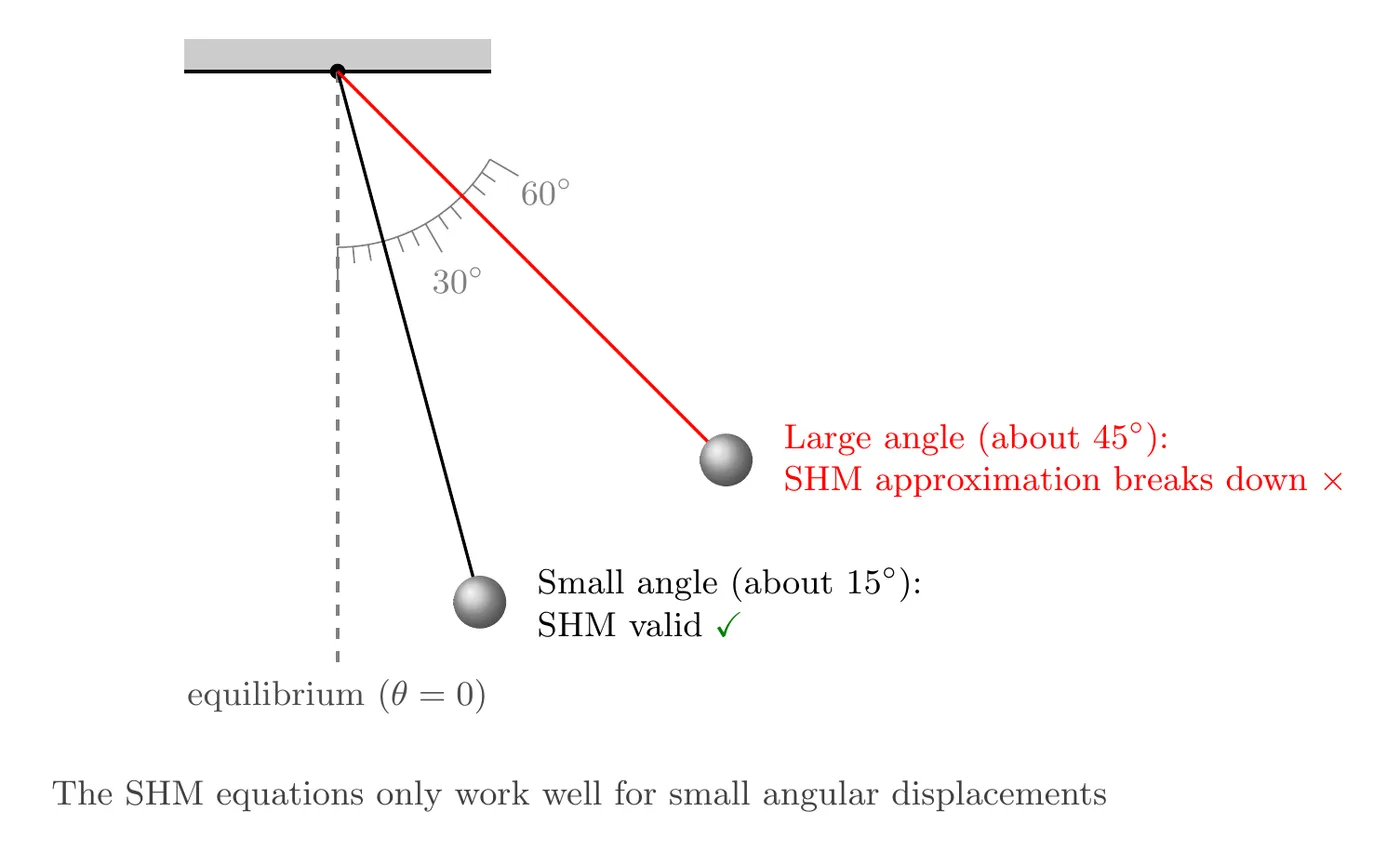
This formula only holds for small angles. Up to about 15°, the true period is within 0.5% of . At 20° it’s about 0.8% longer, and at 30° about 1.7% longer. The reason is the restoring force: it’s really , and at larger angles is noticeably smaller than , so the restoring force is no longer proportional to the displacement. The pendulum still swings back and forth (it’s still periodic), but it isn’t SHM anymore, and its period grows a little as the amplitude grows.
Application: Determining Gravitational Acceleration
The pendulum equation lets you experimentally measure gravitational acceleration. Starting from : dividing by gives , squaring both sides gives , cross multiplying gives , and solving for :
This method could, in principle, be used on other planets (Mars, the Moon, and so on) to find their gravitational acceleration, just by timing a pendulum of known length.
Linearizing Data for Lab Analysis
Both mass-spring and pendulum systems can be analyzed by linearizing their equations into straight-line graphs.
Mass-spring linearization: starting from . Plotting vs. gives a straight line with slope , letting you solve for . Alternatively, squaring gives , and plotting vs. gives a straight line with slope , so . This method involves varying the mass and measuring how the period responds to determine the spring constant.
Pendulum linearization: starting from . Plotting vs. gives a straight line with slope , letting you solve for . Alternatively, , and plotting vs. gives a straight line with slope , so . This involves varying the pendulum length and measuring the resulting periods to find gravitational acceleration.
Worked Example: Finding g from Pendulum Data
A simple pendulum has length cm and period s. Find the local acceleration due to gravity.
Using , with m:
That’s very close to the standard value of 9.8 m/s².
Worked Example: Period of a Mass-Spring System
A mass kg is attached to a spring with N/m and set oscillating. Find the period and frequency.
Period:
Frequency:
About 2.0 Hz, roughly 2 oscillations per second.
Worked Example: Comparing Two Pendulums
Pendulum A has length m, Pendulum B has length m, both on Earth. Find the ratio .
Pendulum A’s period is about 1.58 times longer than Pendulum B’s.
Worked Example: Period and Frequency from a Count
A toy hanging from a spring completes 24 full oscillations in 15.0 s. Find its period and frequency.
Check: Hz, the same answer. The 24 is an exact count, so the answers keep the three significant figures of 15.0 s. If your stopwatch reaction time is off by 0.2 s, that’s an error of less than 0.01 s in each period, since it’s spread over 24 oscillations.
Worked Example: Factors of Change
A 0.50 kg block on a spring oscillates with a period of 1.2 s. Find the new period if (a) the block is replaced with a 2.0 kg block, (b) the 0.50 kg block is hung from a spring that is twice as stiff, or (c) the original system is taken to the Moon, where m/s².
(a) The mass is multiplied by 4, and , so the period is multiplied by : s.
(b) is multiplied by 2, and , so the period is divided by : s.
(c) has no in it, so the period is still 1.2 s. The spring stretches less when the block hangs at rest on the Moon, but that only moves the equilibrium position.
Worked Example: A Pendulum on the Moon
A pendulum has a period of 2.0 s on Earth. Find its period on the Moon, where m/s² (use m/s² for Earth). Set up a ratio so the length cancels:
Weaker gravity means a weaker restoring force on the same mass, so the bob speeds up more slowly and each swing takes longer. Compare this with part (c) of the last example: the spring’s period didn’t change on the Moon, but the pendulum’s more than doubled.
Worked Example: Finding the Spring Constant from a Graph
A student hangs different masses from the same spring, pulls each one down a few centimeters, and times 10 full oscillations. Sample data are below. Find the spring constant using a graph.
Mass (kg) | Time for 10 oscillations (s) | Period (s) | (s²) |
0.20 | 9.0 | 0.90 | 0.81 |
0.40 | 12.5 | 1.25 | 1.56 |
0.60 | 15.5 | 1.55 | 2.40 |
0.80 | 17.7 | 1.77 | 3.13 |
1.00 | 19.9 | 1.99 | 3.96 |
Choosing what to graph: vs. would curve, because . Squaring gives a straight-line form:
So plot on the vertical axis and on the horizontal axis. The points should fall on a line through the origin with a slope of .
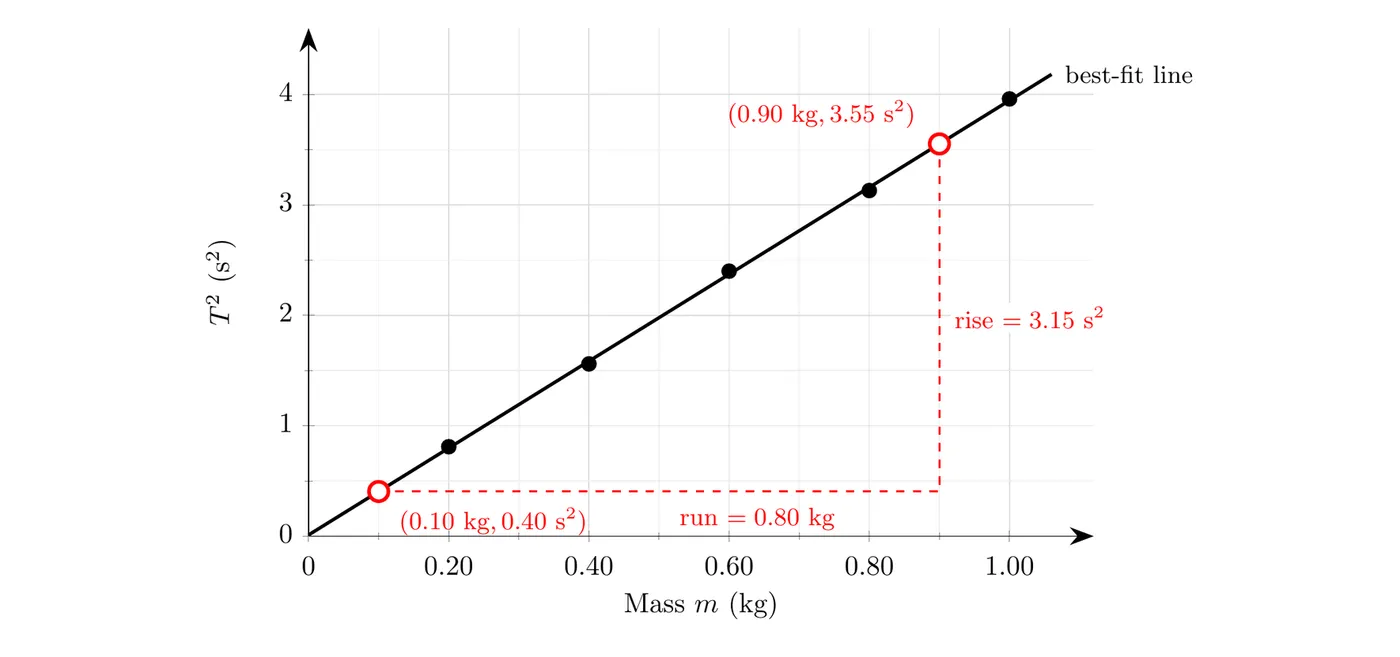
Slope: draw one best-fit line through the data (not a line connecting the first and last points), then pick two points on the line that are far apart. Here, (0.10 kg, 0.40 s²) and (0.90 kg, 3.55 s²):
The units work out because . Using the slope of a best-fit line instead of a single trial averages out the random timing errors. The line also passes very close to the origin, as the equation predicts, which is a good sign the model fits.
Procedure tips: keep the amplitude small (it doesn’t change the period, but big bounces can make the spring swing sideways), start and stop timing as the mass passes through equilibrium, where it moves fastest and the moment is easiest to judge, and repeat each trial a few times and average.
Common Mistakes
Thinking amplitude affects period: for ideal SHM, period never depends on amplitude, pulling a spring 5 cm or 10 cm doesn’t change the period, and neither does displacing a pendulum 10° or 15° (within the small angle approximation).
Confusing the mass-spring and pendulum formulas: mass-spring is (mass in the numerator), while the pendulum is (no mass dependence at all), don’t mix these up.
Using the pendulum formula for large angles: it only holds for small angles, under about 15° (where the error in the period is under about 0.5%), larger angles need more complex analysis.
Forgetting unit conversions: length has to be in meters, period in seconds, always convert before plugging into the equations.
Confusing angular frequency with angular velocity: in oscillations, is angular frequency, in rotation, is angular velocity, same symbol, different context.
Algebra errors solving for or : squaring properly gives , not , the becomes once squared.
Using diameter instead of length for a pendulum: is the distance from the pivot to the bob’s center of mass, not the bob’s diameter, and not the total length of string plus bob.
Thinking stiffer springs have longer periods: it’s the opposite, stiffer springs (larger ) have shorter periods, since sits in the denominator of .
Plotting the wrong variables when linearizing: vs. isn’t linear, you need vs. or vs. to get a straight line, check that your chosen variables actually give a form.
Forgetting multiple trials in lab design: always collect multiple data points, vary the independent variable (mass for springs, length for pendulums), and measure the period more than once for each setup to reduce error.