

7.1 - Defining Simple Harmonic Motion (SHM)
Periodic Motion
Periodic motion is any motion that repeats at regular time intervals, like the Earth orbiting the Sun (a one-year period), a clock pendulum swinging back and forth, ocean tides rising and falling, or seasonal weather patterns. The defining trait is that the motion follows the same pattern over and over, with consistent timing.
Simple Harmonic Motion
Simple harmonic motion (SHM) is a special case of periodic motion, where a restoring force acts on an object, and that force is directly proportional to the object’s displacement from equilibrium. There must be an equilibrium position (a stable point with zero net force), a restoring force that kicks in whenever the object is displaced, that restoring force must be proportional to displacement, and the resulting motion repeats in a regular, predictable pattern.
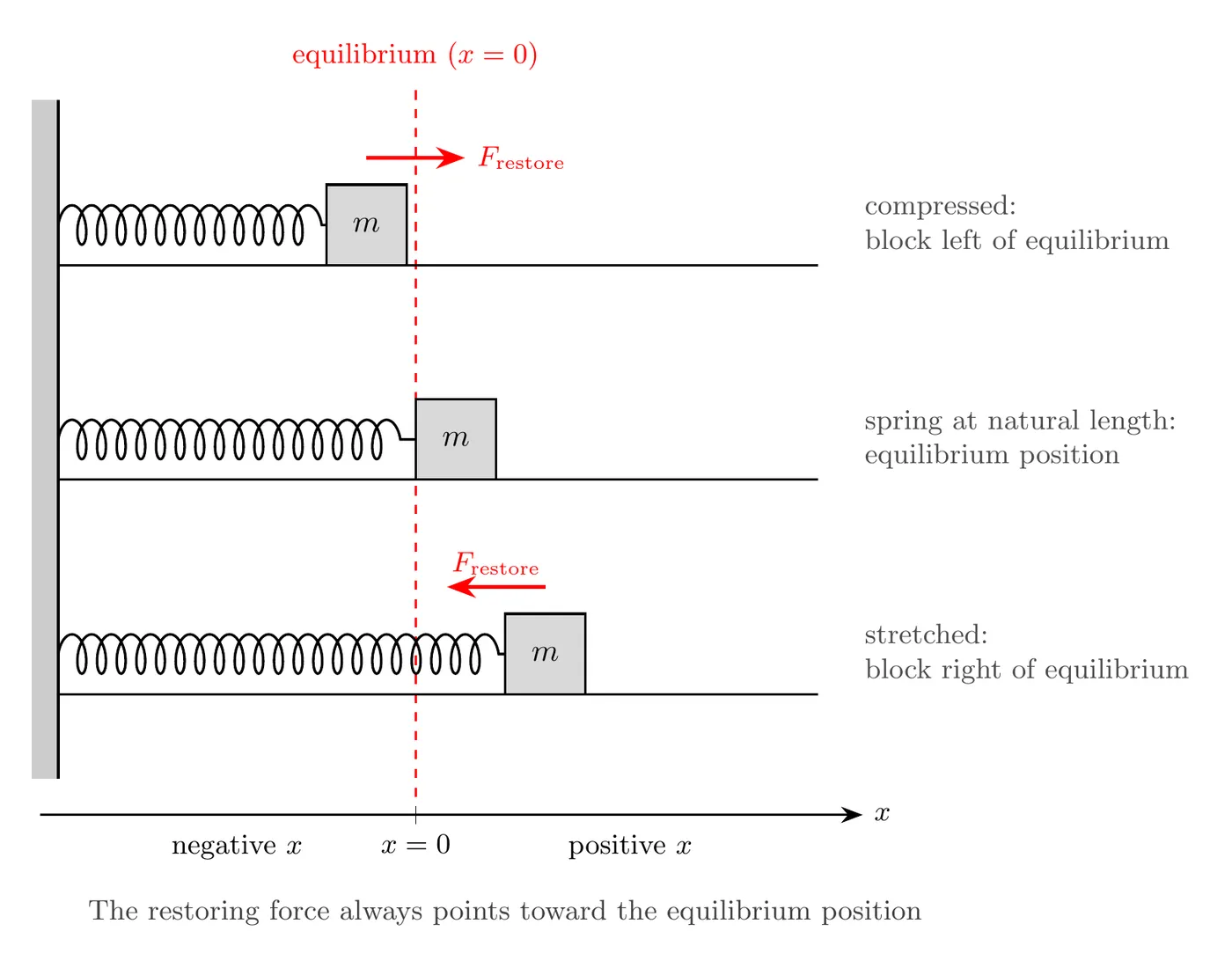
A restoring force is a force exerted in the direction opposite to the object’s displacement from equilibrium, so it always points back toward the equilibrium position. Pull a block on a spring to the right and the spring pulls it left. Push it to the left and the spring pushes it right.
A restoring force by itself isn’t enough for SHM. The motion is simple harmonic only when the magnitude of the restoring force is proportional to the displacement from equilibrium: twice as far from equilibrium means twice the restoring force, and three times as far means three times the force. That proportionality is what gives SHM its two signature features. The position vs. time graph is a sine or cosine curve, and the period doesn’t depend on the amplitude (how far the object is pulled).
Periodic, but not SHM: every SHM is periodic, but not every periodic motion is SHM. A ball bouncing straight up and down on a hard floor repeats its motion, so it’s periodic. But while it’s in the air, the only force on it is gravity, which is the same at every height. The restoring force doesn’t grow with distance from the floor, so the motion isn’t SHM, and its position vs. time graph is a row of upside-down parabolas instead of a cosine curve. A worked example below puts numbers on this.
Equilibrium Position
The equilibrium position is where the net force on an object or system is zero. For oscillating systems, this is the “resting” position, and when displaced, restoring forces pull the system back toward it. The object passes through equilibrium at maximum speed, and at that exact point, acceleration is zero even though velocity is at its peak.
Two Types of Simple Harmonic Oscillators
Mass-spring system: a mass attached to a spring undergoes SHM when displaced and released, with the restoring force given by Hooke’s Law:
where is the spring constant in N/m, is displacement from equilibrium in meters, and the negative sign shows the force opposes the displacement.
Pendulum: a mass suspended from a fixed point, swinging back and forth under gravity, with the restoring force being a component of gravity:
where is the bob’s mass, is gravitational acceleration, is the angle from vertical, and again the negative sign shows opposition to displacement. For small angles (under about 15°), (in radians), and a pendulum’s period stays within about 0.5% of the small-angle formula in 7.2.
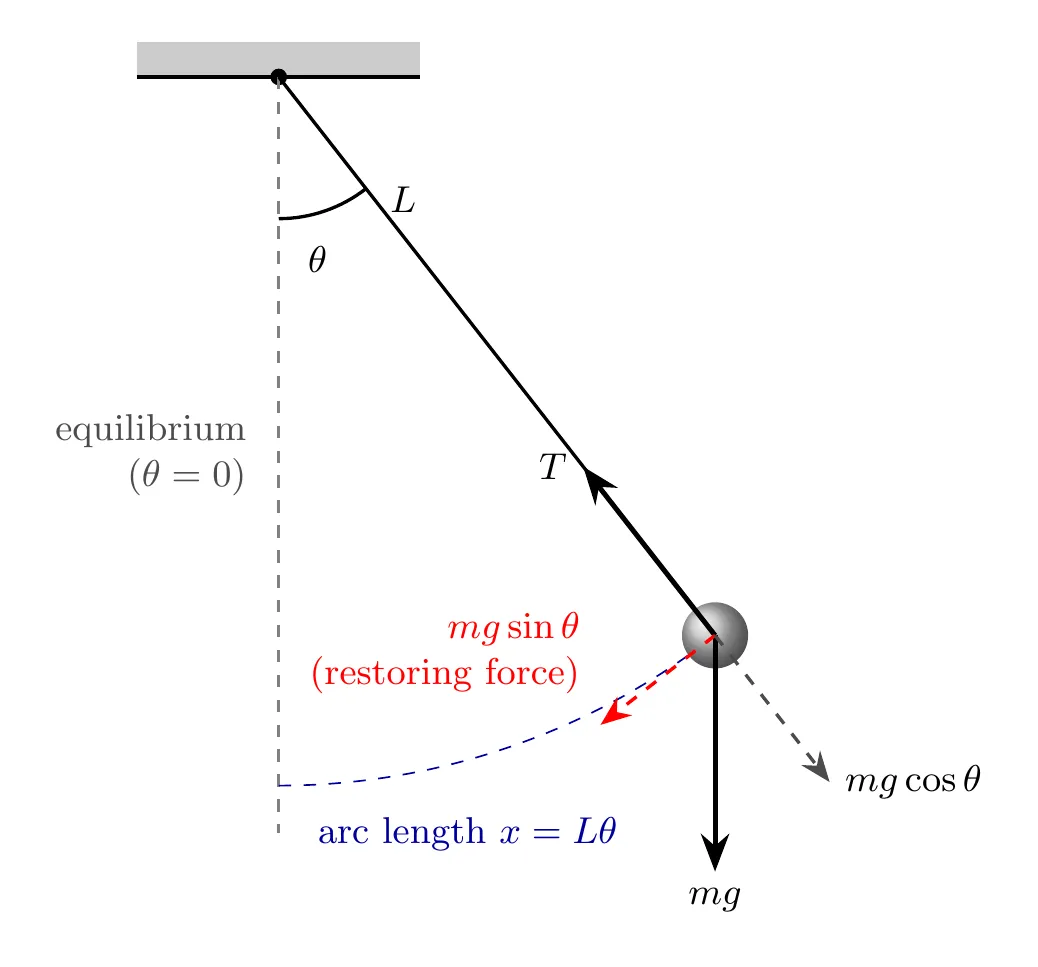
Why a pendulum is SHM (restoring torque): you can also think of the pendulum as rotating about the pivot. The restoring component of gravity, , is perpendicular to the string and acts a distance from the pivot, so it exerts a torque about the pivot ( on the equation sheet) that always twists the bob back toward the vertical:
For small angles, (in radians), so the restoring torque is proportional to the angular displacement . That’s the rotational version of , which is why a pendulum with a small angular displacement can be modeled as SHM. At large angles, grows more slowly than , so the torque is no longer proportional to the angle. The pendulum still swings back and forth, but the motion is no longer simple harmonic.
Deriving Acceleration for a Mass-Spring System
Consider a mass on a frictionless horizontal surface, attached to a spring with constant , pulled some distance from equilibrium and released.
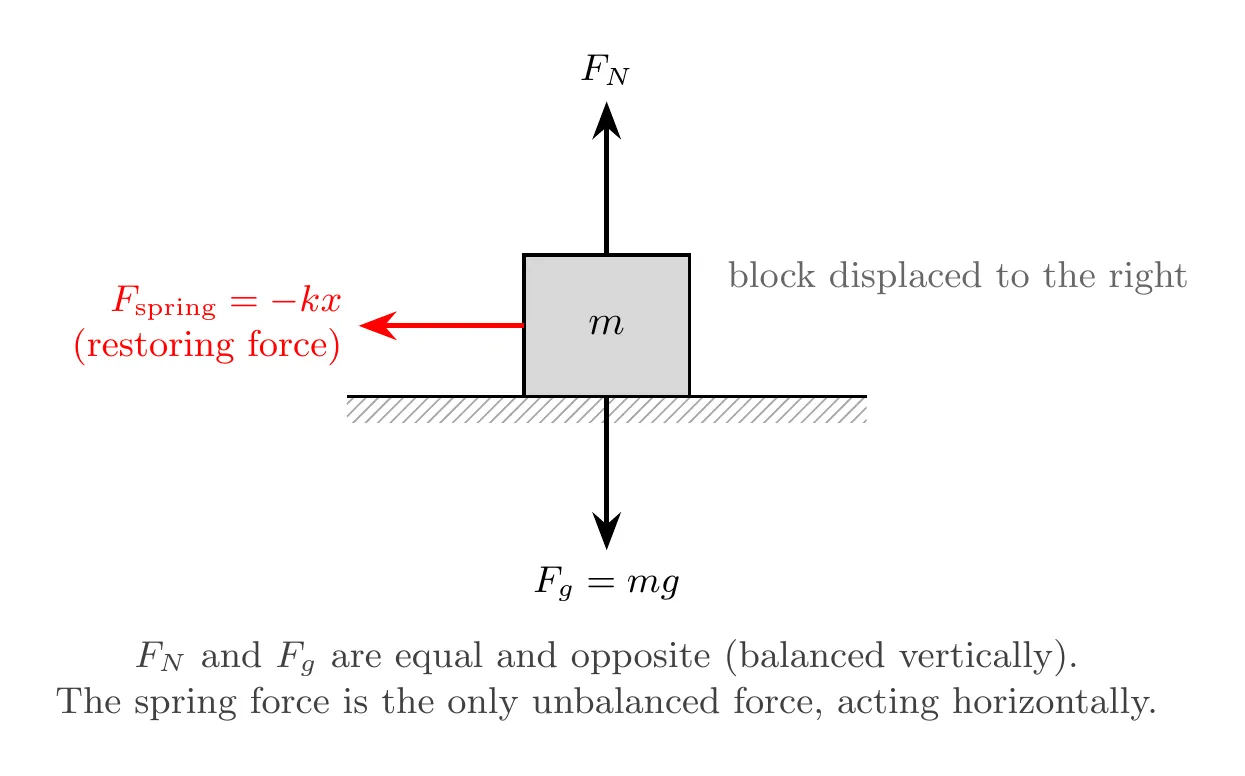
In the horizontal direction, the only force is the spring force:
Solving for acceleration:
The minus sign means the acceleration always points back toward equilibrium, and its magnitude is proportional to displacement, so maximum acceleration happens at maximum displacement.
AP Physics 1 writes this as the derived equation for SHM, using to stress that the displacement is measured from the equilibrium position:
It comes straight from Newton’s second law and the spring force on the AP equation sheet, . It also works as a test for SHM in any system: if the net force can be written as a negative constant times the displacement from equilibrium, the motion is simple harmonic, and that constant plays the role of .
Worked Example: Mass-Spring Maximum Acceleration and Velocity
A block of mass on a frictionless surface is attached to a spring with constant , pulled a distance from equilibrium, and released. Find expressions for the maximum acceleration and maximum velocity.
Maximum acceleration: occurs at maximum displacement, where the spring force is greatest. At :
Maximum velocity (using energy): maximum velocity happens at equilibrium, once all the potential energy has converted into kinetic energy. Initially (at ): (starting from rest), . Finally (at ): , .
Applying conservation of energy:
Solving for :
Worked Example: Vertical Mass-Spring System
A 0.50 kg block hangs from a spring with N/m, pulled down 0.15 m from equilibrium and released. Find the maximum acceleration and maximum velocity.
Maximum acceleration:
Maximum velocity:
Why gravity doesn’t change the answer: the block’s equilibrium position is not where the spring is unstretched. Equilibrium is where the net force is zero, so the spring’s upward pull balances gravity: , where is how far the spring is already stretched when the block hangs at rest.
Now pull the block a distance below equilibrium. The spring is stretched , so it pulls up with , while gravity still pulls down with . The net force is , pointing up, back toward equilibrium. That’s a restoring force proportional to the displacement from equilibrium, with the same , so a vertical spring does SHM exactly like a horizontal one. Gravity only shifts where the equilibrium position is. That’s why the example measures the 0.15 m from equilibrium and never needs .
Worked Example: Restoring Force at Two Positions
A 0.25 kg cart on a level, frictionless track is attached to a spring with N/m. Take to the right, with at equilibrium. Find the spring force and the cart’s acceleration when the cart is (a) 0.080 m to the right of equilibrium and (b) 0.040 m to the left of equilibrium.
(a) The displacement is m:
Both are negative: the force and the acceleration point left, back toward equilibrium.
(b) The displacement is m:
Half the distance from equilibrium gives half the force and half the acceleration (6.4 m/s² vs. 12.8 m/s²), and the direction flips because the cart is on the other side. A force that is proportional to the displacement and always points back toward equilibrium is exactly the SHM condition.
Worked Example: Periodic but Not SHM
A rubber ball is dropped from rest 1.2 m above a hard floor and bounces perfectly elastically, so it keeps returning to 1.2 m. Find its period. Then find the period if it’s dropped from 0.30 m instead, and decide whether the motion is SHM. Use m/s².
Period from 1.2 m: the ball falls from rest with acceleration , so gives the fall time. Rising back up takes the same time, so one full cycle is twice the fall time:
Period from 0.30 m:
Is it SHM? The motion repeats, so it’s periodic. But a quarter of the height gave half the period, so the period depends on the amplitude, and in SHM the period never depends on amplitude. The reason is the force: in the air, the only force on the ball is gravity, a constant no matter how high the ball is, so the restoring force isn’t proportional to the displacement. Periodic, but not simple harmonic.
Worked Example: Restoring Torque on a Pendulum
A 0.200 kg bob hangs from a 0.800 m string. Find the restoring torque about the pivot when the string makes (a) 6.0° and (b) 12.0° with the vertical. Then compare the torques at 40° and 80°. Use m/s².
The restoring force acts perpendicular to the string, a distance from the pivot, so the torque has magnitude , where N·m.
Doubling the small angle almost exactly doubles the torque (), so the torque is proportional to the angular displacement and the motion is SHM. Now the large angles:
Doubling a large angle only multiplies the torque by about 1.53, so the proportionality breaks down. A pendulum swinging out to 80° is periodic, but it isn’t SHM, and won’t give its period.
Energy Considerations in SHM
Throughout SHM, mechanical energy oscillates between kinetic and potential forms. At maximum displacement (), velocity is zero and all energy is potential, . At equilibrium (), displacement is zero and all energy is kinetic, . At intermediate positions, the energy splits between the two, but the total remains constant if there’s no friction:
Common Mistakes
Confusing where maximum acceleration and maximum velocity occur: maximum acceleration happens at maximum displacement (farthest from equilibrium), while maximum velocity happens right at equilibrium (), they never occur at the same spot.
Forgetting the negative sign in restoring force: the restoring force always points toward equilibrium, if displaced right (), the force points left, and the equation already builds this in.
Using the wrong displacement value: for maximum acceleration, always use the maximum displacement, , don’t substitute a smaller value.
Not knowing when to use energy vs. force methods: use Newton’s Second Law to find acceleration, and energy conservation to find velocity (especially maximum velocity), energy methods are often easier when comparing velocities at different positions.
Assuming velocity peaks where acceleration peaks: they’re actually opposite, when the spring force is strongest (maximum displacement), the object is momentarily stopped, and when it passes through equilibrium (zero net force), it’s moving fastest.
Misusing for pendulums: this is only the tangential (restoring) component, and don’t forget the small angle approximation (in radians), valid only for small angles, typically under 15°.
Setting up energy equations incorrectly: make sure you’re placing potential energy at the right position, maximum displacement means all potential energy, equilibrium means all kinetic energy.
Sign errors in acceleration: acceleration always has the same sign as the restoring force, and is opposite to the displacement direction, positive means negative acceleration, and vice versa.