

7.3 - Representing and Analyzing SHM
Mathematical Representation of SHM
Simple harmonic motion can be described mathematically with sine or cosine functions. Displacement from equilibrium as a function of time follows one of:
where is displacement at time in meters, is amplitude (maximum displacement) in meters, is frequency in Hz, and is time in seconds. Time () is the independent variable, displacement () is the dependent variable.
Choosing Between Sine and Cosine
The choice depends on where the object is at .
Use cosine when starting at maximum displacement ( at ), since , representing an object pulled to maximum displacement and released. Most problems use cosine.
Use sine when starting at equilibrium ( at ), since , representing an object passing through equilibrium at the starting instant.
The Three Functions of SHM
A complete description needs three related functions.
Displacement:
Velocity: , or with angular frequency (),
Acceleration: , or with angular frequency,
Maximum Values
Quantity | Maximum Value |
Displacement | |
Velocity | |
Acceleration |
Graphical Representation
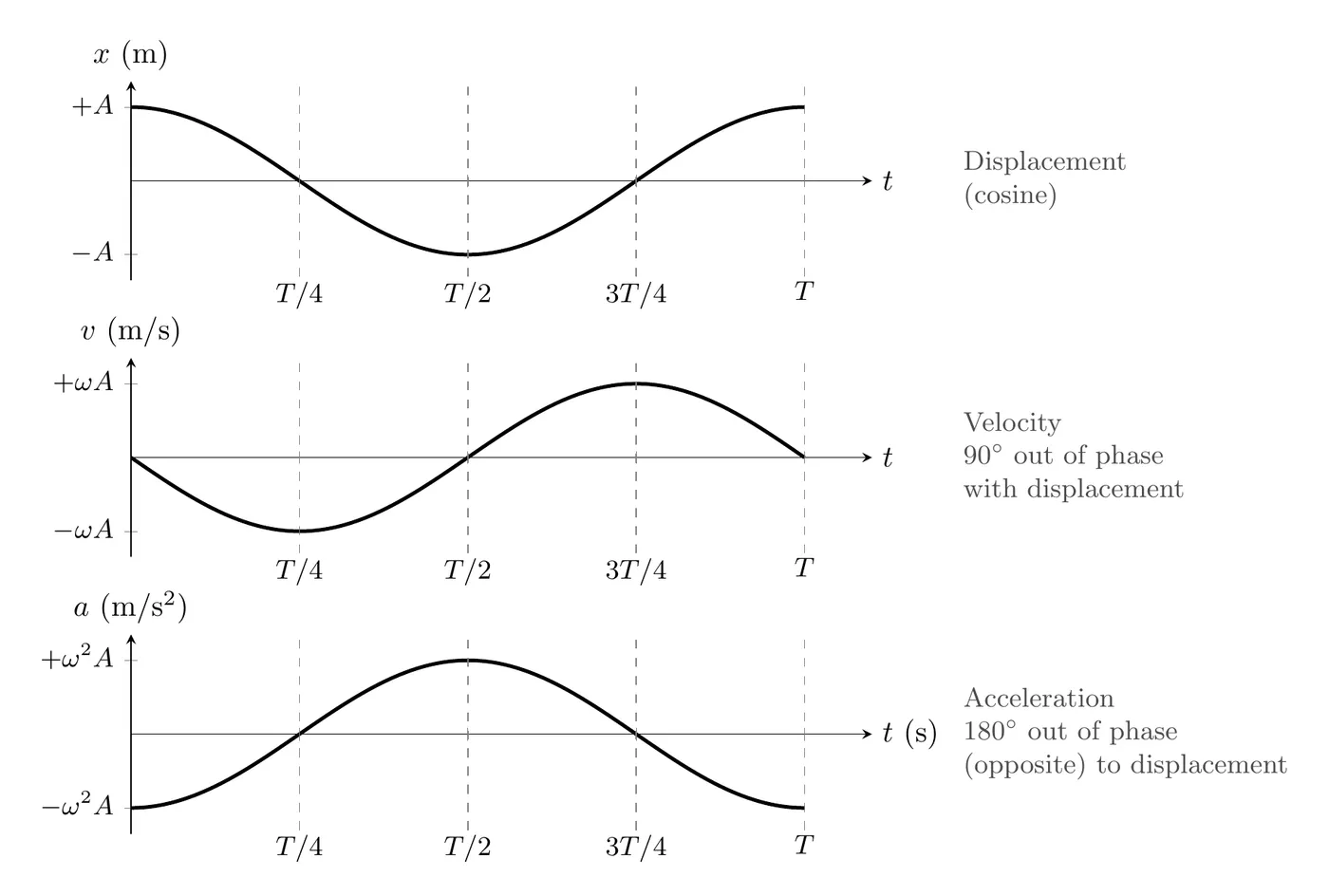
When displacement is at maximum (), velocity is zero and acceleration is at its maximum magnitude (). When displacement is zero (at equilibrium), velocity is at its maximum magnitude () and acceleration is zero. In terms of phase, velocity leads displacement by 90° ( radians), and acceleration is 180° ( radians) out of phase with displacement, meaning acceleration always points opposite to displacement.
Here’s one full cycle as a table, for an object released from rest at (the cosine case, matching the graphs above):
Time | Where the object is | Displacement | Velocity | Acceleration |
turning point (positive end) | (max) | |||
equilibrium, moving in the direction | ||||
turning point (negative end) | (min) | |||
equilibrium, moving in the direction | ||||
back at the start | (max) |
Opposite signs: and always have opposite signs, and is zero exactly where is zero. The acceleration always points toward equilibrium.
Extremes and zeros line up: where is at a maximum or minimum, is zero (the object is turning around). Where is zero, the speed is at its maximum.
Speeding up or slowing down: moving toward equilibrium, and point the same way, so the object speeds up. Moving away from equilibrium, they point opposite ways, so it slows down.
Reading slopes: the velocity at any instant is the slope of the vs. graph, so the velocity is zero at the peaks and valleys (where the graph is flat) and largest at the zero crossings (where it’s steepest). In the same way, the acceleration is the slope of the vs. graph.
Important Properties
Amplitude doesn’t affect period at all, changing how far you pull the mass changes how far it travels, but not the frequency or period, a larger amplitude travels farther at the same frequency, and a smaller amplitude travels less far, also at the same frequency.
Why: for a spring, doubling the amplitude doubles the restoring force at every matching point in the cycle (since ), which doubles the acceleration, which doubles the speed. The object has twice as far to go, but it moves twice as fast the whole way, so each cycle takes the same time. You can also see it in the equations: and have no in them. (For a pendulum, this holds only while the angle stays small.)
On a graph, a bigger amplitude stretches the curve vertically, but the peaks and zero crossings stay at the same times:
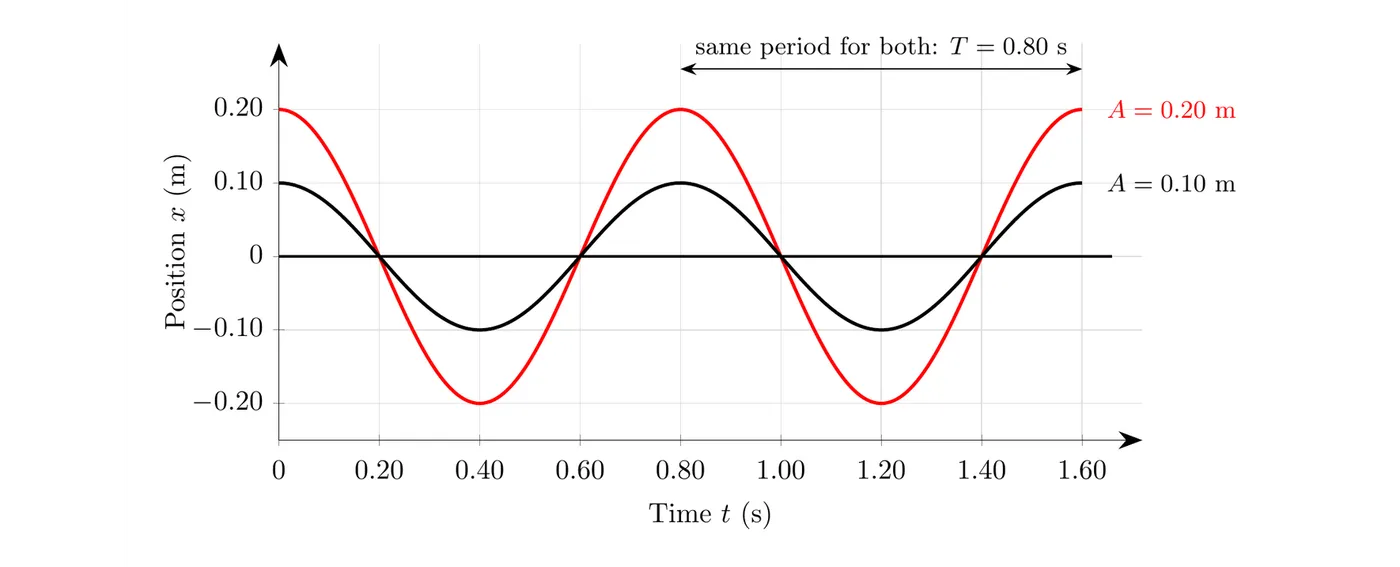
The graphs’ key features, maxima, minima, and zero-crossings, help you identify where kinetic energy is maximum, where potential energy is maximum, and where the object changes direction.
Worked Example: Analyzing an SHM Function
An object’s motion follows , with in meters and in seconds. Find the maximum displacement, frequency, period, displacement at s, and the first positive time when displacement is zero.
Maximum displacement: the amplitude is the coefficient in front of cosine, m.
Frequency: comparing to the general form , we see Hz.
Period: s.
Displacement at s:
Making sure the calculator is in radian mode, , so m. This makes sense, since the period is 1 second, at s the object has completed exactly 4 full cycles and returned right back to its starting position.
First positive time when : setting , dividing by 6, . Taking the inverse cosine, , so s. Physically, starting at maximum displacement, the object reaches equilibrium after a quarter of a period.
Worked Example: Creating an SHM Equation
A mass oscillates with amplitude m and frequency Hz, starting at maximum positive displacement at . Write the displacement equation.
Since it starts at maximum displacement, use cosine:
Worked Example: Finding Maximum Velocity
A simple harmonic oscillator follows . Find the maximum velocity.
From the equation, m and rad/s (the coefficient of inside the cosine).
Worked Example: Phase and Negative Amplitude
An oscillator follows . Find the displacement at , and explain what the negative sign means.
At : m.
The negative sign shows the object starts on the negative side of equilibrium (below or to the left, depending on orientation). Without the negative sign, it would start at , but with it, it starts at . The object still oscillates with amplitude 3 m, it just begins at the opposite extreme compared to a positive cosine function.
Worked Example: Reading SHM Graphs
A 0.50 kg cart on a horizontal spring oscillates on a frictionless track. Its position, velocity, and acceleration graphs are below, with three instants marked P, Q, and R. (a) Find the amplitude, period, and frequency. (b) Write the equation for . (c) Find the maximum speed and maximum acceleration, and check them against the graphs. (d) Describe the motion at P, Q, and R. (e) Find the spring constant.
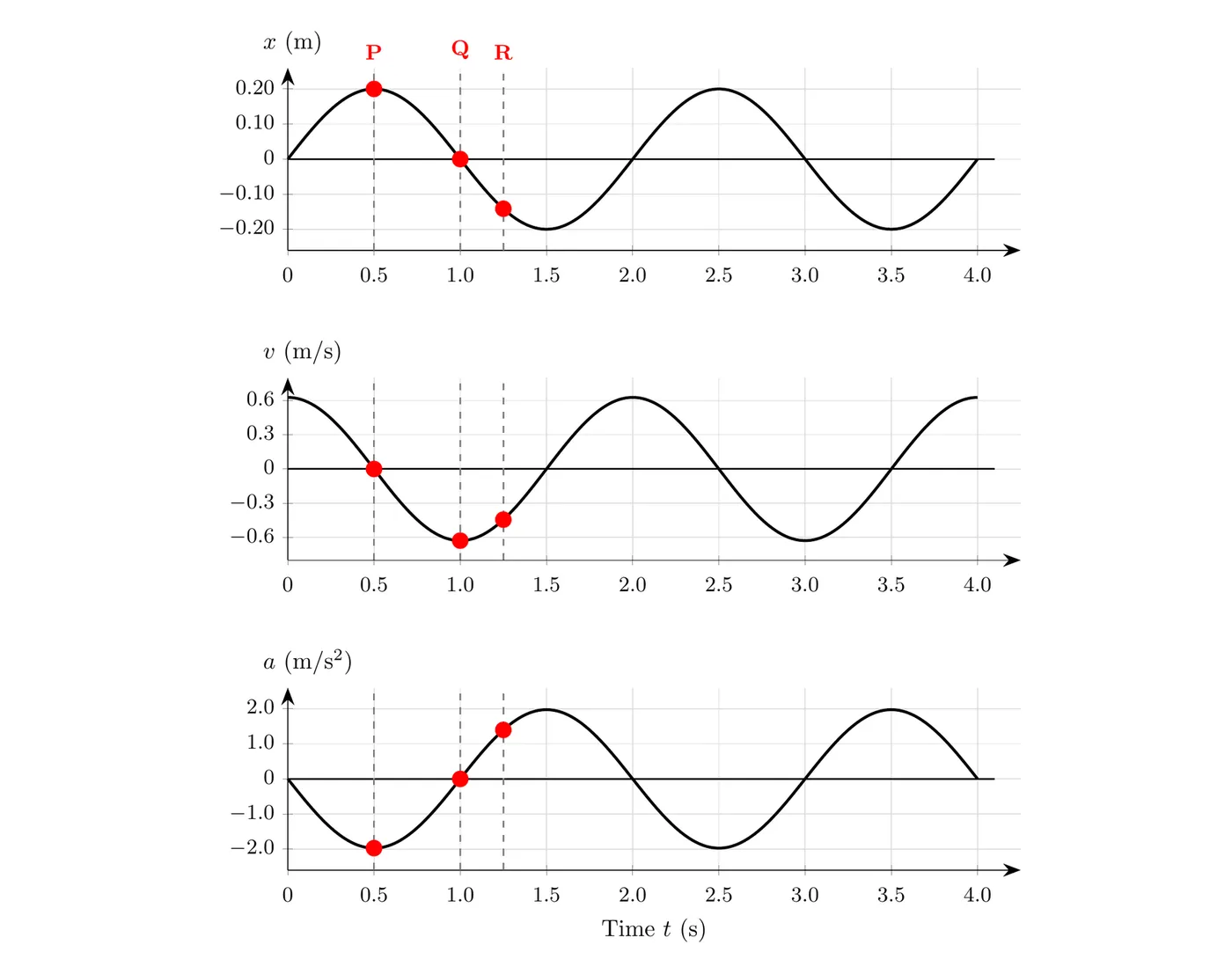
(a) From the top graph, the cart goes from m to m, so m. One full cycle (from heading in the direction, out to , back through equilibrium to , and back to heading in the direction again) takes 2.0 s, so s and Hz.
(b) At the cart is at equilibrium and moving in the direction (the graph rises), so use sine. With in meters and in seconds:
(c) Use and from the Maximum Values table:
The velocity graph peaks just above 0.6 m/s and the acceleration graph just under 2.0 m/s², so both match.
(d) At P ( s), the cart is at the positive turning point, m. It’s momentarily at rest (), and the acceleration has its largest magnitude, about m/s², pointing back toward equilibrium.
At Q ( s), the cart is passing through equilibrium () in the direction at its maximum speed, m/s. The net force is zero there, so .
At R ( s), the cart is at about m and still moving in the direction ( m/s), but the acceleration is positive (about m/s²). Velocity and acceleration point opposite ways, so the cart is slowing down as it heads toward the negative turning point, which it reaches at s.
(e) Solve for :
Check with Newton’s second law at P: m/s², the same as the graph.
Worked Example: Doubling the Amplitude
A cart on a spring is pulled 0.10 m from equilibrium and released, and it oscillates with a period of 0.80 s. It’s stopped, pulled out to 0.20 m, and released again. Find the period, maximum speed, and maximum acceleration in each case. (These are the two curves in the graph under Important Properties.)
Period: the period doesn’t depend on amplitude, so it’s 0.80 s both times, and Hz.
Doubling the amplitude doubled the maximum speed and the maximum acceleration, but not the period. The cart covers twice the distance at twice the speed, so the timing stays the same.
Connecting Angular Frequency
Since , the equations can also be written more compactly as:
Common Mistakes
Using degrees instead of radians: the argument inside sine and cosine in SHM equations is always in radians, always check your calculator is in radian mode.
Thinking amplitude affects frequency: amplitude only affects how far the object travels, period and frequency depend purely on system properties (mass, spring constant, or length), doubling amplitude never doubles the period.
Confusing sine and cosine starting conditions: cosine starts at maximum displacement, sine starts at equilibrium, always check the initial condition before choosing.
Getting the phase relationships wrong: velocity is not in phase with displacement, and acceleration is not in phase with velocity, when is at its maximum, is zero, and when is zero, is at its maximum.
Forgetting the negative signs in velocity and acceleration: the velocity function is and the acceleration function is , these negatives reflect the restoring nature of the motion.
Miscalculating maximum values: , not just , and , not , the angular frequency factors in through the derivatives.
Misreading amplitude from a negative function: in , the amplitude is still 5 m, take the absolute value, the negative sign just indicates the starting position.
Misinterpreting inverse cosine: (90° in radians), not 0, , and , know your unit circle values.
Not recognizing completed cycles: if s, then at s, the object has completed exactly 5 full cycles and returned to its starting position, a useful sanity check.
Confusing angular frequency here with rotational angular velocity: in SHM, is angular frequency, in rotational motion, is angular velocity, same units, but different physical meanings depending on the context.