

7.4 - Energy of Simple Harmonic Oscillators
Total Energy in SHM
The total mechanical energy of a system in simple harmonic motion is the sum of kinetic and potential energy:
By conservation of energy, this total stays constant throughout the oscillation, assuming no friction or air resistance. As the system oscillates, energy continuously shifts between kinetic and potential forms, whenever kinetic energy increases, potential energy decreases by the same amount, and vice versa, but the sum never changes.
The AP equation sheet uses for kinetic energy and for potential energy (, and for a spring), so AP Physics 1 writes the same idea as:
The total stays constant only for the right system: it has to include whatever stores the potential energy (the object and the spring for a spring oscillator, the bob and Earth for a pendulum), and nothing can be taking energy away, such as friction turning mechanical energy into thermal energy or an outside force doing negative work.
Energy at Key Positions
At the equilibrium position (): kinetic energy is at its maximum, , potential energy is zero, and total energy is . All energy here is kinetic, the object is moving at its top speed.
At maximum displacement (the turning points, ): kinetic energy is zero, potential energy is at its maximum (), and total energy is . The object momentarily stops here (velocity is zero), so all energy is potential, and the restoring force is at its strongest.
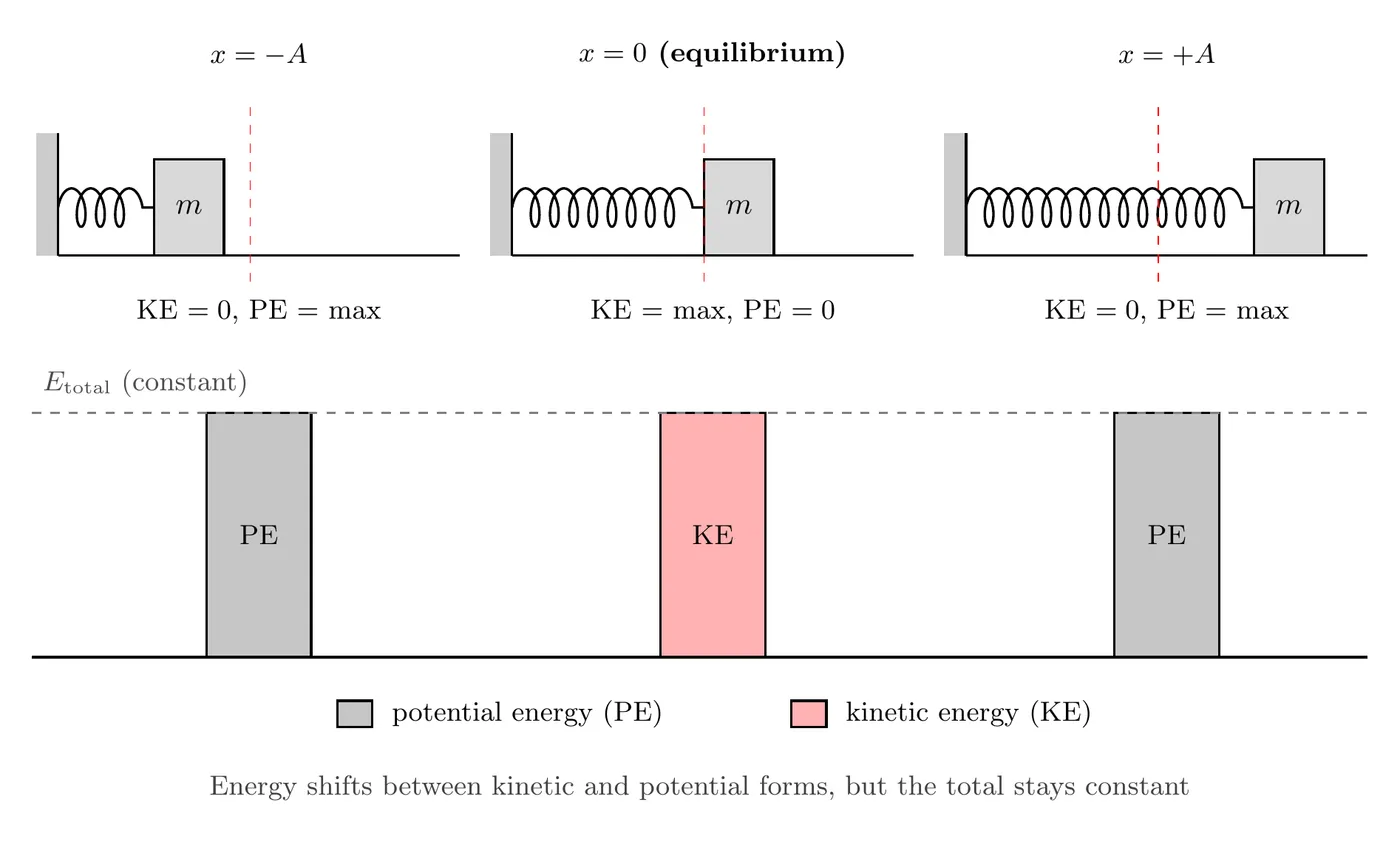
In other words, kinetic energy is at a maximum exactly when potential energy is at a minimum, and potential energy is at a maximum exactly when kinetic energy is at a minimum. The total is fixed, so the two always trade off: the more energy is stored as , the less is left for . And since can never be negative, the smallest the kinetic energy can ever be is zero, which happens at the turning points.
Minimum, not always zero: for a block hanging from a vertical spring, the spring is already stretched at equilibrium, so its elastic potential energy isn’t zero there. But the system’s total potential energy (elastic plus gravitational) is at its minimum at equilibrium, which is exactly where the kinetic energy is at its maximum. If you set that total potential energy to zero at equilibrium, it works out to at a displacement from equilibrium, so the spring equations on this page work for a vertical spring too.
Maximum Energy Equations
The maximum (total) energy depends on the type of oscillator.
Mass-spring system: the maximum energy equals the maximum elastic potential energy, , where is the spring constant and is the amplitude. This also equals the maximum kinetic energy, , so:
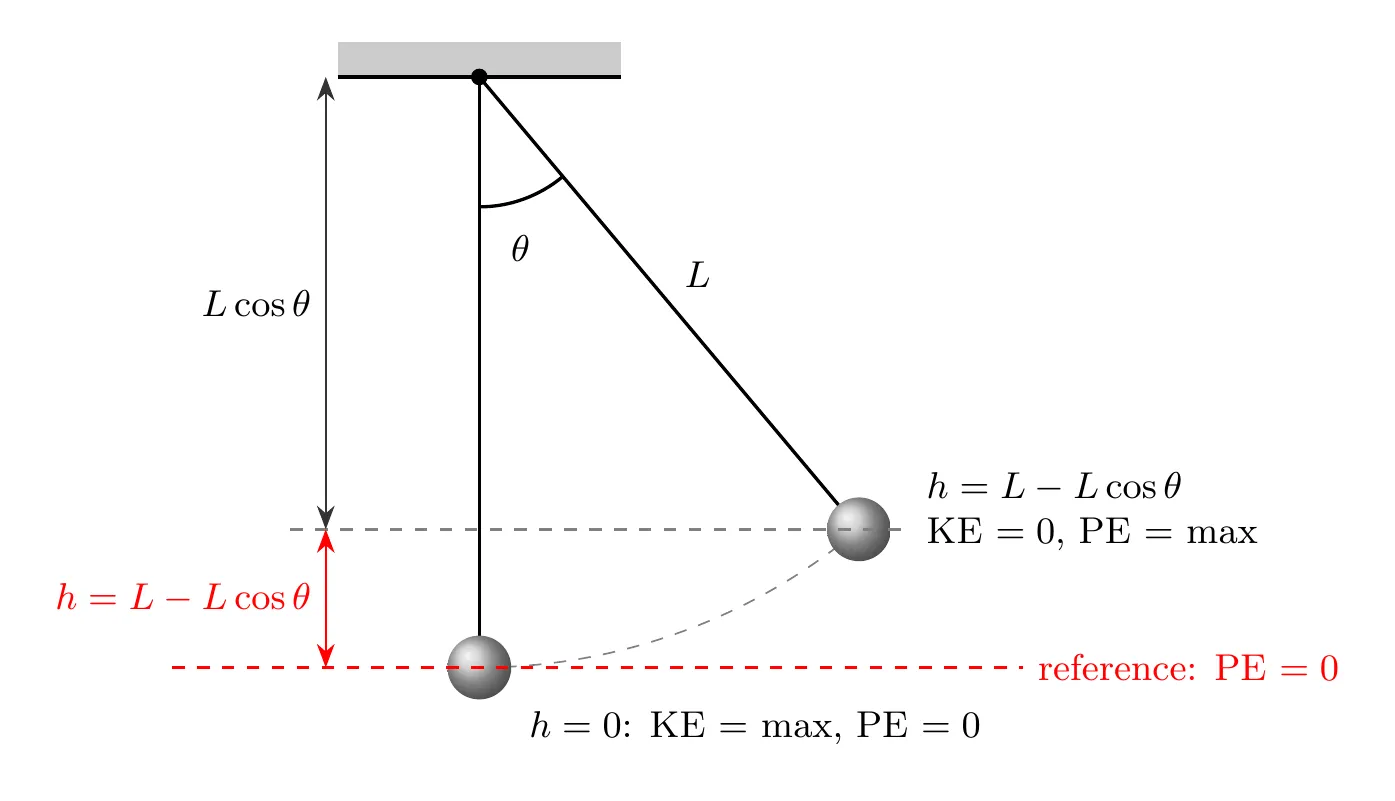
Simple pendulum: the maximum energy equals the maximum gravitational potential energy:
where is the bob’s mass, is gravitational acceleration, is the pendulum’s length, and is the maximum angle from vertical. This comes from the height difference at angle compared to the lowest point, , based on the geometry of the triangle the pendulum forms at that angle.
Effect of Amplitude on Energy
Changing the amplitude changes the total energy of the system. For a mass-spring system, : doubling the amplitude () increases the energy by a factor of 4, since , and tripling it () increases energy ninefold. In general, energy is proportional to the square of amplitude, . But changing amplitude never changes the period or frequency, those depend only on and .
Energy at Intermediate Positions
At any point between equilibrium and maximum displacement, energy splits between kinetic and potential, with the total staying constant:
At a position halfway to maximum displacement, some energy is kinetic and some potential, and how it splits depends on exactly where the object is. Closer to equilibrium means more kinetic energy and less potential. For a mass-spring at position :
Energy vs. Position Graph
Graphing energy against position shows all of this at once. The spring’s potential energy, , is a parabola opening upward with its minimum (zero) at equilibrium. The total energy is a horizontal line at . The kinetic energy is whatever is left over, , which is an upside-down parabola that touches zero at . The object can only be where is at or below the total energy line, so the points where the curve meets that line are the turning points.
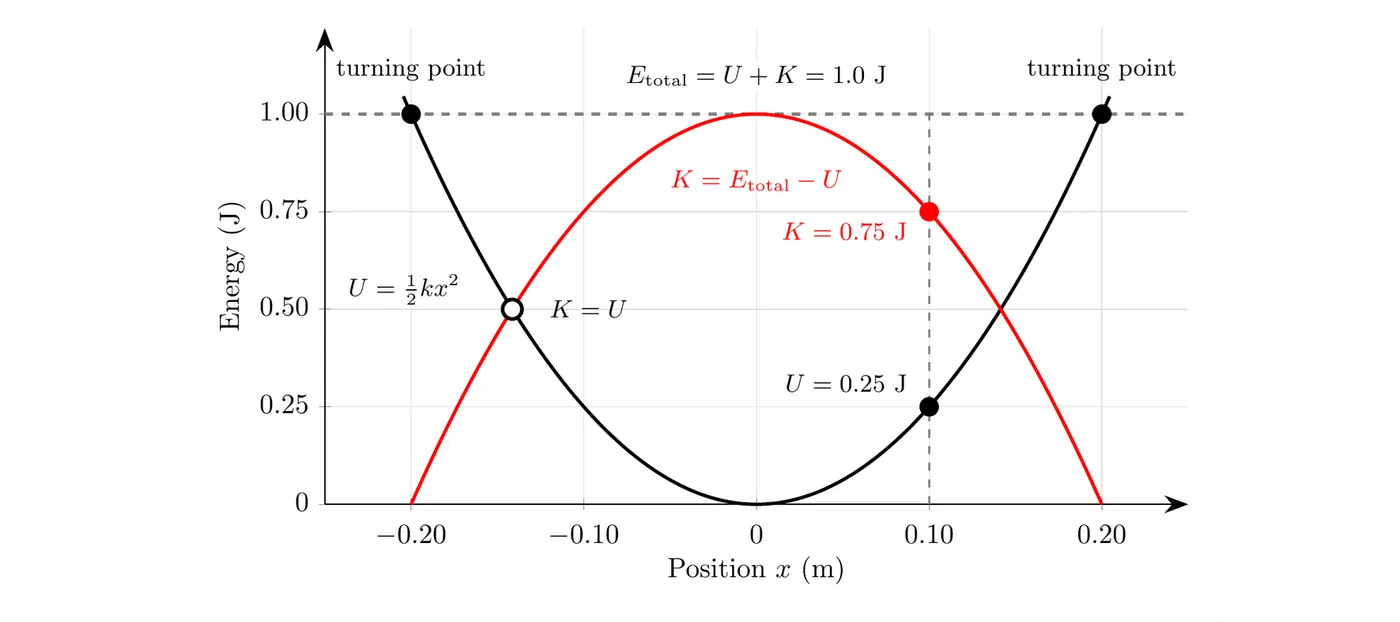
This graph is for the system in the next example: N/m and m, so J.
Worked Example: Reading an Energy Graph
A 0.50 kg block on a horizontal spring with N/m oscillates with an amplitude of 0.20 m on a frictionless surface. Find (a) the total energy and the maximum speed, (b) , , and the speed at m, (c) where , and (d) the total energy, maximum speed, and period if the amplitude is doubled to 0.40 m.
(a) At a turning point, all the energy is potential:
(b) At m:
The block is halfway to the turning point, but only a quarter of the energy is potential, because depends on . That’s why the speed is still close to its maximum there.
(c) when each is half the total, 0.50 J:
That’s where the two curves cross on the graph, at .
(d) With m:
Doubling the amplitude raised the maximum potential energy, and with it the total energy, by a factor of 4. On the graph, the total energy line moves up to 4.0 J and the parabola meets it farther out, at m. The period doesn’t change.
Energy vs. Time Graph
For the same block released from at , starts at its maximum, drops to zero at (equilibrium), climbs back to its maximum at (the other turning point), and so on. does the opposite, and the two always add up to the flat total energy line.
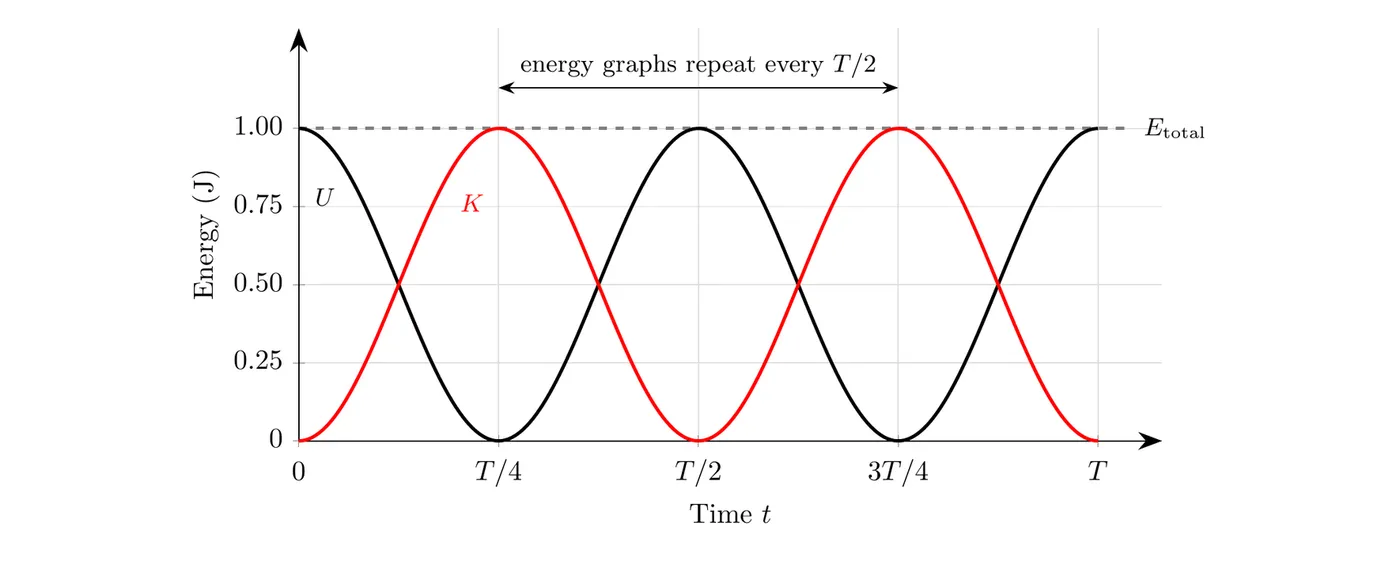
Notice that and each go through two full cycles while the block goes through one. The block passes through equilibrium twice per period (once in each direction) and reaches a turning point twice per period, so the energy graphs repeat every . Here that’s about 0.31 s, half of the 0.63 s period.
Worked Example: Maximum Velocity from Energy Conservation
A mass kg attached to a spring with N/m is compressed 0.25 m and released from rest. Find the maximum velocity.
Direct energy conservation: the maximum velocity happens at equilibrium, where all potential energy has converted to kinetic. Initially (compressed): . Finally (at equilibrium): . Setting these equal:
Substituting values:
Checking with a two-step approach: first find the total energy, J. Then set that equal to maximum kinetic energy:
Same answer either way, use whichever approach feels more natural.
Worked Example: Energy of a Pendulum
A pendulum bob with mass kg, length m, swings to a maximum angle from vertical. Use m/s². Find the maximum potential energy and maximum velocity.
Maximum potential energy: using , with :
Maximum velocity: occurs at the lowest point, where all potential energy converts to kinetic:
Worked Example: Velocity at an Intermediate Position
A 0.60 kg mass oscillates on a spring with N/m and amplitude m. Find the velocity at m from equilibrium.
Using energy conservation, total energy equals energy at amplitude:
Multiplying through by 2 and rearranging:
Substituting values:
Common Mistakes
Forgetting where each energy type is maximum: at equilibrium, KE is maximum and PE is zero; at the turning points, PE is maximum and KE is zero. Don’t mix these up.
Using the wrong energy equation for the system: mass-spring is , pendulum is , don’t use the spring formula for a pendulum problem.
Forgetting conservation of energy: energy at one position equals energy at any other position (with no friction), , this is the foundation of most SHM energy problems.
Not recognizing amplitude in a problem: the initial displacement, however far you pull or compress the system, is the amplitude , and belongs in the energy equations, .
Calculator mode errors with pendulums: when computing , make sure your calculator matches the angle’s units, degrees or radians.
Thinking changing amplitude changes frequency: amplitude changes the energy (by a factor of ), but never changes period or frequency, those depend only on system properties (, , , ).
Wrong reference point for pendulum height: the reference point (, ) is the lowest point of the swing, and height is measured from there, not from the pivot.
Sign errors: kinetic energy and spring potential energy are never negative (squares ensure this), velocity can be positive or negative in direction, but is always positive, and when solving for you technically get , though magnitude is what matters for energy.
Not checking for friction: conservation of energy only holds if mechanical energy is actually conserved, if friction is present, mechanical energy decreases over time, so read carefully for phrases like “frictionless” or “negligible friction.”
Forgetting the factor of : spring PE is , not , and kinetic energy is , not , this factor matters in every calculation.
Squaring amplitude incorrectly: means squaring the amplitude value itself, if m, then m², not , be careful with decimals.
Mixing up intermediate position equations: at position , total energy is , and this must equal , don’t forget that both kinetic and potential energy contribute at intermediate positions.