

8.2 - Pressure
Definition of Pressure
Pressure is the magnitude of the perpendicular force per unit area over a surface:
where is pressure in pascals (Pa), is the force perpendicular to the surface in Newtons, and is the area the force spreads over in m². The SI unit is the pascal, .
Pressure tells you how concentrated a force is over an area, the same force spread over a smaller area gives higher pressure, and over a larger area gives lower pressure.
The AP equation sheet writes this as to remind you that only the perpendicular component of a force creates pressure. If a force is tilted, split it into components: the part perpendicular to the surface pushes into it and counts, while the part parallel to the surface just slides along it and doesn’t count.
Example: you push on a window with a 60 N force at 53° to the surface of the glass, and your palm covers 0.012 m². The perpendicular component is N, so Pa. The parallel component, N, adds nothing to the pressure.
Pressure Is a Scalar
Pressure comes from a force, but pressure itself has no direction. It’s a scalar, like mass or energy. At any point in a fluid at rest, the pressure pushes equally in every direction, so it doesn’t make sense to say pressure points down or sideways. Direction only shows up when pressure acts on a surface: the force it creates, , always points perpendicular to that surface, pushing into it. That’s how the same water pressure pushes down on the floor of a pool, sideways on its walls, and up on the bottom of a floating raft.
Area Formulas for Common Shapes
For a circle (common for cylinders and pistons), . For a rectangle, . For a square, .
Pascal’s Principle
An incompressible fluid keeps the same volume and density no matter how much pressure is exerted on it. That’s what makes Pascal’s Principle work: when pressure is applied to a confined fluid, that pressure change is transmitted equally to every part of the fluid and to the container’s walls. The fluid can’t squish to absorb the push, so it passes the push along.
Application to hydraulics: in a hydraulic system with two connected pistons of different sizes at the same height, the pressure is the same at both pistons, , so:
If , then , meaning a small input force produces a large output force, exactly the principle behind hydraulic jacks, car lifts, and brake systems.
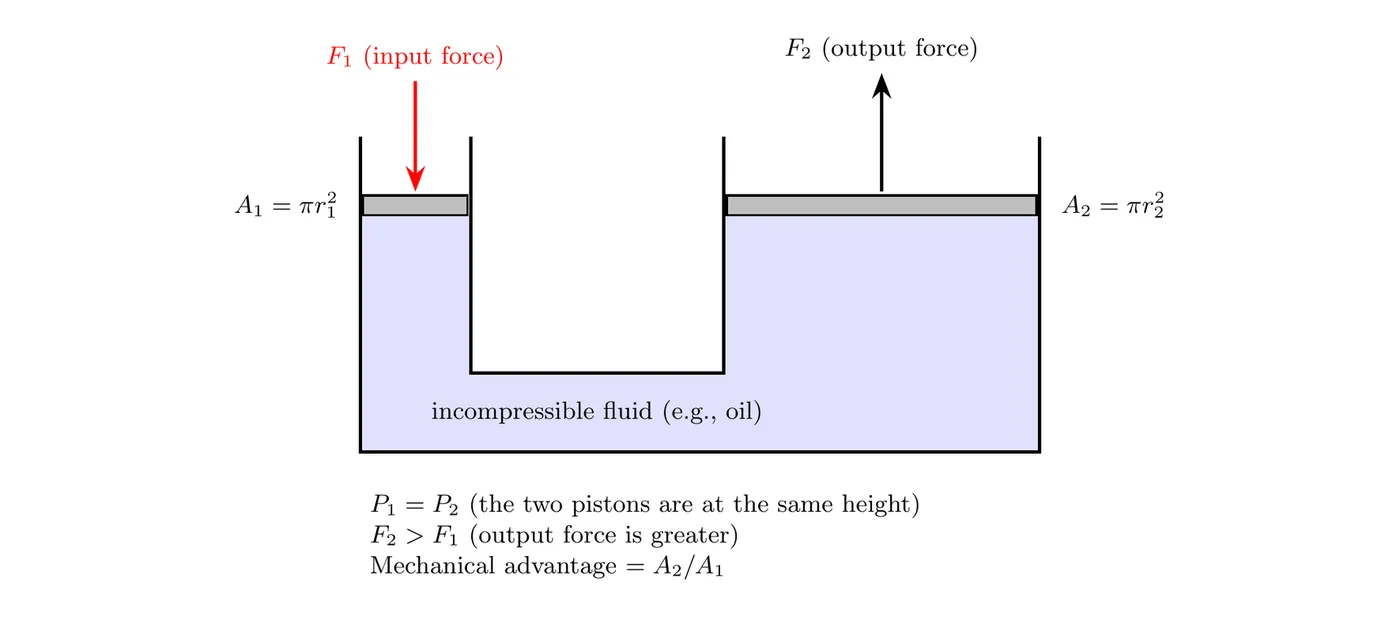
Hydraulic systems use incompressible liquids (usually oil, sometimes water), found in car brakes, hydraulic jacks, and construction equipment. Pneumatic systems use compressible gases (usually air), found in air brakes for trucks and trains, pneumatic tools, and air-powered factory equipment.
Where Fluid Pressure Comes From
The pressure a fluid exerts is the combined result of all of its particles interacting with a surface. The particles in a gas or liquid are always moving and bumping into whatever they touch, and each collision gives the surface a tiny push. One collision is nothing, but there are an enormous number of them (around collisions every second on each square centimeter of a surface in room air), and together they add up to a steady force spread over the area: the pressure. More particles packed into the same space, or faster-moving particles, means more and harder hits, so more pressure.
In a liquid, the fluid near the bottom also has to support the weight of all the fluid above it, so it pushes harder on everything around it. That’s why pressure increases with depth.
Gauge Pressure vs. Absolute Pressure
Gauge pressure is the pressure from a fluid column above a given point:
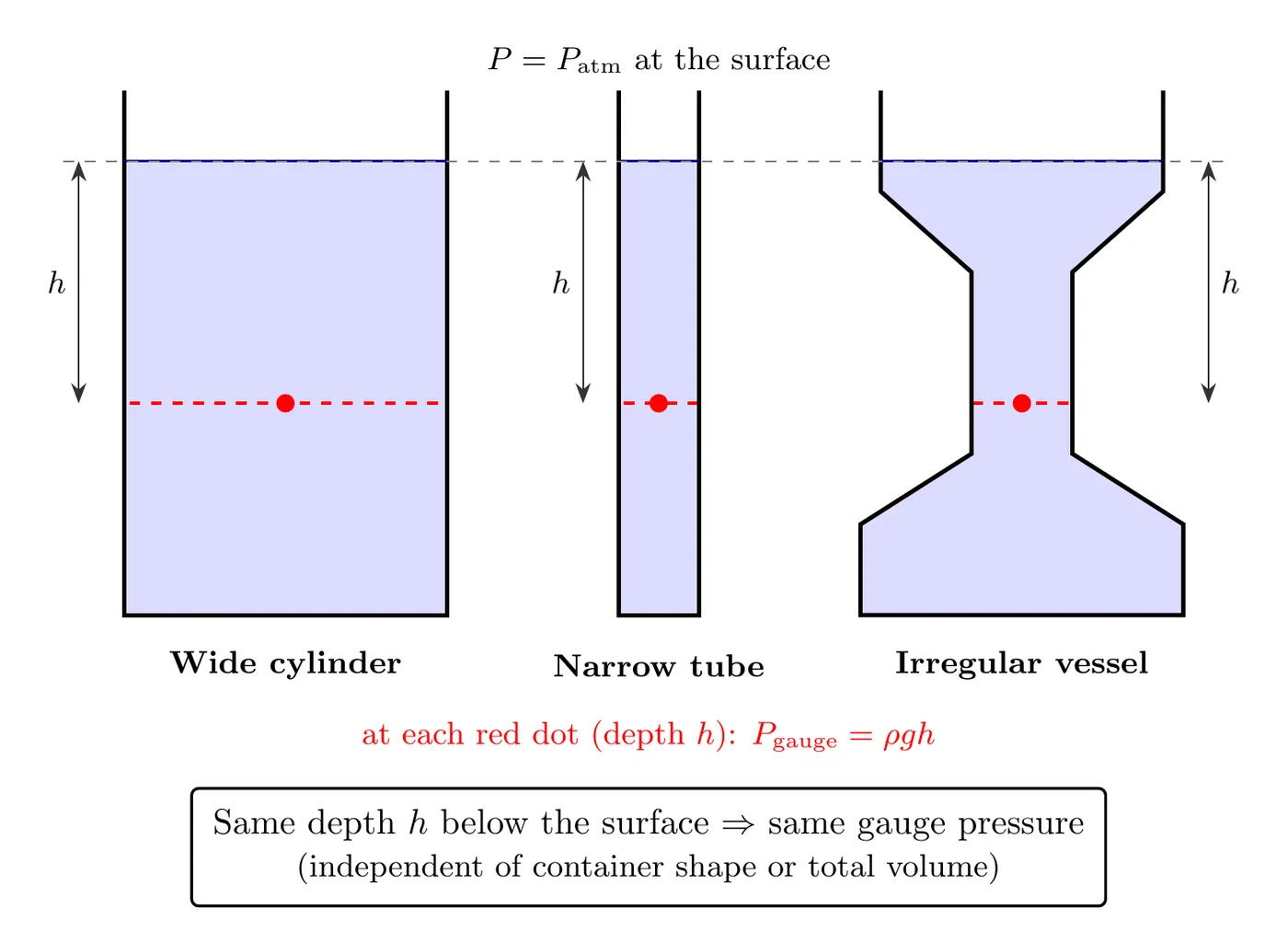
where is fluid density, is gravitational acceleration, and is depth below the surface. This comes directly from the weight of the fluid column above that point. Importantly, the same fluid gives the same pressure at the same depth, regardless of the container’s shape, a swimming pool and a narrow tube of the same water have identical pressure at 2 meters depth, only vertical depth matters.
Where comes from: picture a column of fluid with cross-sectional area reaching from the surface down to depth . Its volume is , so its mass is and its weight is . That weight is spread over the area at the bottom of the column:
The area cancels, which is exactly why the container’s shape doesn’t matter, only the depth. This is the gauge pressure equation on the AP equation sheet, .
Absolute pressure is the total pressure at a point, including atmospheric pressure:
Standard atmospheric pressure is Pa (sometimes given more precisely as Pa, but AP Physics 1 uses Pa). Gauge pressure measures relative to atmospheric pressure, while absolute pressure measures relative to a perfect vacuum, and most everyday gauges (like tire pressure gauges) actually read gauge pressure, not absolute.
On the AP equation sheet, absolute pressure is written . is the reference pressure, the pressure at the top surface of the fluid, and is the depth below that surface. is often atmospheric pressure, but not always: for a sealed tank with pressurized gas above the liquid, is that gas’s pressure.
The same idea compares any two points in one fluid: , where is the difference in depth. The reference pressure cancels out.
Why don’t we feel the atmosphere? Air presses on every square meter of your body with about N, roughly the weight of a 10,000 kg truck. You don’t get crushed because the fluids inside your body push outward with about the same pressure, so the forces nearly cancel. You only notice when the outside pressure changes faster than your body can match, like your ears popping on a plane or at the bottom of a deep pool.
Graphing Pressure vs. Depth
Since has the same form as , a graph of absolute pressure vs. depth is a straight line. The vertical intercept is the pressure at the surface, , and the slope is . A gauge pressure graph has the same slope but starts at zero.
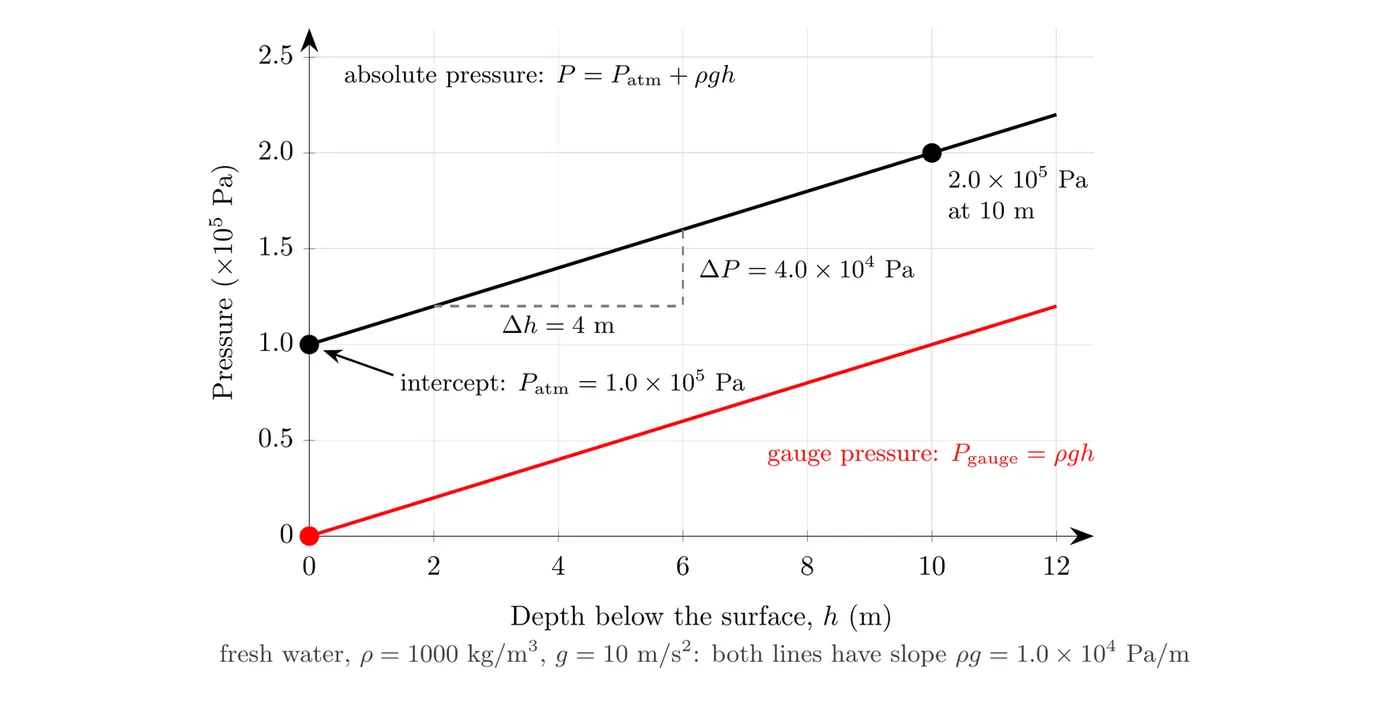
For fresh water (using m/s², the value the AP exam uses for numerical answers), the slope is Pa/m. Every meter of depth adds Pa, so 10 m of water adds a whole atmosphere, and the absolute pressure there is Pa, double the pressure at the surface. A denser liquid gives a steeper line. Going the other way, if you’re given a pressure vs. depth graph, the fluid’s density is the slope divided by .
Example: a pressure sensor is lowered into a tank of an unknown liquid. It reads Pa at the surface and Pa at a depth of 3.0 m. The slope is Pa/m, so kg/m³. The liquid is denser than water.
Worked Example: Pressure Under Chair Legs
A 65 kg person sits on a 5.0 kg chair with 4 circular legs, each 1.8 cm in diameter. Find the pressure each leg exerts on the floor.
Total weight: N.
Force per leg: N.
Area of each leg: m, so m, giving m².
Pressure: Pa.
Each leg exerts roughly Pa, about 6.9 times atmospheric pressure, since that force concentrates onto such a small area.
Real-World Applications of Pressure
High heels vs. flat shoes: heels have a very small contact area, so the same body weight creates much higher pressure, potentially damaging soft floors or causing foot and back pain. Flats have a larger contact area, spreading that same weight into lower pressure. For example, a 600 N person on heels with 4 cm² total area gets Pa, versus flats with 200 cm² giving Pa, the heels create 50 times more pressure.
Bed of nails: a person’s weight spreads across hundreds of nails, keeping the pressure at each contact point low enough not to break skin. With a 700 N person on 1000 nails, each nail bears just 0.7 N, and if each tip has area m², the pressure per nail is Pa, tolerable when spread out, but standing on just one nail would give Pa, easily piercing skin.
Snowshoes: a large surface area keeps you from sinking into snow, since spreading the same weight over more area lowers the pressure, letting you walk on soft snow that couldn’t support a concentrated point load.
Worked Example: Hydraulic Car Jack
An input piston has radius cm, and an output piston has radius cm, lifting a 12,000 N car. Find the required input force.
Areas: m², m².
Applying Pascal’s Principle:
Just 214 N (about 48 pounds) can lift a 12,000 N car! The mechanical advantage is .
Worked Example: Pressure at Ocean Depth
A submarine sits at 350 m depth, with seawater density kg/m³, atmospheric pressure Pa, and m/s². Find the gauge and absolute pressure.
Gauge pressure:
Absolute pressure:
That’s about 37 times atmospheric pressure, which is exactly why submarine hulls need such specialized design.
Common Mistakes
Confusing force and pressure: force is measured in Newtons, pressure in Pascals (N/m²), pressure is force divided by area, not just force alone.
Forgetting to divide among support points: if an object has 4 legs, each leg only supports a quarter of the total weight, don’t use the full weight when finding pressure under just one leg.
Using diameter instead of radius: area formulas use radius, if given diameter, divide by 2 first, using diameter directly makes the area 4 times too large.
Unit conversion errors: convert cm to m (divide by 100), mm to m (divide by 1000), and remember 1 cm² equals m², not .
Confusing gauge and absolute pressure: gauge pressure is above atmospheric, absolute pressure includes atmospheric, , and most everyday gauges read gauge pressure.
Using the wrong fluid pressure equation: it’s , not (that’s potential energy), and there’s no need for (for a fluid column it equals anyway, since ).
Thinking container shape affects pressure at depth: pressure at depth only depends on , not on the container’s width or shape, a wide pool and a narrow tube have the same pressure at the same depth.
Mixing up areas and forces in hydraulic systems: Pascal’s principle equates pressures, , not the forces or areas themselves, the larger area gets a proportionally larger force.
Forgetting to square the radius: requires squaring, if m, m², not .
Not accounting for angled forces: pressure needs the force component perpendicular to the surface. If the force is angled, use when is measured from the perpendicular (the normal), or when is measured from the surface itself.
Getting the atmospheric pressure value wrong: AP Physics 1 uses Pa, though you might see the more precise Pa elsewhere, check your formula sheet.
Assuming pressure equals weight: a heavy object over a large area can have lower pressure than a light object over a tiny area, pressure depends on both force and area together.