

8.3 - Fluids and Newton’s Laws
Newton’s Laws Applied to Fluids
Newton’s Laws describe motion within fluids too, and the key force to understand here is the buoyant force.
A fluid is made of particles, and each small chunk of fluid (a fluid parcel) obeys Newton’s laws just like a block or a cart. The forces on a parcel come from two places: the surrounding fluid pushing on it (these pressure forces come from the interactions between the fluid’s particles) and outside forces like gravity, a pump, a piston, or the walls of a pipe. The way a fluid moves as a whole, like water speeding up through a nozzle or sitting still in a glass, comes from adding up these forces.
When does a fluid’s velocity change? Only when the net force on it isn’t zero. If the pressure is the same on both sides of a parcel in a horizontal pipe, the pressure forces cancel and the fluid keeps moving at constant velocity (Newton’s first law). If the pressure behind the parcel is greater than the pressure in front of it, the net force points forward and the fluid speeds up (Newton’s second law). If the pressure ahead is greater, the fluid slows down. The walls of a pipe can push on the fluid too, which is how a bend in a pipe changes the fluid’s direction.
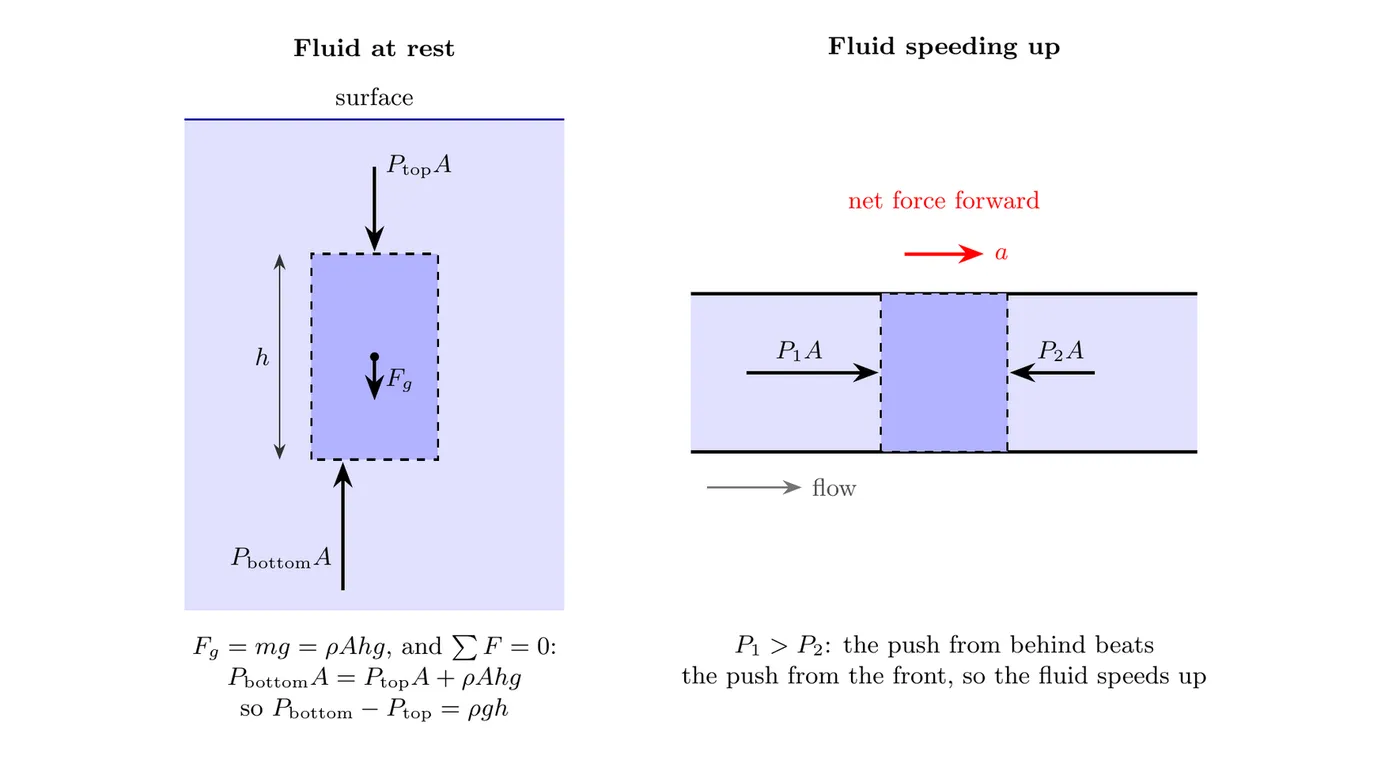
Fluid at rest (left): a column of still water has zero net force. The push up on its bottom () has to balance the push down on its top () plus its weight (). Solving gives , which is exactly why pressure increases with depth (8.2).
Fluid speeding up (right): if , the net force on the parcel is , pointing forward, so the parcel accelerates forward. This is why fluid speeds up when it flows from a region of high pressure into a region of low pressure, the idea behind Bernoulli’s equation in 8.4.
Worked Example: A Pressure Difference Accelerates Water
Water flows through a horizontal pipe with cross-sectional area m². Look at a 0.10 m long parcel of the water. The pressure just behind it is Pa, and the pressure just ahead of it is Pa. Find the parcel’s acceleration.
Net force: N, forward.
Mass of the parcel: kg.
The parcel speeds up at 20 m/s² in the direction of flow. Notice that the size of the pressure (about Pa) doesn’t matter, only the difference across the parcel does. The pipe is the same width everywhere, so all the water in it speeds up together, the way it does just after a tap is opened. Once the flow is steady, an ideal fluid needs no pressure difference to keep moving through a level pipe of constant width.
Buoyant Force
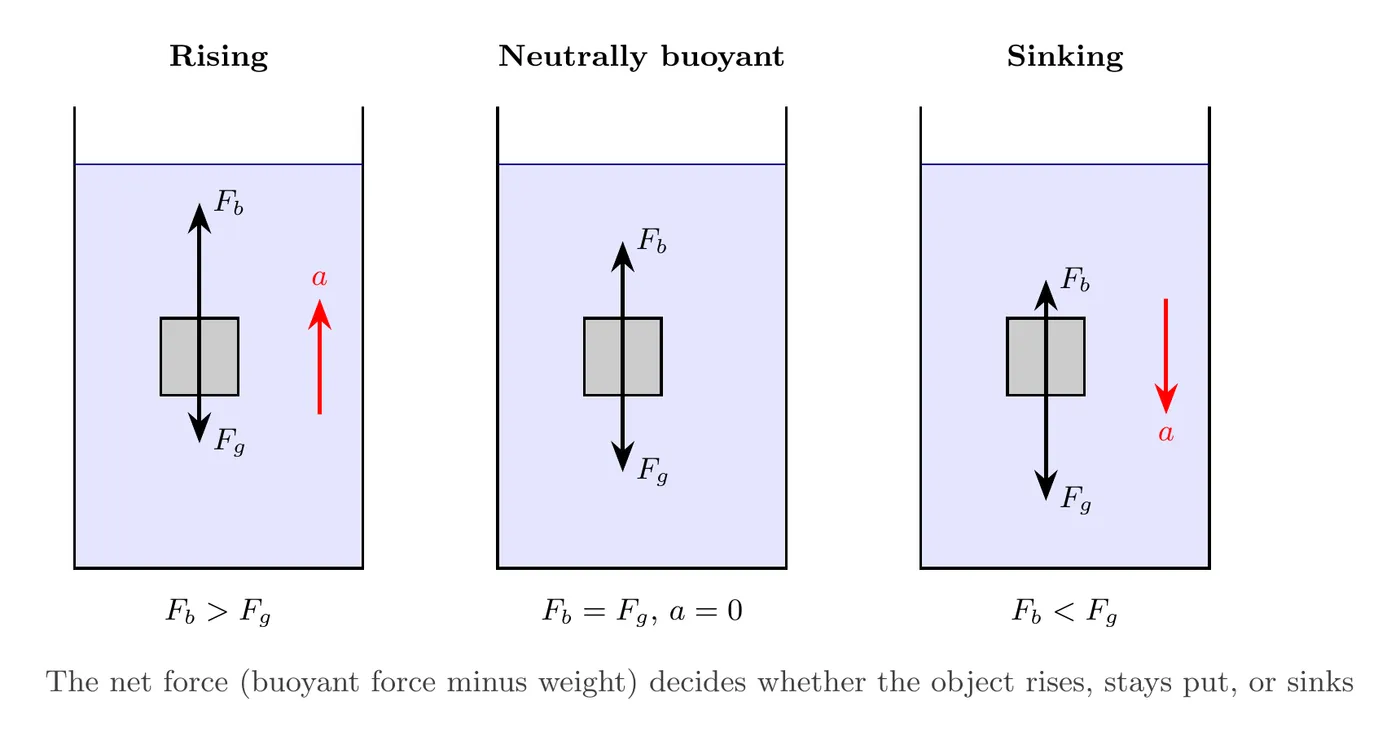
The buoyant force is the net upward force a fluid exerts on an object. There are three scenarios: if buoyant force equals weight, the object floats in equilibrium (neutrally buoyant), like a submarine hovering at constant depth. If buoyant force exceeds weight, the object rises to the surface, like a helium balloon in air or wood in water. If buoyant force is less than weight, the object sinks, like a rock in water, or denser fluids settling below less dense ones.
Physically, the buoyant force is the collective result of all the fluid particles pressing on every surface of the object, it’s not one single force, but the sum of countless microscopic forces from the surrounding fluid.
Where the Buoyant Force Comes From
The fluid pushes on every surface of a submerged object, always perpendicular to that surface. The pushes on the sides cancel, since opposite sides are at the same depth and feel the same pressure. But the bottom of the object is deeper than the top, so the pressure on the bottom is greater. The upward push on the bottom beats the downward push on the top, and the difference is the buoyant force.
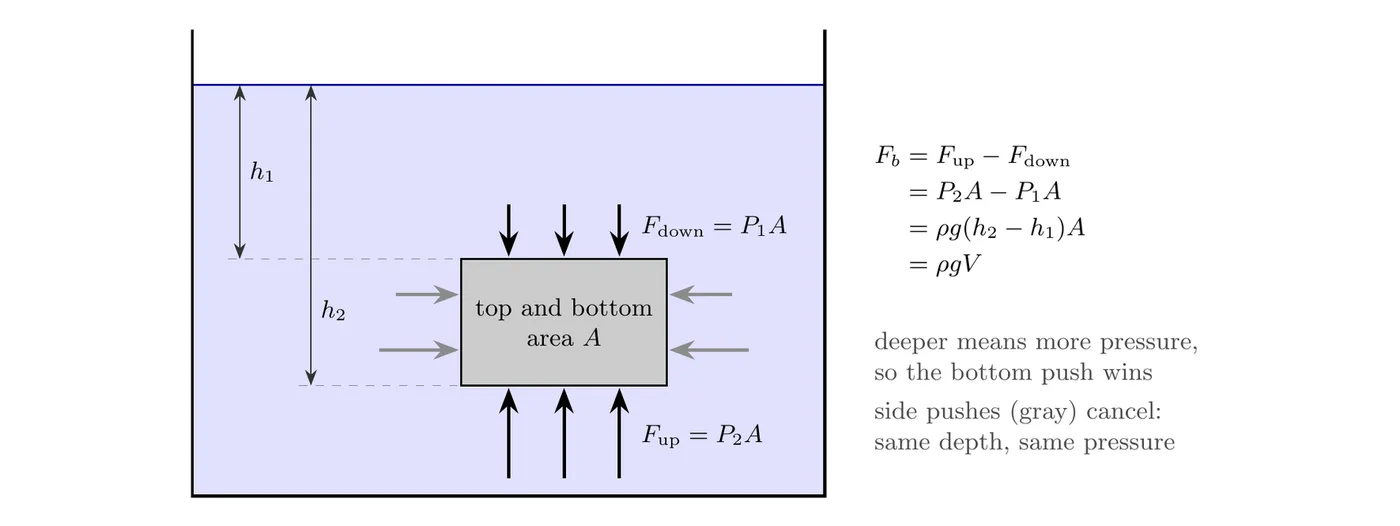
For a block with top and bottom area , with its top at depth and its bottom at depth , the pressures are and , where is the fluid’s density. So:
since is the block’s volume. The surface pressure cancels, and so does the depth: lowering the block deeper raises and by the same amount, so their difference, the buoyant force, doesn’t change. This is Archimedes’ principle (next), built straight from pressure.
Archimedes’ Principle
Archimedes’ Principle states that the magnitude of the buoyant force on an object equals the weight of the fluid it displaces.
Deriving the buoyant force equation: starting from weight, , and density, , substituting gives . For buoyant force, we use the density and volume of the displaced fluid:
where is the density of the surrounding fluid (not the object), is the volume of fluid displaced, and is gravitational acceleration. This distinction is critical, always use the fluid’s density, never the object’s own density.
On the AP equation sheet this appears as . The sheet doesn’t say it, but is the fluid’s density and is the volume of fluid displaced (the part of the object that’s underwater).
Historical Context: Archimedes
Legend has it that King Hiero II asked Archimedes to figure out whether his crown was pure gold without damaging it. Archimedes realized that submerging the crown in water and comparing the displaced water volume to what pure gold of that mass would displace could reveal if lighter metals had been mixed in. According to the story, he discovered this idea while taking a bath, noticed the water level rise, and ran through the streets shouting “Eureka!” (“I have found it!”). Archimedes is also said to have worked on large ship designs and floating structures, which relied heavily on understanding buoyant forces. Today, his principle underlies ship design, submarine operation, hot air balloons, and measuring the density of irregularly shaped objects.
Free Body Diagrams with Buoyant Force
Always include buoyant force in a free body diagram for objects in fluids.
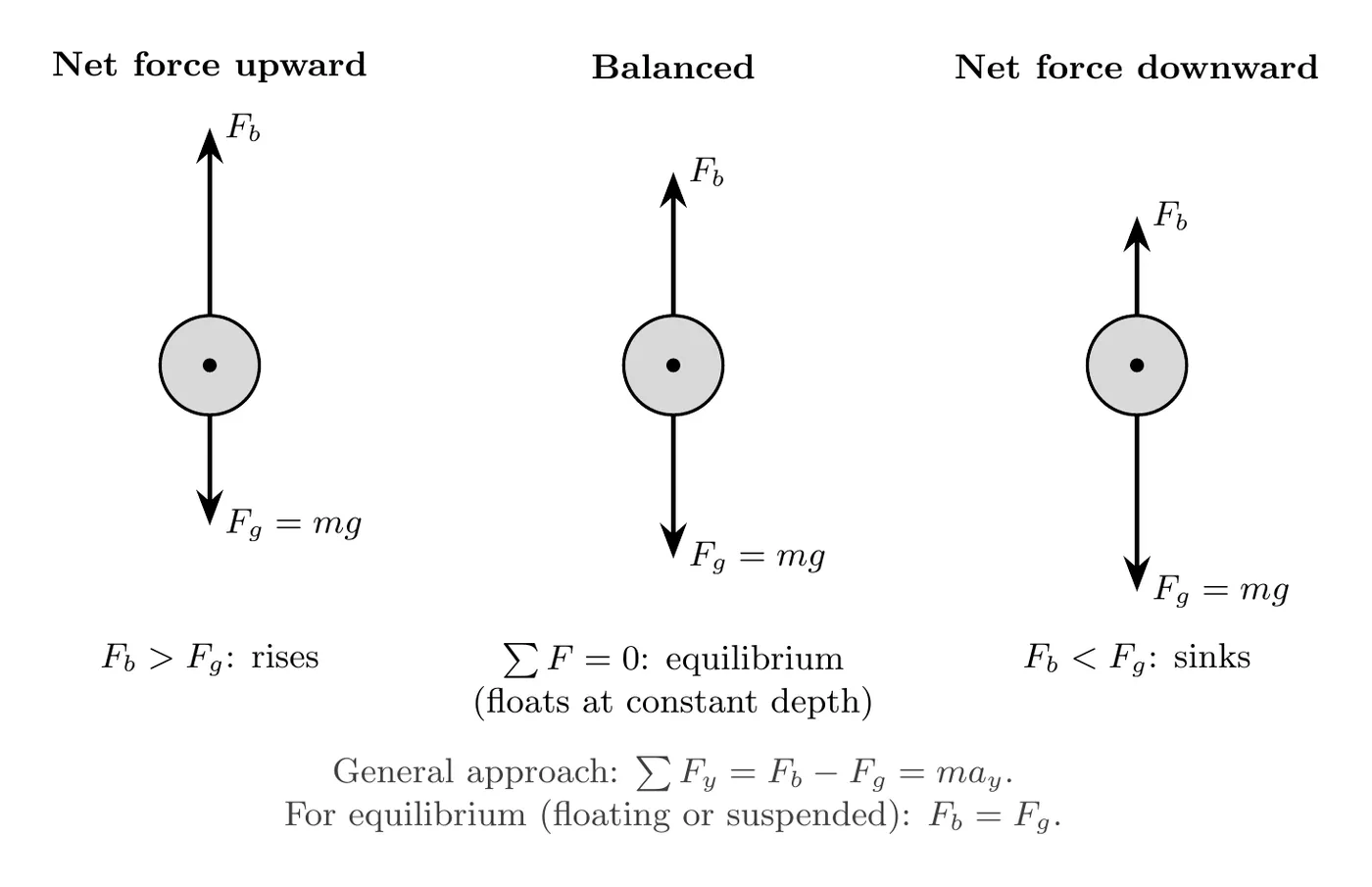
In general:
For equilibrium (floating or suspended):
The buoyant force is just one more force on the diagram. If anything else pushes or pulls on the object (a string, a hand, a spring scale, the bottom of the tank), draw that force too and apply Newton’s second law the same way.
Worked Example: Block Held Underwater by a String
A 0.60 kg block of wood (density 600 kg/m³) is tied to the bottom of a tank by a string, so it’s held completely underwater. Find the buoyant force, the tension in the string, and the block’s acceleration right after the string is cut. Use m/s².
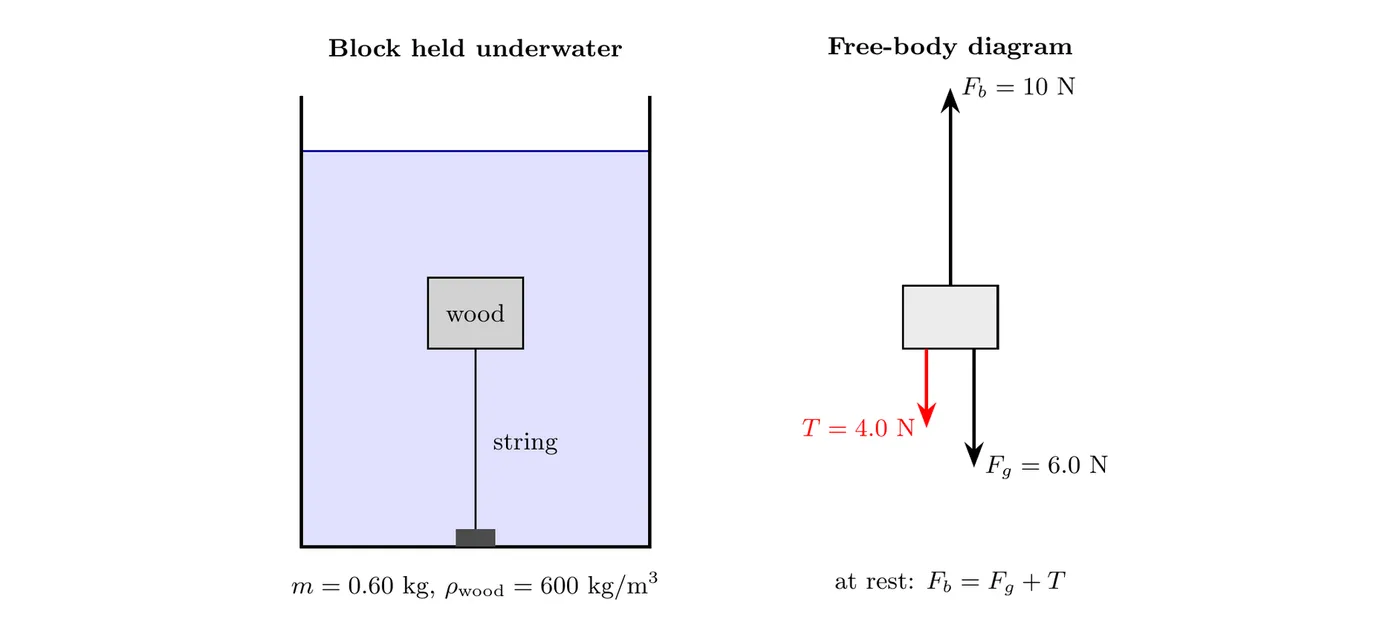
Volume: m³. The block is fully underwater, so .
Buoyant force: N, upward.
Tension: the block is at rest, so . Up: . Down: N, and the tension (the string pulls the block down toward the bottom of the tank).
Right after the string is cut: the tension disappears, but and don’t change, so N upward and m/s² upward (ignoring water resistance). The block rises until it floats at the surface with , with of its volume underwater.
Worked Example: Buoyant Force on a Weather Balloon
A weather balloon has volume L m³, filled with hydrogen. Air density is kg/m³, hydrogen density is kg/m³, and the balloon material has mass kg. Use m/s². Find the buoyant force in air, and the net vertical force when released.
Buoyant force: the balloon displaces air, so we use air’s density (not the density of what’s inside):
Net vertical force: three forces act here: buoyant force (up, 0.0452 N), the weight of the balloon material (down), and the weight of the hydrogen inside (down).
Mass of hydrogen: kg, giving weight N.
Weight of the balloon material: N.
Net force:
The net upward force is about 0.022 N, so the balloon rises.
Finding acceleration (an extension): total mass is kg, giving:
The balloon accelerates upward at about 9.5 m/s².
Worked Example: Determining if an Object Floats
A solid plastic sphere has mass 0.45 kg and radius 0.080 m. Water density is 1000 kg/m³. Does it float?
Comparing densities: m³, giving kg/m³. Since 210 kg/m³ is less than water’s 1000 kg/m³, the sphere floats.
Comparing forces (checking): the buoyant force if fully submerged would be N, while the weight is N. Since exceeds , it floats, confirming our density comparison.
How much is submerged: the volume submerged is just enough to satisfy :
Fraction submerged: , so about 21% of the sphere sits underwater, with 79% above the surface.
Worked Example: Object Suspended in Water
A metal block hangs from a spring scale, reading 45.0 N in air and 39.2 N fully submerged in water. Water density is 1000 kg/m³. Find the buoyant force, the block’s volume, and its density.
Buoyant force: the difference in readings equals the buoyant force:
When submerged, buoyancy pushes up, reducing the tension the scale reads.
Volume: from :
Density: the block’s mass from its weight in air is kg. So:
That’s close to iron or steel (roughly 7,800 kg/m³).
Worked Example: Same Boat, Fresh Water vs. Seawater
A small boat floats in a freshwater lake ( kg/m³), displacing 2.00 m³ of water. It then sails out into the ocean ( kg/m³). Does it float higher or lower, and how much seawater does it displace?
Key idea: a floating object always has . The boat’s weight doesn’t change, so the buoyant force doesn’t change either. Since stays the same, has to stay the same: if the fluid’s density goes up, the displaced volume goes down by the same factor.
The boat floats slightly higher in seawater, displacing about 2.4% less volume. (Its mass is kg in both cases.) This is why ships have load lines painted on their hulls for different kinds of water.
Common Mistakes
Using the object’s density instead of the fluid’s: the buoyant force equation is , always use the surrounding fluid’s density (water, air, oil), never the object’s own density.
Forgetting multiple downward forces: for balloons or hollow objects, remember to include both the weight of the container material and the weight of whatever’s inside, both act downward.
Using total volume instead of displaced volume: for a floating object, only the submerged portion displaces fluid, use , not the total object volume (though for a fully submerged object, they’re the same).
Forgetting unit conversions with volume: 1 liter equals m³ (0.001 m³), always convert to m³ before calculating buoyancy.
Thinking buoyant force depends on depth: it depends on volume displaced, not depth, has no depth term. An object fully submerged at 1 m has the same buoyant force as at 10 m (pressure varies with depth, but buoyant force doesn’t for incompressible objects).
Getting the direction wrong: buoyant force always points upward, opposite gravity, even for sinking objects, it’s just smaller than the weight in that case.
Forgetting in the buoyant force equation: it’s , don’t drop the , buoyancy is fundamentally tied to the weight of displaced fluid.
Comparing the wrong quantities to determine floating: compare to , or (if fully submerged) to . If , it floats; if greater, it sinks.
Saying something floats because it’s “lighter” than water: a steel cargo ship with a mass of thousands of tonnes floats, while a small pebble sinks. What matters is whether the buoyant force can match the weight, which for a solid object comes down to comparing densities. A ship floats because its hull holds a lot of air, so its average density (total mass divided by the total volume it encloses) is less than water’s.
Using the wrong density for gas-filled objects: for a helium balloon in air, use air’s density for buoyancy, for an air bubble underwater, use water’s density, always use the density of whatever fluid the object is in, not what it contains.
Incomplete free body diagrams: always include both (up) and (down), plus any additional weights (like gas inside a balloon).
Thinking the scale reading is the true weight: when submerged, a scale reads the apparent weight, which equals true weight minus buoyant force, the true weight is what the scale reads in air.
Assuming floating objects are fully submerged: floating objects sit partly above the surface, only calculate buoyant force for the submerged portion, and use for equilibrium.