

8.4 - Fluids and Conservation Laws
Fluid Flow
So far we’ve looked at fluids at rest, or just shifting slightly. Now let’s look at fluids that actually flow, moving from one place to another. The key principle: a pressure difference is what makes a fluid start flowing, fluid naturally moves from high pressure regions to low pressure regions.
Example: when you drink through a straw, you lower the pressure inside your mouth. The air pressure on the surface of the drink is now greater than the pressure at the top of the straw, so the drink gets pushed up the straw. You don’t pull the drink up; the atmosphere pushes it.
Volume Flow Rate
The volume flow rate () describes how much fluid volume passes through a given area per unit time.
By definition: , where is in m³/s, is volume in m³, and is time in seconds.
Physically: , where is the cross-sectional area the fluid flows through in m², and is the fluid’s speed in m/s.
The amount of fluid flowing through a pipe depends on both how wide the pipe is and how fast the fluid moves. Since both expressions equal :
which can be rearranged to solve for volume, time, or any other variable depending on what a problem gives you.
Why : in a time , the fluid moves forward a distance . All the fluid in that stretch of pipe, a cylinder with cross-sectional area and length , has passed through the cross-section, so . Divide both sides by to get . This is a derived equation: it’s not on the AP equation sheet, so know how to build it.
Example: water moves at 0.80 m/s through a pipe with cross-sectional area m². The volume flow rate is m³/s, so filling a 20 L ( m³) bucket takes s.
Conservation of Mass: The Continuity Equation
For an incompressible fluid flowing through a pipe, conservation of mass requires that matter entering one end has to equal matter exiting the other end, at the same rate.
where , are area and speed at one location, and , are area and speed at another. When a pipe narrows, the fluid speeds up to maintain the same flow rate; when it widens, the fluid slows down.
Larger area means smaller velocity, smaller area means larger velocity.
Why this is conservation of mass: the mass passing a point each second is the mass flow rate, (density times volume flow rate). In a pipe that’s completely full, mass can’t pile up or disappear between two points, so the mass flow rate in equals the mass flow rate out: . For an incompressible fluid, is the same everywhere and cancels, leaving , the form on the AP equation sheet. (This is why the AP exam assumes pipes are completely filled: the fluid then uses the pipe’s whole cross-section.)
Because , area depends on the radius squared. Halving a pipe’s diameter cuts its area to , so the fluid moves 4 times as fast.
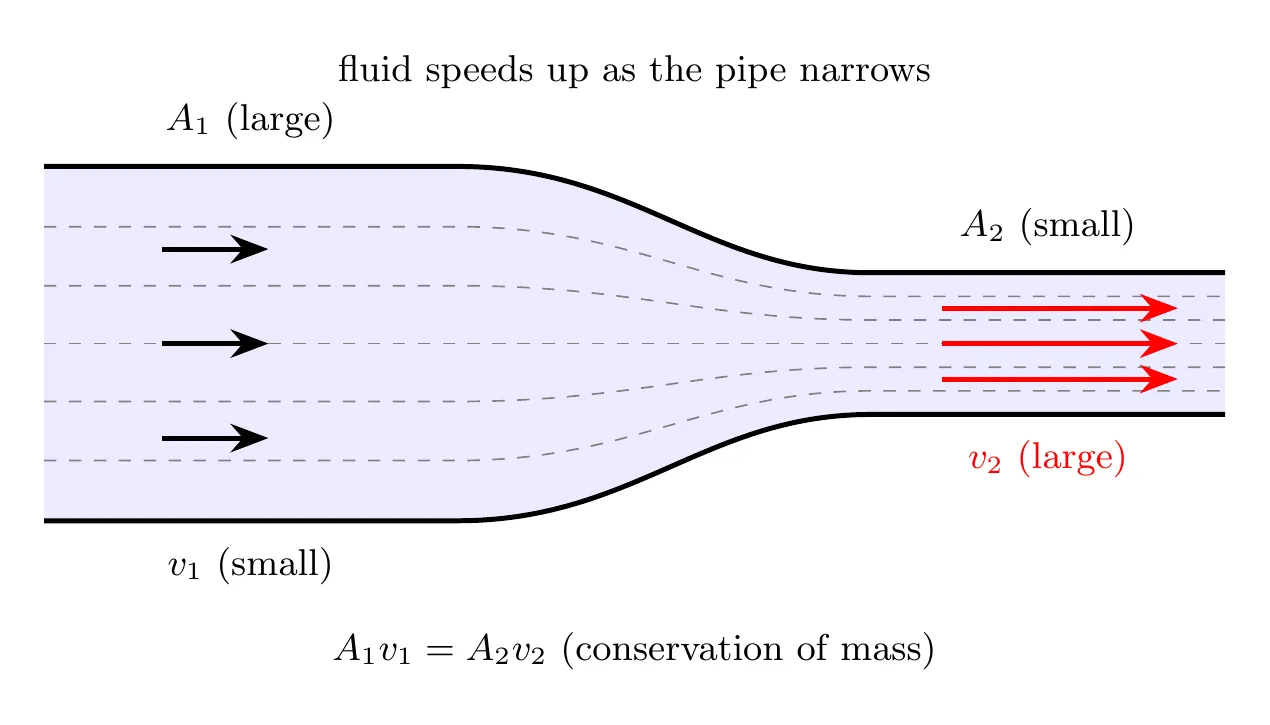
Garden hose example: placing your thumb partially over a hose opening decreases the cross-sectional area, and by the continuity equation, velocity has to increase, producing a fast, narrow stream. Without your thumb, the hose’s full opening gives lower velocity and a gentler flow, something you can test yourself.
Conservation of Energy: Bernoulli’s Equation
Bernoulli’s Equation describes conservation of mechanical energy in a flowing fluid, relating pressure, kinetic energy, and gravitational potential energy at different points.
Between two locations:
where is pressure in Pa, is fluid density in kg/m³, is fluid speed in m/s, is gravitational acceleration, and is height above a reference level in meters.
The pressure term is the fluid’s static pressure. The kinetic energy term represents kinetic energy per unit volume, comparable to but with replacing and then dividing by . The potential energy term represents gravitational potential energy per unit volume, similarly derived from . As fluid flows, energy shifts between these three forms, but the total stays constant, assuming no losses to friction or turbulence.
On the AP equation sheet, Bernoulli’s equation uses for height and lists the terms in a different order, but it’s the same equation:
Where it comes from (energy): a pascal is a N/m², which is the same as a J/m³, so every term is energy per unit volume. As a volume of fluid moves from point 1 to point 2, the surrounding fluid pushes it from behind and holds it back from the front. The net work done by those pressure forces is , and (by the work-energy idea from Unit 3) that work changes the kinetic and gravitational potential energy of the fluid-Earth system:
Divide by , then put the point 1 terms on one side and the point 2 terms on the other, and you get Bernoulli’s equation. That’s why it describes conservation of mechanical energy in fluid flow. It applies to an ideal fluid (incompressible, no viscosity) in steady flow. With viscosity, some energy turns into thermal energy, and the total at point 2 would come out smaller than at point 1.
Trading Height for Speed or Pressure
When fluid moves downhill, the fluid-Earth system loses gravitational potential energy ( drops). That energy doesn’t vanish: it shows up as more kinetic energy (faster flow), more pressure, or some of both. Which one depends on the situation.
Same-width pipe going down: continuity says the speed can’t change (same means same ), so all of the lost becomes extra pressure. If water drops 3.0 m in a pipe of constant width, the pressure at the bottom is higher by Pa. That’s the same you’d get for still water, which makes sense, since the flow speed doesn’t change.
Open stream falling through the air: the stream is surrounded by air at atmospheric pressure the whole way down, so can’t change. All of the lost becomes kinetic energy, and the water speeds up. By continuity, faster water needs a smaller area, which is why the stream from a faucet gets narrower as it falls. For example, using Bernoulli’s equation with equal pressures, a stream that leaves a faucet at 0.50 m/s is moving at m/s just 0.20 m lower, so its cross-sectional area shrinks to about of what it was (about half the diameter).
Applications of Bernoulli’s Equation
Airplane wing lift: wings are shaped (airfoils) and tilted slightly (the angle of attack) so air flows faster over the top than underneath.
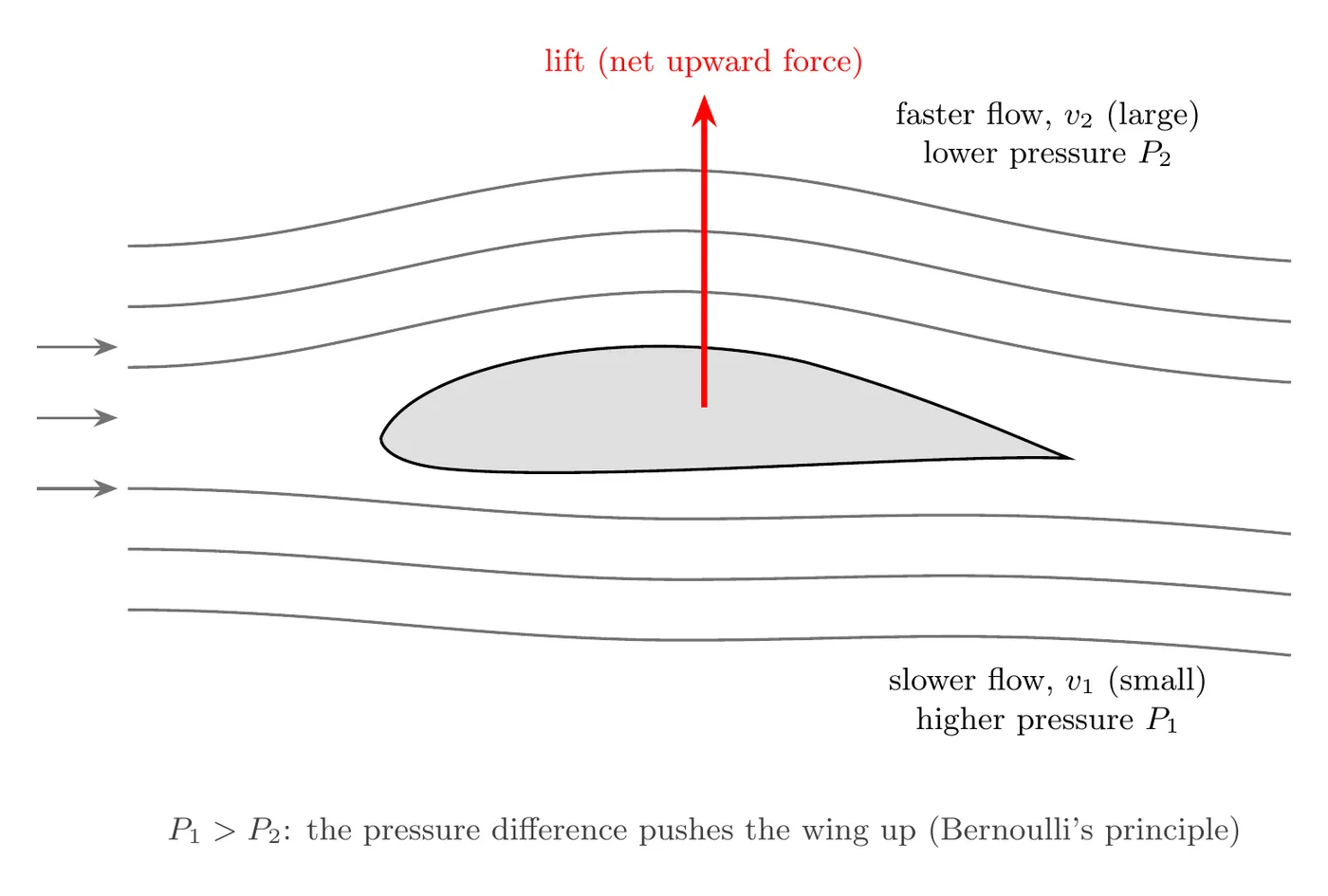
Air splits at the leading edge; the wing’s curved top and slight upward tilt turn the airflow so it moves faster over the top and slower underneath. (A common myth says the top air must go faster because its path is longer and it has to meet the bottom air at the back edge. In reality the top air reaches the back edge first.) By Bernoulli’s equation, higher speed means lower pressure (on top), and lower speed means higher pressure (on the bottom). That pressure difference creates a net upward force: lift.
Mathematically, if heights are roughly equal ():
Since (top is faster), , meaning bottom pressure exceeds top pressure. That pressure difference, multiplied by the wing’s area, gives the lift force.
Race car rear wings (often called spoilers) work the opposite way: their shape and tilt make air flow slower over the top and faster underneath, giving higher pressure on top and lower pressure below, a net downward force called downforce, pushing the car into the road for better traction at high speed. Think of it as an upside-down airplane wing.
Curved balls (the Magnus effect): when a spinning ball flies through the air, one side of the ball spins in the same direction the air is flowing past it and drags that air along, speeding it up. The other side spins against the airflow and slows the air down. Faster air means lower pressure, so the ball curves toward the side spinning with the airflow. This explains curveballs in baseball, curved shots in soccer, and spin in tennis. (The ball has to grip the air for this to happen, which takes viscosity, so it’s a bit beyond the ideal fluid model, but the pressure idea is the same.)
Torricelli’s Theorem
Torricelli’s Theorem relates the exit speed of fluid from an opening to the height difference between that opening and the fluid’s surface, derived from energy conservation.
where is exit speed, is gravitational acceleration, and is the vertical distance from the surface to the opening. This looks exactly like the free fall velocity equation!
Deriving it from Bernoulli’s equation: compare point 1 at the top surface of the fluid with point 2 at the opening, and put at the opening so the surface is at . Both points are open to the air, so and the pressure terms cancel. If the tank is much wider than the hole, continuity says the surface barely moves, so . That leaves:
The density cancels too, so the exit speed is the same for water, oil, or any ideal fluid. Torricelli’s theorem is a derived equation, so it’s not on the AP equation sheet: be ready to set up Bernoulli’s equation and derive it. It only works when the surface and the opening are at the same pressure; if the gas above the liquid is pressurized, go back to the full Bernoulli equation.
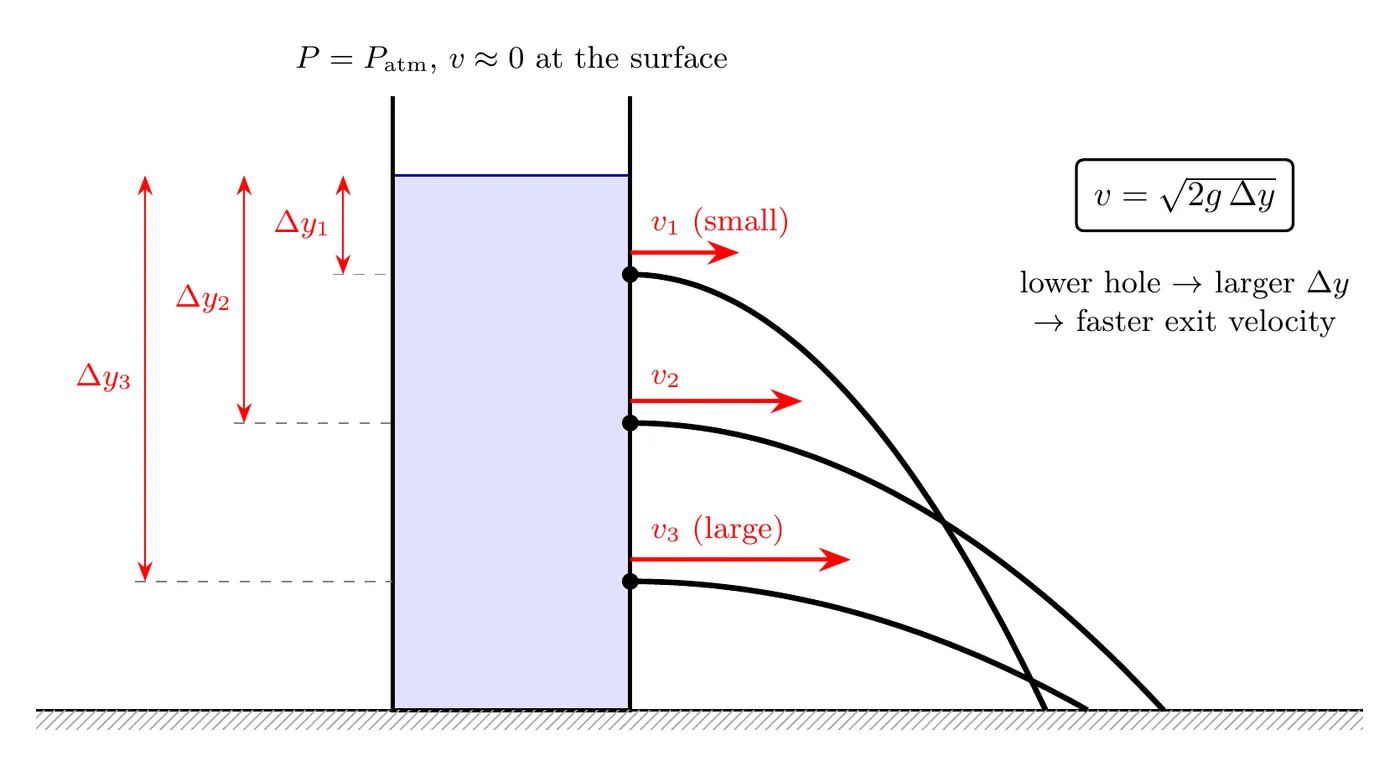
A lower hole produces a faster jet (more fluid pressure above it), while a higher hole produces a weaker jet (less pressure above it). Exit velocity depends only on the depth below the surface, not the container’s shape.
Once fluid exits the opening, it becomes a projectile, following the usual projectile motion equations, a natural bridge between fluid mechanics and kinematics. A typical problem gives the opening height and water level, and asks for the exit velocity (Torricelli’s theorem) and the horizontal range (projectile motion).
Worked Example: Water Flow Through Hose and Nozzle
A garden hose has radius 1.2 cm ( m), a nozzle has radius 0.35 cm ( m), and the flow rate is L/s ( m³/s). Find the speed in the hose and in the nozzle.
Speed in the hose: using :
Speed in the nozzle:
The nozzle speed is about 12 times faster than the hose speed, for the exact same water, because of the much smaller cross-sectional area. Checking with the continuity equation:
confirming the calculation.
Worked Example: Pressure Difference Using Bernoulli’s Equation
Using the same hose and nozzle, with m/s, m/s, atmospheric exit pressure Pa, water density 1000 kg/m³, and negligible height difference, find the pressure inside the hose.
Since heights are equal, , and solving for :
The hose pressure is about Pa, roughly 2.4 times atmospheric. The wider hose has higher pressure and lower velocity, and as water squeezes into the narrow nozzle, pressure drops sharply while velocity climbs, exactly as Bernoulli’s principle predicts.
Worked Example: Torricelli’s Theorem and Projectile Motion
A water tank has a small hole 2.5 m below the water surface and 1.2 m above the ground. Find the exit speed and how far the water lands from the tank.
Exit speed:
Horizontal range: water exits horizontally, so initial vertical velocity is zero. Time to fall the remaining 1.2 m:
Horizontal distance:
The water lands about 3.5 m from the tank. This problem nicely combines fluid mechanics (Torricelli’s theorem gives the initial speed) with kinematics (projectile motion takes it from there).
Worked Example: Venturi Tube
A horizontal pipe has Section 1 with diameter 8.0 cm ( m) and Section 2 (a constriction) with diameter 4.0 cm ( m). Pressure at Section 1 is Pa, with speed m/s, and water density is 1000 kg/m³. Find the speed and pressure at Section 2.
Speed at Section 2 (continuity equation):
Pressure at Section 2 (Bernoulli’s equation): since the pipe is horizontal, :
At the narrow section, velocity is 4 times greater, but pressure is lower, the fluid speeds up and pressure drops, a defining feature of Bernoulli’s principle.
Worked Example: Pipe That Narrows and Rises
Water is pumped up to a second floor through a pipe. At point 1 the pipe’s inside diameter is 4.0 cm, the water moves at 1.8 m/s, and the pressure is Pa. Point 2 is 2.5 m higher, where the diameter is 2.0 cm. Find the speed and pressure at point 2 and the volume flow rate. Use m/s² and kg/m³.
Speed at point 2 (continuity): halving the diameter cuts the area to , so
Pressure at point 2 (Bernoulli): set and m, then solve for :
Volume flow rate: m³/s, about 2.3 L every second. It’s the same at point 2, since gives the same value.
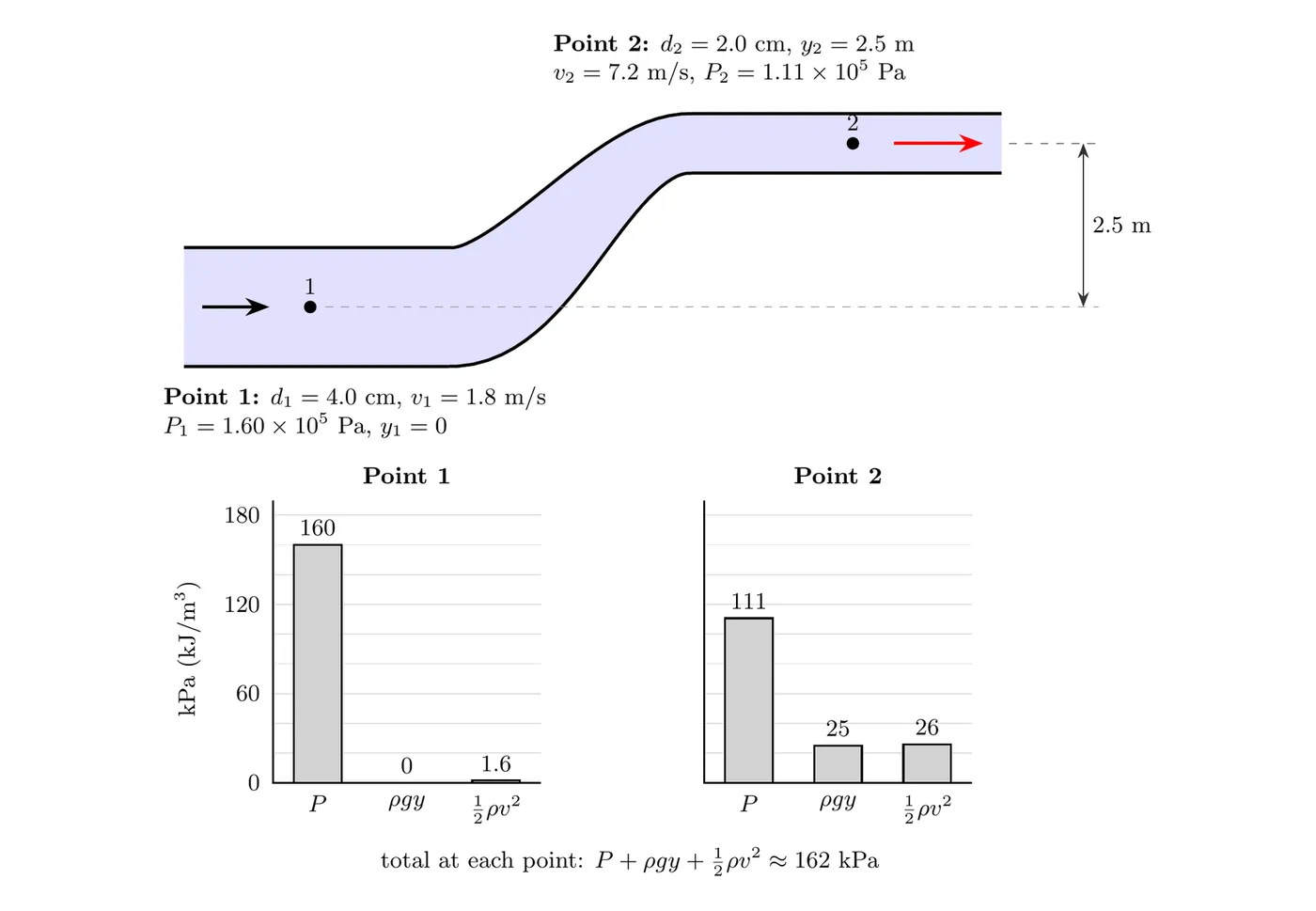
Reading the bar charts: each bar is one term of Bernoulli’s equation in kPa, which is the same as kJ/m³ (energy per volume). At point 1, almost everything is pressure. At point 2, the water is moving faster (bigger ) and is higher up (bigger ), and the pressure bar shrinks by exactly enough to keep the total the same, about 162 kPa at both points. The pressure drops for two reasons here: some of it went into speeding the water up, and some went into lifting it.
Common Mistakes
Confusing volume and volume flow rate: volume (, in m³) is an amount, while volume flow rate (, in m³/s) is a rate, don’t swap these when a problem asks for one or the other.
Using diameter instead of radius: circle area is , using diameter directly makes area 4 times too large, always divide by 2 first if given diameter.
Thinking a larger area means faster flow: it’s backwards, the continuity equation says larger area means slower velocity, and smaller area means faster velocity.
Forgetting unit conversions: 1 liter equals m³, 1 cm equals 0.01 m, and 1 cm² equals m², always convert to SI units before calculating.
Dropping Bernoulli’s equation terms incorrectly: you can only drop terms when heights are equal, drop terms when velocities are equal, and drop pressure terms when pressures are equal, read carefully to see what the problem actually gives you.
Thinking fast-moving fluid has high pressure: a fast jet from a hose hits hard because the water gets stopped when it hits something, not because its pressure is high. Inside a horizontal pipe, Bernoulli’s equation says the faster section has the lower pressure.
Using Torricelli’s theorem when it doesn’t apply: assumes the top surface and the opening are both at atmospheric pressure and the tank is much wider than the hole. If the tank is sealed and pressurized, or the hole is nearly as wide as the tank, use the full Bernoulli and continuity equations.
BackNext