

8.1 - Internal Structure and Density
States of Matter
The differences between states of matter come from how atoms and molecules interact with each other. Solids have a fixed shape and fixed volume, with atoms or molecules tightly packed into fixed positions. Liquids have a fixed volume but no fixed shape, with atoms or molecules close together but able to flow. Gases have neither a fixed shape nor a fixed volume, with atoms or molecules far apart and moving freely.
What decides the state is a contest between how strongly the particles attract each other and how much they move around. In a solid, the attractions win: each particle is held in place and can only vibrate around a fixed spot, so the solid keeps its shape. In a liquid, the particles still attract each other enough to stay in contact (so the volume stays fixed), but they move enough to slide past one another, which is why liquids flow. In a gas, the particles move fast and are far apart, so they barely interact except when they collide, which is why a gas spreads out to fill any container.
What is a Fluid?
A fluid is any substance with no fixed shape. For our purposes, there are two types.
Gases: no definite shape, no definite volume, expand to completely fill their container, and are highly compressible.
Liquids: no definite shape (they take the shape of their container), but a definite volume (a fixed amount of substance), flow to match the container, and are nearly incompressible.
Both gases and liquids can flow and deform, which is exactly why they’re both classified as fluids.
Density
Density is the ratio of mass to volume:
where (the Greek letter rho) is density in kg/m³, is mass in kg, and is volume in m³. Common units are kg/m³ (SI) or g/cm³ (especially in chemistry), with the conversion .
Density tells you how much mass is packed into a given volume, high density means a lot of mass in a small volume, and low density means very little mass spread over a large volume.
The AP equation sheet lists this exactly as . For a uniform material, density doesn’t depend on how much of it you have, so it works like a fingerprint: you can identify a substance, including a fluid, by measuring its density.
Density is also how fluids sort themselves. Liquids that don’t mix stack up in order of density, densest on the bottom: vegetable oil (about 920 kg/m³) floats on top of water (1000 kg/m³), and liquid mercury (about 13,500 kg/m³) sits underneath both.
Volume Formulas for Common Shapes
Calculating density often means finding volume first. For a sphere, (where is radius). For a cube, (where is side length). For a rectangular box, (length times width times height). For a cylinder, (radius and height). Always identify the object’s shape first, and make sure every dimension uses the same units.
You don’t have to memorize these: the geometry box on the AP equation sheet gives the rectangular solid (), cylinder (), and sphere () volumes, plus the circle area .
Ideal Fluids
In algebra-based physics, we often work with ideal fluids to simplify things, which have two key properties.
Incompressible: volume (and therefore density) doesn’t change under pressure. This is a good approximation for liquids, though gases are generally compressible, so it’s a limitation there.
No viscosity: viscosity is a fluid’s internal friction, or “thickness,” representing its resistance to flow. High viscosity fluids like honey or syrup flow slowly, low viscosity fluids like water or gasoline flow easily, and an ideal fluid has zero viscosity, flowing with no internal resistance at all. (Motor oil commercials talking about “no viscosity breakdown” are referring to the oil maintaining its ability to let engine pistons move smoothly.) In reality, every fluid has some viscosity, but we ignore it in ideal scenarios to simplify the math.
Why liquids are nearly incompressible: their particles are already touching, so squeezing barely brings them any closer. Even 100 atmospheres of pressure shrinks water’s volume by only about 0.5%. Gas particles are far apart, so a gas squeezes easily.
On the AP exam: fluids are assumed to be ideal, and pipes are assumed to be completely filled by the fluid, unless a problem says otherwise. So treat every fluid as incompressible with no viscosity unless you’re told something different.
Worked Example: Comparing Densities of Saturn and a Neutron Star
Saturn has the lowest density of any planet in our solar system, with mass kg and volume m³. A neutron star has an extremely high density, kg/m³. A ping-pong ball has diameter m (radius m) and empty mass 2.7 grams. Find Saturn’s density, then how much Saturn material and how much neutron star material would fit inside the ping-pong ball, and compare.
Saturn’s density:
Water has a density of 1000 kg/m³, so Saturn is actually less dense than water, if you found an ocean large enough, Saturn would float!
Volume of the ping-pong ball:
Mass of Saturn material in the ball: using :
Mass of neutron star material in the ball:
Comparing the results: 23 grams of Saturn material is roughly the weight of a few teaspoons of sugar, while kg (33.5 trillion kilograms) of neutron star material would weigh about the same as 6,000 Great Pyramids of Giza combined. The neutron star material is roughly times denser for the same volume.
Worked Example: Finding Density from Mass and Dimensions
A solid aluminum cube has mass 540 grams, with each side measuring 6.0 cm. Find its density in kg/m³.
Converting mass and length: kg, m. Volume: m³.
The actual density of aluminum is about 2700 kg/m³, so this is close, the small difference might come from impurities or trapped air pockets in the cube.
Worked Example: Comparing Densities of Two Spheres
Sphere A has radius m and mass kg. Sphere B has radius m and mass kg. Which is denser?
Sphere A: m³, giving kg/m³.
Sphere B: m³, giving kg/m³.
Sphere B is denser (4771 kg/m³ vs. 1909 kg/m³), even though it’s smaller and has less mass, its material packs in more than twice the density.
Worked Example: Finding Density from a Graph
A student wants to identify an unknown metal. She cuts five samples of different sizes, measures each mass on a balance, and finds each volume by water displacement: she lowers the sample into a graduated cylinder of water and reads how much the water level rises. Her sample data:
Volume (cm³) | Mass (g) |
10 | 27 |
20 | 55 |
30 | 80 |
40 | 107 |
50 | 136 |
Since , a graph of mass vs. volume should be a straight line through the origin with slope . Plot the points, draw one best-fit line through them (don’t connect the dots), and find the slope using two points on the line that are far apart, not two of the data points.
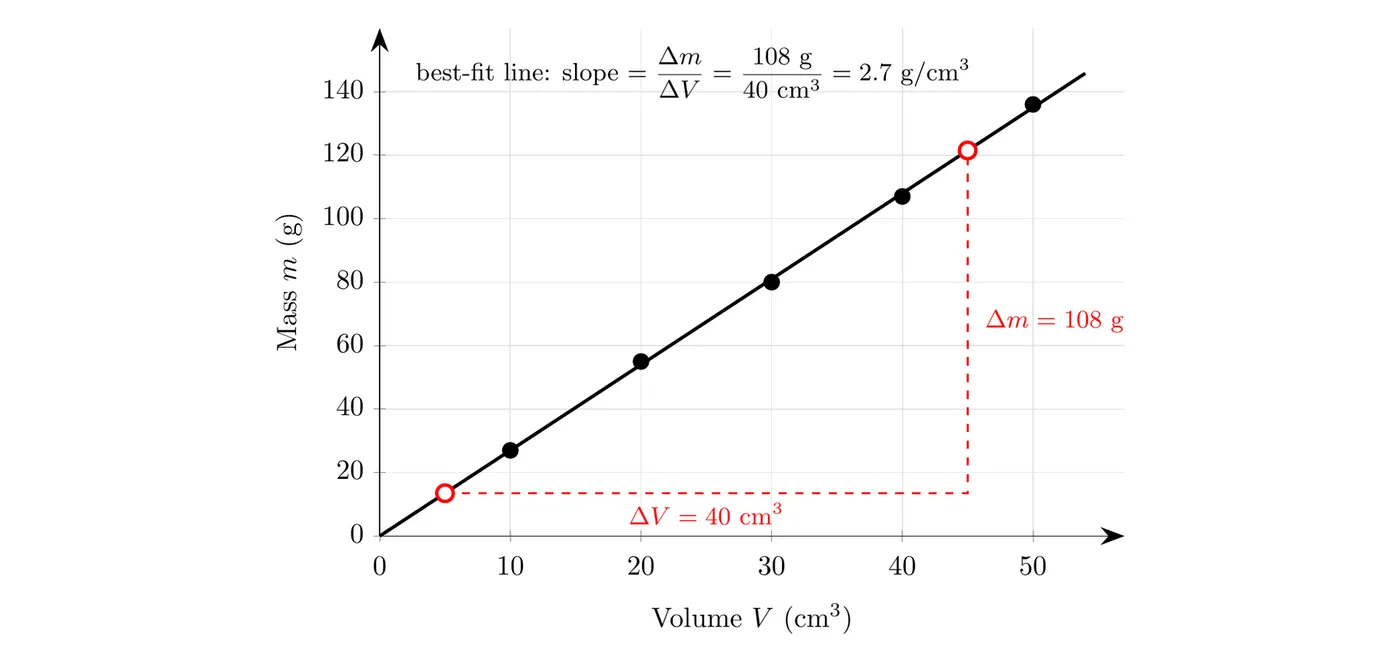
Converting, kg/m³, which matches aluminum in the table below. Using the slope of a best-fit line instead of a single sample averages out small measurement errors, and a line that passes through (or very close to) the origin confirms that mass is proportional to volume, just as predicts.
Common Densities (for reference)
Material | Density (kg/m³) |
Air (at sea level) | ~1.2 |
Water | 1000 |
Ice | 917 |
Gasoline | ~700 |
Aluminum | 2700 |
Iron/Steel | ~7800 |
Lead | 11,300 |
Gold | 19,300 |
Objects with density less than water (1000 kg/m³) will float in water, and objects denser than water will sink.
Common Mistakes
Confusing mass and density: mass is the amount of matter (kg), density is mass per unit volume (kg/m³), the same material always has the same density but can come in different masses.
Mixing up mass, weight, volume, size, and density: mass is how much matter there is (kg), weight is the gravitational force on it (, in N), volume is how much space it takes up (m³), size is a loose everyday word for how big something looks, and density is mass per volume (kg/m³). Saying an object sinks because it’s “heavy” or “big” is too vague for an AP free response; name the quantity, like “its density is greater than the water’s density.”
Using the wrong volume formula: sphere is (not with diameter), cube is (not or ), always identify the shape first.
Unit conversion errors: convert grams to kilograms (divide by 1000), centimeters to meters (divide by 100), and cm³ to m³ (divide by ), final density should always come out in kg/m³.
Using diameter instead of radius: sphere and cylinder volume formulas need radius, not diameter, remember .
Calculator errors with scientific notation: (add exponents when multiplying), (subtract when dividing), keep careful track of positive and negative exponents.
Flipping the density formula: it’s , mass over volume, not volume over mass.
Assuming larger objects are denser: density doesn’t depend on size, a small lead ball has the same density as a huge lead block, size affects mass and volume but not their ratio.
Mixing up incompressible and viscosity: incompressible means volume doesn’t change under pressure, no viscosity means no internal resistance to flow, these are two separate properties of ideal fluids.
Forgetting to cube the side length for a cube: if the side is 0.06 m, volume is m³, not .
Rounding too early: keep extra digits through intermediate steps, and only round your final answer, early rounding can introduce real errors, especially with very large or small numbers.