

4.2 - Magnetism and Moving Charges
Magnetic Field from Moving Charges
A single moving charged object makes its own magnetic field.
What the Field Depends On
The magnetic field at a given point from a moving charge depends on:
- The object’s velocity ().
- The distance from the object to the point.
- The charge of the object.
Direction of the Field
At any point in space, the field from a moving charge points perpendicular to both:
1. The object’s velocity ().
2. The position vector from the object to that point ().
Right-hand rule for the field direction:
- Point your fingers along the velocity ().
- Curl them toward the position vector ().
- Your thumb points along the magnetic field () for a positive charge.
- For a negative charge, the field points the opposite way.
Maximum Field Strength
The field is strongest when the velocity and the position vector are perpendicular (at 90°).
When the velocity and position vector are parallel or antiparallel (0° or 180°), the field at that point is zero.
Reading the symbols: means a vector points out of the page (the tip of an arrow coming at you), and means it points into the page (the tail of an arrow flying away).
Example: a proton moves to the right across the page. Which way does its magnetic field point at a spot directly above it, directly below it, and directly ahead of it?
- Above it: fingers point right (), curl them toward the spot above ( points up the page), and your thumb points out of the page.
- Below it: fingers right, curl toward the spot below, and your thumb points into the page.
- Directly ahead or behind: and are parallel or antiparallel, so there.
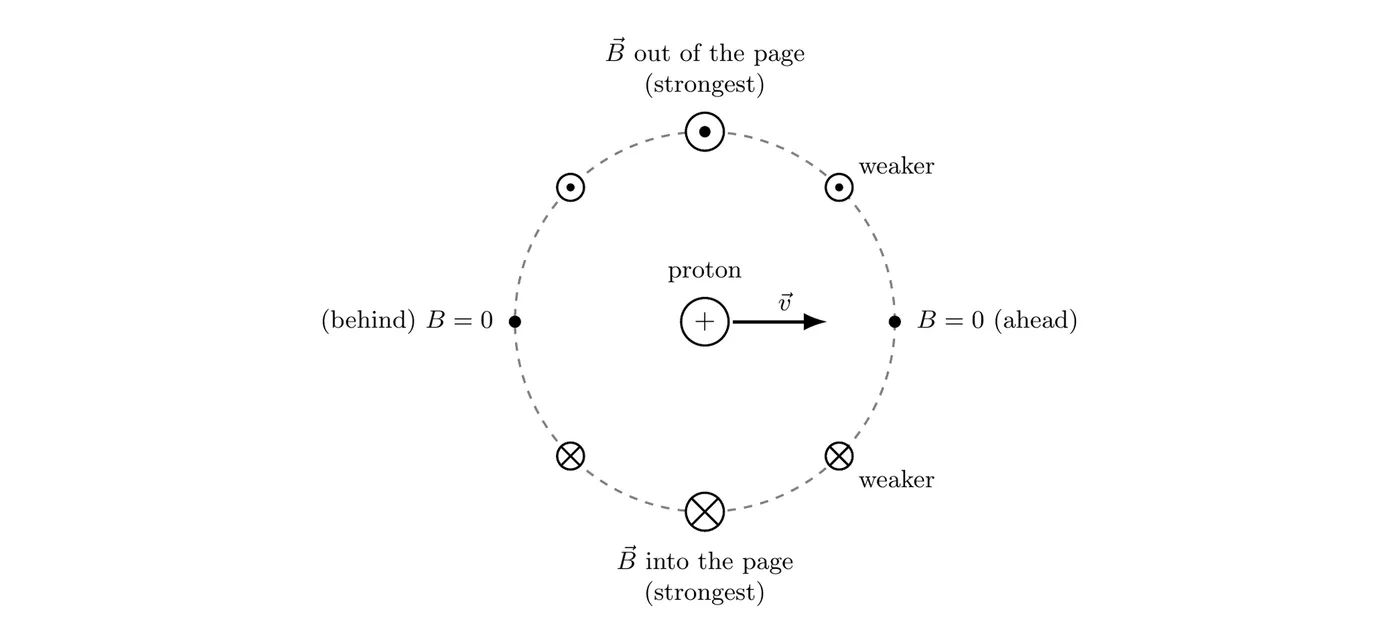
At the same distance, the field is strongest at 90° from the velocity (straight above and below), weaker at the angled spots, and zero along the line of motion. All together, the field circles around the proton’s path. For an electron moving the same way, every one of these directions flips.
Magnetic Force on Moving Charges
Magnetic forces are the interactions between moving charged objects.
A magnetic field can push on a charged object moving through it.
That’s why magnetism is an interaction between moving charges. A moving charge makes a magnetic field, and a second moving charge passing through that field feels a force (and the same goes the other way). A charge sitting still makes no magnetic field and feels no magnetic force, so it only takes part in electric interactions. The word can matters too: the field only pushes on a moving charge whose velocity points at an angle to the field.
Magnitude of the Magnetic Force
where:
- = magnetic force (N)
- = magnitude of the charge (C)
- = speed of the charged object (m/s)
- = magnitude of the magnetic field (T)
- = angle between the velocity vector and the magnetic field vector
This is the equation sheet form, . Rearranging it also tells you what a tesla is: .
The Force Depends On:
- The size of the charge ().
- The size of the velocity ().
- The size of the magnetic field ().
- The angle between and .
Special Cases
(perpendicular): (the maximum force).
or (parallel or antiparallel): (no force).
Note: the boundary statement keeps quantitative problems to angles of 0°, 90°, and 180°. You can still reason about other angles qualitatively.
Example: an alpha particle (charge C) moves at m/s perpendicular to a 0.20 T field. The force is N. If the field were doubled, the force would double to N. If the particle moved at the same speed parallel to the field instead, the force would be zero.
Direction of the Magnetic Force
The force points perpendicular to both the magnetic field and the velocity of the charge.
Right-hand rule for the force direction (positive charge):
1. Point your fingers along the velocity ().
2. Curl them toward the magnetic field ().
3. Your thumb points along the force ().
For negative charges: the force points the opposite way.
Example: a uniform field points into the page. Find the force on each particle below.
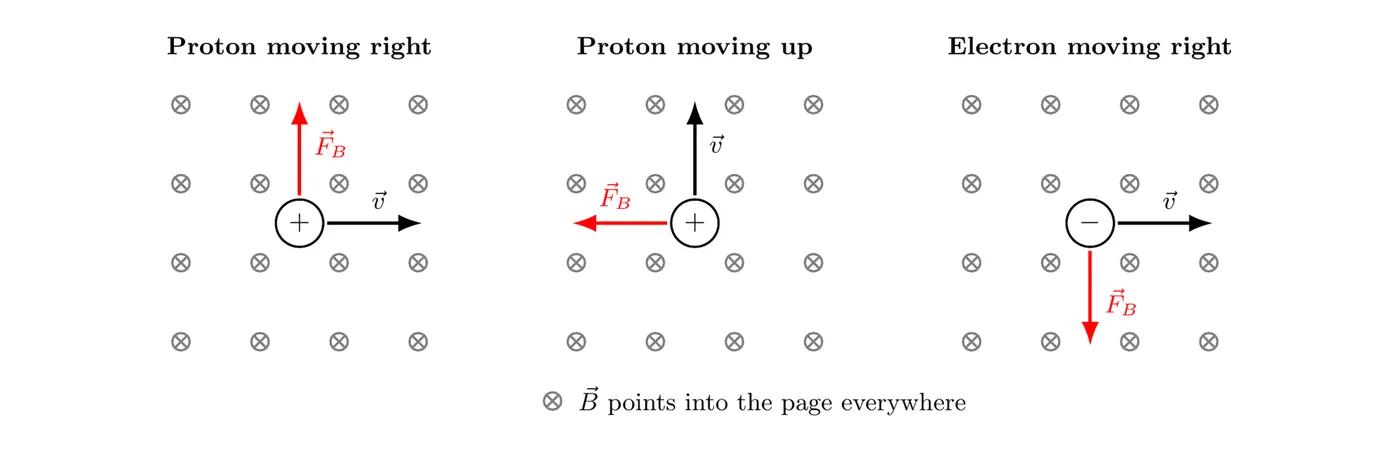
- Proton moving right: fingers right, curl them into the page, and your thumb points up the page.
- Proton moving up the page: fingers up, curl into the page, and your thumb points left.
- Electron moving right: the same hand position as the first case gives up, then flip it for the negative charge, so the force points down the page.
In every case the force is perpendicular to both and , so here it lies in the plane of the page at a right angle to the velocity. That sideways push is what bends the particle into a circle.
Important: since the force is always perpendicular to the velocity, magnetic forces do no work on charged particles (the force is perpendicular to the displacement). A magnetic force can change which way a particle moves, but not its speed or kinetic energy.
Combined Electric and Magnetic Fields
In a region with both a magnetic field and an electric field, a moving charge feels independent forces from each one:
The electric force and the magnetic force act at the same time and don’t interfere with each other.
Example: Balancing the Two Forces
Two parallel plates make a uniform electric field pointing down the page, and a magnetic field points into the page in the same region. A proton enters moving to the right. This setup is called a velocity selector.
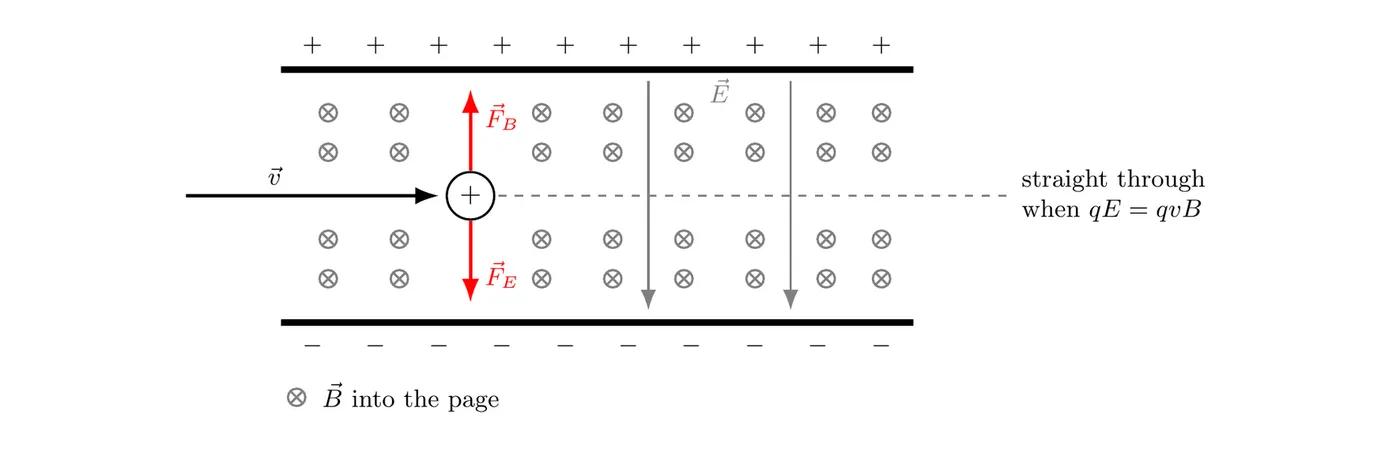
- Electric force: points the same way as for a positive charge, so it’s down. Its size, , doesn’t depend on the speed.
- Magnetic force: fingers right, curl into the page, thumb up. Its size, , grows with speed.
- Straight through: the proton keeps going straight only if the two forces cancel: , so .
With N/C and T, m/s. A faster proton feels a bigger magnetic force and curves up; a slower one curves down. The charge cancels out of , so an electron at m/s also goes straight (both of its forces flip).
Hall Effect
The Hall effect is the potential difference that shows up in a conductor when an external magnetic field has a component perpendicular to the direction the charges are moving.
How It Works
- Current flows through a conductor (moving charges).
- An external magnetic field is applied perpendicular to the current.
- The magnetic force pushes the moving charges to one side of the conductor.
- That build-up of charge sets up a transverse electric field.
- That electric field creates a measurable Hall voltage across the conductor.
The Hall effect gets used to:
- Figure out the sign of the charge carriers (positive or negative).
- Measure magnetic field strength.
- Measure current.
Which Edge Charges Up
Take a strip carrying current to the right with the field into the page. If the charge carriers are positive, they move right, and the force right-hand rule pushes them up, so the top edge becomes positive. If the carriers are electrons, they move left (opposite the current). Fingers left, curl into the page, thumb points down, then flip for the negative charge: the electrons are also pushed up, so the top edge becomes negative.
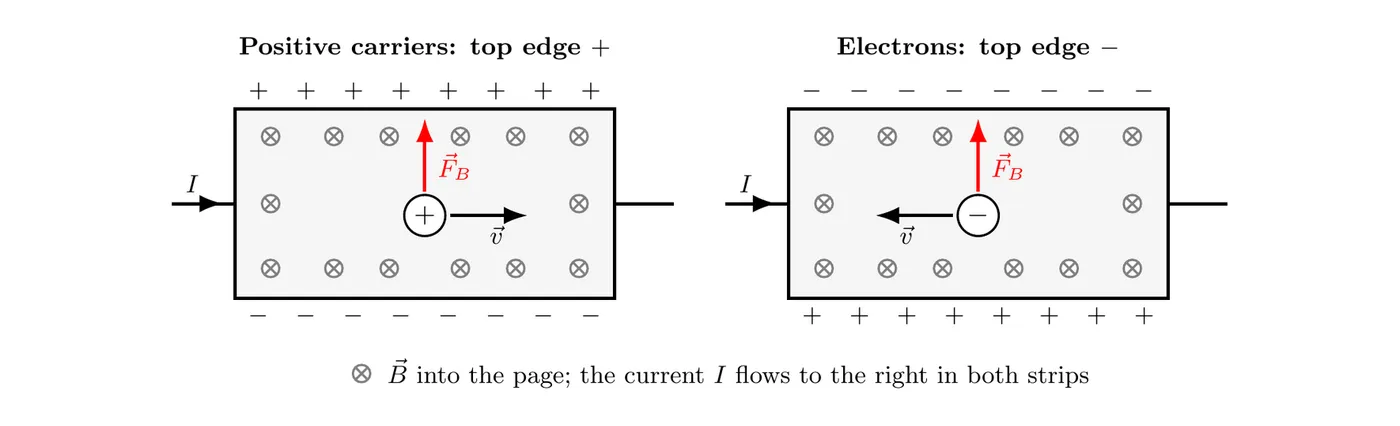
Both kinds of carriers get pushed to the same edge, so the sign of that edge tells you the sign of the carriers. In copper and most metals the top edge comes out negative, because the carriers are electrons.
The charge stops piling up once the electric force from the built-up charge pushes on the moving carriers as hard as the magnetic force does. A stronger magnetic field means more built-up charge and a bigger Hall voltage, which is how a Hall probe measures magnetic fields.
Practice Problems
1. An electron moves at m/s to the right through a magnetic field of magnitude T pointing into the page.
- (a) What’s the magnitude of the magnetic force on the electron?
- (b) Which way does the force point?
2. A proton moves parallel to a magnetic field. What’s the magnetic force on it?
3. A charged particle moves perpendicular to a uniform magnetic field. Describe its path and explain why.
4. A particle with charge C moves at m/s at an angle of 30° to a magnetic field of magnitude T. Roughly, how does the force compare to the force it would feel moving perpendicular to the field?
5. A conducting strip carries current to the right through a magnetic field pointing out of the page. The top edge of the strip becomes positive and the bottom edge becomes negative. Are the charge carriers positive or negative? Explain.
6. A region has a uniform electric field N/C pointing up and a magnetic field T pointing north. An electron moves east at m/s. Describe the electric and magnetic forces on it.
Solutions
1.
(a) The electron moves perpendicular to the field (right vs. into the page), so :
For an electron, C:
Answer: the force is N.
(b) Use the right-hand rule: fingers point right (velocity), curl them into the page (field), and your thumb points up, toward the top of the page. That’s the direction for a positive charge. The electron is negative, so the force flips to the opposite direction.
Answer: the force points down, toward the bottom of the page. (It can’t point out of the page: the magnetic force is always perpendicular to the field, and the field points into the page.)
2. When the velocity is parallel to the field, :
Answer: the magnetic force is zero. Magnetic forces only act on charges that have a velocity component perpendicular to the field.
3. The particle moves in a circle.
Why: the magnetic force is always perpendicular to the velocity (from the right-hand rule and the definition of the force). A force that’s perpendicular to velocity gives centripetal acceleration, which bends the path into a circle.
Since the magnetic force does no work (force ⊥ displacement), the particle’s speed stays constant. The force stays the same size too ( when perpendicular), so you get constant centripetal acceleration and uniform circular motion.
You find the radius by setting , which gives , so .
4. At , the force is:
If it were perpendicular ():
Comparison: the force at 30° is half the maximum force at 90°.
Answer: the force is smaller, exactly half of what it’d be perpendicular to the field. The force tracks the component of the velocity that’s perpendicular to the field.
5. Test both options with the force right-hand rule (field out of the page).
If the carriers were positive, they would move right with the current. Fingers right, curl out of the page, and your thumb points down, so positive charge would pile up on the bottom edge. That would make the top edge negative, which doesn’t match.
If the carriers are electrons, they move left (opposite the current). Fingers left, curl out of the page, thumb points up, then flip for the negative charge: the electrons get pushed down. Electrons piling up on the bottom make the bottom edge negative and leave the top edge positive. That matches. Answer: the carriers are negative (electrons), as in copper and most metals.
6.
Electric force:
For an electron (negative charge), the force is opposite to the field:
- The field points up.
- So the force on the electron points down.
- Magnitude: N.
Magnetic force:
Use the right-hand rule:
- Velocity: east.
- Field: north.
- For a positive charge, the force would point up.
- For an electron (negative), the force points down.
- Magnitude: N.
Answer: the electric force is N downward, and the magnetic force is N downward. The magnetic force is roughly 1000 times bigger here. Both forces act independently and both point the same way (down).
Common Mistakes
- Using the wrong right-hand rule. There’s one for the field made by a moving charge and a different one for the force on a moving charge. Don’t mix them up.
- Forgetting about negative charges. The right-hand rule gives you the direction for positive charges. For negatives (electrons), the force points the opposite way.
- Thinking magnetic forces do work. They’re always perpendicular to the velocity, so they do zero work. They change direction but never speed or kinetic energy.
- Using the wrong angle. The angle is between the velocity vector and the magnetic field vector, not between velocity and force or field and force.
- Dropping the sin θ. Don’t forget the in . It’s only when things are perpendicular.
- Getting the zero-force case backwards. The force is zero when the velocity is parallel or antiparallel to the field ( or ), not when it’s perpendicular.
- Assuming the particle speeds up. Magnetic forces change direction, not speed. A charged particle in a magnetic field keeps a constant kinetic energy (as long as nothing else acts on it).
- Botching the circular motion reasoning. Particles go in circles when the velocity is perpendicular to the field. If the velocity has a component along the field, the path becomes a helix (a spiral).
- Forgetting the forces are independent. Electric and magnetic forces act at the same time and independently. Work out each one separately, then add them as vectors.
- Misunderstanding the Hall effect. The Hall voltage shows up perpendicular to both the current and the field. It comes from charge piling up because of the magnetic deflection.
- Unit confusion. Keep charge in coulombs, velocity in m/s, and the field in tesla so the force comes out in newtons.
- Circular vs. straight paths. A charged particle in a uniform field (with v ⊥ B) travels in a circle at constant speed, not a straight line.