

4.1 - Magnetic Fields
Properties of Magnetic Fields
A magnetic field is a vector field that tells you the magnetic force on moving electric charges, electric currents, or magnetic materials.
Symbol: (measured in tesla, T).
To get a feel for the size of a tesla, here are some typical field strengths:
- Earth’s field at the surface: about T (roughly 25 to 65 μT, depending on where you are).
- A refrigerator magnet: about T.
- A hospital MRI machine: 1.5 to 3 T.
Magnetic Dipoles
Magnetic fields come from magnetic dipoles (or combinations of them), never from monopoles.
Key Properties
Magnetic dipoles have two poles:
- North pole (N): where the field lines come out.
- South pole (S): where the field lines go in.
There’s no such thing as a magnetic monopole. You never find a north pole off by itself without a south pole. Break a bar magnet in half and each piece turns into a full dipole with both a north and a south pole.
Pole Interactions
- Like poles push apart: N-N or S-S.
- Opposite poles pull together: N-S.
Field Strength
The strength of the field from a magnetic dipole fades as you get farther from the dipole.
Magnetic Field Lines
You can picture magnetic fields with vector field maps.
A vector field map puts an arrow at each point on a grid. The arrow points in the direction of at that spot, and a longer arrow means a stronger field. Here’s the map for a bar magnet:
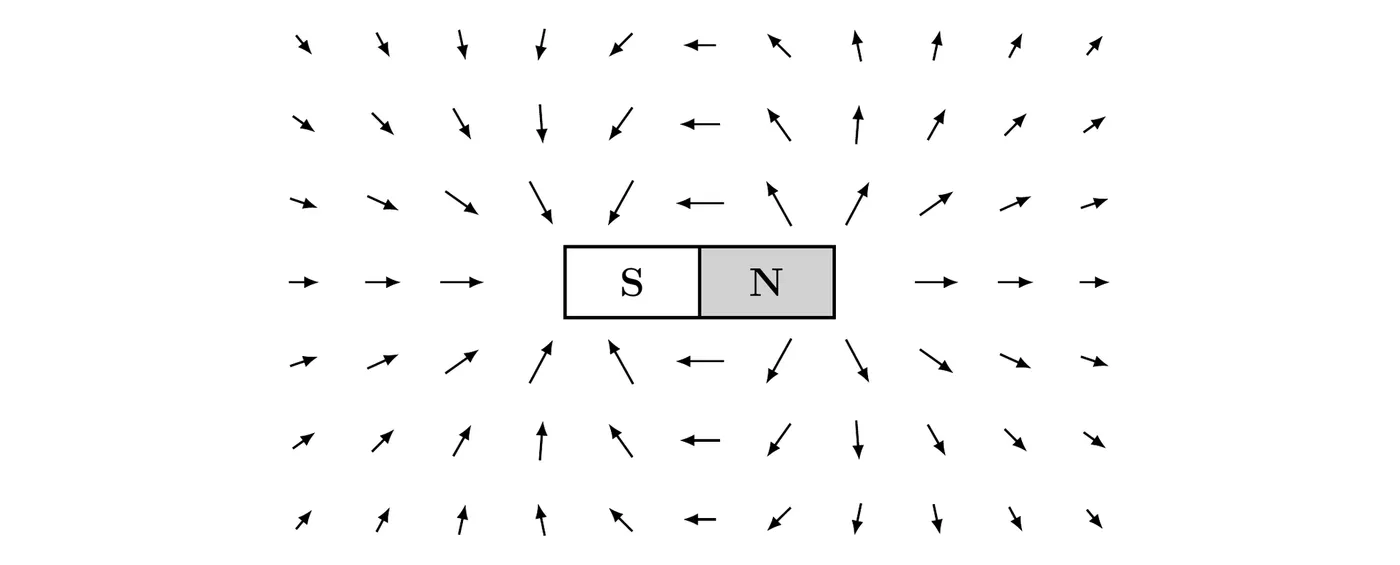
Read it like this: outside the magnet the arrows point away from the N end and curve back toward the S end, and they’re longest right next to the poles, where the field is strongest. A field line diagram shows the same field with curves instead of arrows: at every point, is tangent to the line through that point.
Properties of Magnetic Field Lines
Magnetic field lines form closed loops. They don’t start or stop anywhere (unlike electric field lines, which begin on positive charges and end on negative ones).
For a bar magnet:
- Outside the magnet, the field lines point away from the north pole.
- They loop back around to the south pole.
- They keep going inside the magnet from south to north, closing the loop.
How closely packed the lines are tells you the field strength. Tighter lines mean a stronger field.
Source of Magnetic Dipoles
Magnetic dipoles come from the circular or rotational motion of electric charges.
In magnetic materials, that motion comes from:
- Electrons orbiting the nuclei.
- The intrinsic spin of the electrons.
Permanent vs. Induced Magnetism
Each atom in a magnetic material acts like a tiny dipole. Whether the whole object acts like a magnet depends on how all those dipoles are arranged, so magnetism is a property of the system (the whole object), not of a single atom.
- Unmagnetized: the dipoles point in random directions, so their fields cancel and the object has no overall N or S pole.
- Induced magnetism: an external field lines up the dipoles, but only while the field is there. A paper clip touching a magnet becomes a magnet itself and can pick up a second paper clip. Take the magnet away and most of that alignment disappears.
- Permanent magnetism: the dipoles stay lined up after the external field is removed, so the object keeps its own N and S poles. A steel needle stroked with a magnet stays magnetized, which is how you can make a homemade compass.
Example: why does a magnet attract an unmagnetized iron nail no matter which pole you bring close? Bring the magnet’s N pole near one end of the nail. The magnet’s field lines up the nail’s dipoles so the near end of the nail becomes an S pole and the far end becomes an N pole. Opposite poles are now closest together, and since the field gets weaker with distance, the pull on the near S end beats the push on the far N end. Flip the magnet around and the induced poles flip too, so it’s attraction again.
Alignment in Magnetic Fields
A magnetic dipole (like a compass needle) placed in an external magnetic field tends to line up with the field.
The north pole of the dipole ends up pointing along the direction of the external field.
Why it lines up: the field pushes the dipole’s north pole along and its south pole the opposite way. In a uniform field those two forces are equal and opposite, so the needle doesn’t slide anywhere, but they twist it (a torque) until it points along the field, where the twist drops to zero.
That’s how you map a field with a compass. At any spot, the north end of the needle points in the direction of there, so a compass placed anywhere on the vector field map above would line up with the arrow at that point. Around a bar magnet, a compass points away from the magnet’s N pole and toward its S pole.
Types of Magnetic Materials
What a material is made of shapes how it responds to an external magnetic field.
Ferromagnetic Materials
Examples: iron, nickel, cobalt.
Behavior:
- Can be permanently magnetized by an external field.
- The external field lines up their magnetic domains (regions where the atomic dipoles are already pointing the same way).
- The dipoles stay lined up even after the external field is gone.
- Strong magnetic response.
Paramagnetic Materials
Examples: aluminum, titanium, magnesium.
Behavior:
- Interact only weakly with external fields.
- Their magnetic dipoles line up a little with the field.
- The dipoles do not stay lined up once the external field is removed.
- Weak attraction to magnets.
Diamagnetic Materials
Every material has some diamagnetism.
Behavior:
- The electronic structure lines up dipole moments opposite to the external field.
- Usually a weak effect.
- Leads to a weak repulsion from magnets.
Ferromagnetic and paramagnetic materials are diamagnetic too. Their diamagnetic push is just much smaller than their pull toward a magnet, so you only notice diamagnetism in materials with nothing else going on, like water, copper, and bismuth.
Earth’s Magnetic Field
Earth’s magnetic field can be roughly modeled as a magnetic dipole.
A few things to keep straight:
- Earth’s magnetic north pole actually sits near the geographic south pole.
- Earth’s magnetic south pole actually sits near the geographic north pole.
- That’s why the north end of a compass needle (which is a north pole) points toward geographic north. It’s being pulled toward Earth’s magnetic south pole, which lives up there.
Watch the wording here. The spot in the Arctic is usually called the “north magnetic pole” because of where it is, but in physics terms it behaves like the south pole of a bar magnet: Earth’s field lines point toward it and go into the ground there. Outside Earth, the field lines run from near the geographic south pole to near the geographic north pole.
Magnetic Permeability
Magnetic permeability () measures how much a material magnetizes in response to an external magnetic field.
Vacuum Permeability
Free space has a fixed value called vacuum permeability:
This constant shows up all over the equations for magnetic phenomena.
On the AP Physics 2 equation sheet it’s listed as (T·m)/A. In this unit it shows up in the field of a long straight wire, (Topic 4.3). Air has almost exactly the same permeability as empty space, so that equation works for wires in air too.
Material Permeability
The permeability of matter has values different from free space.
Material permeability:
- Comes from the material’s composition and arrangement.
- Is not constant for a given material.
- Shifts with lots of factors, like temperature, orientation, and the strength of the external field.
Example: iron shows how much permeability can change. Up to a point, a stronger external field lines up more and more of its domains, so its permeability is very large. Once most domains are already lined up (in a strong field), adding more field barely magnetizes it further, so its permeability drops. Heat iron above 770°C (its Curie temperature) and it stops being ferromagnetic altogether.
Relative permeability: .
- Ferromagnetic materials: (hundreds to thousands).
- Paramagnetic materials: a little above 1.
- Diamagnetic materials: a little below 1.
Practice Problems
1. A student snaps a bar magnet into three pieces. How many north poles and how many south poles are there in total afterward?
2. Explain why magnetic field lines have to form closed loops while electric field lines don’t.
3. A compass is set near the north pole of a bar magnet. Which end of the compass needle (north or south) points toward the magnet’s north pole?
4. An iron nail is placed in a strong magnetic field, and after the field is removed the nail stays magnetized. An aluminum rod goes through the same field but isn’t magnetized afterward. Explain the difference using material properties.
5. A material has relative permeability . Is it ferromagnetic, paramagnetic, or diamagnetic? Explain.
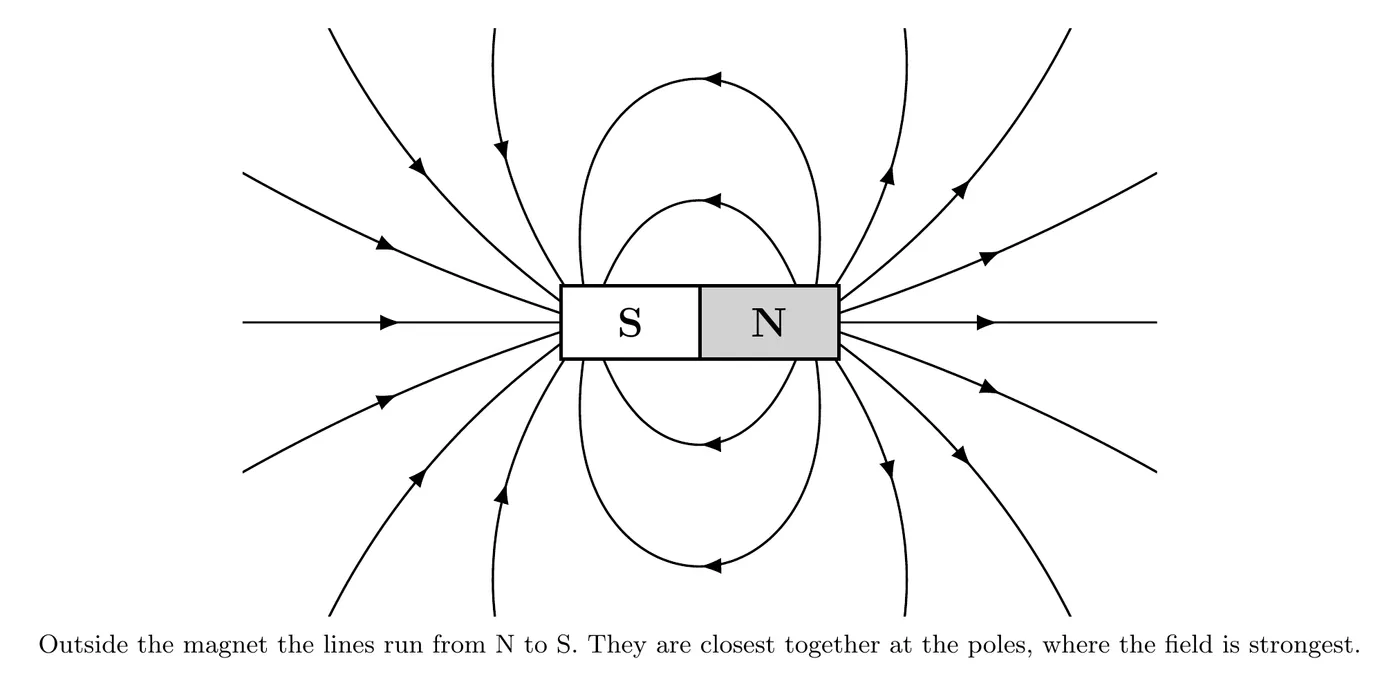
6. Draw the magnetic field line pattern around a bar magnet. Label the north and south poles and show the direction of the lines.
7. A small magnetic dipole is placed at different distances from a large bar magnet, first at distance , then at distance . Compare the field strength at the two spots, roughly.
Solutions
1. Breaking a magnet never gives you isolated poles. Each piece becomes a complete dipole.
Original magnet: 1 north pole, 1 south pole.
After breaking into 3 pieces: 3 north poles, 3 south poles.
Answer: 3 north poles and 3 south poles.
2. Magnetic field lines form closed loops because magnetic monopoles don’t exist. Every north pole is paired with a south pole. The lines come out of north poles and return to south poles, then keep going through the inside of the material back to the north pole, closing the loop.
Electric field lines are different. They start on positive charges and end on negative charges (or run off to infinity). Positive and negative charges can each exist on their own as monopoles, so electric field lines don’t have to close into loops.
3. The south end of the compass needle points toward the bar magnet’s north pole.
Why: opposite poles attract. The magnet’s north pole pulls in the compass needle’s south pole. (This trips people up because the needle’s “north-pointing end” is actually its north pole, which points toward Earth’s magnetic south pole located near geographic north.)
4. Iron is ferromagnetic while aluminum is paramagnetic.
In iron, the external field lines up the magnetic domains (big regions of aligned atomic dipoles) with the field. That alignment sticks around after the field is gone because the domains stay locked in place, so the iron ends up permanently magnetized.
In aluminum, individual atomic dipoles line up weakly with the external field, but there are no magnetic domains. Once the field is removed, thermal motion scrambles the dipoles again and the material goes back to being unmagnetized.
5. Ferromagnetic material.
A relative permeability of 500 means the material’s permeability is 500 times that of vacuum. A number that big is the signature of a ferromagnetic material.
Paramagnetic materials sit just barely above 1 (something like 1.00001), and diamagnetic materials just barely below 1 (like 0.99999). Only ferromagnetic materials reach into the hundreds or thousands.
6.
7. The field strength drops as you move farther from the magnet. At (twice as far), the field is weaker than at . The exact relationship depends on the geometry, but in general the field falls off fast with distance, often faster than . For a magnetic dipole far from the source, the field scales roughly as , so doubling the distance makes the field about 8 times smaller: . So the small dipole placed at would feel less force and line up less strongly than it would at .
Common Mistakes
- Thinking magnetic monopoles exist. Poles always come in pairs. You can’t isolate a north or a south pole, since breaking a magnet just makes more complete dipoles.
- Mixing up pole names. A magnet’s “north pole” is defined as the end the field lines come out of. Earth’s magnetic south pole sits near the geographic north pole, which is why compass north poles point that way.
- Drawing field lines that don’t close. Unlike electric field lines, magnetic field lines always form complete closed loops with no start or end.
- Thinking the lines start and stop at the poles. The lines look like they come out of north and go into south, but they actually keep going through the inside of the magnet, forming closed loops.
- Confusing magnetic attraction with gravity. Magnets strongly attract only ferromagnetic materials (and opposite poles). Paramagnetic materials feel a pull too weak to notice without a strong magnet, and most stuff (paper, plastic, wood) barely reacts.
- Assuming all metals are ferromagnetic. Only iron, nickel, cobalt, and their alloys are strongly ferromagnetic. Aluminum, copper, and gold aren’t pulled in by magnets (aluminum is weakly paramagnetic, and copper and gold are diamagnetic).
- Thinking permanent magnets last forever. Permanent magnets can lose their magnetization from heating (above the Curie temperature), hard impacts, or being exposed to opposing fields.
- Confusing permeability with permittivity. Permeability () is about magnetic fields. Permittivity () is about electric fields. Don’t swap them.
- Assuming permeability is constant. A material’s permeability shifts with temperature, field strength, and other factors. Only vacuum permeability () is a true constant.
- Getting the field line direction wrong. Magnetic field lines run from north to south outside the magnet, and from south to north inside it.