

4.3 - Magnetism and Current Carrying Wires
Magnetic Fields from Current-Carrying Wires
Any wire carrying a current makes its own magnetic field. That makes sense once you remember current is just moving charge, and moving charges always create magnetic fields, so a whole stream of them does too.
Field Around a Long Straight Wire
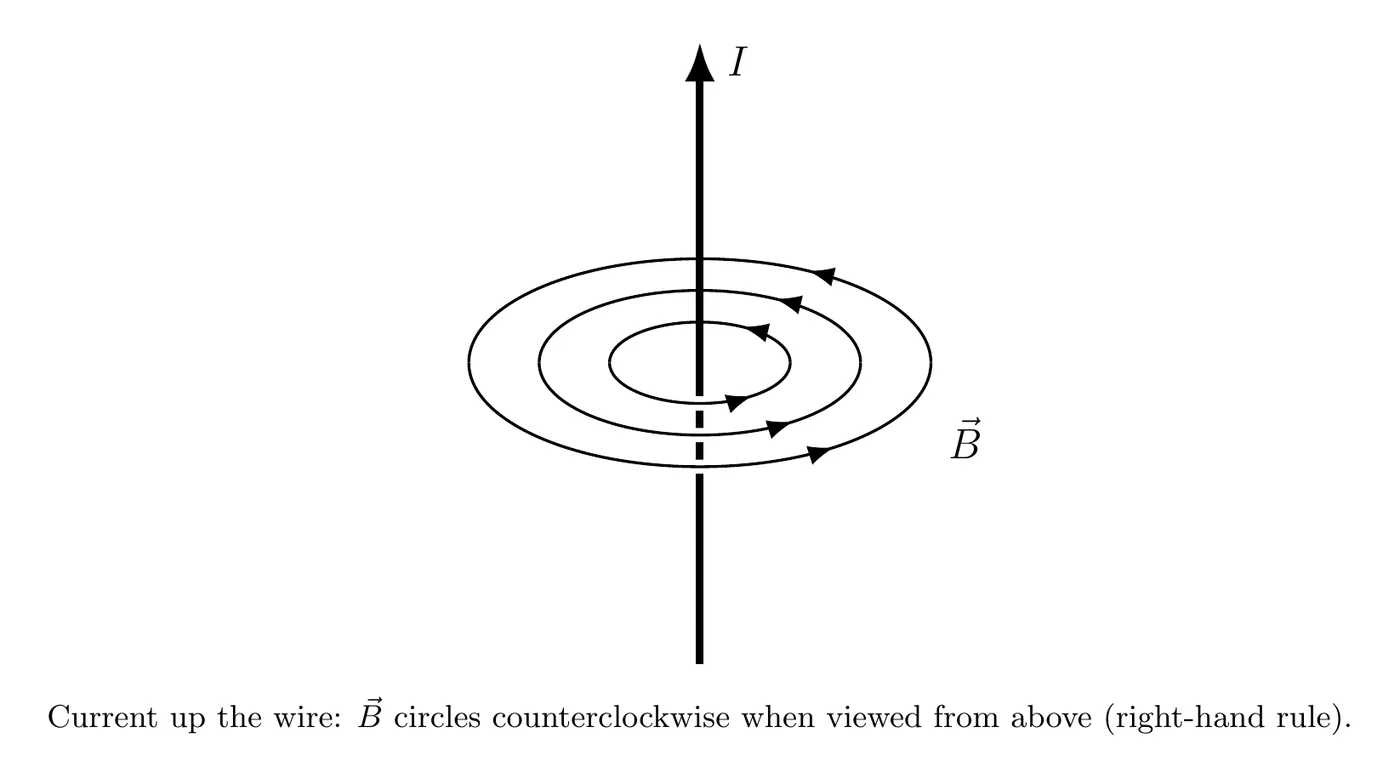
Field pattern. The magnetic field around a long straight wire wraps around it in circles. Picture a bunch of concentric rings centered on the wire, and the field vectors are tangent to those rings. There’s no part of the field pointing toward the wire, away from it, or along it. It only circles around.
Magnitude. The strength of the field is:
where:
- = magnetic field strength (T)
- = vacuum permeability = T·m/A
- = current in the wire (A)
- = perpendicular distance from the wire’s central axis (m)
Two relationships fall right out of this:
- , so more current means a stronger field.
- , so the field gets weaker the farther you go from the wire.
This is the equation sheet form, (the same thing written as one fraction).
Example: a wire carries 10 A. At 4.0 cm from it, T, about the same as Earth’s field. That’s why a compass held near a wire with a big current swings noticeably.
Factor of change: triple the current to 30 A and move out to 8.0 cm. Tripling triples , and doubling halves it, so T.
Direction (Right-Hand Rule #1). Point your thumb in the direction of the conventional current, and your fingers curl the way the field circles. Another way to picture it: grab the wire with your thumb pointing along the current, and your curled fingers show the field direction.
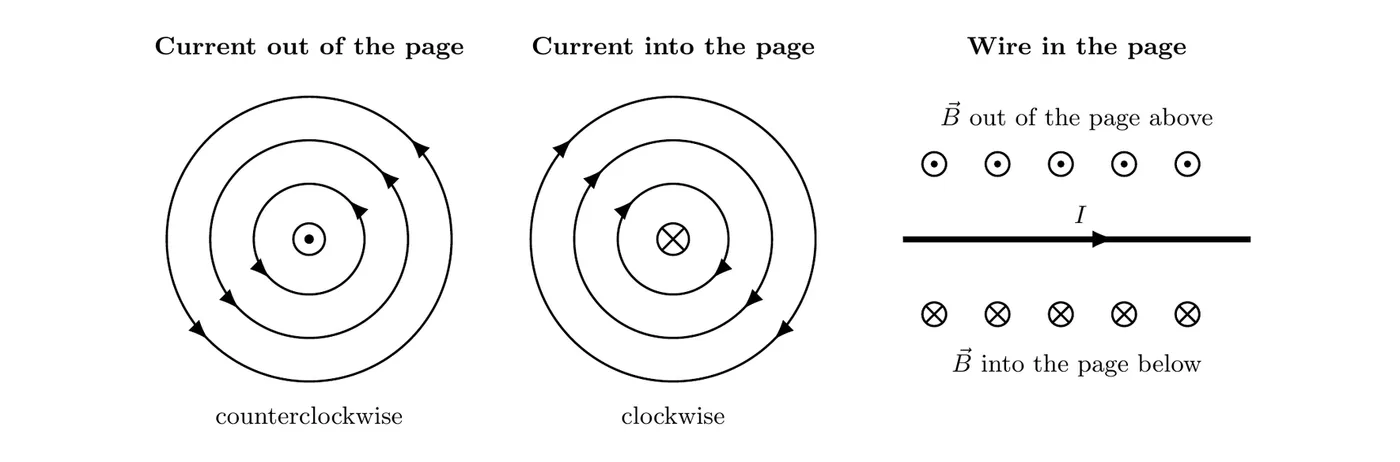
On paper: for a wire coming straight out of the page (), the field circles counterclockwise. For a wire going into the page (), it circles clockwise. For a wire lying in the page with the current to the right, the field comes out of the page above the wire and goes into the page below it.
Field from a Current Loop
If you bend that wire into a loop, the field at the center of the loop points straight along the loop’s axis.
Right-hand rule for a loop: curl your fingers the way the current flows around the loop, and your thumb points in the direction of the field through the center.
A current loop basically behaves like a little bar magnet (a magnetic dipole). One face acts like a north pole where the field comes out, and the other face acts like a south pole where the field goes back in.
The picture below slices the loop in half and looks at it edge-on. The top of the loop carries current out of the page () and the bottom carries it into the page (). Near each wire the field circles that wire, and in between both wires push the field the same way, so the field is strongest inside the loop and points along its axis (to the right here).
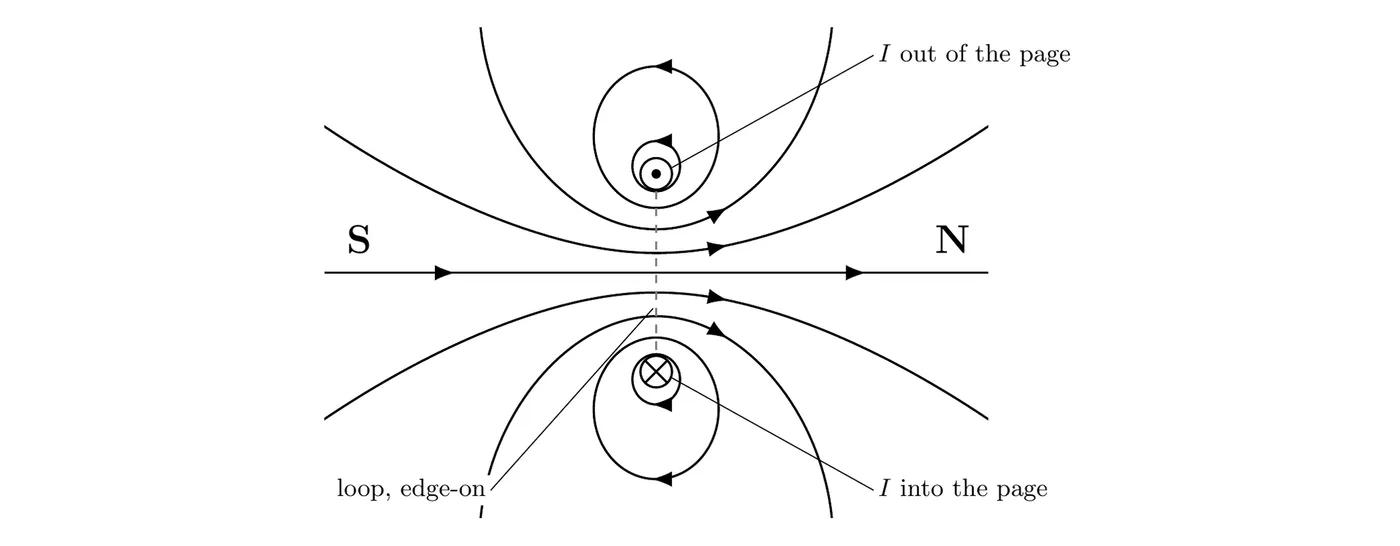
Field lines come out of the right face, so the right face acts like the N pole of a bar magnet. Check it with the loop rule: curl your fingers the way the current flows and your thumb points right, through the center.
Adding Magnetic Fields Together (Superposition)
If you’re near two or more current-carrying wires, you find the total field with vector addition. Work out the field from each wire on its own, then add them as vectors, keeping track of both size and direction.
Example: two long parallel wires are 6.0 cm apart. Wire 1 (on the left) carries 3.0 A out of the page, and wire 2 (on the right) carries 3.0 A into the page. Find the field at point P, halfway between them.

- Size from each wire: each wire is cm m from P, so each makes T.
- Wire 1 (out of the page): its field circles counterclockwise, so at P, to its right, the field points up the page.
- Wire 2 (into the page): its field circles clockwise, so at P, to its left, the field also points up.
- Add them: same direction, so T, pointing up the page.
If both currents pointed the same way, the two fields at P would point in opposite directions and cancel (that’s Practice Problem 2).
Force on a Current-Carrying Wire in a Magnetic Field
A magnetic field can push on a wire that’s carrying current.
Magnitude:
where:
- = magnetic force on the wire (N)
- = current in the wire (A)
- = length of wire sitting inside the field (m)
- = magnetic field strength (T)
- = angle between the current direction and the field direction
So the force depends on the current, how much of the wire is in the field, how strong the field is, and the angle between the current and the field.
Special cases:
- (current perpendicular to field): , which is the maximum possible force.
- or (current parallel or antiparallel to field): , no force at all.
Direction (Right-Hand Rule #2). Point your fingers along the current, bend them toward the field, and your thumb points along the force. The force always comes out perpendicular to both the current and the field.
Force between two parallel wires. This puts both halves of the topic together. Wire 1 makes a field at wire 2 (), and wire 2’s current sits in that field, so it feels a force . Currents in the same direction attract, and currents in opposite directions repel.
Example: two long parallel wires 5.0 cm apart carry 10 A and 15 A in the same direction. Find the force on a 2.0 m length of the second wire.
- Field from wire 1 at wire 2: T.
- Force: N, toward wire 1 (attractive).
- Newton’s third law: a 2.0 m length of wire 1 feels the same N pulling it toward wire 2, even though the currents are different.
Practice Problems
1. A long straight wire carries a current of 5.0 A. What is the magnetic field strength 2.0 cm from the wire?
2. Two parallel wires 10 cm apart each carry 3.0 A in the same direction.
- (a) Find the field midway between the wires.
- (b) Is the force between the wires attractive or repulsive?
3. A circular loop of radius 0.10 m carries 2.0 A. Using the right-hand rule, find the direction of the field at the center if the current runs clockwise as seen from above.
4. A straight wire carries 8.0 A to the east. At a point 5.0 cm directly below the wire, what is the magnitude and direction of the field?
5. A 0.50 m wire carrying 4.0 A sits perpendicular to a uniform 0.30 T field. What is the force on the wire?
6. A wire carries current northward through a field pointing east. Which way is the force on the wire?
7. Two long parallel wires carry A and A in opposite directions, separated by 8.0 cm. At what distance from wire 1 is the net field zero?
Solutions
1. Convert the distance: cm m.
The field is T, or 50 μT.
2. (a) At the midpoint each wire is cm m away.
Since both currents run the same way, at the midpoint their fields point in opposite directions. The currents and distances are equal, so:
The net field at the midpoint is zero.
(b) Currents in the same direction attract. Here’s the reasoning: wire 1 creates a field at wire 2’s location. Wire 2 is carrying current through that field, so it feels a force, and the force right-hand rule points it toward wire 1. By Newton’s third law the two forces are equal and opposite, so the wires pull on each other. The force is attractive.
3. Using the loop right-hand rule, curl your fingers clockwise (as seen from above) and your thumb points downward. The field at the center points downward, into the loop.
4. The current runs east and we want the field at a point below the wire.
For direction, point your thumb east and let your fingers curl around the wire. Directly below the wire, the field points north.
Magnitude T, pointing north.
5. The wire is perpendicular to the field, so :
The force is 0.60 N.
6. Point your fingers north (the current), bend them east (the field), and your thumb points down, toward the ground. The force points downward. (Quick check: east bent toward north gives up, so north bent toward east gives the opposite, down.)
7. Let be the distance from wire 1. Because the currents are opposite, the two fields point the same way everywhere between the wires, so they can’t cancel there. Outside the pair the fields point opposite ways, and they can only be equal in size on the side of the weaker current (wire 2), where you’re farther from the stronger wire. So the point is beyond wire 2, with m.
- Field from wire 1:
- Field from wire 2:
Beyond wire 2 the two fields point opposite ways, so the net field is zero where their sizes match:
The net field is zero 24 cm from wire 1, on the far side of wire 2 (16 cm beyond wire 2). Check: T and T, equal in size and opposite in direction.
Common Mistakes
- Grabbing the wrong right-hand rule. For the field around a straight wire, thumb is current and fingers are field. For the field at the center of a loop, fingers are current and thumb is field.
- Mixing up the field rule and the force rule. One right-hand rule finds the field a current makes. A different one finds the force on a current sitting in a field. They aren’t interchangeable.
- Dropping the . The equation is , not .
- Using the wrong distance. The is the perpendicular distance out from the wire, not a length along it.
- Adding fields like plain numbers. Fields are vectors, so direction matters when you combine them.
- Assuming parallel currents always cancel. Equal same-direction currents make fields that cancel at the midpoint (unequal ones cancel closer to the weaker wire). Opposite-direction currents make fields that add everywhere between the wires, so if they cancel at all, it’s outside the pair, on the side of the weaker current.
- Getting the force direction wrong. The force is perpendicular to both the current and the field, so use the force right-hand rule carefully.
- Forgetting in the force equation. It’s . You only get the full when the current and field are perpendicular.
- Confusing attraction and repulsion. Same-direction currents attract, opposite-direction currents repel.
- Unit slips. Amps, meters, tesla. Watch for cm-to-m conversions.
- Thinking the field is constant. It falls off as , so it’s never uniform around a wire.
- Using the thumb for current in loops. In loops the fingers show the current and the thumb shows the field.
- Pushing the formula past its limits. The straight-wire formula assumes a long wire. Near the ends or for short wires it isn’t accurate.
- Sign errors in superposition. Nail down each field’s direction before combining. Opposite directions subtract.