

4.4 - Electromagnetic Induction and Faraday’s Law
Magnetic Flux
Magnetic flux () measures how much of a magnetic field pokes straight through a surface. It’s basically a count of how much field passes through an area.
Definition:
where:
- = magnetic flux (weber, Wb, or T·m²)
- = magnetic field strength (T)
- = cross-sectional area of the surface (m²)
- = angle between the field and the area vector (the direction perpendicular to the surface)
One weber (Wb) equals one T·m².
The equation sheet writes it as . All of these say the same thing: only the part of that points straight through the surface () counts.
Flux goes up when more of the field points straight through the surface, and it goes up when the surface itself is bigger.
The area vector. Every surface has an area vector that points straight out of the surface, perpendicular to it. The angle is measured from that vector, so:
- : field lines up with the area vector, (most flux)
- : field lies flat along the surface, (no flux)
- : field points opposite the area vector, (most negative flux)
Which way the area vector points. For a flat loop, the area vector can point out of either face. Pick one and stick with it for the whole problem, since that choice sets the sign of the flux. For a closed surface (like a box or a sphere), the area vector always points outward. Magnetic field lines form closed loops, so every line that goes into a closed surface also comes back out, and the net magnetic flux through any closed surface is zero.
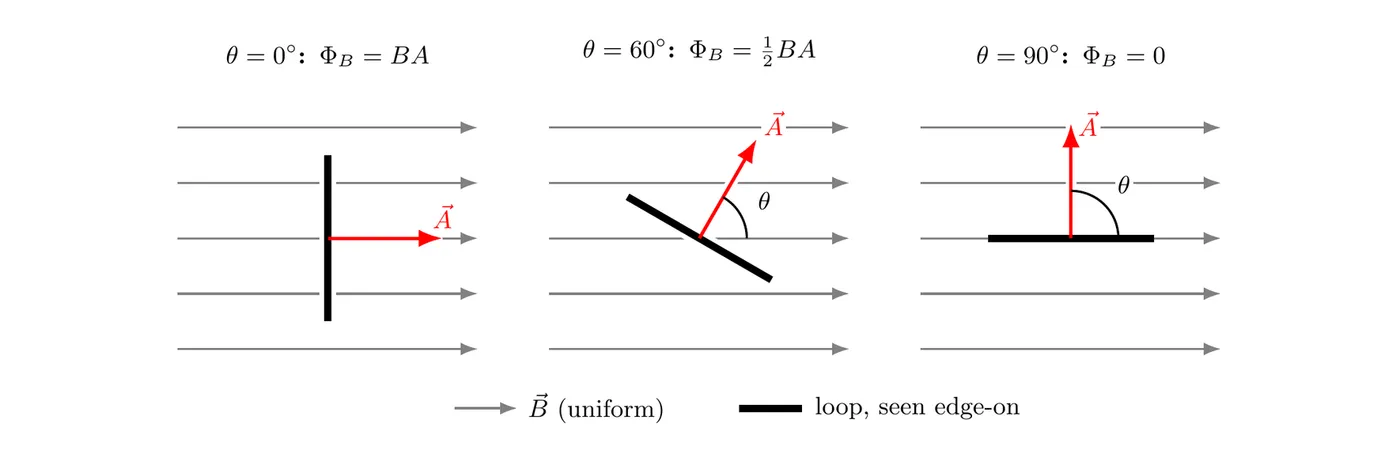
Example: a 0.20 m by 0.30 m rectangular loop ( m²) sits in a uniform 0.50 T field.
- Field perpendicular to the loop’s plane: , so Wb.
- Loop turned so the field skims along its plane: , so .
- Loop flipped over from the first case: , so Wb. The field didn’t change; only the face the area vector comes out of did.
Sign of the flux. The sign just tells you whether the field runs with the area vector (positive) or against it (negative).
Faraday’s Law
Faraday’s law ties a changing magnetic flux to the voltage (emf) it induces:
or, writing the flux out:
where:
- = induced emf (V)
- = change in flux (Wb)
- = time interval (s)
The equation sheet gives the magnitude version, . Use it for the size of the emf, then use Lenz’s law (below) for the direction. The emf is the induced electric potential difference around the loop, so if the loop is a closed conductor with resistance , it drives a current .
The big idea: when the flux through a loop changes, it induces a voltage in that loop. You can change the flux four ways:
1. Change the field strength .
2. Change the loop’s area .
3. Change the angle between the loop and the field.
4. Move the loop into or out of the field.
And the key catch: a steady, unchanging flux induces nothing. Only a changing flux produces an emf.
Example: a circular loop of radius 0.050 m and resistance 0.20 Ω lies flat in a field perpendicular to its plane. The field rises steadily from 0.10 T to 0.40 T in 0.25 s. The area is m², so Wb. Then V, and the current is A.
Reading a flux vs. time graph. Faraday’s law says the emf equals the slope of the flux vs. time graph (with a minus sign for direction). A steep section means a big emf. A flat section means zero emf, no matter how large the flux is. When the slope changes sign, the emf and the induced current reverse direction.
Example: the top graph shows the flux through a loop with resistance 0.50 Ω.
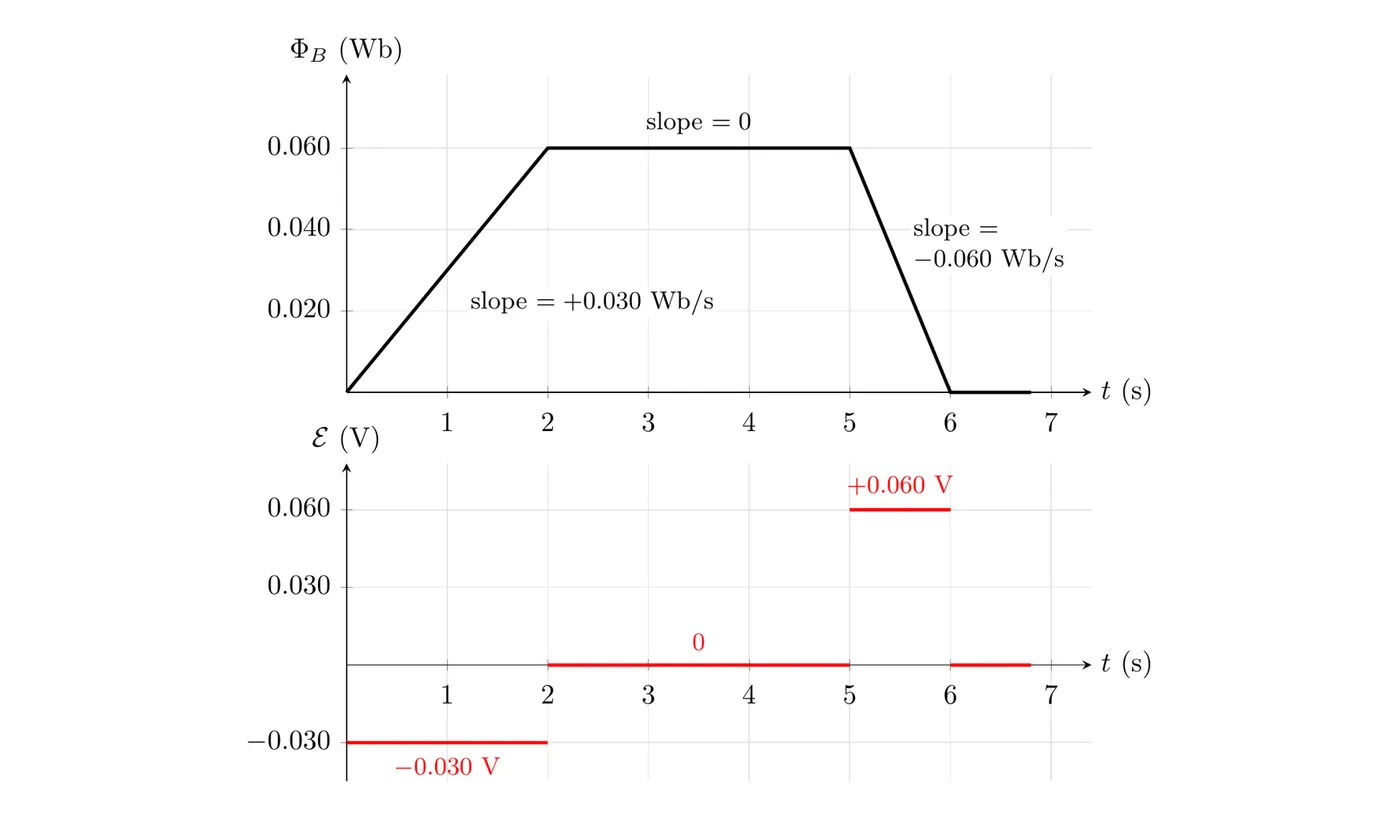
- 0 to 2.0 s: the flux rises by 0.060 Wb, so V and A.
- 2.0 to 5.0 s: the flux is constant, so and , even though the flux is at its largest.
- 5.0 to 6.0 s: the flux drops by 0.060 Wb in 1.0 s, so V and A, flowing the opposite way from the first interval (the flux is now decreasing instead of increasing).
The bottom graph plots : negative while the flux grows, zero while it’s flat, positive while it drops. The emf is biggest where the flux graph is steepest.
Lenz’s Law
Lenz’s law tells you which direction the induced emf pushes. It’s the reason for the minus sign in Faraday’s law.
The rule: the induced current sets up its own magnetic field that fights the change in flux. Nature basically resists the change, so whatever the flux is doing, the induced current tries to undo it.
How to use it:
1. Figure out whether the flux is increasing or decreasing.
2. The induced current makes a field that opposes that change:
- If flux is increasing, the induced field points opposite the original field.
- If flux is decreasing, the induced field points the same way as the original field.
3. Use the right-hand rule to find the current direction that would make that induced field.
Right-hand rule for a loop: curl your fingers along the induced current, and your thumb points along the induced field.
Example: the N pole of a bar magnet is pushed down toward a flat loop lying on a table. Which way does the induced current flow, as seen from above?
- Field through the loop: field lines leave the N pole, so below the magnet points down through the loop.
- Change: the magnet is getting closer, so the downward flux is increasing.
- Oppose the change: the induced field must point up through the loop.
- Right-hand rule: thumb up, and your fingers curl counterclockwise as seen from above.
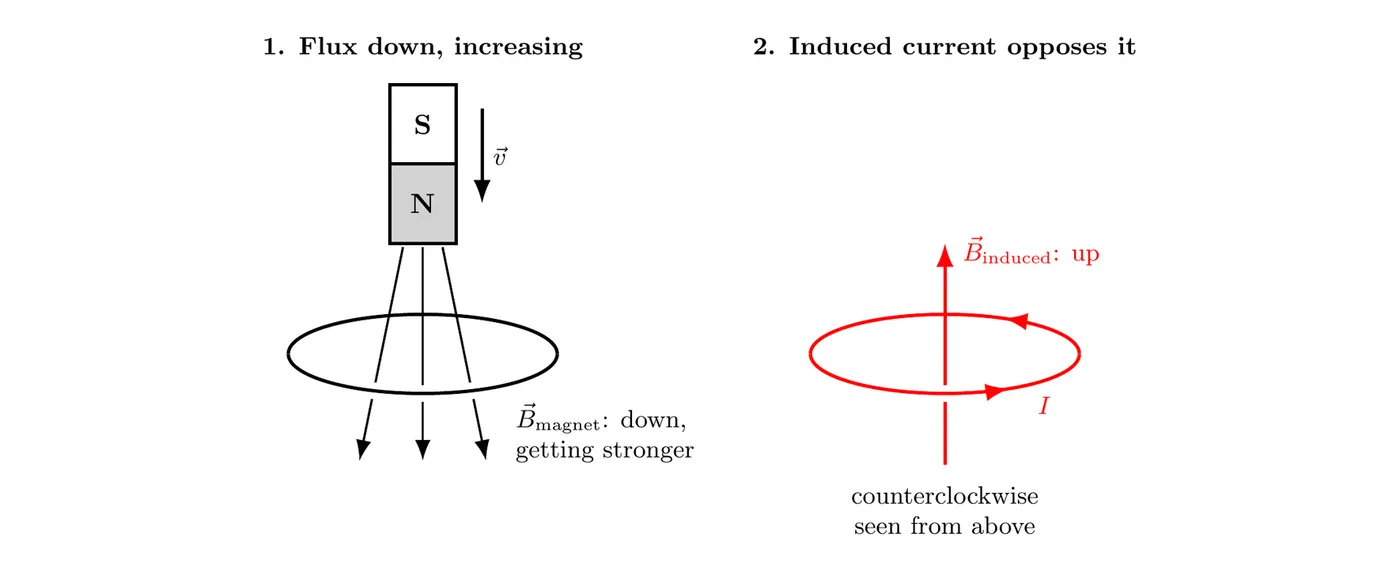
The loop now acts like a small magnet with its N face up, facing the magnet’s N pole, so it repels the incoming magnet. You have to push to keep the magnet moving, and that work is where the electrical energy in the loop comes from. Pull the magnet away instead and the downward flux decreases, so the induced field points down to prop it up, the current runs clockwise, and the loop attracts the magnet, again fighting the motion.
Motional EMF: Rod on Rails
A classic setup is a conducting rod sliding along two parallel rails in a uniform magnetic field.
Setup. A rod of length moves at velocity (perpendicular to its length) along parallel rails, with the field perpendicular to the plane of the rails.
Induced emf:
where:
- = induced emf (V)
- = field strength (T)
- = length of the rod (m)
- = rod’s speed, perpendicular to both its length and the field (m/s)
Where it comes from. As the rod slides, the loop’s area changes:
So the flux changes by:
and the emf is:
The charges’ point of view. You can also get from the magnetic force. The charges in the rod move with it at speed , so each one feels a force along the rod. That pushes charge toward one end, just like a battery would, and the work per charge over the length is .
Example: rails 0.40 m apart are connected by a 2.0 Ω resistor, and a uniform 0.50 T field points into the page. A rod slides to the right at a steady 3.0 m/s.
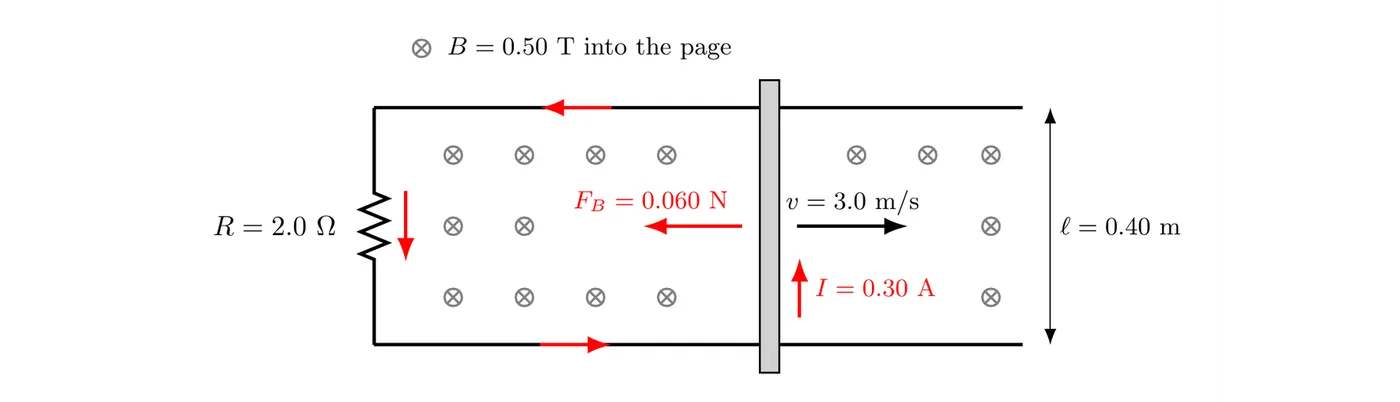
- emf: V.
- Current: A.
- Direction: the loop’s area is growing, so the flux into the page is increasing. The induced field must point out of the page inside the loop, so the current runs counterclockwise: up through the rod and down through the resistor.
- Force on the rod: N. Fingers up (the current in the rod), curl into the page, and your thumb points left, opposite the motion. That’s Lenz’s law again: the force fights the change.
- Energy check: to keep the rod at a steady speed, something has to push it right with 0.060 N, delivering W. The resistor uses W. The mechanical work becomes electrical energy.
Practice Problems
1. A circular loop of radius 0.10 m sits in a uniform 0.50 T field, with the field perpendicular to the loop. What is the flux through the loop?
2. A square loop with 0.20 m sides sits in a 0.80 T field. The field makes a 60° angle with the loop’s area vector. Find the flux.
3. The flux through a coil changes from 0.040 Wb to 0.010 Wb in 0.020 s. What is the magnitude of the induced emf?
4. A field perpendicular to a loop is increasing (pointing upward). By Lenz’s law, which way does the induced current flow, clockwise or counterclockwise as seen from above?
5. A 0.50 m rod moves at 3.0 m/s perpendicular to a 0.40 T field, with rod, field, and velocity all mutually perpendicular. What is the induced emf?
6. A rectangular loop 0.15 m × 0.25 m sits in a field that starts at 0.60 T perpendicular to the loop and drops uniformly to zero in 0.30 s.
- (a) What is the starting flux?
- (b) What is the magnitude of the induced emf during that time?
7. Explain why you need a changing field to induce an emf, not just a field sitting there.
Solutions
1. The field is perpendicular to the loop, so .
The flux is 0.016 Wb, or Wb.
2.
The flux is 0.016 Wb, or Wb.
3.
The induced emf is 1.5 V.
4. The upward field is increasing, so the upward flux is increasing. The induced current has to make a downward field to fight that. By the right-hand rule, a downward field through the loop means the current runs clockwise as seen from above.
5.
The induced emf is 0.60 V.
6. (a) With :
The starting flux is 0.0225 Wb, or Wb.
(b) The flux drops from 0.0225 Wb to 0:
The induced emf is 0.075 V, or 75 mV.
7. Faraday’s law says the emf depends on the rate of change of flux:
If the field just sits there unchanging, then , so . You only get an emf when the flux actually changes over time, which you can do by changing the field, the area, the angle, or by moving the conductor. A static field, no matter how strong, induces nothing. This is a real difference from electric fields, where a steady field can drive a steady current. Magnetic fields only induce an emf when they’re changing.
Common Mistakes
- Confusing flux with field. Flux () isn’t the same as field (). Flux depends on the field, the area, and how they’re oriented.
- Using the wrong angle. is measured between the field and the area vector (perpendicular to the surface), not between the field and the surface itself.
- Forgetting that steady flux does nothing. Only a changing flux induces an emf. A loop sitting still in a constant field has zero induced emf.
- Misreading the Lenz’s law sign. The minus sign means the induced effect fights the change. If flux rises, the induced field opposes it. If flux falls, the induced field tries to prop it up.
- Mixing up “opposes the change” with “opposes the field.” Lenz’s law opposes the change in flux, not the field itself. If the field is dropping, the induced field points the same way to slow the drop.
- Getting current direction backwards. Work it in order: figure out the induced field you need first, then use the right-hand rule to find the current.
- Unit slips. Flux is in webers (or T·m²), emf is in volts. Keep area in m² and time in seconds.
- Treating emf as identical to voltage everywhere. Emf is measured in volts, but it isn’t quite the terminal voltage of a real battery with internal resistance. Emf is work per unit charge.
- Misusing the motional emf formula. assumes the rod, field, and velocity are all mutually perpendicular. Otherwise you need the right component.
- Botching flux through a closed surface. For a fully closed surface in a uniform field, the net flux is zero, since as much goes in as comes out.
- Confusing average and instantaneous emf. gives the average over an interval. Instantaneous emf needs calculus.
- Skipping the physics. Don’t just plug in numbers. Induction is how nature turns motion into electricity and responds to changing magnetic surroundings.