

5.2 - Images Formed by Mirrors
Types of Mirrors and Focal Points
Concave (converging) mirror. This curves inward, like the inside of a cave or the bowl of a spoon. Rays coming in parallel to the principal axis reflect toward a single spot called the focal point (F). It converges light, can make real or virtual images, and its focal point sits in front of the mirror (a real focal point).
Convex (diverging) mirror. This curves outward, like the back of a spoon. Parallel rays reflect so they seem to come from a focal point behind the mirror. It spreads light out, always makes virtual images, and its focal point is behind the mirror (a virtual focal point).
Plane mirror. This is flat. Its focal point is infinitely far away, so you can think of it as having infinite radius of curvature. It always makes virtual images, and .
Focal Length of Spherical Mirrors
For a spherical mirror, the focal point sits on the principal axis, halfway between the mirror’s surface and its center of curvature:
where is the focal length and is the radius of curvature. The principal axis is the line running through the center of curvature and the center of the mirror.
Not on the equation sheet. isn’t printed on the AP equation sheet, so memorize it. It works for convex mirrors too, with a sign flip: a convex mirror’s focal point is behind it, so its focal length is negative.
Example. A concave mirror with a radius of curvature of 30.0 cm has cm. A convex mirror with the same 30.0 cm radius has cm (its focal point is 15.0 cm behind the mirror).
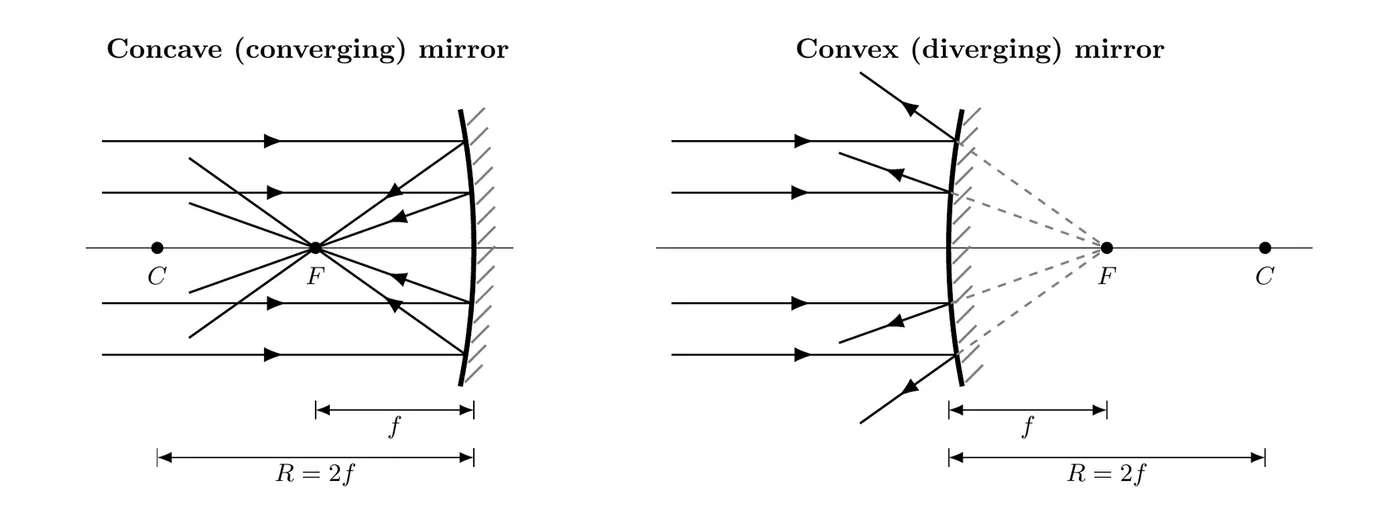
On the left, rays parallel to the principal axis reflect off a concave mirror and cross at F, halfway between the mirror and the center of curvature C. On the right, parallel rays reflect off a convex mirror and spread out. Trace them backward (dashed) and they all seem to come from F behind the mirror. The halfway rule is an approximation that works for rays close to the principal axis, which is what ray diagrams and the mirror equation assume.
Real vs. Virtual Images
Real image. This forms when reflected rays actually cross and meet at a point. The light really converges there, so you can catch it on a screen. It shows up on the same side as the incoming light (in front of the mirror) and is usually upside down.
Virtual image. This forms when reflected rays spread apart but look like they came from a common point behind them. The rays never actually meet, so you can’t project it on a screen. It appears behind the mirror and is usually right-side up.
Mirror Equation
Where the image lands depends on the mirror’s focal length and how far the object is from the mirror:
where:
- = object distance from the mirror
- = image distance from the mirror
- = focal length
Sign conventions:
Quantity | Positive | Negative |
(object distance) | In front of mirror (real object) | Behind mirror (virtual object, rare) |
(image distance) | In front of mirror (real image) | Behind mirror (virtual image) |
(focal length) | Concave (converging) | Convex (diverging) |
(radius of curvature) | Concave | Convex |
Plane mirror special case. For a flat mirror the image sits as far behind as the object is in front:
The minus sign just says the image is behind the mirror (virtual).
You can get this straight from the mirror equation. A plane mirror has , so . Then , which gives , and .
Example. You stand 1.20 m in front of a plane mirror. Your image is 1.20 m behind the mirror ( m), so it’s m away from you. It’s upright and the same height as you.
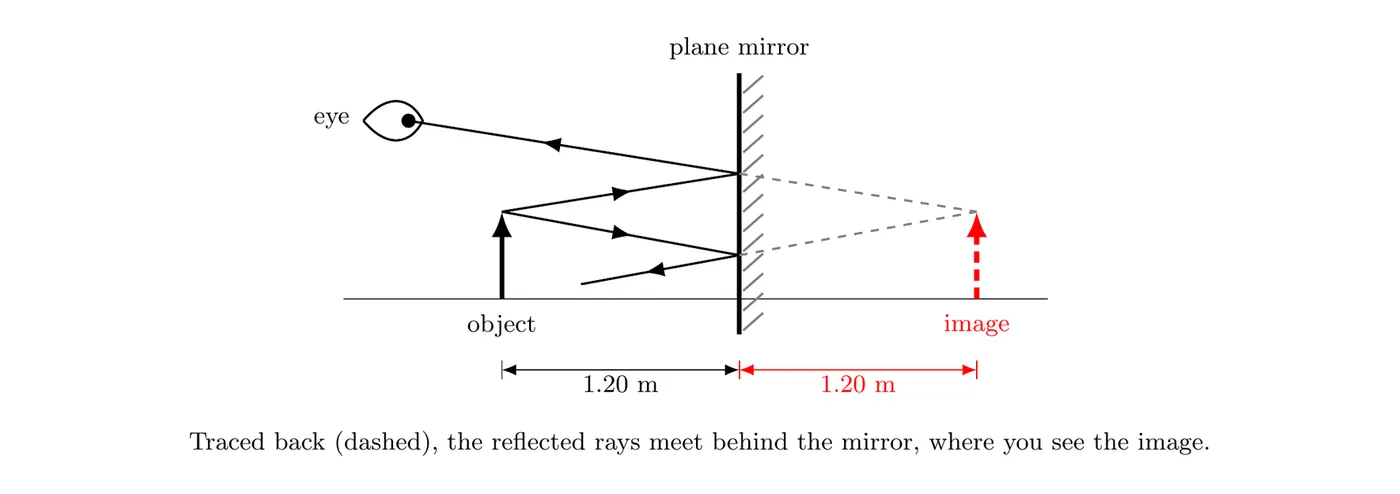
Why a mirror seems to flip words. A plane mirror doesn’t really swap left and right. It reverses front and back: each point of the image sits straight across the mirror from the matching point of the object. Hold a page up with its writing facing the mirror, and the image of the writing faces back at you, so it reads backward.
Magnification
Magnification compares the image size to the object size:
where:
- = magnification (no units)
- = image height
- = object height
- = image distance
- = object distance
Reading the magnitude: means the image is bigger, means it’s the same size, and means it’s smaller. Reading the sign: means upright (same way up as the object), and means inverted (flipped).
On the AP equation sheet. The sheet writes magnification with absolute values: . That version gives only the size (it’s the one the lens page, 5.4, uses). The version above, with the minus sign, is the same relationship with orientation built in, so you can use either one. If you use the sheet’s version, get orientation from the image type instead: for a single mirror and a real object, a real image is inverted and a virtual image is upright.
Ray Diagrams
Ray diagrams let you nail down where an image forms, whether it’s real or virtual, how big it is, and which way up it is. To locate an image, draw any two of these three principal rays from the top of the object:
- Ray 1 (parallel ray): goes in parallel to the principal axis, then reflects through the focal point (or looks like it came from it).
- Ray 2 (chief/central ray): heads for the center of the mirror and reflects symmetrically about the principal axis (angle in equals angle out).
- Ray 3 (focal ray): goes through the focal point on the way in, then reflects out parallel to the principal axis.
- For a convex mirror: the ray heads toward F behind the mirror, then reflects out parallel to the principal axis.
Wherever the reflected rays cross (or seem to cross) is where the image is.
How to draw one.
- Draw the principal axis and the mirror. Mark F and C in front of a concave mirror, or behind a convex mirror, with C twice as far from the mirror as F.
- Draw the object as an upright arrow standing on the axis.
- From the tip of the object, draw at least two principal rays to the mirror and reflect them by the rules above. Put an arrowhead on every ray.
- If the reflected rays cross in front of the mirror, that crossing is the tip of a real image. If they spread apart, extend them behind the mirror with dashed lines. Where the dashed lines cross is the tip of a virtual image.
- Draw the image arrow from the axis to that point, then read off its type, orientation, and size. Check it with the mirror equation.
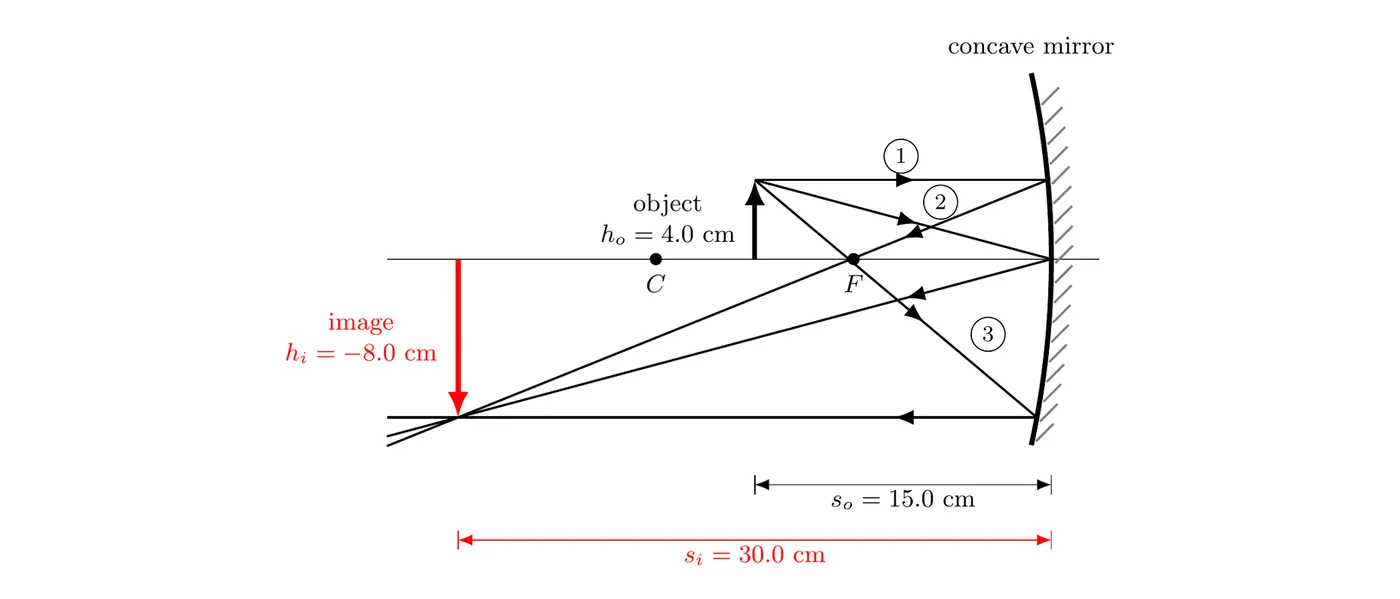
Example 1: concave mirror, object between F and C. A 4.0 cm tall object stands 15.0 cm in front of a concave mirror with a focal length of 10.0 cm. Find the image distance, the magnification, and the image height, and describe the image.
The image is 30.0 cm in front of the mirror: real (), inverted (), and twice as tall as the object (8.0 cm). In the ray diagram, ray 1 comes in parallel and reflects through F, ray 2 hits the center of the mirror and reflects at the same angle on the other side of the axis, and ray 3 passes through F and reflects parallel. All three cross at the tip of the image.
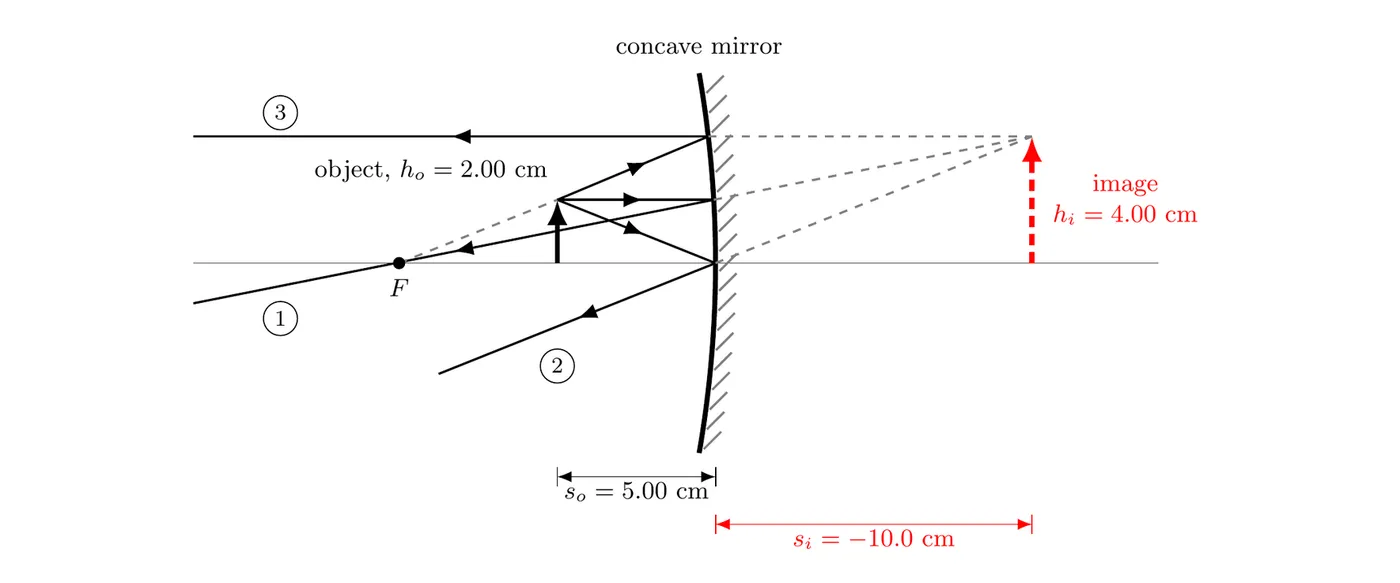
Example 2: concave mirror, object inside F. A 2.00 cm tall object stands 5.00 cm in front of a concave mirror with cm.
The image is 10.0 cm behind the mirror: virtual (), upright (), and twice as tall (4.00 cm). That’s how a makeup or shaving mirror works. Here the reflected rays spread apart, so you trace them backward (dashed) to find where they seem to come from. Ray 3 starts out along the line from F through the tip of the object, since the object sits between F and the mirror.
Example 3: convex mirror. A 5.0 cm tall object stands 15.0 cm in front of a convex mirror whose focal length has a magnitude of 10.0 cm. The mirror is convex, so cm.
The image is 6.00 cm behind the mirror: virtual, upright, and reduced (40% of the object’s height), sitting between the mirror and F, which is where a convex mirror always puts it. In the diagram, ray 1 reflects as if it came from F, ray 3 aims at F and reflects parallel, and the dashed extensions meet behind the mirror.
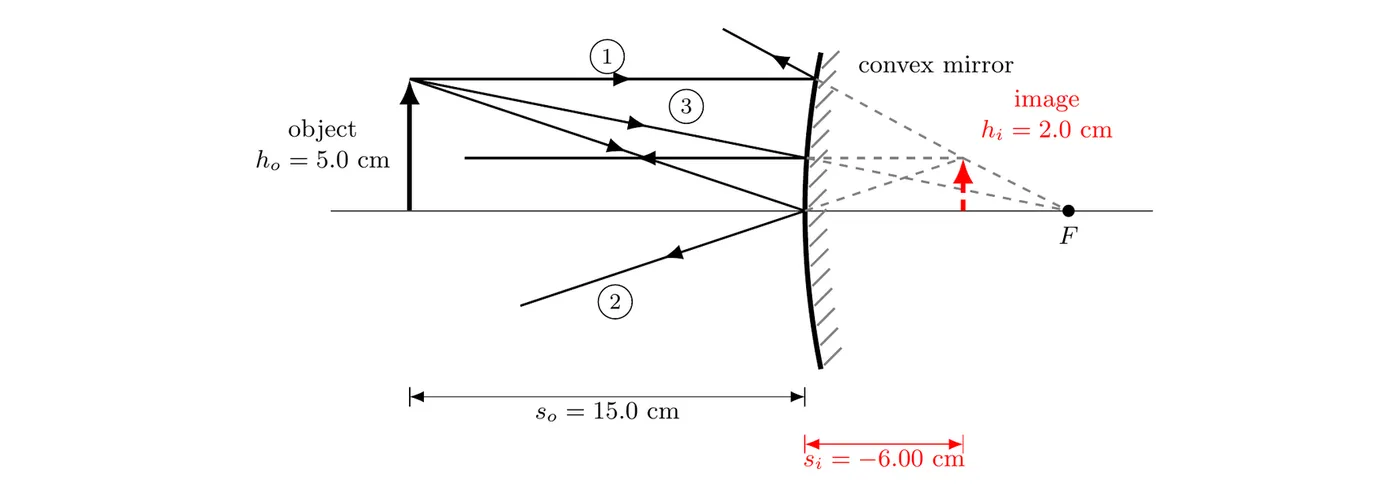
Image Characteristics
Any mirror image can be described three ways. Orientation: upright or inverted. Type: real (rays actually converge, projectable) or virtual (rays only seem to diverge from the image). Size: enlarged (), same size (), or reduced ().
Summary by Mirror Type
Plane mirror: always virtual, upright, and the same size (), with the image as far behind as the object is in front ().
Concave mirror:
- Object beyond C (center of curvature): real, inverted, reduced
- Object at C: real, inverted, same size
- Object between C and F: real, inverted, enlarged
- Object at F: no image (rays come out parallel)
- Object inside F: virtual, upright, enlarged
Where a concave mirror puts the image: object beyond C, image between F and C; object at C, image at C; object between C and F, image beyond C; object inside F, image behind the mirror. As the object moves in from far away toward F, the real image moves out from F toward infinity and keeps growing.
Convex mirror: always virtual, upright, and reduced, with the image always between the mirror and the focal point.
Practice Problems
1. An object sits 30 cm in front of a concave mirror with a 10 cm focal length.
- (a) Find the image distance.
- (b) Find the magnification.
- (c) Describe the image.
2. An object is 15 cm in front of a convex mirror with a focal length of magnitude 20 cm.
- (a) Find the image distance.
- (b) Find the magnification.
- (c) Describe the image.
3. A 5.0 cm tall object sits 8.0 cm in front of a concave mirror with a 12 cm focal length. Where is the image, and how tall is it?
4. A plane mirror forms an image of an object 25 cm in front of it. Where is the image?
5. A concave mirror has a 40 cm radius of curvature. An object sits 60 cm away. Find the image location and magnification.
6. Explain why convex mirrors are used as side-view mirrors on cars.
Solutions
1. (a) Mirror equation with cm and cm (positive, concave):
The image is 15 cm in front of the mirror.
(b) .
(c) The image is real (, in front), inverted (), and reduced (, half size).
2. (a) Convex mirror, so cm. With cm:
The image is 8.6 cm behind the mirror.
(b) .
(c) The image is virtual (, behind), upright (), and reduced (about 57% of the object).
3. With cm and cm:
So the image is 24 cm behind the mirror (virtual). Magnification:
Image height:
The image is 24 cm behind the mirror, virtual, upright, enlarged, and 15 cm tall.
4. For a plane mirror, cm. The image is 25 cm behind the mirror: virtual, upright, and the same size as the object.
5. Focal length first:
With cm:
The image is 30 cm in front of the mirror: real, inverted, half size.
6. Convex mirrors make great side-view mirrors for a few reasons. They spread light out, so you get a wide field of view and can see a lot of the road behind you in a small mirror. They always give upright images, which are quick and easy to read. They shrink things down, fitting more of the scene in (though that makes objects look farther away than they are, hence “objects in mirror are closer than they appear”). And unlike concave mirrors, which can fail to form an image at certain distances, convex mirrors always produce a virtual image no matter where the object is.
Common Mistakes
- Wrong signs in the mirror equation. Concave focal length is positive, convex is negative. Real images have positive , virtual images negative.
- Dropping the minus in magnification. It’s . That minus sign sets the orientation.
- Confusing and . Focal length is half the radius: .
- Misreading the magnification sign. Positive is upright, negative is inverted. The magnitude gives the size change.
- Getting image type wrong. is real (in front), is virtual (behind).
- Fraction arithmetic slips. Find common denominators carefully when solving the equation.
- Forgetting the object-inside-F case. For a concave mirror with , the image is virtual, upright, and enlarged, like a makeup mirror.
- Drawing the wrong principal rays. Ray 1 reflects through F, ray 2 reflects symmetrically off the center, ray 3 comes from F and reflects parallel.
- Assuming convex always means tiny. Convex images are always reduced, but the exact magnification depends on the object distance (always between 0 and 1).
- Mixing up real/virtual with upright/inverted. These are separate properties. Real images are usually inverted and virtual ones usually upright, but check each independently.
- Treating as exact for everything. It’s exact for paraxial rays near the axis, but an approximation for wide-angle rays.
- Unit slips. Keep all distances in the same units, and match image and object heights.
- Not sanity-checking. If you get for a convex mirror, something’s off. Convex always gives .