

5.3 - Refraction
What Refraction Is
Refraction is the bending of a light ray as it crosses from one material into another. Light changes direction at the boundary between two media, like at an air-water or air-glass surface.
Why It Happens
Refraction happens because light changes speed when it enters a new material. Light moves at different speeds in different stuff. When it enters something where it slows down, it bends toward the normal. When it enters something where it speeds up, it bends away from the normal.
Why a speed change bends the ray. Picture a wavefront reaching the boundary at an angle. One end of the wavefront enters the slower material first and slows down, while the other end is still moving at the old speed. So the wavefront pivots, and the ray (which is always perpendicular to the wavefront) changes direction. It’s like a row of marchers walking at an angle from pavement onto mud: the marchers who reach the mud first slow down first, and the whole row swings toward the normal. If the light comes in straight along the normal, the whole wavefront slows at the same moment, nothing pivots, and the ray goes straight through.
Index of Refraction
The index of refraction () of a material is inversely related to the speed of light in it:
where:
- = index of refraction (dimensionless, )
- = speed of light in vacuum = m/s
- = speed of light in the material (m/s)
So a higher means slower light, and a lower means faster light. Vacuum is exactly by definition. Some common values: air is about 1.00 (basically vacuum), water about 1.33, glass around 1.5 (it varies), and diamond about 2.42. Since can never beat , every material has .
Using the inverse relationship. Since , the index and the speed are inversely proportional: double the index and light moves at half the speed. Comparing two materials, . For example, light in diamond () moves times as fast as light in water ().
Snell’s Law
Snell’s law links the angles and the indices when light crosses a boundary:
where:
- = index of the first medium
- = angle of incidence (from the normal, in the first medium)
- = index of the second medium
- = angle of refraction (from the normal, in the second medium)
As always, angles are measured from the normal, not the surface.
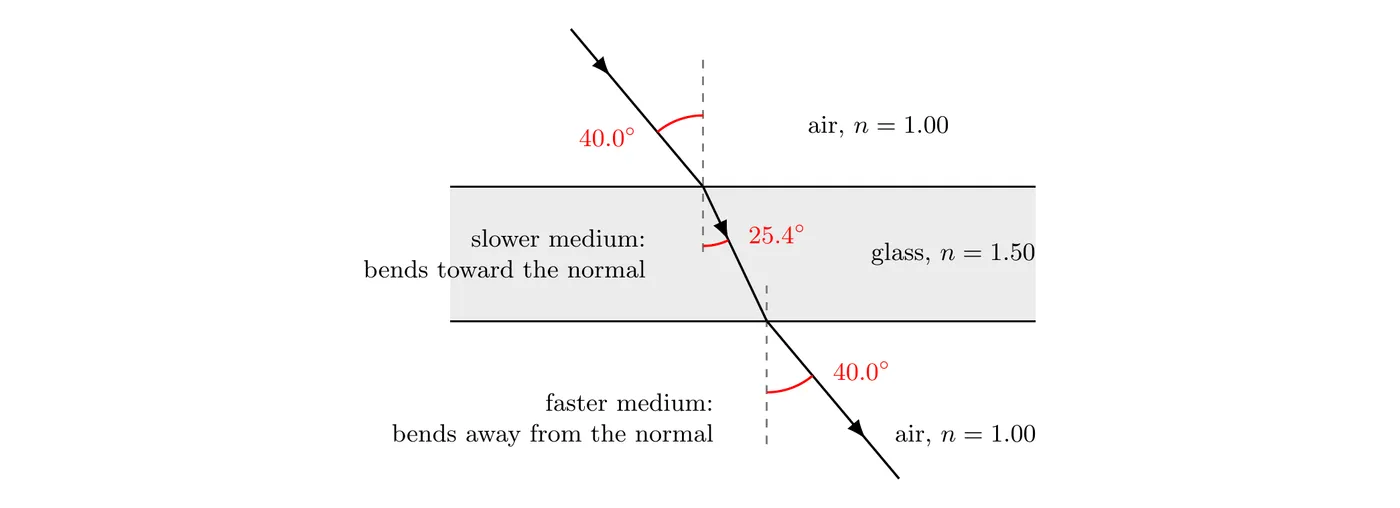
Example. A laser beam in air hits the flat top of a glass block () at from the normal. Find (a) the angle of refraction, (b) the speed of light in the glass, and (c) the angle at which the beam comes out of the block’s flat bottom face, which is parallel to the top.
(a) Snell’s law with and :
(b) Speed in the glass:
(c) The faces are parallel, so the beam hits the bottom face at from the normal there. Going from glass back into air:
The beam bends toward the normal going in (into the slower material) and away from the normal coming out (into the faster material), so it leaves parallel to the way it came in, just shifted sideways.
Which Way the Light Bends
Higher to lower index (): the ray bends away from the normal. Example: light going from water into air.
Lower to higher index (): the ray bends toward the normal. Example: light going from air into water.
Straight-on (normal incidence): if the ray comes in right along the normal (), it doesn’t bend at all () and just goes straight through.
Why a straw looks bent in water. Light from the underwater part of a straw travels up from water () into air (), so it bends away from the normal at the surface. Your eyes and brain assume light travels in straight lines, so they trace that light backward along a straight path and place the underwater part higher than it really is. The straw looks broken at the waterline, and a pool looks shallower than it is, for the same reason.
Total Internal Reflection
Total internal reflection can happen when light tries to go from a higher-index medium into a lower-index one (high to low , that is, from a slower medium into a faster one).
Critical angle. It kicks in once you pass a certain angle called the critical angle. The critical angle () is the angle of incidence where the refracted ray would just skim along the boundary, at 90° to the normal:
where is the higher-index medium (where the light starts) and is the lower-index one. You need for a critical angle to even exist.
Deriving it. The critical angle equation isn’t on the AP equation sheet (the CED lists it as a derived equation), so be ready to get it from Snell’s law. At the critical angle the refracted ray travels along the surface, so , and :
Since can’t be bigger than 1, this only works when .
What happens at different angles:
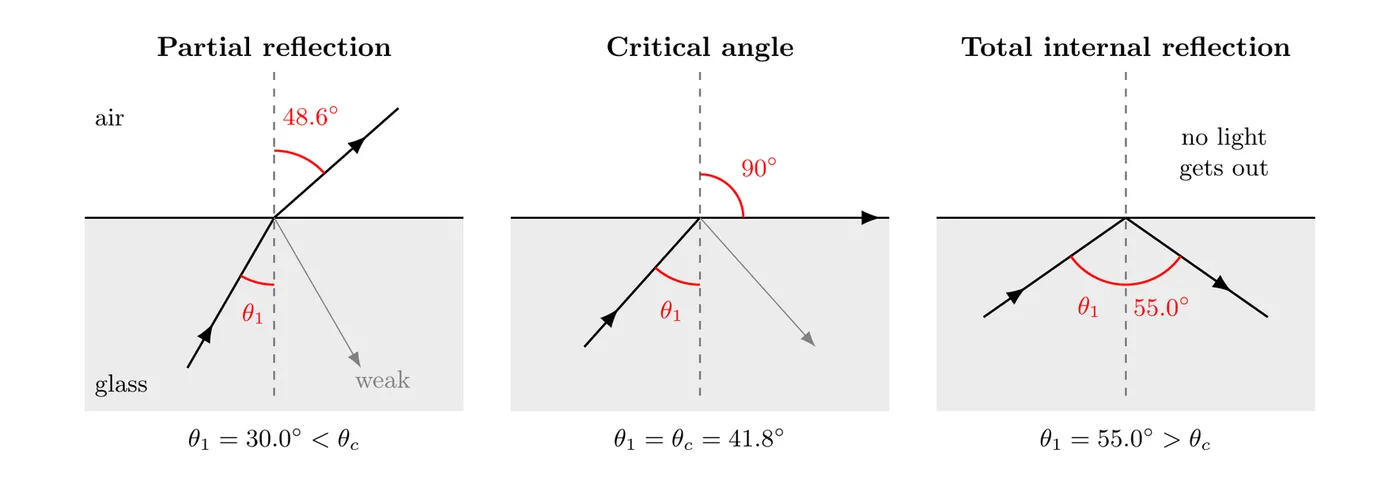
- At the critical angle (): the refracted ray runs along the surface at 90° to the normal. From Snell’s law, .
- Past the critical angle (): all the light reflects back into the original medium, none gets through, and it obeys the law of reflection ().
- Below the critical angle (): normal refraction, with some light reflecting and some passing through.
The figure shows light inside glass () reaching a glass-air surface, where . At , most of the light refracts out at (from ) and a weak ray reflects. At exactly , the refracted ray skims along the surface at . At , no light gets out at all: it all reflects, at .
Where Total Internal Reflection Shows Up
You see it in fiber optics (light stays trapped inside the fiber), in prisms (used in binoculars and periscopes), in diamonds (their high index gives a small critical angle, which makes them sparkle), and in mirages (atmospheric bending can cause it).
Finding the Index of Refraction from Data
A common lab, and a common AP free-response setup: you get a clear block and a laser, and you have to find the block’s index of refraction.
- Set a semicircular acrylic block flat on a sheet of paper and trace its outline. Mark the center of the flat face and draw the normal there.
- Aim the laser at that center point from the air side, at an angle to the normal. The beam bends at the flat face, then travels along a radius to the curved face. It hits the curved face along the normal, so it leaves without bending again, and you can mark its path.
- Measure and the angle inside the block, , from the normal with a protractor.
- Repeat for at least five different angles.
Linearize. Snell’s law says . That has the form , so graph on the vertical axis against on the horizontal axis. The points should fall on a straight line through the origin, and the slope is .
10.0° | 7.0° | 0.122 | 0.174 |
20.0° | 13.0° | 0.225 | 0.342 |
30.0° | 19.5° | 0.334 | 0.500 |
40.0° | 25.5° | 0.431 | 0.643 |
50.0° | 30.5° | 0.508 | 0.766 |
60.0° | 35.5° | 0.581 | 0.866 |
70.0° | 39.5° | 0.636 | 0.940 |
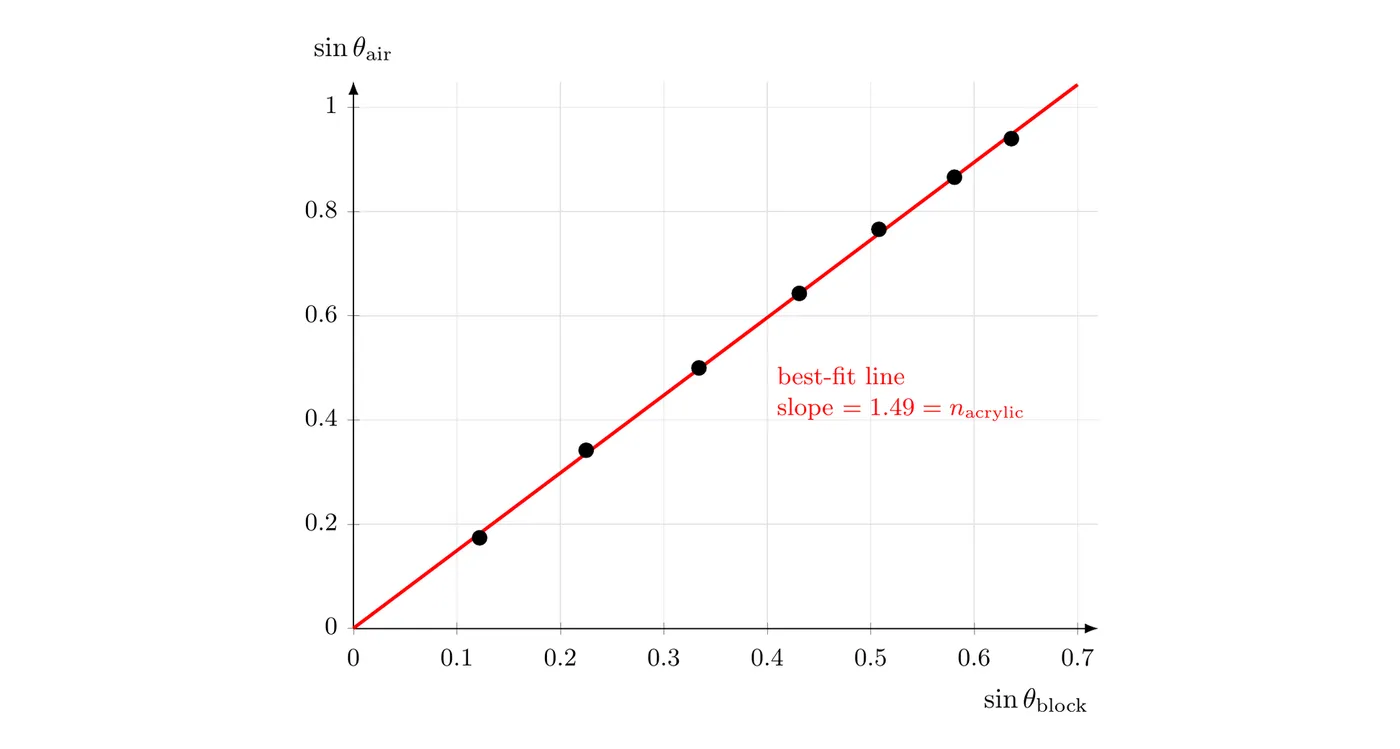
The best-fit line has a slope of 1.49, so , and light moves through the acrylic at m/s. Why bother with a graph? Single rows disagree: the row alone gives , and the row gives . The best-fit line averages out those small protractor errors. If the line missed the origin by a lot, that would point to a systematic error, like measuring angles from the surface instead of from the normal.
Practice Problems
1. Light goes from air () into glass () at a 30° angle of incidence. What’s the angle of refraction?
2. What’s the speed of light in water ()?
3. Light in water () hits the water-air boundary at 50° to the normal. Does it bend toward or away from the normal entering the air?
4. Find the critical angle for light going from glass () into air ().
5. Light goes from diamond () into water () at a 25° angle of incidence. What’s the angle of refraction?
6. Light in glass () hits the glass-air interface at 45°. Does total internal reflection happen?
7. Explain why total internal reflection can’t happen when light goes from air into water.
Solutions
1. Snell’s law with , , :
The angle of refraction is 19.5°. It bends toward the normal (from 30° to 19.5°) because it’s entering a higher-index medium.
2.
Light travels at m/s in water, about 75% of its vacuum speed.
3. Light goes from water () to air (). Since , it bends away from the normal, so the refracted angle is bigger than 50°.
4. Critical angle with (glass) and (air):
The critical angle is 41.8°. Any incidence angle bigger than this gives total internal reflection.
5. Snell’s law with , , :
The angle of refraction is 50.3°. It bends away from the normal (from 25° to 50.3°) because it’s entering a lower-index medium.
6. Critical angle for the glass-air boundary:
The incidence angle (45°) is bigger than the critical angle (41.1°), so yes, total internal reflection happens.
7. Total internal reflection needs light going from a higher-index medium to a lower-index one (). Air to water is the opposite, . Plugging into the critical angle formula gives:
which is impossible, since sine can’t be more than 1. So there’s no critical angle. Physically, entering a higher-index medium always bends light toward the normal, so the refracted angle is always smaller than the incoming one and can never reach 90° to reflect back. Total internal reflection only works going from higher to lower index.
Common Mistakes
- Measuring from the surface. Angles go from the normal, always.
- Mixing up “toward” and “away from” the normal. High to low bends away (angle grows). Low to high bends toward (angle shrinks).
- Forgetting direction matters for total internal reflection. It only happens high to low , never the reverse.
- Putting the indices in backwards for the critical angle. In , is the higher index (where light starts) and is the lower one.
- Treating total internal reflection like ordinary reflection. It’s a special case at a boundary. Regular reflection can happen at any interface.
- Confusing speed and index. Higher index means slower light, not faster. They’re inverses: .
- Forgetting the inverse sine. When solving for an angle with Snell’s law, take at the end.
- Ignoring the critical angle conditions. No critical angle if , and the result must have .
- Assuming light always bends. At normal incidence () it goes straight through, index change or not.
- Calculator in the wrong mode. Use degrees when your angles are in degrees.
- Not sanity-checking. If you get for ordinary refraction, something’s wrong. Angles stay between 0° and 90°.
- Confusing refraction with dispersion. Refraction is the bending at a boundary. Dispersion is colors splitting apart because bending depends on wavelength.
- Forgetting some light always reflects. Even below the critical angle, a bit reflects at the boundary. Only past the critical angle is it 100%.