

5.1 - Reflection
5.1 Reflection
Light as a Ray
A light ray is just a straight line pointing the way a light wave travels, drawn perpendicular to the wavefront.
Far from a source (or in a laser beam), the wavefronts are flat and parallel, so the rays are parallel lines. Close to a small source, the wavefronts are spheres (circles in a drawing), so the rays point straight out from the source in every direction. Either way, every ray crosses every wavefront at a right angle.
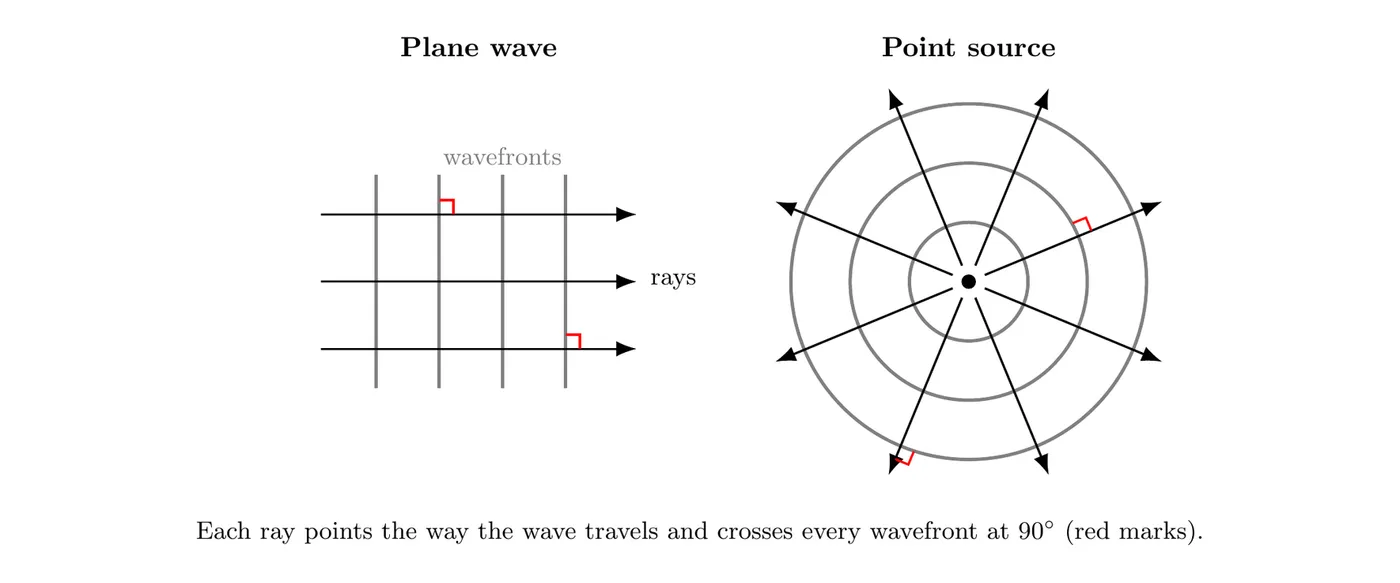
Ray model (geometric optics). When you treat light as rays, you can predict how it behaves without worrying about its wave nature. This works well when light travels in straight lines, when you’re dealing with reflection and refraction, when you’re studying mirrors and lenses, and when the wavelength is way smaller than the objects involved.
Where the ray model breaks down. Rays can’t explain light spreading out. For interference and diffraction, the wave nature of light really matters and you can’t ignore it (that’s Unit 6, Waves, Sound, and Physical Optics). The ray picture fails when light hits small openings (about the size of a wavelength), edges of objects, or any situation that needs wave behavior.
Lasers. A laser is a handy source of a single, coherent, monochromatic beam that you can model as a ray. Coherent means the waves are in step, monochromatic means one wavelength (one color), and the beam is directional, staying tight with almost no spreading. Its wave nature shows up later, in Unit 6.
Ray Diagrams
Ray diagrams show the path light takes before and after it hits something. You use them to trace light through optical systems, predict where images form, work through reflection and refraction, and figure out what an image looks like.
A few conventions: straight arrows are rays, the arrows point the way light is going, and angles are always measured from the normal (the line perpendicular to the surface).
Reflection of Light
When light hits a surface, some or all of it can bounce back into the medium it came from. That’s reflection.
Reflect, transmit, or absorb. When light reaches the boundary between two materials, it can do three things, and usually it does some of each. Part of it reflects. Part of it transmits, passing into the new material (usually bending as it goes, which is refraction in 5.3). Part of it gets absorbed, and its energy ends up as thermal energy in the material. A window reflects a faint image of you but lets most of the light through. A black shirt absorbs most of the light that hits it. Anything you see that doesn’t make its own light, you see because some of the light hitting it reflects into your eyes.
Law of Reflection
The law of reflection says the angle between the incoming ray and the normal equals the angle between the reflected ray and the normal:
where:
- = angle of incidence (between the incoming ray and the normal)
- = angle of reflection (between the reflected ray and the normal)
Both angles are measured from the normal, not from the surface. A few more points worth remembering: the incoming ray, the reflected ray, and the normal all sit in the same plane, the angles are always from the normal, and this holds for reflection off any surface.
The law of reflection isn’t printed on the AP equation sheet, so know it by heart.

In the figure, the ray comes in 55° from the mirror’s surface. That’s from the normal, so , and the ray reflects at on the other side of the normal.
Types of Reflection
Specular reflection happens off a smooth surface, and the light comes off evenly. The surface is mirror-like, the normal points basically the same way across the whole area, parallel incoming rays stay parallel on the way out, and you get a clear sharp image. Mirrors, calm water, and polished metal are good examples.
Diffuse reflection happens off a rough surface, and the light scatters in all directions. The surface has tiny microscopic bumps, the normal points different ways across it, parallel incoming rays bounce off every which way, and you don’t get a clear image. Paper, clothing, walls, and most everyday stuff work this way.
Here’s the thing though: the law of reflection () still holds at every single point on a rough surface. The rays scatter because the surface normals point in different directions, not because the law is broken.
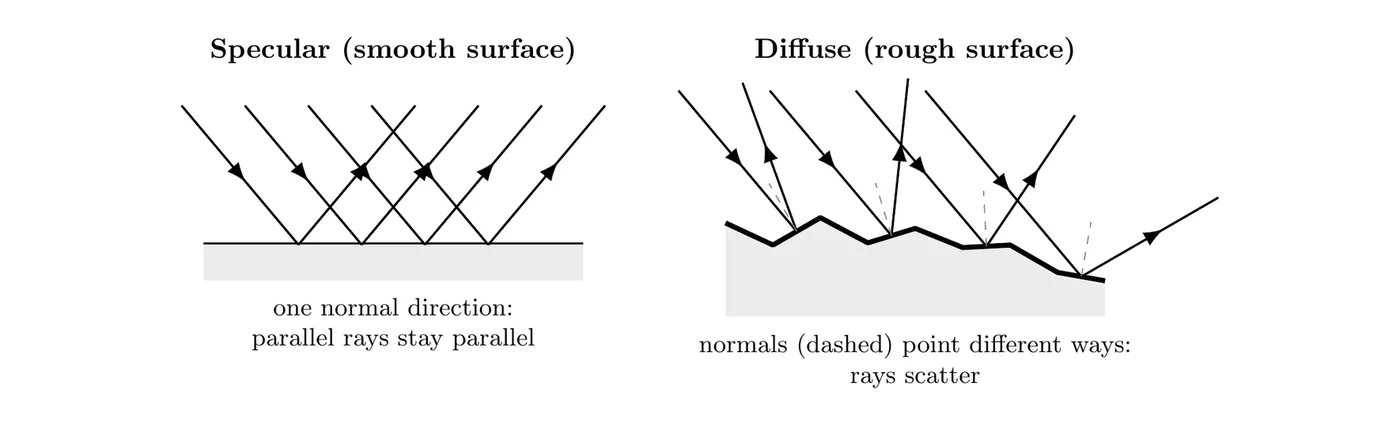
On the smooth surface every normal points the same way, so parallel rays leave parallel. On the rough surface each tiny facet has its own normal (dashed), so each ray reflects off in its own direction, even though every one of them obeys at its own facet.
Practice Problems
1. A ray hits a flat mirror at 35° to the normal. What’s the angle of reflection?
2. A ray hits a mirror at 50° to the surface. What’s the angle between the incoming and reflected rays?
3. Explain why you see a clear reflection in a mirror but not in a sheet of paper, even though both reflect light.
4. A ray hits a horizontal mirror at 25° to the surface.
- (a) What’s the angle of incidence?
- (b) What’s the angle of reflection?
- (c) What’s the angle between the incoming and reflected rays?
5. Two mirrors sit at 90° to each other. A ray hits the first at 40° to the normal. After bouncing off both, which way does the final ray go relative to the original?
6. Explain why diffuse reflection still obeys the law of reflection, even though the rays scatter everywhere.
7. A laser reflects off a smooth surface. If the angle between the incoming and reflected beams is 80°, what’s the angle of incidence?
Solutions
1. By the law of reflection, . The angle of reflection is 35° from the normal.
2. The ray hits at 50° to the surface, so first convert to the angle from the normal:
By the law of reflection, . The angle between the two rays is:
The angle between the incoming and reflected rays is 80°.
3. Both surfaces obey the law of reflection, but the difference is smoothness. A mirror is smooth at the microscopic level, so every point’s normal points the same way. Parallel rays from your face stay parallel and land in your eyes in the right arrangement, giving a clear image. Paper is rough at the microscopic level, full of fibers and bumps, so its normal points all over the place. Rays from your face scatter randomly, only a few reach your eyes, and the spatial info gets scrambled, so no image forms.
4. (a) . The angle of incidence is 65°.
(b) By the law of reflection, .
(c) The angle between the rays is .
5. First mirror: the ray comes in at 40° to the normal and reflects at 40°. That reflected ray then hits the second mirror. Because the mirrors are perpendicular, the ray meets the second mirror’s normal at , and reflects at 50°. After both bounces, the final ray heads back parallel to the original but in the opposite direction, a full 180° reversal. Perpendicular mirrors always do this, no matter the starting angle.
6. Zoom in on a rough surface and it’s really a bunch of tiny flat facets tilted at different angles. At each facet, holds perfectly against that facet’s local normal. But since neighboring facets face different directions, rays hitting different spots bounce off different ways. Parallel rays in, scattered rays out, even though every individual bounce follows the law. Think of throwing parallel balls at a bunch of randomly tilted little mirrors: each ball obeys the bounce rule, but they scatter because the mirrors face different ways.
7. The angle between the two rays is 80°, and they sit on opposite sides of the normal:
Since :
The angle of incidence is 40°.
Common Mistakes
- Measuring from the surface. Angles go from the normal, not the surface. If you’re given an angle from the surface, subtract it from 90°.
- Confusing the angle of incidence with the ray’s direction. The angle of incidence is specifically between the incoming ray and the normal.
- Thinking diffuse reflection breaks the law. It doesn’t. Every point still obeys . The scatter comes from the surface normals pointing different ways.
- Adding angles wrong. The angle between the incoming and reflected rays is .
- Assuming rough surfaces don’t reflect. They do, that’s why you can see them. They just reflect diffusely instead of like a mirror.
- Forgetting the rays and normal share a plane. The incoming ray, reflected ray, and normal all lie in the plane of incidence.
- Swapping specular and diffuse. Specular is smooth and mirror-like, diffuse is rough and scattered.
- Botching multiple reflections. Draw a fresh normal for each surface and apply the law separately at each bounce.
- Assuming rays always work. The ray model falls apart for interference, diffraction, and other wave effects.
- Confusing reflection with refraction. Reflection bounces light back into the same medium. Refraction bends light as it enters a new medium.