

2.1 - Electric Potential Energy
Conservative Forces and Potential Energy
From mechanics, we know that every conservative force has an associated potential energy. The electric force is conservative, which means:
- The work done is path-independent.
- Energy is conserved.
- A potential energy function exists.
So just as the gravitational force has gravitational potential energy, the electric force has electric potential energy.
Definition
Electric potential energy is the work an external force has to do to bring point charges in from an infinite distance to their current positions.
This energy belongs to the system of charges, not to either charge by itself. Two charges 0.30 m apart might store 0.30 J, but that energy is in their interaction, so it belongs to the pair. The definition also assumes the external force moves the charges slowly, starting and ending at rest, so none of its work turns into kinetic energy. All of that work gets stored as .
Compared to Gravitational Potential Energy
Gravitational PE | Electric PE |
Work against gravity | Work against the electric force |
Bringing mass closer to Earth | Bringing charges into a configuration |
(off the surface) | |
Always attractive | Attractive or repulsive |
The Formula
The electric potential energy between two point charges is:
or equivalently:
where:
- = electric potential energy (J)
- N·m²/C²
- = the two charges (C)
- = distance between them (m)
- C²/(N·m²)
Remember that .
The Derivation Connection
Electric potential energy comes from integrating the electric force:
That’s analogous to how gravitational potential energy relates to gravitational force.
Here’s where the formula comes from, using the definition above. Hold fixed at the origin and bring in from infinity to a distance . The electric force on is along . To move without speeding it up, the external force has to be equal and opposite, . Add up its work on the way in:
That work is exactly the stored energy, so . The sign takes care of itself: for like charges , so you do positive work pushing them together.
Example: Work to Bring Two Charges Together
Problem: A μC charge is held fixed. (a) How much work does an external force have to do to bring a μC charge from very far away to a point 0.30 m from it, starting and ending at rest? (b) How much more work does it take to push the μC charge in from 0.30 m to 0.10 m?
Solution (a): Starting from infinity, , so the work equals the final potential energy of the pair:
Solution (b): The work is the change in potential energy:
Answer: (a) 0.30 J. (b) 0.60 J more. Since , cutting the distance to a third triples (from 0.30 J to 0.90 J). If the moving charge were μC instead, at 0.30 m would be J, so the external force would do negative work: it has to hold the charge back as the attraction pulls it in.
The Sign of Electric Potential Energy
The sign depends on whether the charges attract or repel. This is one of the most important things to get right.
Same Sign Charges (Both + or Both −)
The charges want to separate, since likes repel.
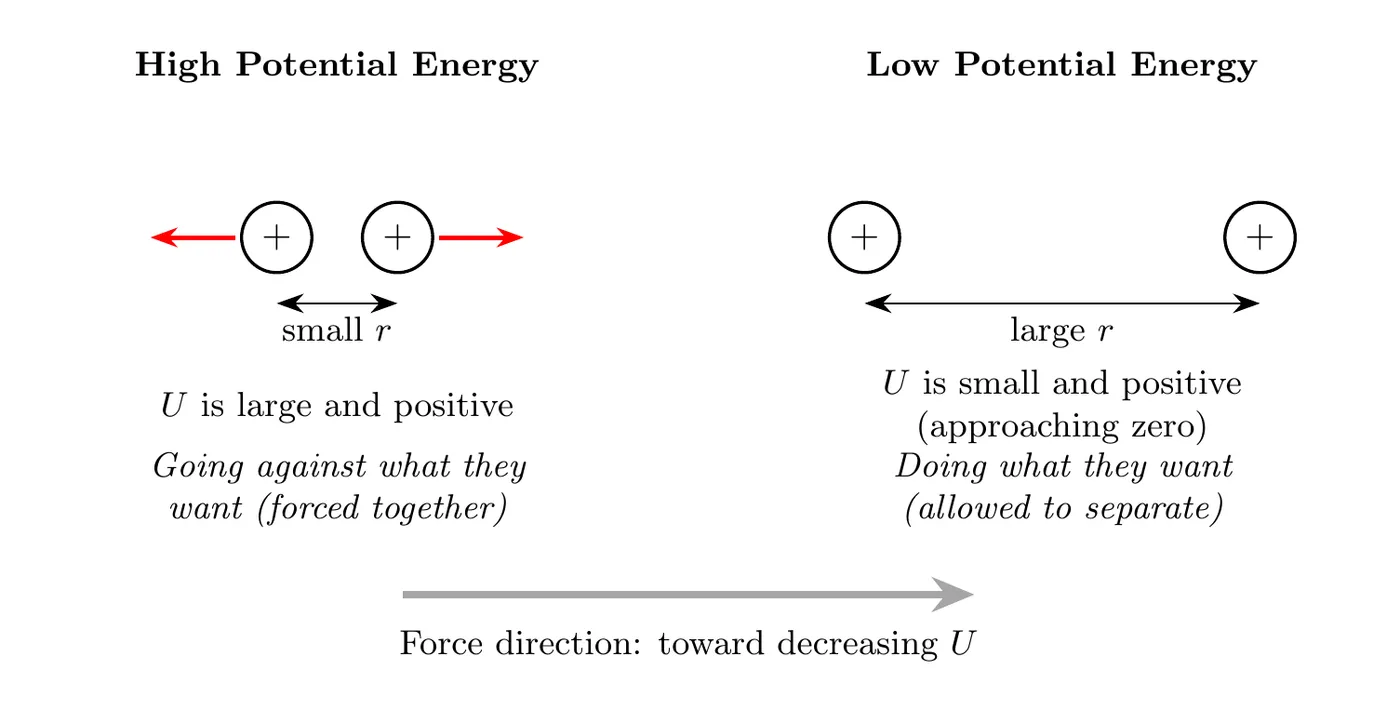
Characteristics:
- , positive potential energy.
- increases as the charges get closer.
- decreases as the charges get farther apart.
- The force points toward decreasing , so away from each other.
Example: two protons pushed close together store positive PE.
Opposite Sign Charges (+ and −)
The charges want to come together, since opposites attract.
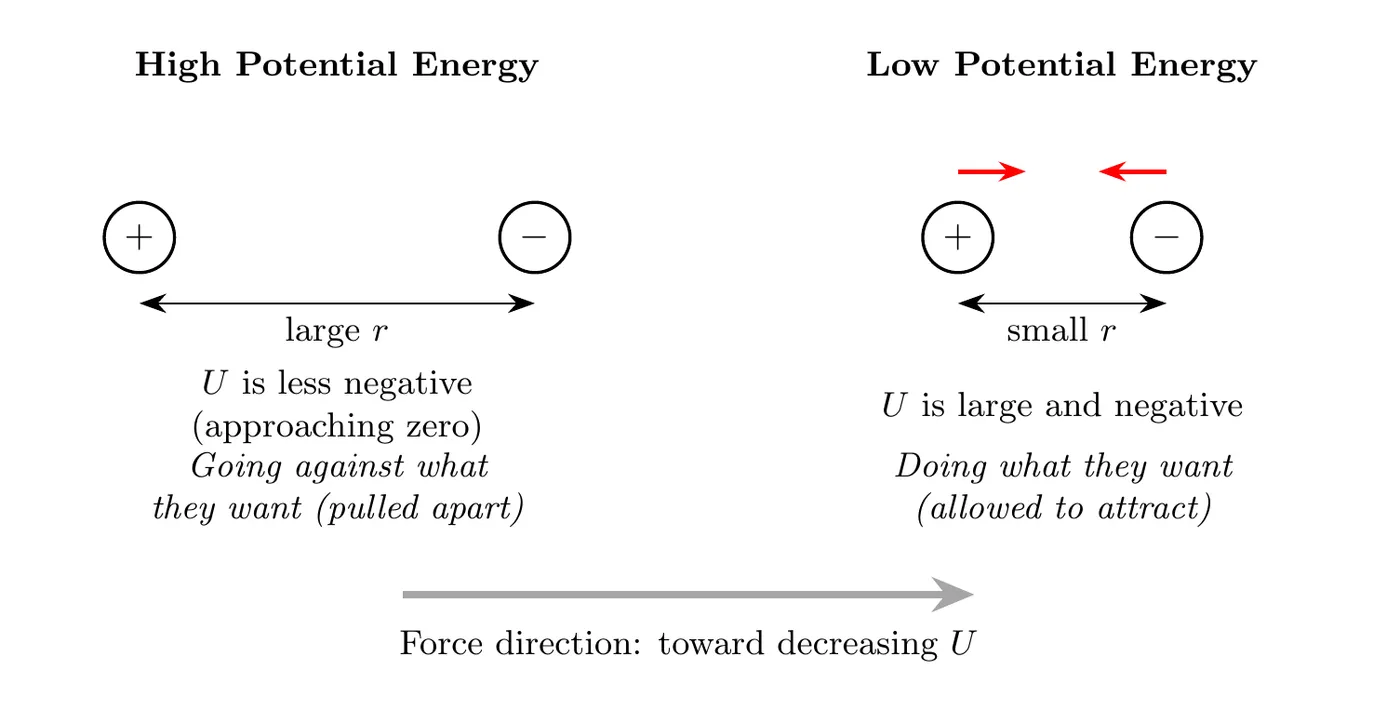
Characteristics:
- , negative potential energy.
- decreases (gets more negative) as the charges get closer.
- increases (gets less negative) as they get farther apart.
- The force points toward decreasing , so toward each other.
Example: an electron near a proton has negative PE.
Graphs of U vs. r
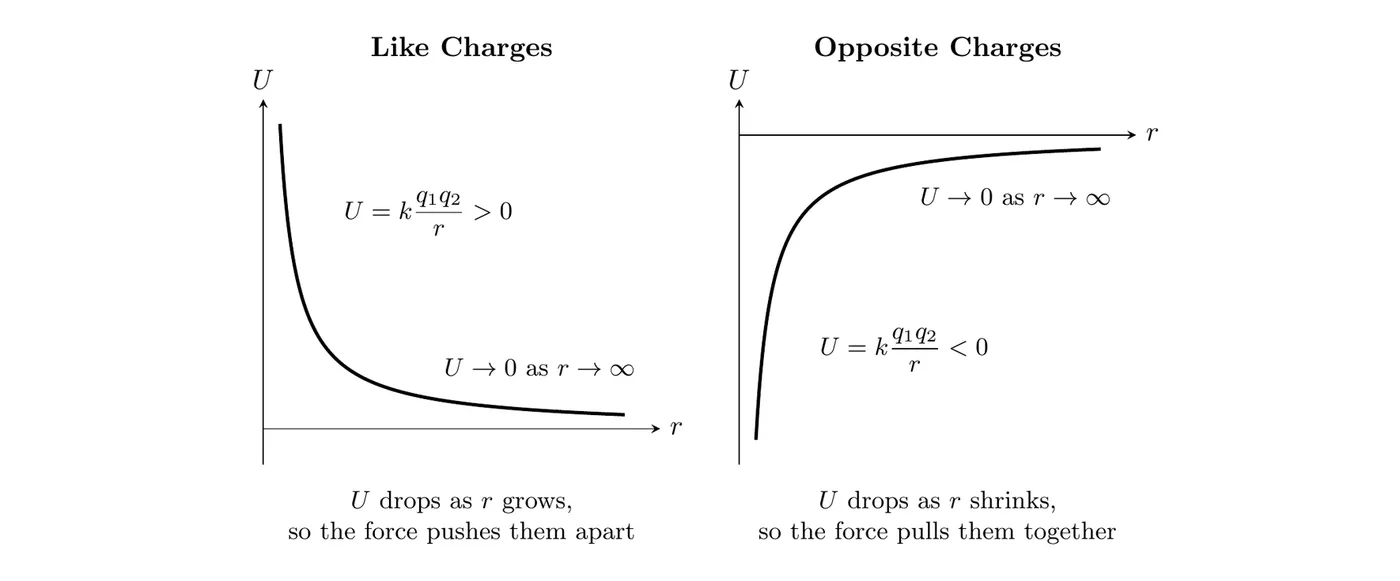
Both curves approach as . The slope tells you the force: . For like charges the curve slopes down as grows, so (repulsive). For opposite charges the curve slopes up as grows, so (attractive). Both curves get steeper at small , which matches the force getting stronger as the charges get closer.
Key Principle: Force and Potential Energy
The electric force always points in the direction of decreasing potential energy.
This is a fundamental principle across all of physics:
- When charges move with the force, the PE decreases.
- When charges move against the force, the PE increases, which takes external work.
Summary Table: PE Behavior
Charge Combination | Sign of U | What the Charges Want | U when close | U when far |
Same signs (++, −−) | Positive | To separate | Large + | Small + (→0) |
Opposite signs (+−) | Negative | To attract | Large − | Small − (→0) |
The universal rule: at infinite separation, for every charge pair. That’s the reference point.
Systems with Multiple Charges
For a system with several charges, the total electric potential energy is the sum of the potential energies of every unique pair.
The Principle of Superposition
Important:
- Count each pair only once. The interaction between charges 1 and 2 is the same as between 2 and 1.
- Include the signs of the charges, since the positive and negative terms add algebraically.
- The distance is the separation between charges and .
Counting the Pairs
For charges, the number of unique pairs is:
- 2 charges: 1 pair
- 3 charges: 3 pairs
- 4 charges: 6 pairs
- 5 charges: 10 pairs
Example Problem: Three Charges in a Triangle
Problem: Derive an expression for the work required to assemble three charges into the configuration shown. They sit at the vertices of an equilateral triangle, with at the top, at the bottom left, and at the bottom right. Each side of the triangle has length .
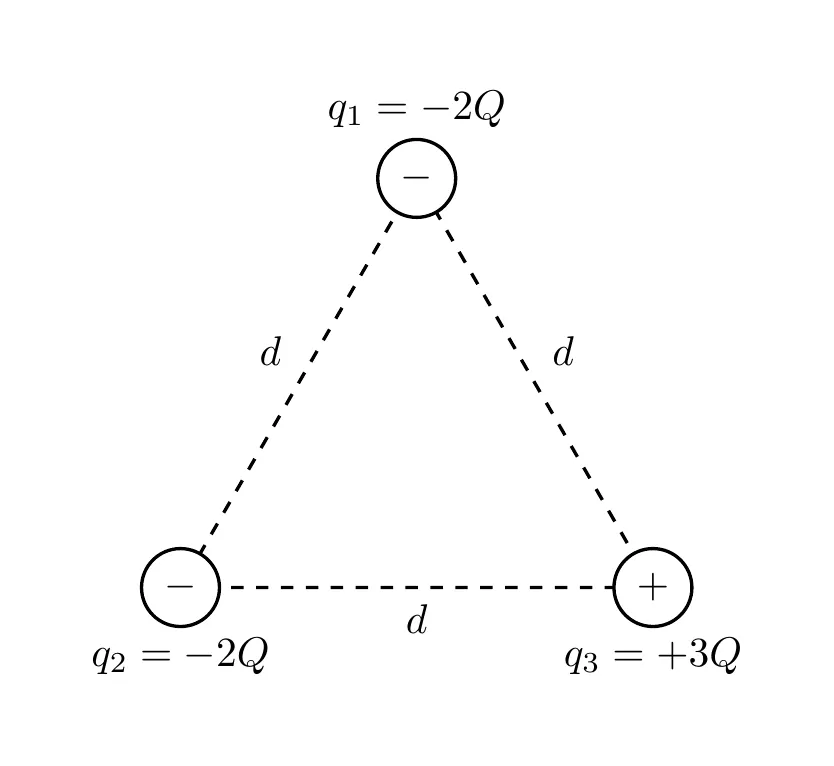
Solution
Step 1: Identify all the unique pairs
With 3 charges, there are 3 pairs:
- Pair (1,2): and
- Pair (1,3): and
- Pair (2,3): and
Step 2: Write the total potential energy
Step 3: Substitute the distances
All the sides have length :
Step 4: Factor out the common terms
Step 5: Substitute the charge values
With , , and :
Answer: the work required to assemble the configuration is
The read: the negative value means this is a bound system. Energy would be released during assembly, not required. The attractive interactions between the unlike charges beat out the repulsive one between the like charges.
Alternative Example: Four Charges in a Square
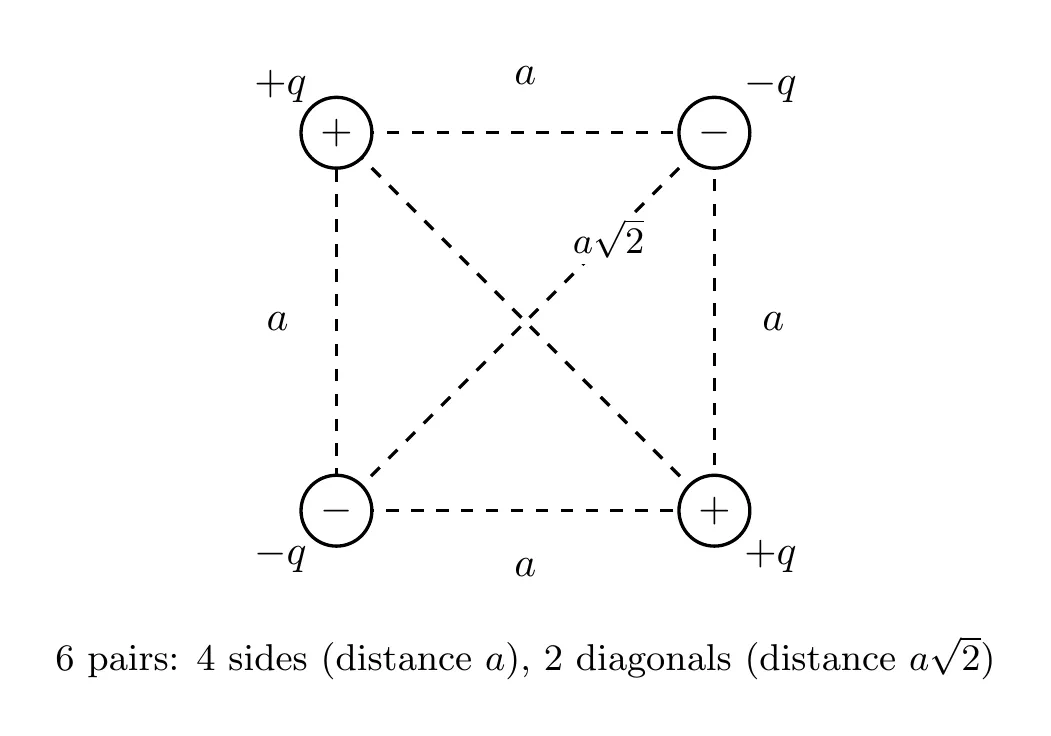
Problem: Four charges sit at the corners of a square with side length . Each has magnitude , arranged as: top-left (+), top-right (−), bottom-left (−), bottom-right (+). Find the total electric potential energy.
Solution
Identify the 6 pairs and their distances.
Side interactions (distance = ):
1. Top-left to top-right: , so negative.
2. Top-right to bottom-right: , so negative.
3. Bottom-right to bottom-left: , so negative.
4. Bottom-left to top-left: , so negative.
Diagonal interactions (distance = ):
5. Top-left to bottom-right: , so positive.
6. Top-right to bottom-left: , so positive.
Calculate the total PE:
Answer: , net negative, so it’s a bound system.
Example Problem: Three Charges on a Line
Problem: Three point charges sit on a line: μC at , μC at m, and μC at m. (a) Find the total electric potential energy of the system. (b) How much work would an external force have to do to pull all three charges infinitely far apart, starting and ending at rest?

Solution
Step 1: List the pairs and their distances
With 3 charges, there are 3 pairs:
- Pair (1,2): m
- Pair (1,3): m
- Pair (2,3): m
Step 2: Find each pair’s potential energy, keeping the signs
Step 3: Add them as scalars
Answer: (a) J. (b) Pulling them apart takes the system from J to , so the external force does J. The system is bound: you have to put energy in to take it apart.
The Connection to Work
The work-energy theorem applies:
When you assemble charges starting from infinity:
- , since all the charges are infinitely far apart.
- is the configuration energy.
- So .
What the sign means:
- Positive work: you have to do work to assemble it, because the charges resist coming together.
- Negative work: the system releases energy as it assembles, because the charges want to come together.
Key Concepts Summary
- PE is a scalar. Add algebraically, not vectorially, unlike forces and fields.
- Signs matter. The product of the charges sets the sign:
- , so positive PE.
- , so positive PE.
- , so negative PE.
- Zero reference at infinity. when the charges are infinitely far apart.
- Conservative force. The path doesn’t matter, only the initial and final positions.
- Superposition. The total PE is the algebraic sum of all the pair interactions.
Common Mistakes
- Counting pairs twice. Each pair interaction gets counted exactly once. Don’t double-count the interaction between charges 1 and 2.
- Forgetting the signs of the charges. The formula includes each charge’s sign. A positive and a negative charge give negative PE, not positive.
- Confusing PE with force. High PE doesn’t mean high force. PE tells you about the energy stored in the configuration, while force tells you which way the charges will move.
- Using the wrong reference point. Always use infinity as the zero-PE reference, not the positions shown in the problem, unless the problem says otherwise.
- Missing the diagonal interactions. In 2D and 3D configurations (squares, cubes, and so on), the charges interact across the diagonals too, not just along the edges.