

1.6 - Gauss’s Law
Introduction to Gauss’s Law
Gauss’s Law gives you a powerful link between the electric flux through a closed surface and the charge enclosed by that surface. It ties together electric fields, flux, and charge distribution into one elegant equation.
Gauss’s Law is the first of Maxwell’s equations, a set of four fundamental equations that completely describe all electromagnetic phenomena, including the nature of light itself.
The Mathematical Statement
Or in its complete integral form:
where:
- = total electric flux through a closed surface (N·m²/C)
- = net charge enclosed within the surface (C)
- C²/(N·m²), the permittivity of free space
- = a surface integral over a closed surface
The Simplified Form
For most AP Physics C problems, the surface integral collapses to:
where is constant over the surface and perpendicular to it everywhere, and is the area of the surface. If part of the surface runs parallel to the field (like the flat ends of a Gaussian cylinder around a line of charge), that part adds no flux, so only the rest of the area counts.
Gaussian Surfaces
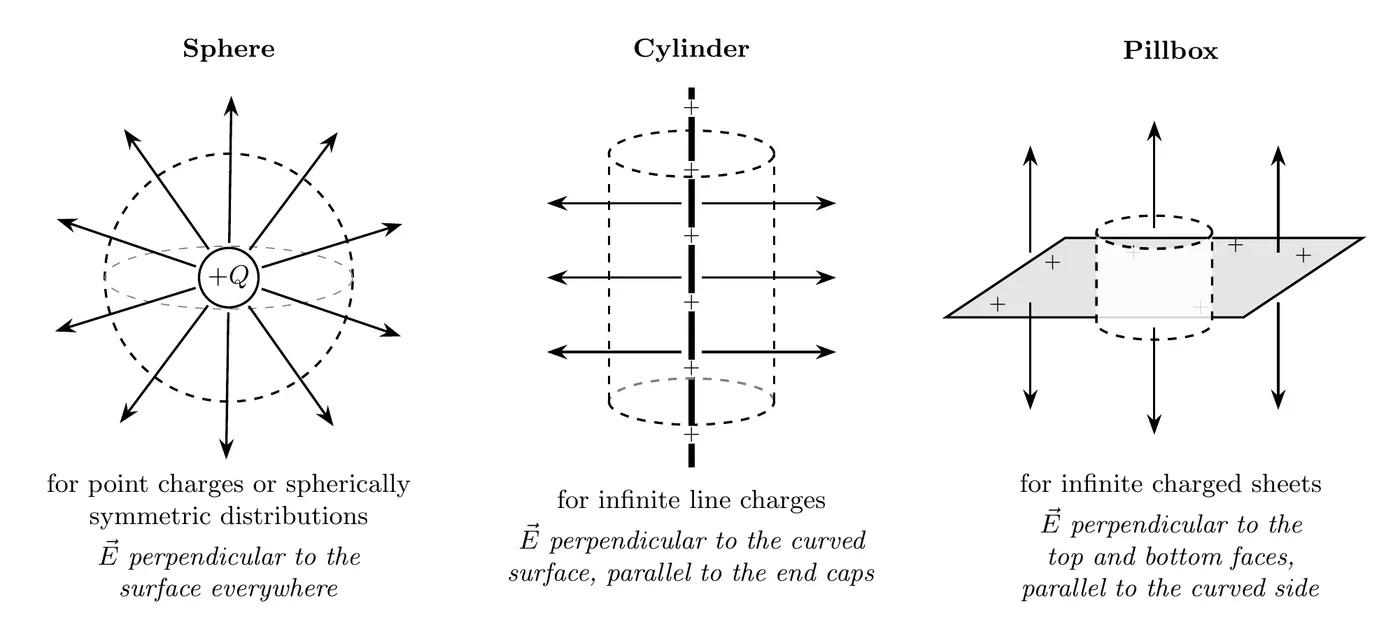
A Gaussian surface is an imaginary closed three-dimensional surface you use to apply Gauss’s Law. Choosing it is strategic, since you want shapes that exploit the symmetry.
Properties of Gaussian Surfaces
- Always closed. It completely encloses a volume, with no openings.
- Imaginary. It’s not a physical object, just a mathematical construct.
- Chosen for symmetry. Pick it so the electric field is either:
- Perpendicular to the surface (maximum flux, ), or
- Parallel to the surface (zero flux, ).
- Flux is independent of the surface size. As long as the enclosed charge stays the same, the total flux is the same no matter how big you make the surface.
Why: for a point charge, falls off as while the area of a sphere grows as , so their product stays the same. A nC charge sends a flux of N·m²/C through a sphere of radius 1 cm, 1 m, or 1 km, and through a cube or any other closed surface around it. If the charge sits at the center of a cube, the six faces are identical, so each one gets a sixth of the total, about 38 N·m²/C. You never need itself, which is lucky, since it changes from point to point on each face.
Common Gaussian Surface Shapes
Charge Density Functions
When charge is spread continuously, we use charge density to describe how it’s distributed through space.
Linear Charge Density (λ, lambda)
Definition: charge per unit length.
For integration:
where is an infinitesimal length element.
Units: C/m. Used for line charges, thin wires, and rods.
Surface Charge Density (σ, sigma)
Definition: charge per unit area.
For integration:
where is an infinitesimal area element.
Units: C/m². Used for charged sheets, surfaces, and thin films.
Volume Charge Density (ρ, rho)
Definition: charge per unit volume.
For integration:
where is an infinitesimal volume element.
Units: C/m³. Used for three-dimensional charge distributions, clouds, and spheres.
Finding Total Charge by Integrating a Density
When the density changes from place to place, you can’t just multiply density by size. Instead, slice the object into pieces small enough that the density is constant on each one, write for one piece, and add up the pieces with an integral. The equation sheet gives the 3D version:
Choose slices that match the shape:
- Line: pieces of length , so .
- Flat disk: thin rings of radius and width , with , so .
- Sphere: thin shells of radius and thickness , with , so .
- Cylinder of length L: thin cylindrical shells, with .
Example (disk): a disk of radius 0.10 m has , with C/m³ and measured from the center.
Example Problem 3 below does the sphere version.
Applying Gauss’s Law: The Strategy
- Identify the symmetry. Is it spherical? Cylindrical? Planar?
- Choose an appropriate Gaussian surface that matches the symmetry of the charge distribution.
- Determine the enclosed charge. Find inside your surface.
- Evaluate the flux integral. Use the symmetry to simplify .
- Apply Gauss’s Law. Set the flux equal to .
- Solve for the field. Isolate algebraically.
Example Problem 1: Field Outside a Uniformly Charged Sphere
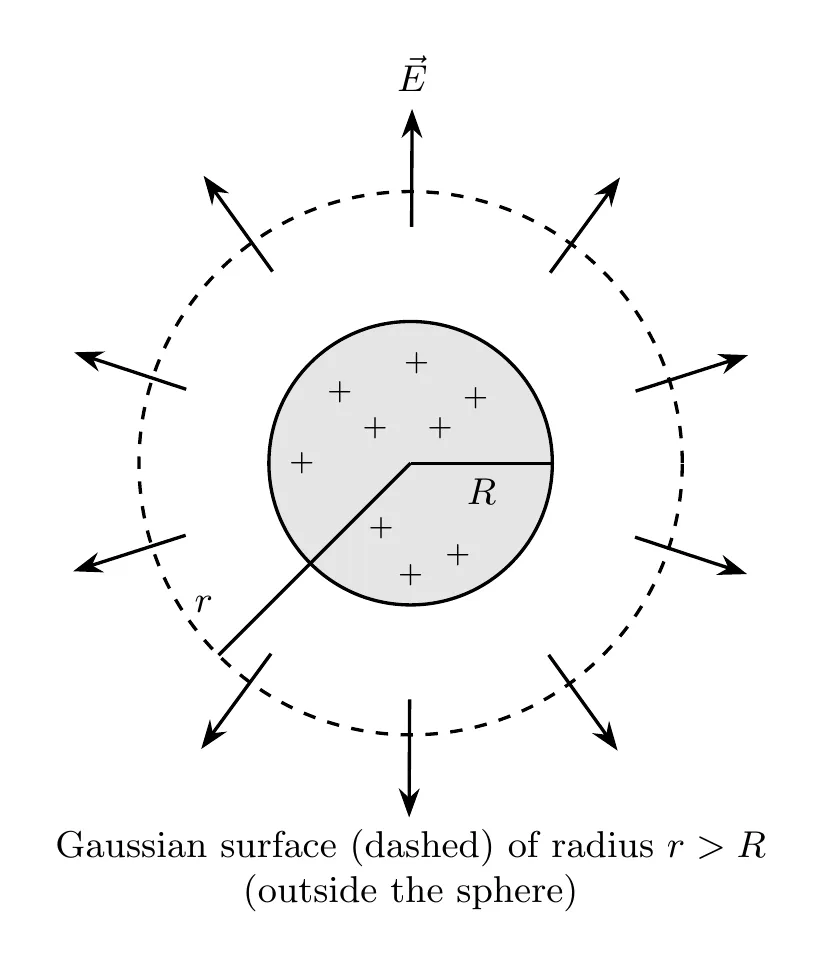
Problem: A solid sphere of radius carries a total charge spread uniformly through its volume. Use Gauss’s Law to find the electric field at a distance , outside the sphere.
Solution
Step 1: Identify the symmetry
It’s spherically symmetric, so use a spherical Gaussian surface centered on the sphere.
Step 2: Choose the Gaussian surface
A sphere of radius (with ), concentric with the charged sphere.
Step 3: Determine the enclosed charge
The entire charged sphere is inside our Gaussian surface, so:
Step 4: Evaluate the flux
By symmetry, is constant at radius and perpendicular to the surface everywhere:
Step 5: Apply Gauss’s Law
Step 6: Solve for E
The result: outside a uniformly charged sphere, the field is identical to that of a point charge. This is exactly where the point charge formula comes from.
Example Problem 2: Field Inside vs. Outside a Sphere
Problem: A spherical cloud of charge has radius and total charge . Find the field magnitude:
(a) Outside the cloud ().
(b) Inside the cloud at radius , assuming uniform charge density.
Solution
(a) Outside the cloud ()
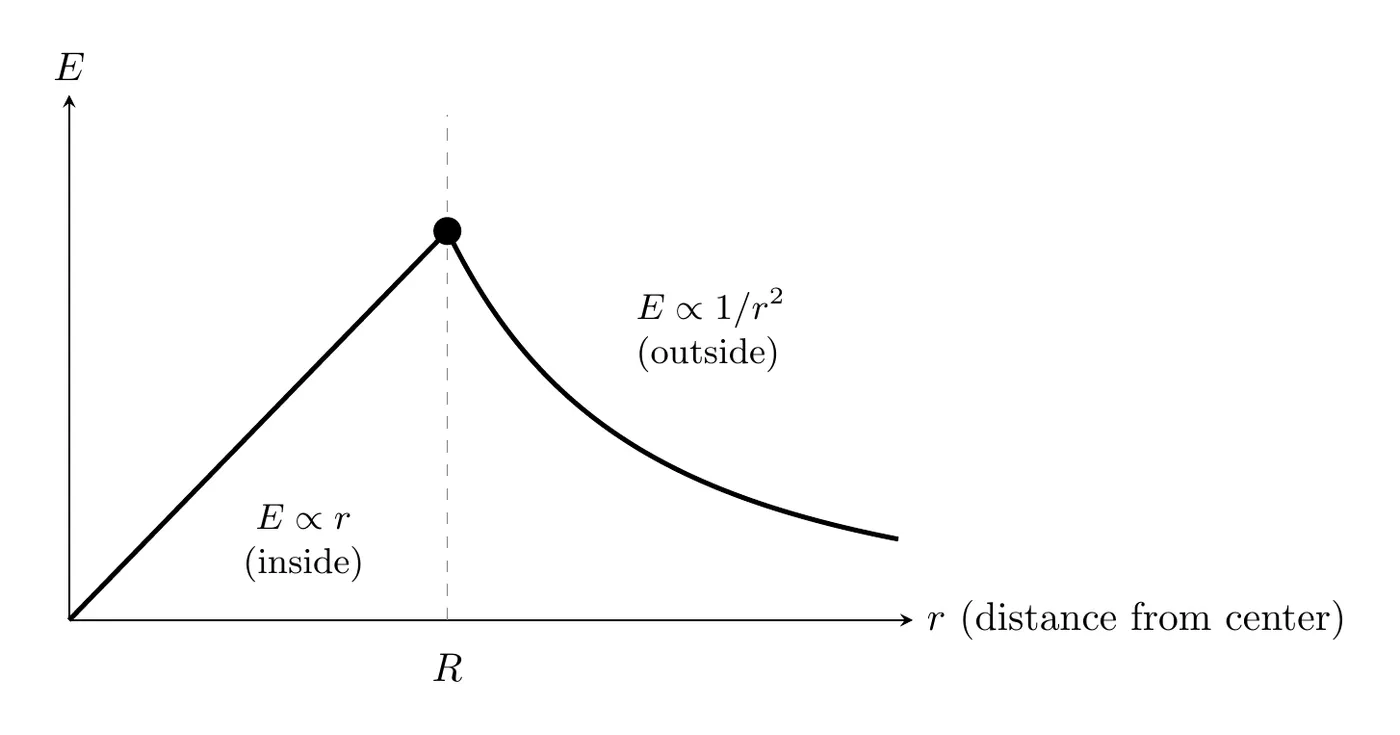
From the previous example:
(b) Inside the cloud ()
Step 1: use a Gaussian sphere of radius .
Step 2: find the enclosed charge.
The volume charge density is:
The charge enclosed within radius :
Step 3: apply Gauss’s Law.
Step 4: solve.
The result: inside a uniformly charged sphere, the field grows linearly with .
Example Problem 3: Non-Uniform Charge Distribution
Problem: A spherical cloud of radius holds total charge with a non-uniform volume charge density:
Find the electric field for , outside the cloud.
Solution
The key insight: when , the Gaussian surface encloses all the charge in the cloud.
Step 1: choose a spherical Gaussian surface with radius .
Step 2: find the enclosed charge.
All of it is enclosed, so , the given total charge.
Step 3: apply Gauss’s Law.
Step 4: solve for E.
The important conclusion: for any spherically symmetric charge distribution, the external field () depends only on the total charge and the distance, not on how that charge is arranged internally. From outside, the sphere acts like a point charge.
Example 3, Continued: Total Charge and the Field Inside
Also find:
(b) The total charge in terms of and .
(c) The field inside the cloud ().
Part (b): Integrate the density over the whole sphere
Use thin shells, :
Part (c): Inside, the Gaussian sphere only encloses the charge out to radius r
Same integral, but the upper limit is now (use for the integration variable so it doesn’t get mixed up with the limit):
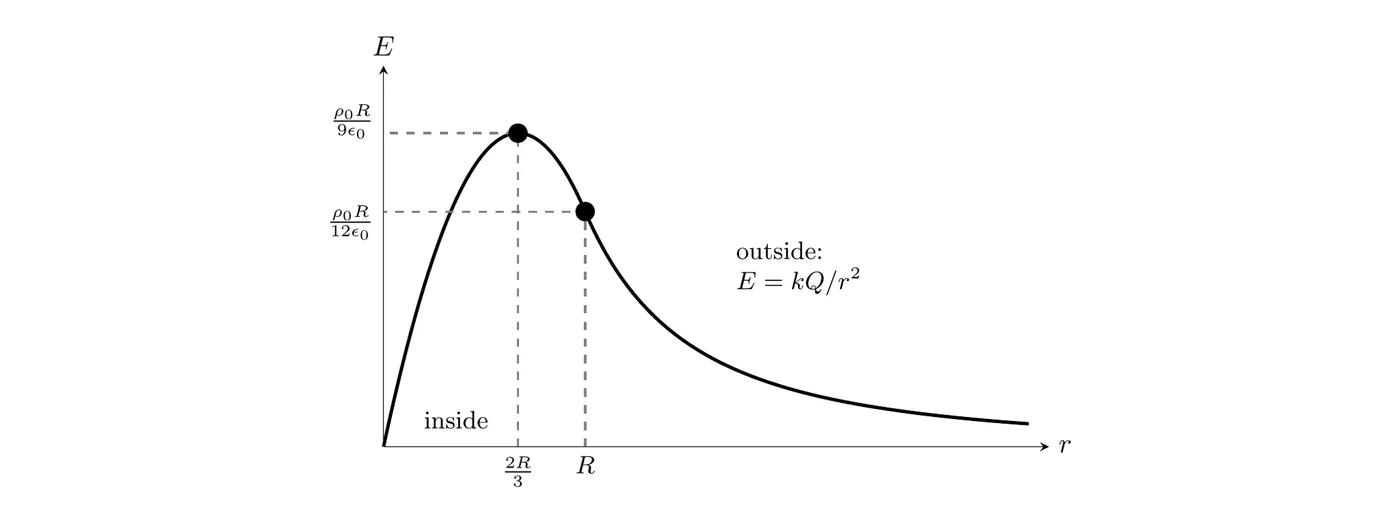
Check at the surface: at this gives . The outside formula gives . They match, so the field is continuous at the surface.
Unlike the uniform sphere, this field isn’t linear inside. Setting gives : the field rises to a peak of there, then dips a little before the surface, because there’s very little charge near the edge to add.
Cylindrical Symmetry: Line Charges and Long Cylinders
Problem: An infinitely long, thin line carries a uniform charge per unit length . Use Gauss’s Law to find the field a distance from the line.
Step 1: Identify the symmetry
The line looks the same from every side and goes on forever in both directions, so the field must point straight out from the line (radially) and have the same strength everywhere at distance .
Step 2: Choose the Gaussian surface
A closed cylinder of radius and length , centered on the line (the middle shape in the Gaussian surfaces figure above).
Step 3: Determine the enclosed charge
Step 4: Evaluate the flux
On the two flat end caps, runs along the surface, so they contribute no flux. On the curved side, is perpendicular to the surface and has the same magnitude everywhere:
Step 5: Apply Gauss’s Law and solve for E
The length cancels, as it should, since you chose it. This is the same answer Topic 1.4 got by integrating, in a fraction of the work.
Solid Cylinder with Uniform Charge Density
A very long solid cylinder of radius has charge spread uniformly through its volume with density . Use the same Gaussian cylinder (radius , length ).
Outside (r > R): the Gaussian cylinder encloses all the charge in its length, :
That’s the line charge field with .
Inside (r < R): only the charge within radius counts, :
Inside, grows linearly with , and both formulas give at the surface.
Planar Symmetry: An Infinite Sheet of Charge
Problem: A very large, flat, thin sheet carries a uniform surface charge density . Use Gauss’s Law to find the field near it.
Step 1: Identify the symmetry
The sheet looks the same everywhere, so the field must point straight away from it on both sides (for ), with the same strength at equal distances on either side.
Step 2: Choose the Gaussian surface
A “pillbox”: a short cylinder that pokes through the sheet, with one flat end of area on each side (the right-hand shape in the Gaussian surfaces figure above).
Step 3: Determine the enclosed charge
Step 4: Evaluate the flux
is perpendicular to both flat ends and points outward through each. On the curved side, runs along the surface, so no flux:
Step 5: Apply Gauss’s Law and solve for E
There’s no distance in the answer: the field of an infinite sheet is uniform. It’s the same 1 mm away or 10 cm away. Real sheets aren’t infinite, so this works when you’re much closer to the sheet than to its edges. Topic 3.3 adds the fields of a sheet and a sheet to get the field inside a parallel plate capacitor.
Example: a large flat sheet has C/m². On both sides, the field points away from the sheet, and its magnitude is:
Gauss’s Law and Maxwell’s Equations
Gauss’s Law is the first of Maxwell’s four equations, which together fully describe all electromagnetic phenomena:
- Gauss’s Law (for electricity):
- Gauss’s Law for Magnetism:
- Faraday’s Law:
- Ampère-Maxwell Law:
A bit of history: James Clerk Maxwell unified these equations in the 1860s. His synthesis revealed that light is an electromagnetic wave and predicted the entire electromagnetic spectrum. It’s one of the greatest achievements in the history of physics.
When to Use Gauss’s Law
Gauss’s Law is most useful when:
- There’s high symmetry (spherical, cylindrical, or planar).
- You need to find the field, not the flux.
- The charge distribution has a simple geometry.
Gauss’s Law is less practical when:
- There’s little or no symmetry.
- The charge distributions are irregular.
- You have multiple charges at arbitrary positions.
In low-symmetry cases, fall back on superposition and direct integration.
Common Mistakes
- Using the wrong charge. Use only the charge enclosed by your Gaussian surface, not every charge in the problem. Charge outside the surface contributes nothing to the flux through it.
- Forgetting that Gauss’s Law only works easily with symmetry. With no symmetry, the integral gets brutal. Gauss’s Law is always true, but it’s only computationally useful when the symmetry is high.
- Using the wrong surface area formula. For a sphere use , and for a cylinder’s curved surface use . Don’t confuse surface area with volume.
- Treating non-uniform fields as uniform. You can only pull out of the integral when it’s constant over the surface. If varies, integrate or pick a different surface.
- Confusing enclosed charge with charge density. When you’re given , , or , you have to integrate to get . For non-uniform distributions, that means or similar.
- Thinking zero flux means zero field. If a closed surface encloses no net charge, the total flux through it is zero, but the field on the surface usually isn’t. Field lines can enter one side and leave the other, like the cube in a uniform field in Topic 1.5.