

2.3 - Conservation of Electric Energy
Electric Potential Energy and Work
When a charged object moves between two spots with different electric potentials, the change in electric potential energy is:
where:
- = change in electric potential energy (J).
- = charge of the object (C).
- = potential difference (V).
The potential energy belongs to the object-field system: the charged object together with the field (really, the object plus the charges that make the field). If you pick just the object as your system instead, it has no potential energy, and the field is an outside force doing work on it. Both views give the same change in kinetic energy.
How it stacks up against gravitational PE:
Gravitational PE is , where you move a mass through a height difference. Electric PE works the same way, except you’re moving a charge through a potential difference.
Gravitational | Electric |
Move mass through a height | Move charge through a potential |
Conservation of Energy with Electric Potential
Conservation of energy stretches to cover electric potential energy too:
Written out in full:
where:
- = change in kinetic energy.
- = change in gravitational potential energy.
- = change in spring or elastic potential energy.
- = change in electric potential energy.
Rearranged for actually solving problems:
Or, when only electric and kinetic energy are in play:
Work and Energy in Electric Fields
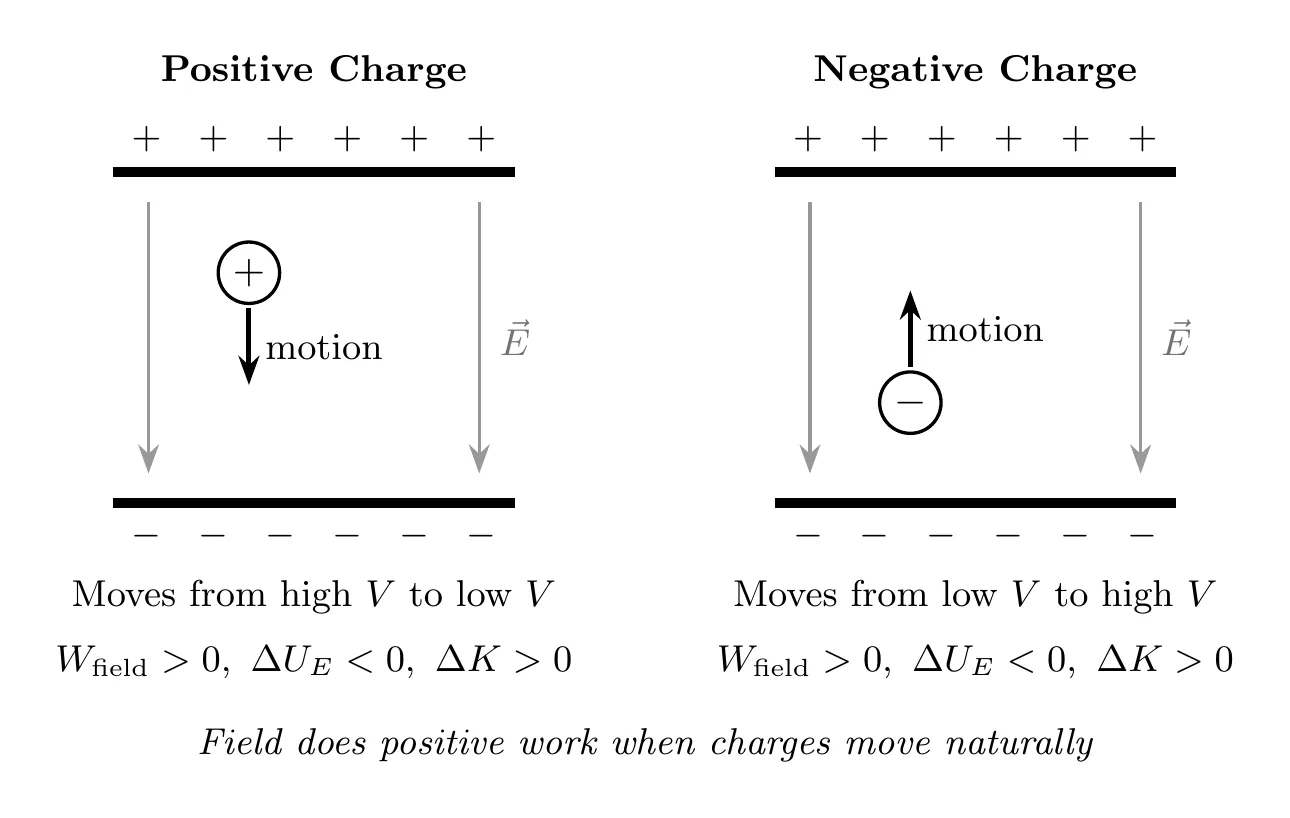
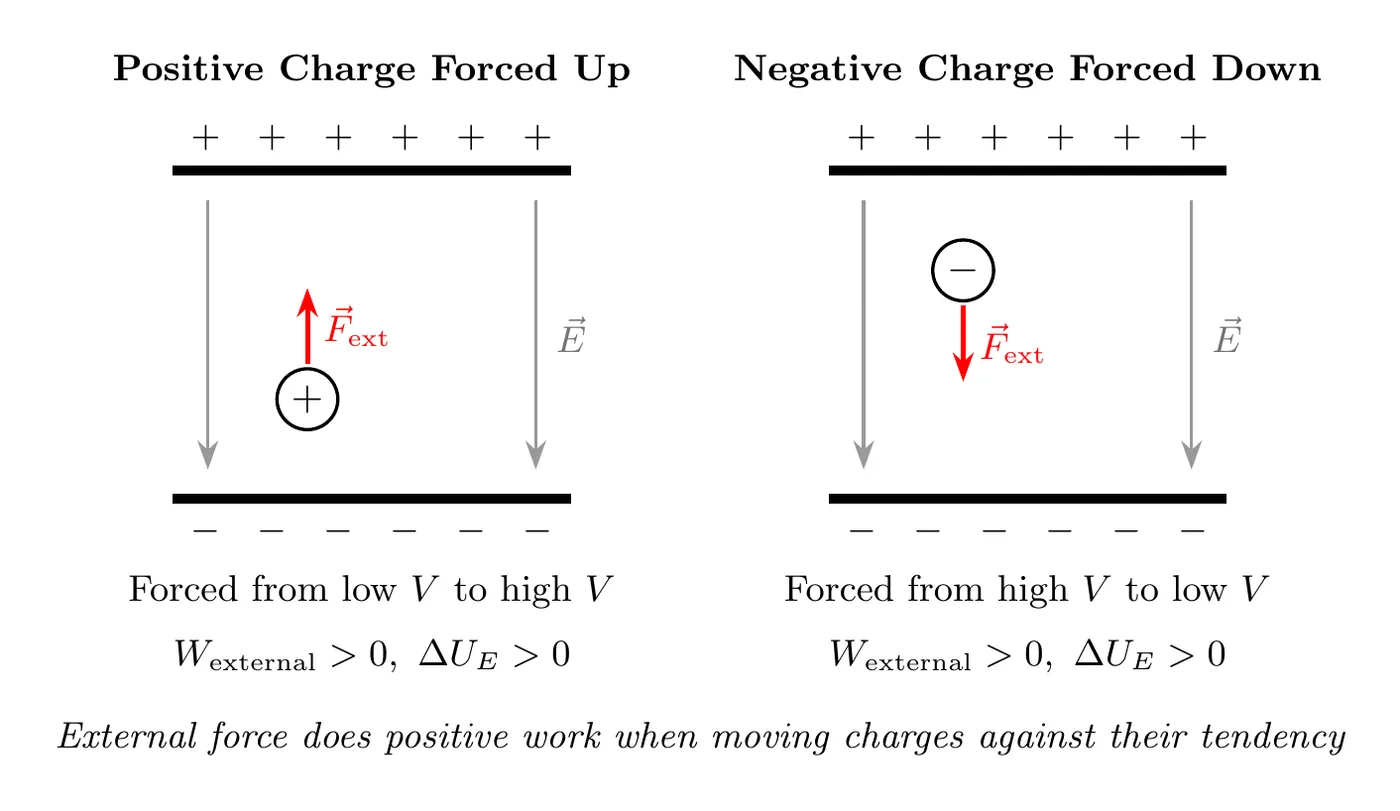
The sign of the work depends on whether the charge is moving the way it naturally wants to, or getting shoved against its tendency.
Positive Work (the Field Does the Work)
When charges move the way they “want” to:
- A positive charge heads toward lower potential (with the field).
- A negative charge heads toward higher potential (against the field).
- The electric field does positive work.
- Electric PE drops, kinetic energy climbs.
Negative Work (an External Force Does the Work)
When something outside pushes charges against their natural tendency:
- A positive charge gets forced toward higher potential (against the field).
- A negative charge gets forced toward lower potential (with the field).
- The external force does positive work, and the field does negative work.
- Electric PE goes up, and kinetic energy goes down if it started from rest.
The key relationships:
Example Problem 1: Proton Accelerated Through a Potential Difference
Problem:
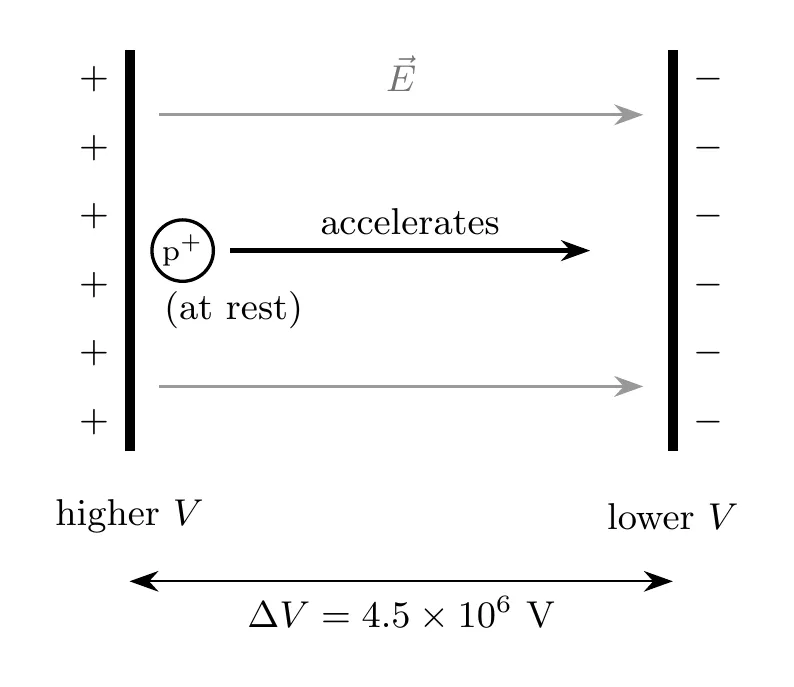
A proton (mass kg) accelerates from rest through a potential difference of V.
- How much kinetic energy did the proton pick up?
- If it started at rest, how fast is it going?
Solution
(a) Kinetic Energy Gained
Use the link between potential difference and energy change:
A proton has charge C. A positive charge speeds up by moving to lower potential, so the proton moves through V.
Since it starts from rest and the only thing happening is electric PE turning into kinetic energy:
So the kinetic energy gained is:
Answer (a): the proton picked up J of kinetic energy.
(b) Final Speed
From the kinetic energy formula:
Solve for :
Answer (b): the proton ends up moving at roughly m/s.
For context: the speed of light is m/s, so this proton is cruising at about 10% of light speed.
Shortcut with electron volts: 1 eV J is the energy a particle with charge gains moving through 1 V. So a proton accelerated through V gains eV (4.5 MeV) of kinetic energy, and J, the same answer as part (a).
Example Problem 2: Electron in a Uniform Field
Problem:
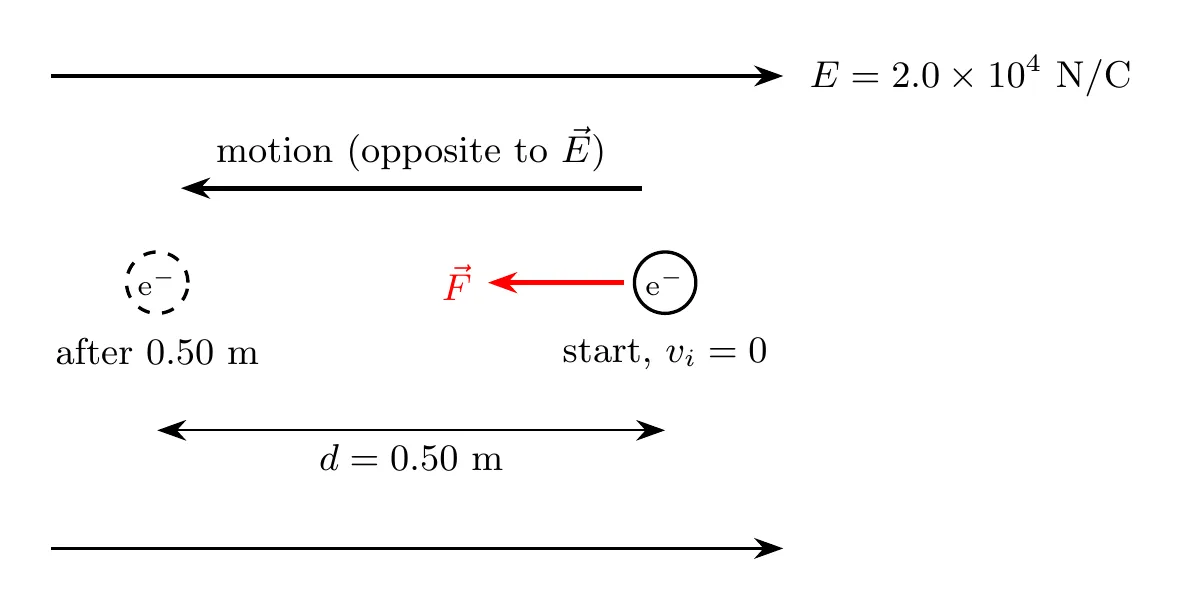
An electron (mass kg, charge C) is released from rest in a uniform electric field of magnitude N/C. After traveling 0.50 m in the direction opposite to the field, how fast is it moving?
Solution
Approach: energy conservation
The electron moves opposite to the field, which means it’s heading from lower potential to higher potential. For a negative charge, that’s a drop in potential energy.
The potential difference it travels through:
The change in electric potential energy:
That negative value means the PE went down, and that energy shows up as kinetic energy.
Using energy conservation from rest:
Solve for the speed:
Answer: the electron is moving at about m/s, roughly 20% of light speed.
Example Problem 3: Proton in a Uniform Field
Problem:
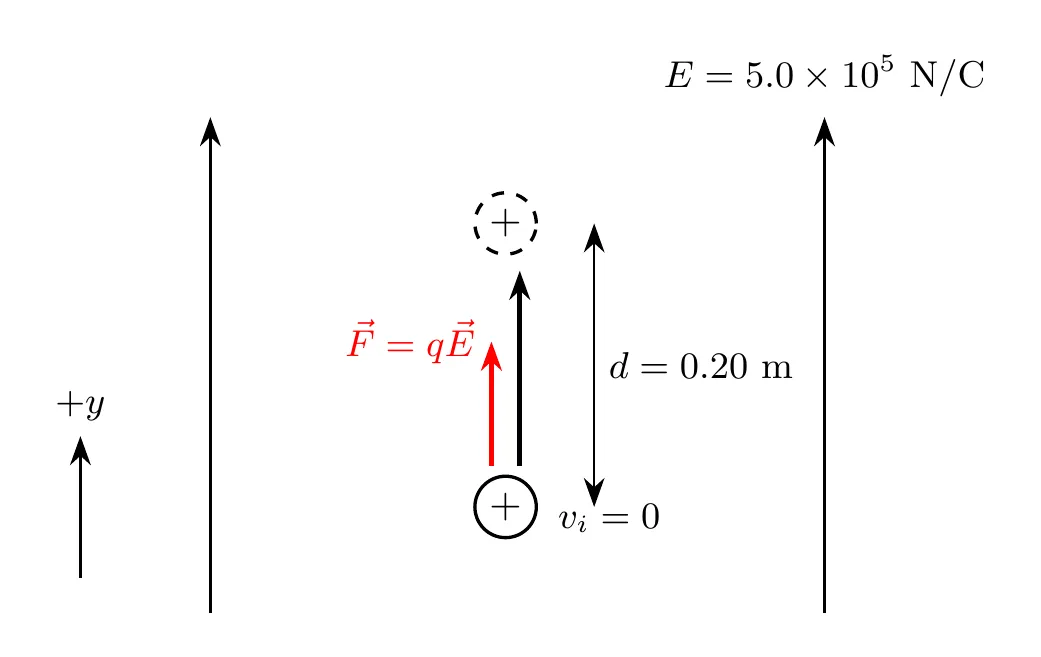
A proton (mass kg, charge C) sits in a uniform electric field of magnitude N/C pointing upward, then gets released from rest.
- After it has moved 0.20 m upward, how fast is it going?
- What potential difference did it move through?
Solution
(a) Final Speed
The proton is positive, so it accelerates upward, right along the field.
Using energy:
The work done by the field:
That work turns into kinetic energy:
Answer (a): m/s.
(b) Potential Difference
For a uniform field, moving along the field direction:
Answer (b): the proton moved through a potential difference of kV, so the potential dropped by 100 kV.
Example Problem 4: Closest Approach
Problem:
A small sphere ( g, μC) slides on a level, frictionless surface straight toward a fixed charge μC. When it’s 0.90 m away, its speed is 15 m/s.
- How close does the sphere get to the fixed charge?
- How fast is it moving once it has been pushed back out to very far away?

Solution
The field of a point charge isn’t uniform, so won’t work here. Use energy conservation with . The surface is level and frictionless, so only the electric force does work.
(a) Closest Approach
At the closest point the sphere is momentarily at rest, so all of its energy is electric potential energy:
First, J·m. The total energy is:
Answer (a): the sphere gets within 0.36 m of the fixed charge, then gets pushed back.
(b) Speed Far Away
Very far away, , so all 0.375 J is kinetic energy:
Answer (b): about 19 m/s. It ends up faster than it was at 0.90 m because the 0.15 J of potential energy it had there also turns into kinetic energy.
Speed Comparisons
It’s handy to size these particle speeds up against the speed of light, since that’s what tells you when relativity starts to matter:
From our examples:
- Proton at m/s: , so about 10% of light speed.
- Electron at m/s: , so about 20% of light speed.
- Proton at m/s: , so about 1.5% of light speed.
Rule of thumb: classical mechanics () works well as long as is a small fraction of . For a given kinetic energy, it overestimates the speed by about 0.4% at 10% of light speed and about 1.5% at 20% (the electron above), so these answers are close enough. The error grows quickly after that (about 11% at half the speed of light), and you’d need special relativity, which isn’t part of this course.
How Speed Scales with the Potential Difference
For a particle that starts from rest, , so and . Four times the potential difference gives twice the speed, not four times.
Example: An electron accelerated from rest through 100 V reaches:
Through 400 V it reaches times that, m/s.
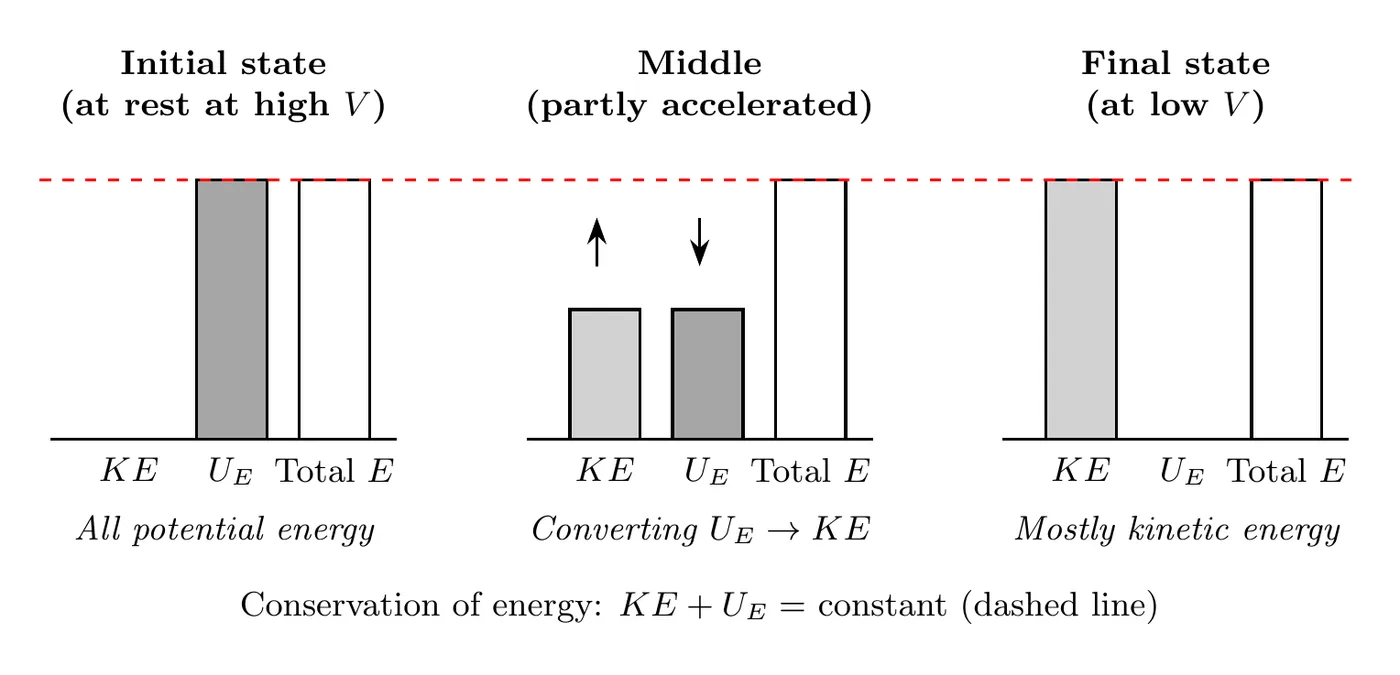
Energy Bar Charts
Drawing out the energy helps make the transformations click:
Problem-Solving Strategy
For conservation of electric energy problems:
- Pin down the initial and final states. Where does the particle start and where does it end up?
- Figure out what you’ve been given. Do you have , or and , or both?
- Pick a zero reference. Usually infinity, or one of the spots in the problem.
- Apply energy conservation:
- Solve for the unknown, which is usually speed, distance, or potential difference.
- Check the signs. Did the PE go up or down? Does that make sense physically?
Key Formulas Summary
Relationship | Formula |
PE change | |
Work by the field | |
Uniform field | (moving with the field) |
Energy conservation | |
Starting from rest | |
Speed from energy |
Sign Conventions
For the potential difference :
Particle | Motion Direction | Speed Change | ||
Positive | With the field (toward −) | Negative | Negative | Speeds up |
Positive | Against the field (toward +) | Positive | Positive | Slows down |
Negative | Against the field (toward +) | Positive | Negative | Speeds up |
Negative | With the field (toward −) | Negative | Positive | Slows down |
The rule: particles speed up whenever , meaning their PE drops.
Common Mistakes
- Forgetting the sign of the charge in . That carries its sign. For an electron it’s C, not positive. The sign flows straight through to and determines whether energy is gained or lost.
- Misreading “accelerated through X volts.” When a problem says a particle is “accelerated through 500 V,” it means the particle moves through a potential difference that speeds it up. For a proton that means going to lower potential, and for an electron it means going to higher potential. The magnitude is 500 V, but the sign of depends on which particle you’ve got.
- Mixing up work by the field with work by an external force. The field does positive work when particles move naturally (). An external force does positive work when it drags particles against their tendency (). Opposite signs.
- Misapplying conservation of energy. only holds when nothing else is doing work. If gravity is in the picture, you have to include too.
- Forgetting the square root when finding speed. Once you’ve got , you still need to take the square root: , not .