

3.1 - Electrostatics with Conductors
What a Conductor Is
An ideal conductor is a material where electrons can roam freely throughout. That freedom of the charge carriers is exactly what separates conductors from insulators.
Important: only electrons move during electrostatic processes. Protons stay locked in the atomic nuclei. Moving protons around would take nuclear reactions, which is a totally different game from electrostatics.
Typical conductors: metals like copper, aluminum, silver, gold, iron, and steel.
Charge Movement in Conductors
Negatively Charged Conductor
When a conductor carries a net negative charge:
- It’s got excess electrons.
- Those electrons head out to the outer surface.
- The interior stays neutral, with equal protons and electrons.
- The surface ends up with a net negative charge spread over it.
Positively Charged Conductor
When a conductor carries a net positive charge:
- There’s a shortage of electrons.
- Electrons have either moved away from certain regions or been stripped off entirely.
- The upshot looks like positive charge sitting on the surface.
- We model it as positive charge carriers on the surface.
The key point: either way, the redistribution happens because electrons, the only mobile charges around, move to reach equilibrium.
Properties of Conductors in Electrostatic Equilibrium
Once a conductor hits electrostatic equilibrium (no more net charge motion), a few crucial properties fall out.
Property 1: All the Excess Charge Sits on the Surface
At equilibrium, all the excess charge migrates to the outer surface. The interior has no net charge at all.
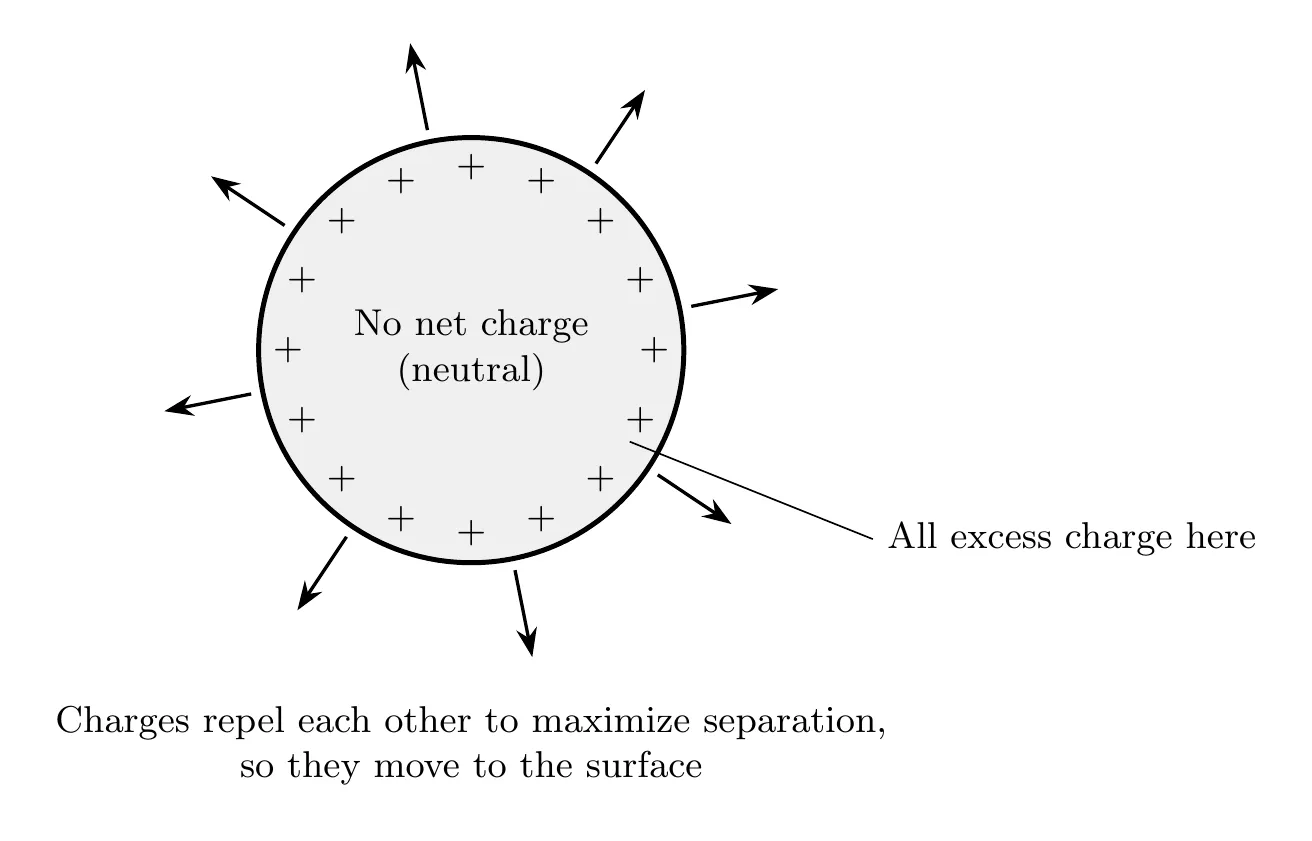
Why? Like charges repel. To cut down on that repulsion and settle into equilibrium, they spread out as far as they possibly can, which lands them on the outermost surface.
How long does that take? Practically no time at all. Each electron only has to shift a tiny distance, and the push it responds to spreads through the metal at close to the speed of light, so a hand-sized conductor settles in far less than a microsecond. That time is negligible, so on the AP exam you always assume a conductor is already in electrostatic equilibrium.
Property 2: The Field Inside Is Zero
The electric field inside a conductor at electrostatic equilibrium is always zero:
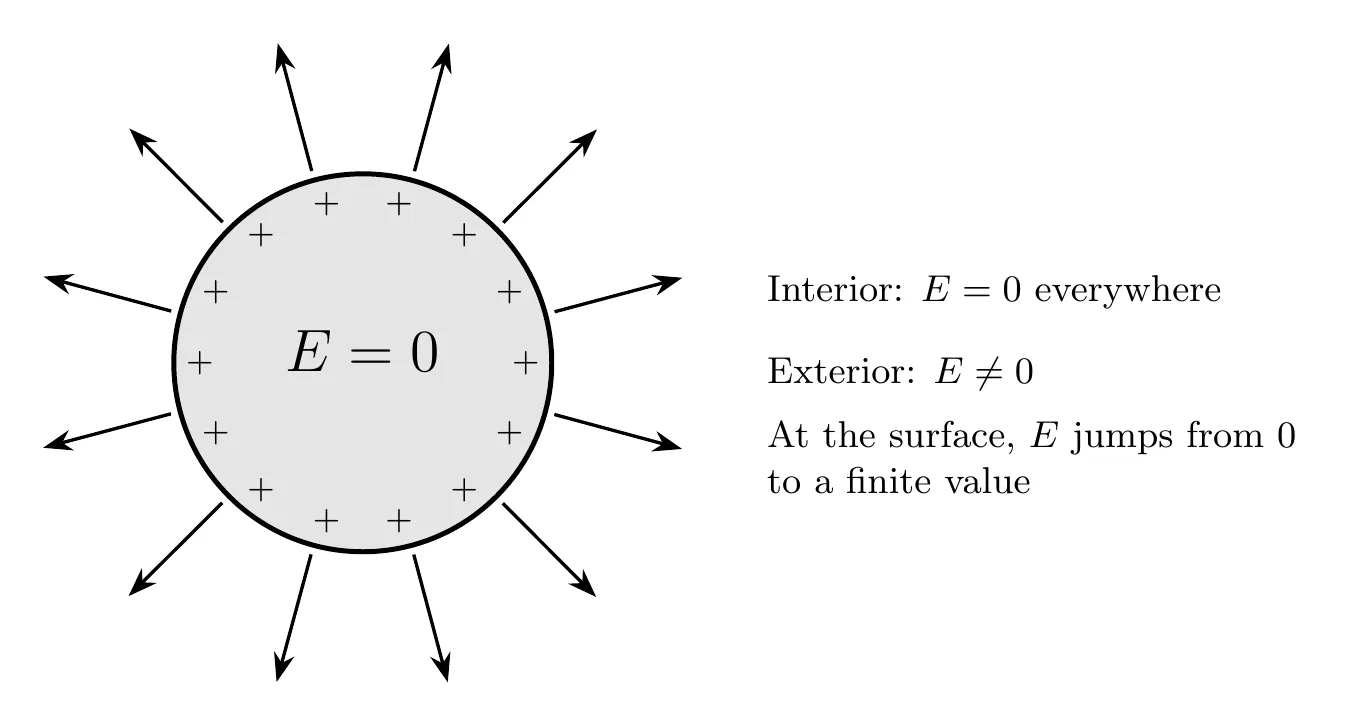
Why? If there were any field inside, the free electrons would feel a force and start moving. But equilibrium means nothing is moving, so there can’t be a field.
Gauss’s law says the same thing. Draw a Gaussian surface anywhere inside the conducting material, as close to the outer surface as you like. at every point on it, so the flux through it is zero, and Gauss’s law, , says . No net charge inside any such surface means no net charge anywhere in the interior. The only place left for the excess charge is the surface.
Test tip: if you’re ever asked for the field anywhere inside a conductor, the answer is zero, no calculation required.
Property 3: The Surface Is an Equipotential
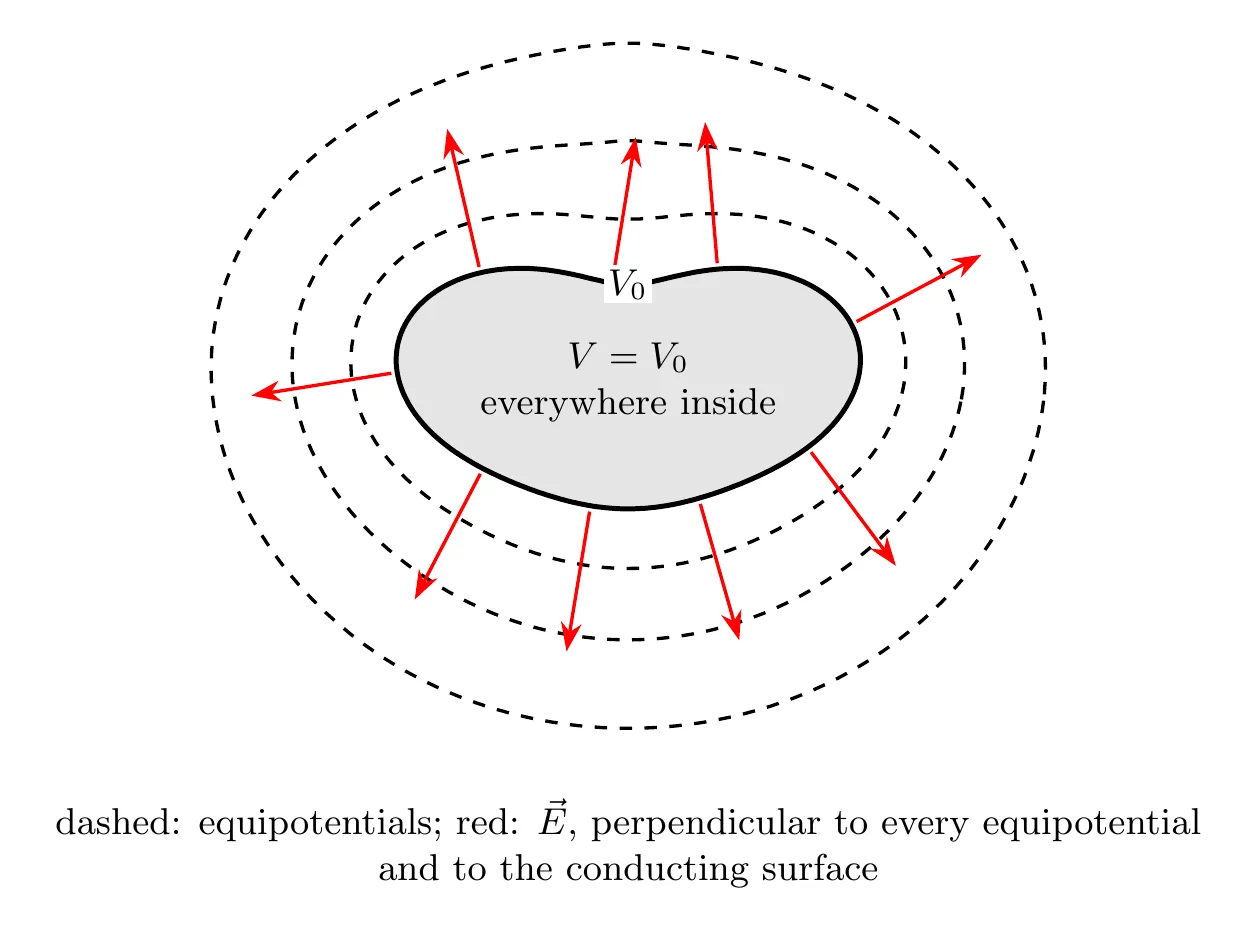
The whole surface of a conductor at equilibrium sits at the same electric potential, making it an equipotential surface:
And since inside and , the potential is actually constant throughout the entire conductor:
Property 4: The Field at the Surface Is Perpendicular
The electric field just outside the surface is always perpendicular to that surface:
Why? If any piece of the field ran parallel to the surface, charges would slide along the surface until that piece disappeared. Equilibrium demands .
How strong is the field at the surface? Use a tiny Gaussian cylinder (a “pillbox”) that pokes through the surface, with one flat end of area just outside and the other end inside the metal. The field inside is zero, and just outside it’s perpendicular to the surface, so the only flux is through the outside end. The pillbox encloses charge , so , which gives:
So the field just outside a conductor is directly proportional to the local surface charge density. That’s why the field is strongest wherever is biggest.
Electric Field vs. Distance for a Conductor
Here’s how the field behaves as you move out from the center:
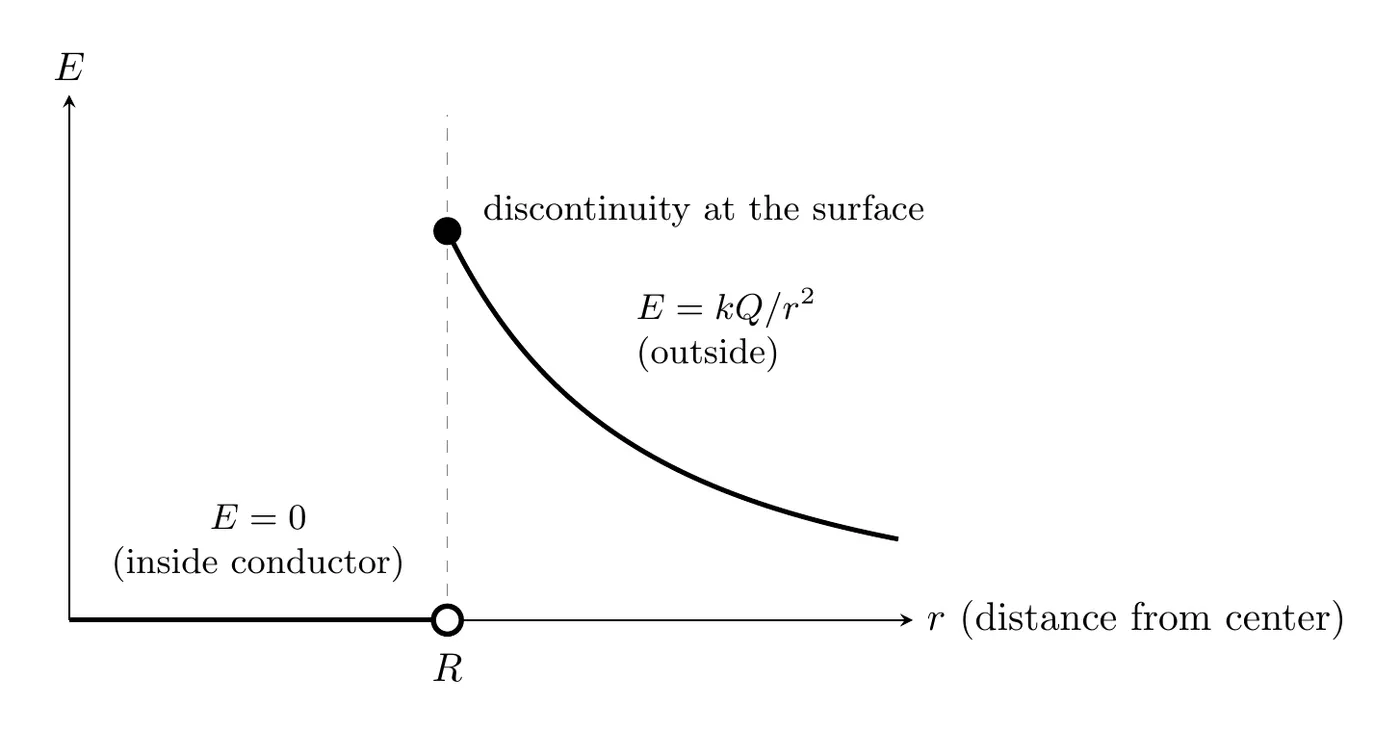
The thing to notice: the field is flat zero everywhere inside, then suddenly jumps to a real value right at the surface.
Surface Charge Density Variation
Even though the whole surface sits at one potential, the surface charge density can change from spot to spot depending on the local shape.
Surface Charge Density Formula
where:
- = surface charge density (C/m²).
- = charge on a surface element.
- = area of that surface element.
The Geometry Effect
Sharp points and edges pack in more charge:
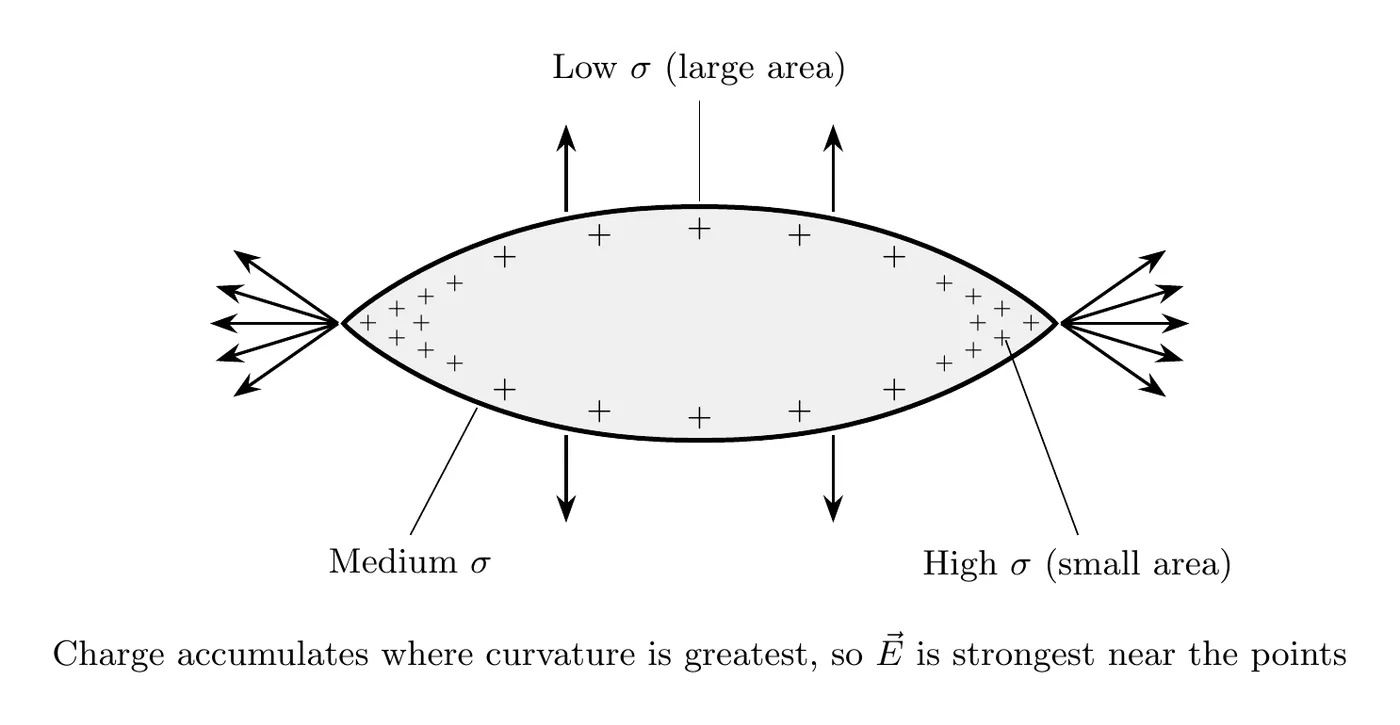
The principle: for a given amount of charge :
- Small surface area gives high (charges crowded together).
- Large surface area gives low (charges spread thin).
The physical payoff: the electric field is strongest wherever the surface charge density is highest, so at sharp points and edges.
Why points get more charge: the whole conductor is one equipotential, so think of a sharp tip as a tiny sphere and a gently curved region as a big sphere, wired together at the same potential. From 3.2, connected spheres split charge so that . In this simple model, a tip with a 1.0 mm radius of curvature on an object whose broad side curves like a 10 cm sphere has about times the charge density of the broad side, and since at the surface, about 100 times the field.
Where you see it: lightning rods use sharp points to build strong fields that ionize the air, giving lightning a safe conducting path to ground.
Polarization of a Conductor
A conductor doesn’t need any net charge to be affected by a field. Put a neutral conductor in an external electric field and its charge separates: the field pushes free electrons opposite to , so one side ends up with extra electrons (negative) and the far side is left short of electrons (positive). The conductor is now polarized, but its net charge is still zero.
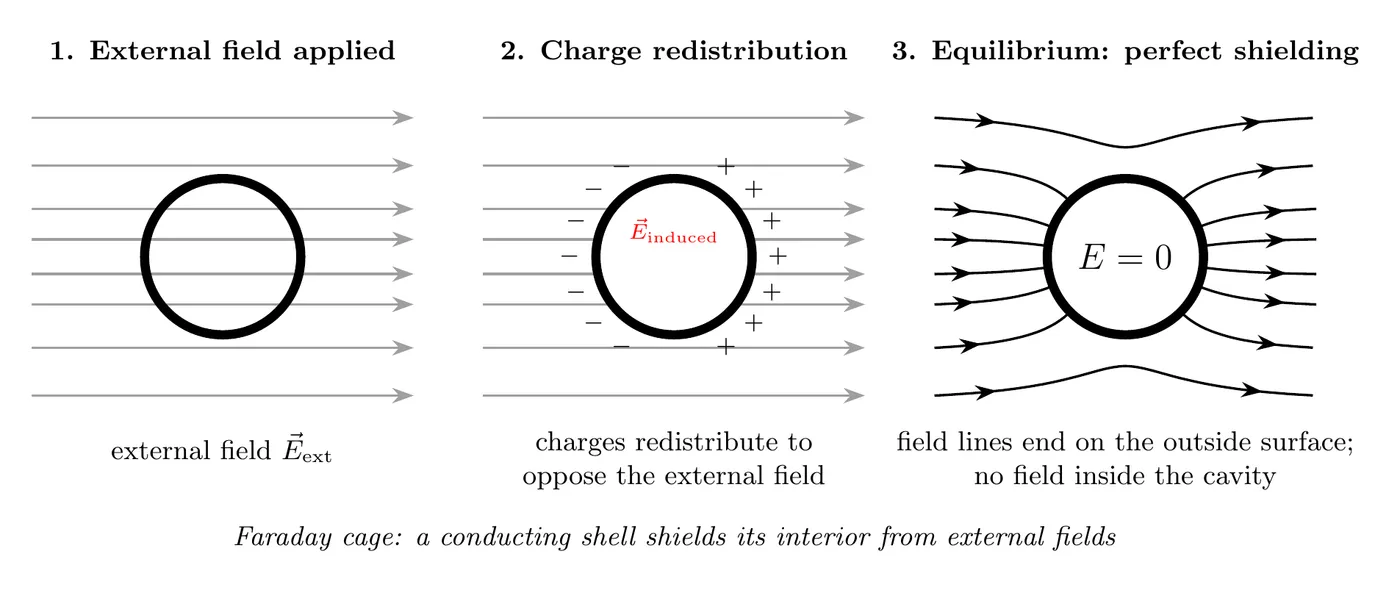
Why it has to happen: a conductor in equilibrium must be an equipotential. The external field on its own would make one end of the conductor sit at a higher potential than the other, since potential drops along the field direction. Free electrons always drift toward higher potential, so they keep moving until the induced charges make a field that exactly cancels the external field inside the metal. At that point inside, the whole conductor is at one potential, and the charges stop. The Faraday cage figure below shows the result: induced charges on the surface, and field lines bent so they meet the surface at right angles.
Example: a neutral metal plate with faces m by m is placed in a uniform field N/C that points straight through it. How much charge collects on each face?
The two faces act like two charged sheets: on the face where the field enters and on the face where it leaves. Between two such sheets their own field is , pointing from to , which is opposite to (3.3 shows why). For inside the metal:
So about nC sits on one face and nC on the other. That’s electrons, a tiny fraction of the plate’s free electrons, which is why a conductor can always cancel an ordinary external field.
Electrostatic Shielding (the Faraday Cage)
One of the most useful consequences of all these conductor properties is electrostatic shielding.
The Idea
Put a conducting shell into an external electric field and here’s what happens:
- The external field pushes charges around on the conductor.
- Those redistributed charges make their own electric field.
- Inside the conductor, the two fields cancel each other out exactly.
- The result is zero field inside the shell, so the interior is shielded.
That’s a Faraday cage, named after Michael Faraday.
The Math
Outside the conductor:
Inside the conducting material:
Inside the hollow cavity:
The conducting material whips up an induced field that perfectly cancels the external one everywhere inside.
Real-World Uses
1. Lightning protection (cars)
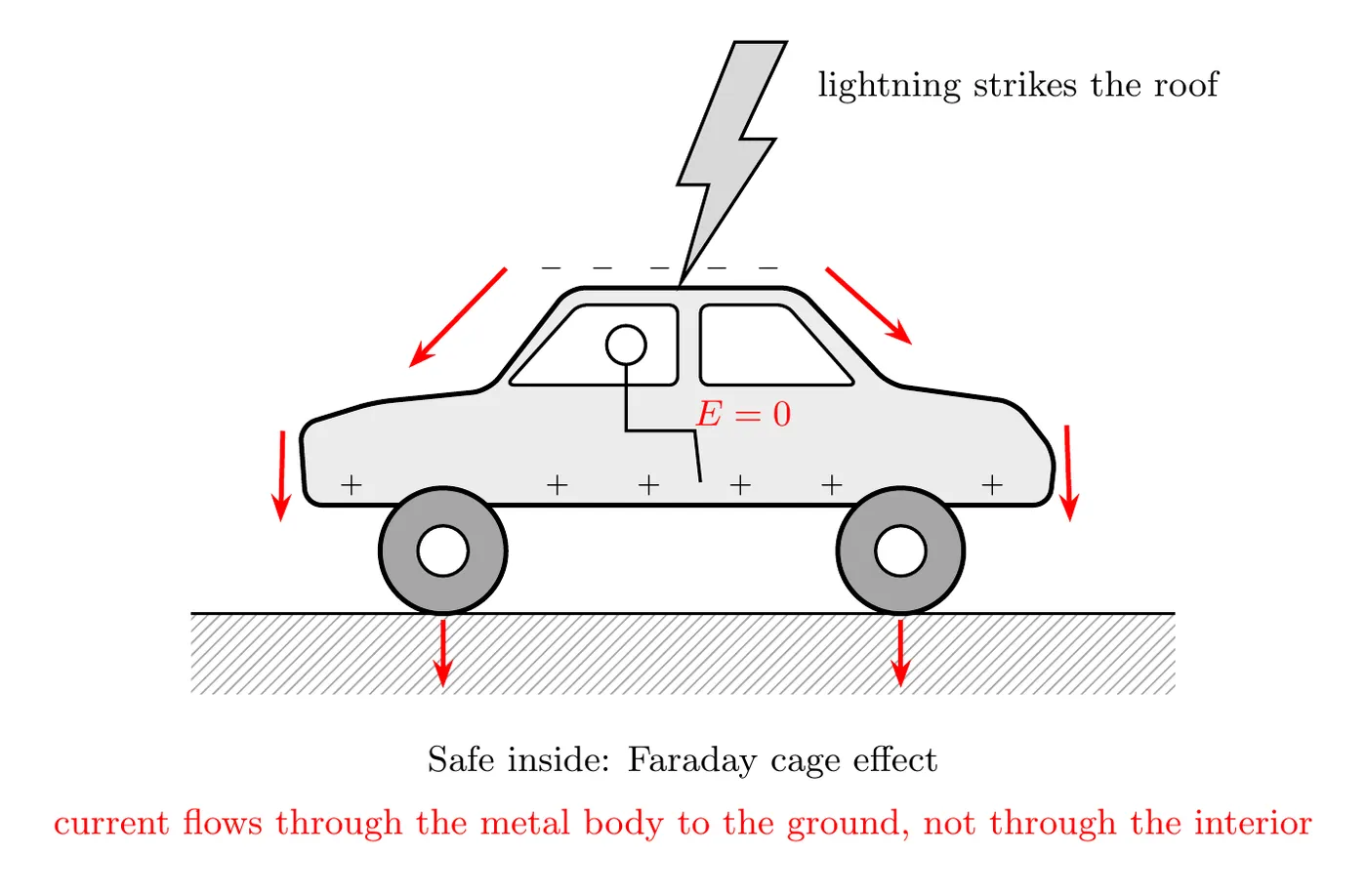
Sitting in a car during a lightning storm is safe because:
- The metal body is a conductor.
- Lightning creates an external electric field.
- The car body shuffles its charge around to cancel the field inside.
- People inside experience zero electric field.
- The current runs through the metal exterior, not through the cabin.
2. RFID-blocking pouches
Metallic pouches block radio signals:
- RFID chips in credit cards react to radio waves, which are electromagnetic fields.
- The metallic pouch acts as a Faraday cage.
- Outside radio signals can’t get in.
- Signals from inside can’t get out either.
- That stops anyone from scanning your cards without permission.
3. Sensitive electronics
Faraday cages shield gear from:
- Electromagnetic interference (EMI).
- Radio frequency interference (RFI).
- External electric fields.
You’ll find them around MRI rooms, electronics testing facilities, and secure communication rooms.
Example Problem 1: Potential at the Surface of a Conducting Sphere
Problem:
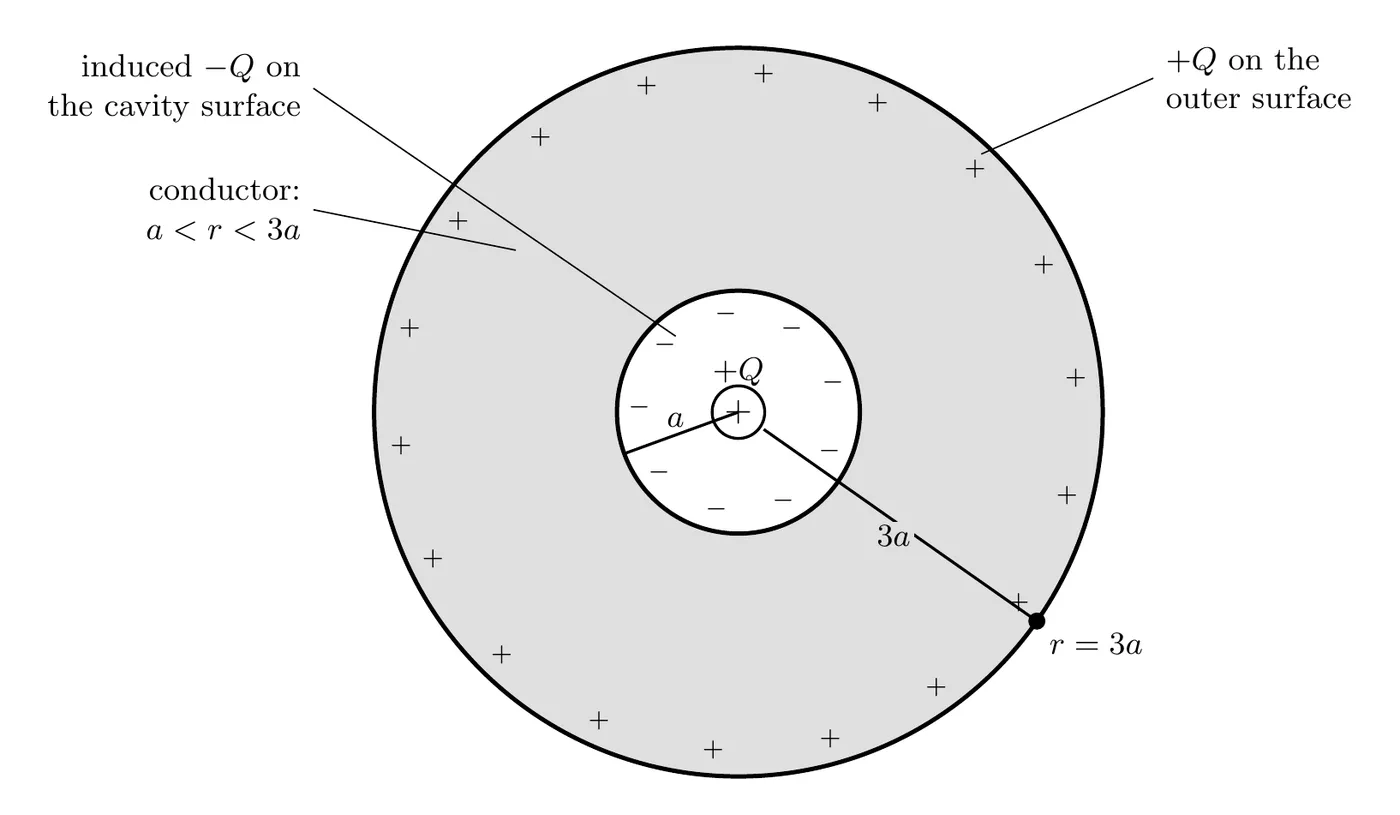
A solid uncharged conducting sphere of radius has a hollow spherical cavity of radius at its center. A point charge sits at the common center. Taking at , find the electric potential at , the outer surface of the conductor.
Solution
Method 1: straight from the point charge formula
The charge distribution is spherically symmetric, so we can treat the whole thing as a point charge when we want the potential at the outer surface.
The potential from a point charge:
At :
Answer:
Method 2: by integration (calculus)
You can also get the potential by integrating the electric field:
For , outside the conductor, the field is just a point charge field:
Set up the integral in the radial direction:
Pull out the constants:
Rewrite it for easier integration:
Integrate with the power rule:
Evaluate the limits:
Answer:
Both routes land in the same place.
Example Problem 2: Field Inside and Outside a Hollow Conductor
Problem:
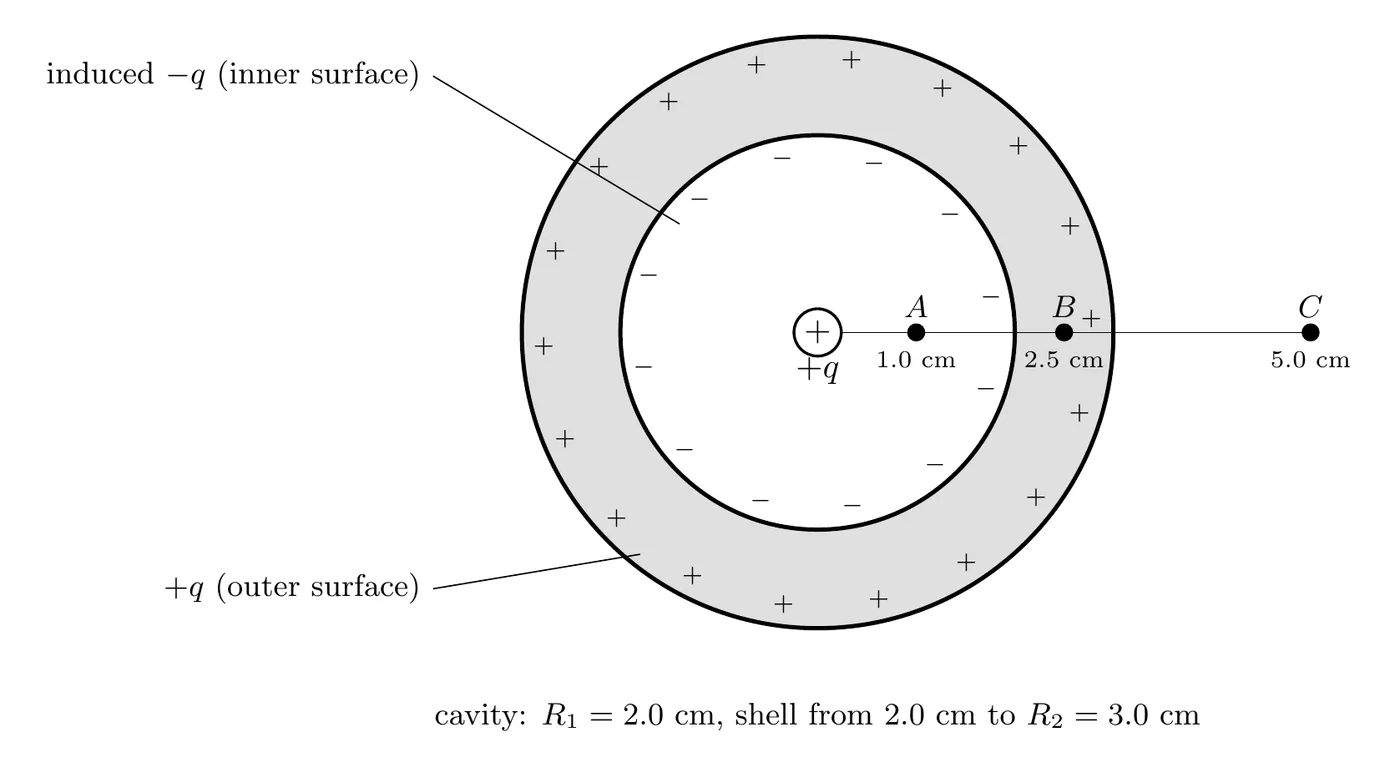
A thin spherical conducting shell has inner radius cm and outer radius cm. A point charge nC sits at the center. Find the electric field at:
- cm (inside the cavity)
- cm (inside the conducting material)
- cm (outside the shell)
Solution
(a) At r = 1.0 cm, inside the cavity
In the hollow cavity, the only thing making a field is the central point charge:
Answer (a): N/C, pointing radially outward.
(b) At r = 2.5 cm, inside the conducting material
Inside the conductor material itself, the field is always zero:
Answer (b): , and you didn’t have to calculate a thing.
(c) At r = 5.0 cm, outside the shell
Outside the shell, just treat it as a point charge at the center:
Answer (c): N/C, pointing radially outward.
Example Problem 3: A Charged Shell with a Charge Inside
Problem:
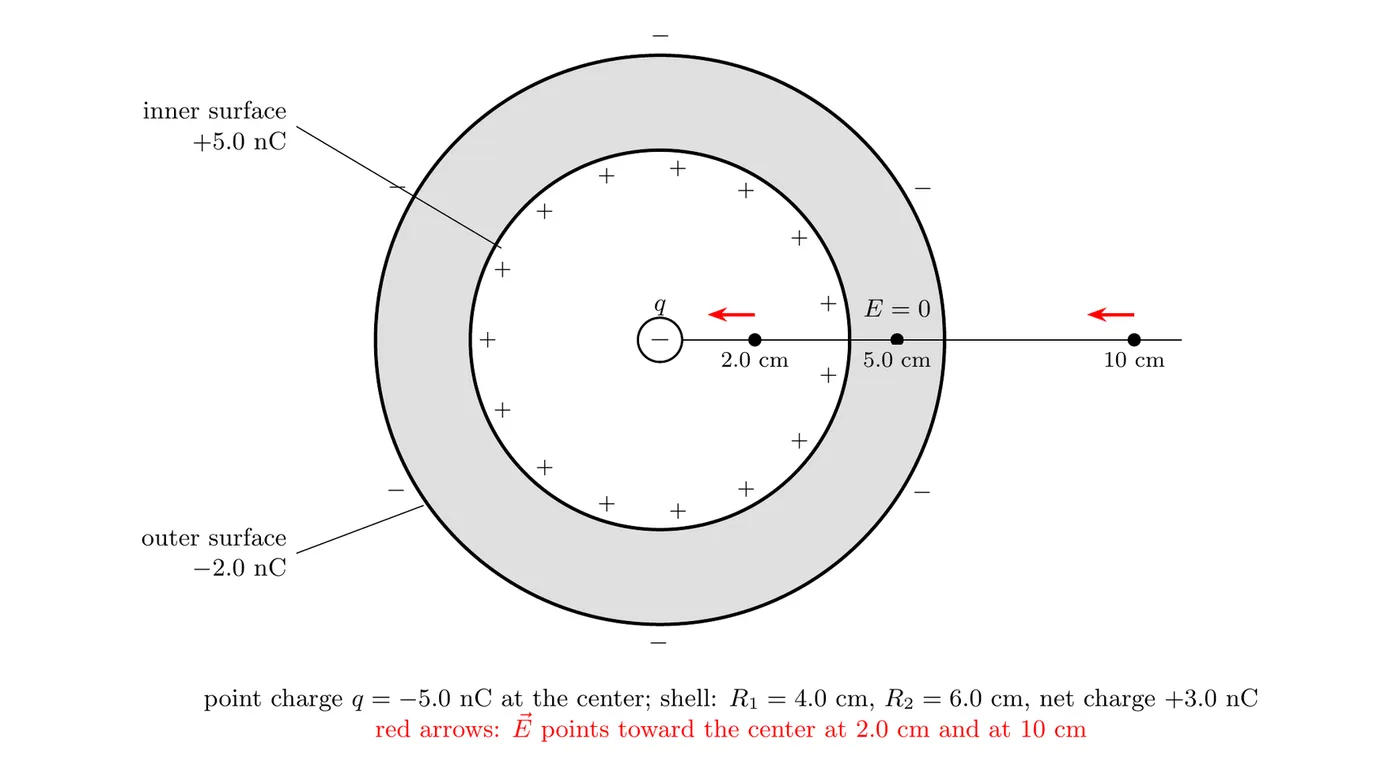
A conducting spherical shell has inner radius cm and outer radius cm, and it carries a net charge of nC. A point charge nC sits at its center. Find:
- The charge on the inner surface and on the outer surface of the shell.
- The surface charge density on the outer surface.
- The electric field at cm, cm, and cm.
Solution
(a) Charge on each surface
Put a Gaussian sphere inside the metal, say at cm. there, so the enclosed charge must be zero: , which gives nC. The shell’s net charge is fixed, so whatever isn’t on the inner surface is on the outer surface:
Answer (a): nC on the inner surface and nC on the outer surface. The outer surface is not just the opposite of the inner one here, because the shell had its own net charge.
(b) Surface charge density on the outer surface
(c) Electric field
At cm (in the cavity), only the point charge is inside the Gaussian sphere. The enclosed charge is negative, so the field points toward the center:
At cm (inside the metal), . At cm (outside), the enclosed charge is nC, so the field again points toward the center:
Check at the surface: just outside the shell, N/C, and the point-charge formula gives N/C. Same answer, and the field there is perpendicular to the surface.
Summary of Key Properties
Location | Electric Field | Electric Potential | Charge Distribution |
Inside the conductor | No net charge | ||
Conductor surface | All the excess charge | ||
Outside the conductor | Acts like a point charge |
Common Mistakes
- Thinking charge is spread through the conductor’s volume. All the excess charge lives on the outer surface. The bulk interior has no net charge at equilibrium.
- Calculating the field inside the conductor instead of just writing zero. If you’re asked for the field anywhere inside a conductor at equilibrium, the answer is instantly . Don’t burn time computing it.
- Confusing the cavity field with the conductor field. In a hollow conductor with a charge in the cavity, the field in the cavity is NOT zero, since the central charge is making one. Only the field inside the conducting material is zero.
- Forgetting the induced charges on cavity surfaces. Put a charge in a cavity and an equal and opposite charge gets induced on the cavity’s inner surface. The outer surface then carries the cavity charge plus whatever net charge the conductor had to begin with (for a neutral conductor, just the cavity charge).
- Assuming uniform surface charge density on irregular conductors. The density changes with curvature. Sharp points have way higher than flat stretches, even though the whole surface sits at the same potential.