

3.3 - Capacitors
Introduction to Parallel Plate Capacitors
A capacitor is a device that stores electric charge and energy. The type you’ll see most in AP Physics is the parallel plate capacitor.
The Structure
A parallel plate capacitor is:
- Two conducting plates, usually the same size and shape.
- Separated by a small distance.
- Carrying equal amounts of charge, but with opposite signs.
- One plate positive (), the other negative ().
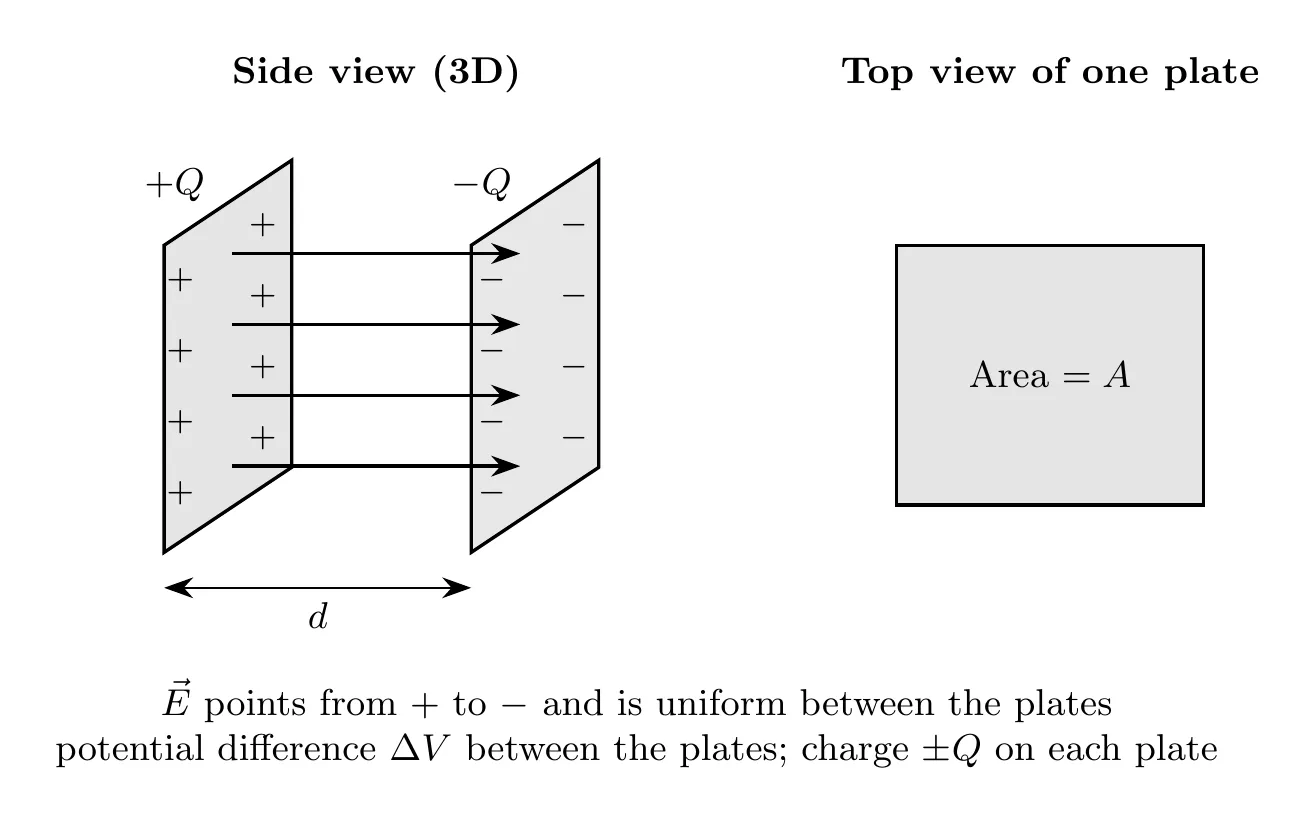
The main features:
- The electric field between the plates is uniform, meaning parallel, evenly spaced field lines.
- Edge effects usually get ignored in AP Physics problems.
- The plates carry equal and opposite charges, and that’s what makes the field.
Capacitance
Capacitance is a property of the capacitor that links the charge it stores to the potential difference across its plates.
The Definition
where:
- = capacitance (F, farads).
- = magnitude of the charge on each plate (C).
- = potential difference between the plates (V).
Units:
Named for Michael Faraday, who did foundational work in electromagnetism.
What it means: capacitance measures the capacity to store charge at a given voltage. Higher capacitance means you can pack in more charge without raising the voltage.
Capacitance of a Parallel Plate Capacitor
The capacitance depends only on the capacitor’s geometry and the material between the plates:
where:
- (kappa) = dielectric constant of whatever’s between the plates (dimensionless).
- C²/(N·m²) = permittivity of free space.
- = area of one plate (m²).
- = separation between the plates (m).
For air-filled capacitors, , so:
What Changes the Capacitance
Reading off :
Change | Effect on C | Why |
Increase the area | goes up | More room to store charge |
Decrease the distance | goes up | Closer plates interact more strongly |
Insert a dielectric () | goes up | The material boosts charge storage |
The key point: capacitance depends ONLY on geometry and materials, NOT on how much charge or voltage you put on it.
Finding Any Capacitance: The Recipe
Every capacitance on the AP exam comes from the same four steps:
- Put on one conductor and on the other.
- Use Gauss’s law to find in the gap.
- Integrate to get the potential difference, (the magnitude is all you need).
- Divide: . The always cancels, which is why depends only on geometry and materials.
Parallel plates: is uniform (see below), so and .
Spherical Capacitors
Two concentric conducting spheres: an inner sphere of radius with charge , and an outer shell of radius with charge . A Gaussian sphere of radius between them () encloses only , so the field is the same as a point charge’s:
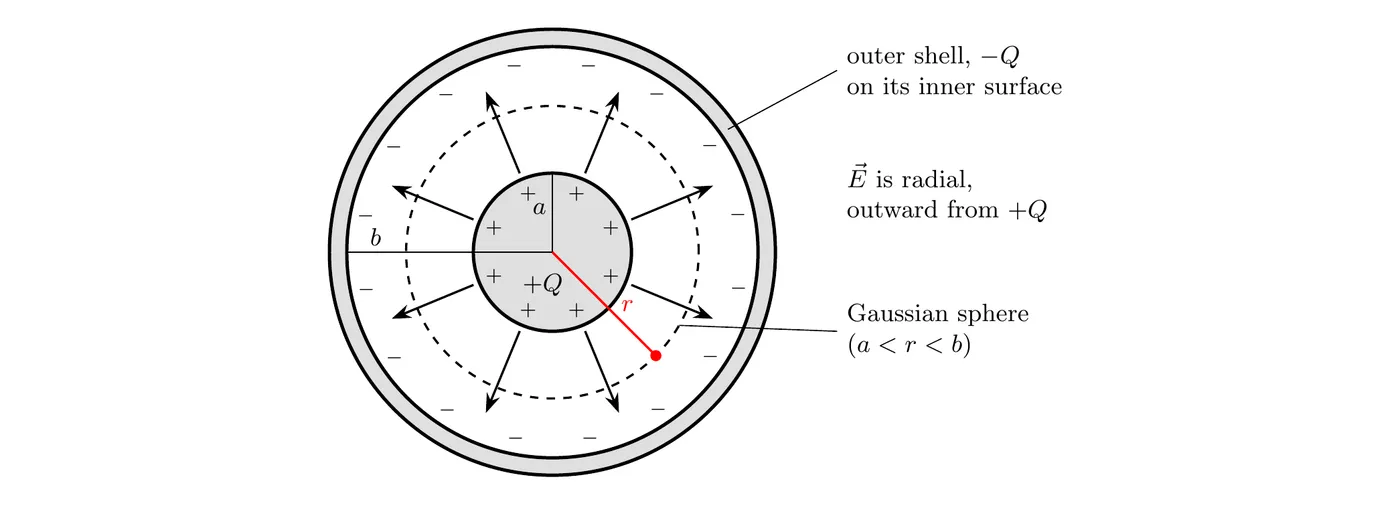
Integrate from the outer shell in to the inner sphere to find how much higher the inner sphere’s potential is:
Sanity checks: if the gap is tiny ( and ), this becomes , the parallel-plate result. If the outer shell moves out to infinity (), it becomes , the capacitance of a single isolated sphere.
Example: a spherical capacitor has cm and cm:
Cylindrical (Coaxial) Capacitors
Same recipe with a Gaussian cylinder. For an inner cylinder of radius and an outer cylindrical shell of radius , both of length , the field in the gap is , and integrating from to gives:
The full derivation (with a dielectric filling the gap) is worked out on the 3.4 Dielectrics page; with air in the gap, just set . These three shapes (parallel plates, concentric spheres, and coaxial cylinders) are the only ones the AP exam asks you to analyze with numbers or equations.
Electric Field in a Capacitor
The field between the plates is uniform, and you can get it two equivalent ways.
Method 1: From the Charge
Method 2: From the Surface Charge Density
where is the surface charge density.
Where it comes from (Gauss’s Law):
Apply Gauss’s Law to a flat conducting plate:
Solve for :
That’s the pillbox from 3.1: one end of the Gaussian cylinder sits inside the metal plate, where , and the other end sits in the gap. You can also get it from Gauss’s law plus superposition, which also explains why there’s no field outside the plates.
Step 1: one charged sheet. Topic 1.6 (Planar Symmetry) used a pillbox that pokes through a single large sheet to show that the sheet makes a uniform field of on both sides, pointing away from it for positive and toward it for negative .
Step 2: add the two plates. The positive plate’s field points away from it, and the negative plate’s field points toward it, each with magnitude :
- Between the plates: both fields point from to , so they add: .
- Outside the plates (either side): the two fields point opposite ways and cancel: .
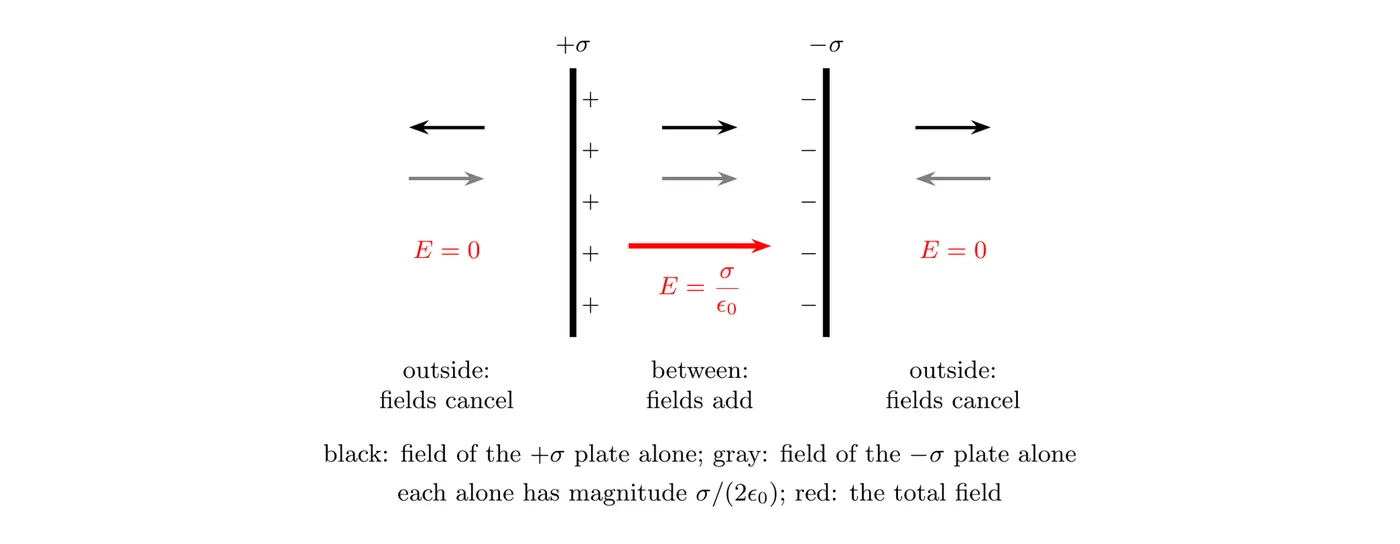
So , directly proportional to the surface charge density on either plate. Double the charge on the plates and you double the field.
Near the edges the field lines bulge outward (called fringing), so the field isn’t uniform there. The uniform-field result works when the plate separation is much smaller than the plates themselves, which is the usual AP assumption.
Relationship to Voltage
The potential difference between the plates connects to the field by:
which comes from applied to a uniform field.
Charged Particles Between the Plates
Because the field between the plates is uniform, a charged particle there feels a constant force , so it has a constant acceleration . That’s the same situation as a ball thrown near Earth’s surface, with playing the role of :
- Along the plates (perpendicular to ), there’s no force, so that velocity component stays constant.
- Across the plates (parallel to ), the particle speeds up or slows down at a constant rate.
- The path is a parabola, bending toward the negative plate for a positive charge and toward the positive plate for a negative charge.
For an electron or proton, gravity is tiny next to the electric force, so ignore it. Example Problem 3 below works one out.
Energy Stored in a Capacitor
A charged capacitor holds electric potential energy, which is basically the work it took to pull the charges apart and park them on the plates.
The Energy Formulas
There are three equivalent ways to write it:
Where the other forms come from:
Start with .
Form 2: substitute :
Form 3: substitute :
Which one should you use?
- If you know and , use .
- If you know and , use .
- If you know and , use .
Where the ½ Comes From
The stored energy equals the work an external force does to separate the charge, moving it bit by bit from one plate to the other. The catch is that the voltage isn’t constant while you do it. When the capacitor holds charge , the voltage is , so moving the next tiny bit takes work . Add it all up from empty () to full ():
On a graph of vs. , that integral is the area under the line. The line is straight with slope , so the area is a triangle, . The first bits of charge cross almost no voltage and the last bits cross the full , so on average each bit crosses half the final voltage. That’s the ½.
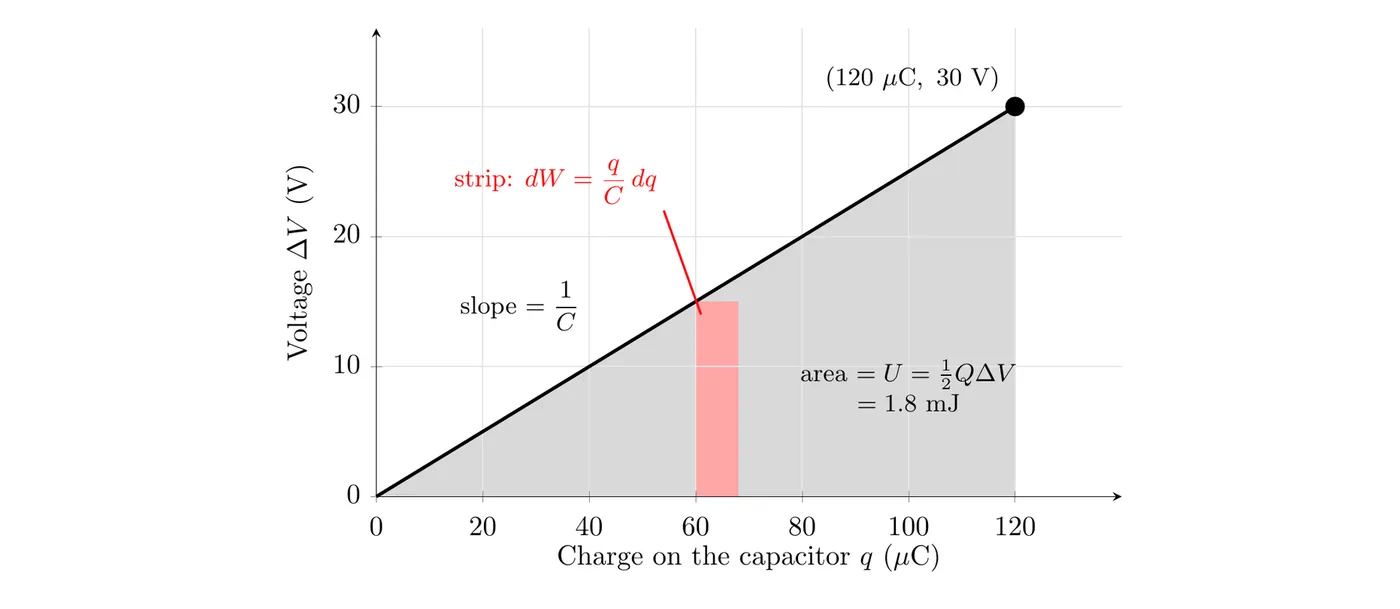
Example: a 4.0 μF capacitor is charged to 30 V. The charge is C, and the stored energy is J, the shaded area in the graph. A battery that charges it does J of work, twice what’s stored. The other half becomes thermal energy in the wires and resistors while the capacitor charges (more on that in RC circuits).
Example Problem 1: Circular Parallel Plate Capacitor
Problem:
A capacitor has two circular parallel plates of radius separated by distance . Its capacitance is .
What would the capacitance be if:
(a) The radius doubles to ?
(b) The distance is cut in half to ?
(c) You do both at once?
Give your answers in terms of .
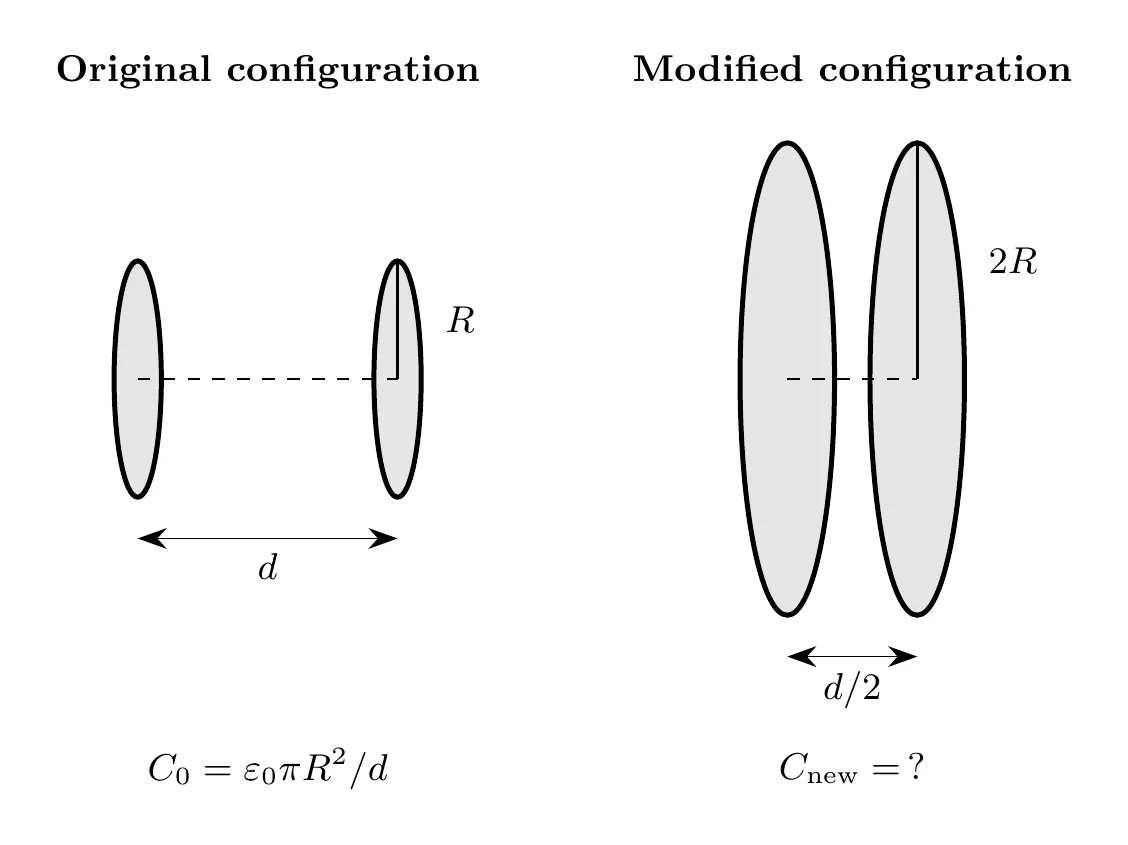
Solution
Method 1: just substitute
The general capacitance formula:
For circular plates, , so:
(a) Radius doubled to 2R, distance unchanged
Answer (a): doubling the radius multiplies the capacitance by 4.
(b) Distance halved to d/2, radius unchanged
Answer (b): halving the distance multiplies the capacitance by 2.
(c) Both changes: radius to 2R and distance to d/2
Answer (c): doing both multiplies the capacitance by 8.
Method 2: the factor-of-one trick
Here’s a faster route. Just figure out what changed and by what factor.
Starting from :
- is constant, so factor of 1.
- is constant, so factor of 1.
- , but it’s squared, so factor of .
- , and it’s in the denominator, so factor of .
Multiply them together:
Same answer, way less work.
Example Problem 2: Energy and Charge Calculations
Problem:
A parallel plate capacitor has capacitance μF and gets charged up to V.
Find:
(a) The charge on each plate.
(b) The energy stored.
(c) The electric field, if the plates are mm apart.
Solution
(a) Charge on Each Plate
Straight from the definition of capacitance:
Answer (a): μC on each plate, one positive and one negative.
(b) Energy Stored
We know and , so use :
Answer (b): J.
(c) Electric Field
Use :
Convert the distance: mm m.
Answer (c): V/m.
Example Problem 3: An Electron Between the Plates
Problem:
An electron enters the gap of a parallel-plate capacitor at m/s, moving parallel to the plates and midway between them. The plates are 4.0 cm long and 1.0 cm apart, with a 45 V potential difference, and the top plate is positive.
(a) Find the electron’s acceleration.
(b) How far has it been deflected when it leaves the plates? Does it hit a plate?
(c) In what direction is it moving as it leaves?
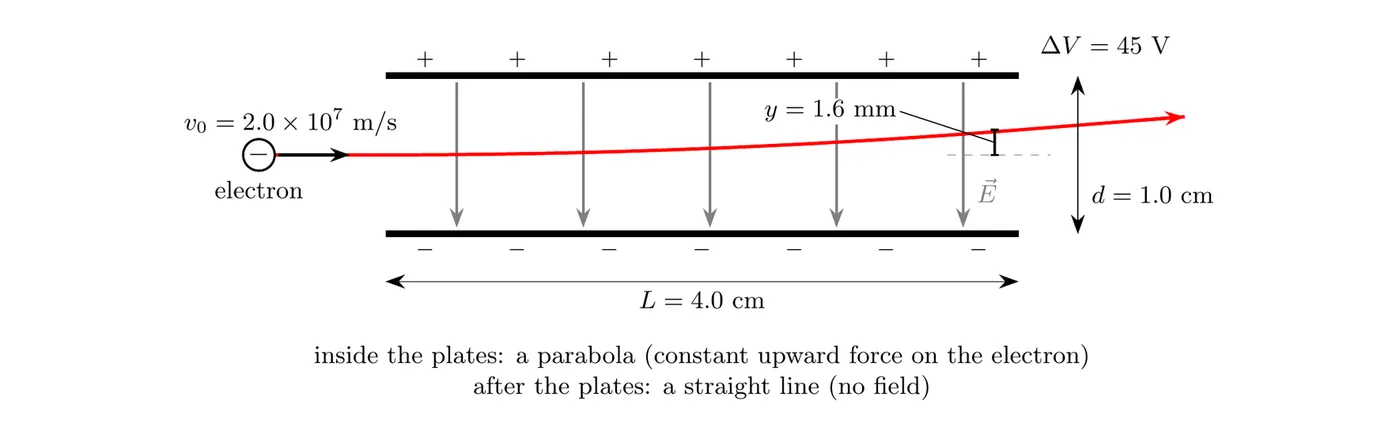
Solution
(a) The field is uniform: V/m, pointing down (from the positive top plate to the negative bottom plate). The electron is negative, so the force on it points up, toward the positive plate. Gravity’s 10 m/s² is nothing next to this, so ignore it:
(b) Treat it like a horizontally launched projectile. Along the plates there’s no force, so the time between the plates is s. Across the plates it starts with zero velocity and has constant acceleration:
Answer (b): it’s deflected 1.6 mm upward. It started 5.0 mm from each plate, so it misses the top plate and leaves the gap.
(c) The velocity component across the plates is m/s, so:
Once the electron leaves the plates, where the field is zero, it keeps going in a straight line at that angle.
Proportionality Relationships
Knowing how the variables lean on each other lets you solve problems fast.
For Capacitance:
For Energy: Three Forms
From :
From :
Important: whether energy goes up or down when changes depends entirely on what’s being held constant, charge or voltage.
Summary of Key Formulas
Quantity | Formula | Units |
Capacitance (definition) | F (farads) | |
Capacitance (geometry) | F | |
Electric field | V/m or N/C | |
Voltage-field relation | V | |
Energy (form 1) | J | |
Energy (form 2) | J | |
Energy (form 3) | J |
Common Mistakes
- Confusing capacitance with charge or voltage. Capacitance is a fixed property baked into the geometry. Changing or doesn’t change it, unless you physically rebuild the capacitor.
- Forgetting to square the radius when the area changes. Double the radius and the area goes up by a factor of 4, not 2, because . Always square the geometric dimensions that show up in area formulas.
- Getting the energy proportionality backwards. Whether rises or falls when changes depends on what’s held fixed. Constant voltage means . Constant charge means . Know your constraint.
- Reaching for the wrong energy formula. Pick the one that matches what you actually know. Don’t force when you only have and . Use instead.
- Unit conversion slip-ups. Always get everything into SI: cm to m, mm to m, μF to F, kV to V. Mixed units are the single most common source of numerical errors in capacitor problems.