

5.2 - Magnetism and Moving Charges
Introduction
Moving charged particles create magnetic fields, and they also feel forces when they move through magnetic fields. This interplay between charge, motion, and magnetism is fundamental to electromagnetism.
The key principle: a single moving charged object produces a magnetic field that depends on:
- The velocity of the charge.
- The distance from the charge to the observation point.
- The direction, which is perpendicular to both the velocity and position vectors.
Magnetic Field of a Moving Charge
A single charged object moving with velocity creates a magnetic field around it. (A charge at rest creates no magnetic field at all.) The field comes from the Biot-Savart Law (Topic 5.3) applied to one charge: a current element is just moving charge, , so for a single charge you swap for :
where:
- = charge of the moving object (C)
- = its velocity (m/s)
- = distance from the charge to the point where you want the field (m)
- = unit vector pointing from the charge to that point
This one isn’t on the AP equation sheet, but it’s the sheet’s with replaced by . Its magnitude is
where is the angle between and . What it tells you:
- Distance: , so the field weakens quickly as you move away.
- Speed: . A faster charge makes a stronger field.
- Direction: is perpendicular to both and . Point your right thumb along , and your fingers curl the way circles around the charge’s line of motion. For a negative charge, flip the direction.
- Angle: is largest when and are perpendicular (), and it’s zero straight ahead of or behind the charge ( or ).
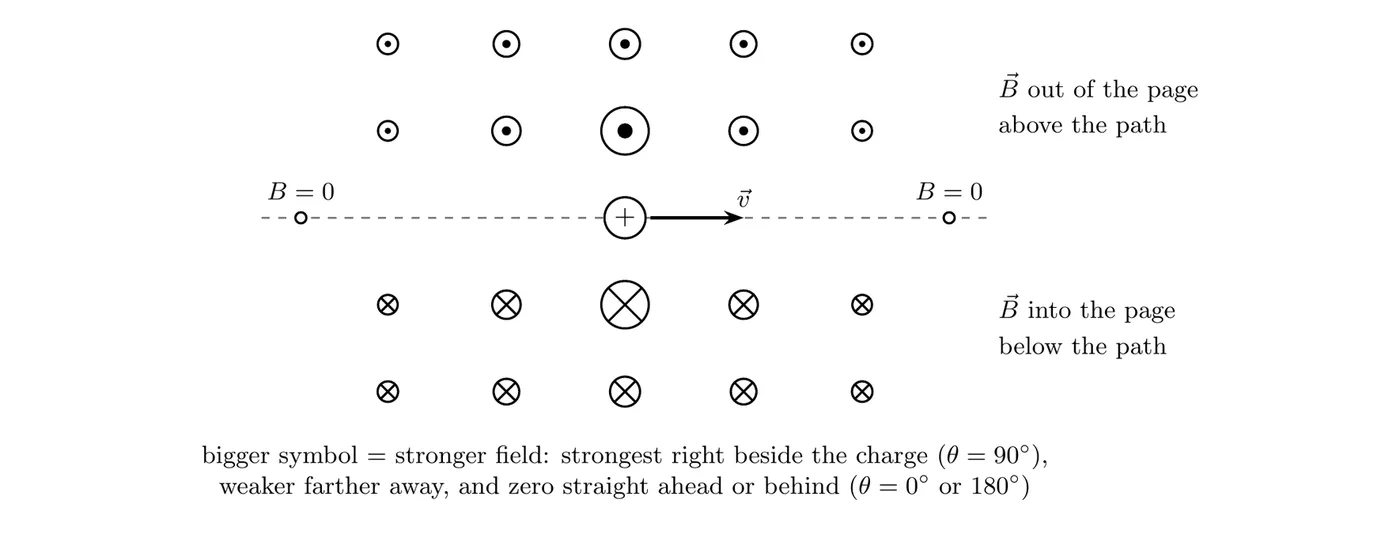
Example. A proton moves to the right at m/s. Find the magnetic field it creates at a point m directly above it (about the width of an atom). Then find the field at a point the same distance away, along a line 30° from the proton’s direction of motion.
Directly above, . Use T·m/A:
Direction: points right () and points up (), so points along , out of the page.
At 30°, only changes: T. Straight ahead of the proton (), the field is zero.
The physical read: 3.2 T is a strong field, but only because the point is so close. At 1.0 mm from the proton, is times bigger, so is times smaller ( T). A single charge’s field only matters up close. A wire makes a useful field because it has enormous numbers of charges moving together.
Magnetic Force on a Charged Particle
The Lorentz Force Law (Magnetic Part)
When a charged particle moves through a magnetic field, it feels a force:
where:
- = magnetic force on the particle (N)
- = charge of the particle (C)
- = velocity of the particle (m/s)
- = magnetic field strength (T, tesla)
- = cross product
The key observation: this is a cross product, not a dot product. The force is perpendicular to both the velocity and the magnetic field.
Magnitude of the Magnetic Force
where is the angle between and .
Special cases:
- Maximum force (): , with the velocity perpendicular to the field.
- No force ( or ): , with the velocity parallel or antiparallel to the field.
Important: for a magnetic force to exist at all, the particle has to be moving, and its velocity needs a component perpendicular to the magnetic field.
Example: Using the Cross Product
Problem: A proton moves with velocity through a uniform magnetic field . Find the magnetic force on it. Then find the force on an electron with the same velocity.
Use with and ( points out of the page when points right and points up):
The -part of is parallel to , so it adds nothing to the force. Only the part of perpendicular to counts. Check with the magnitude form: T at from , so N. Same answer.
Electron: same velocity and field, but C, so the force flips: , into the page.
Right-Hand Rules
To find the direction of the magnetic force, use a right-hand rule. There are two common versions.
Method 1: Palm Rule
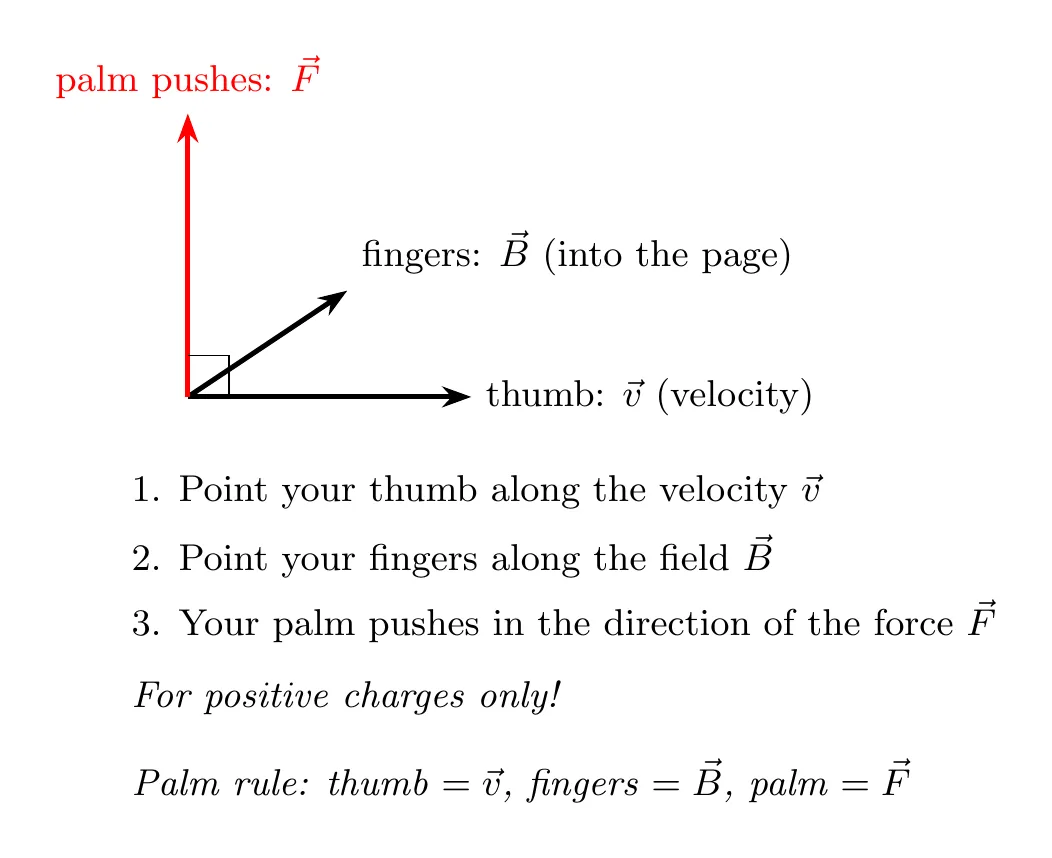
The steps:
1. Point your thumb in the direction of the velocity ().
2. Point your fingers in the direction of the magnetic field ().
3. Your palm pushes in the direction of the force ().
Method 2: Three-Finger Rule
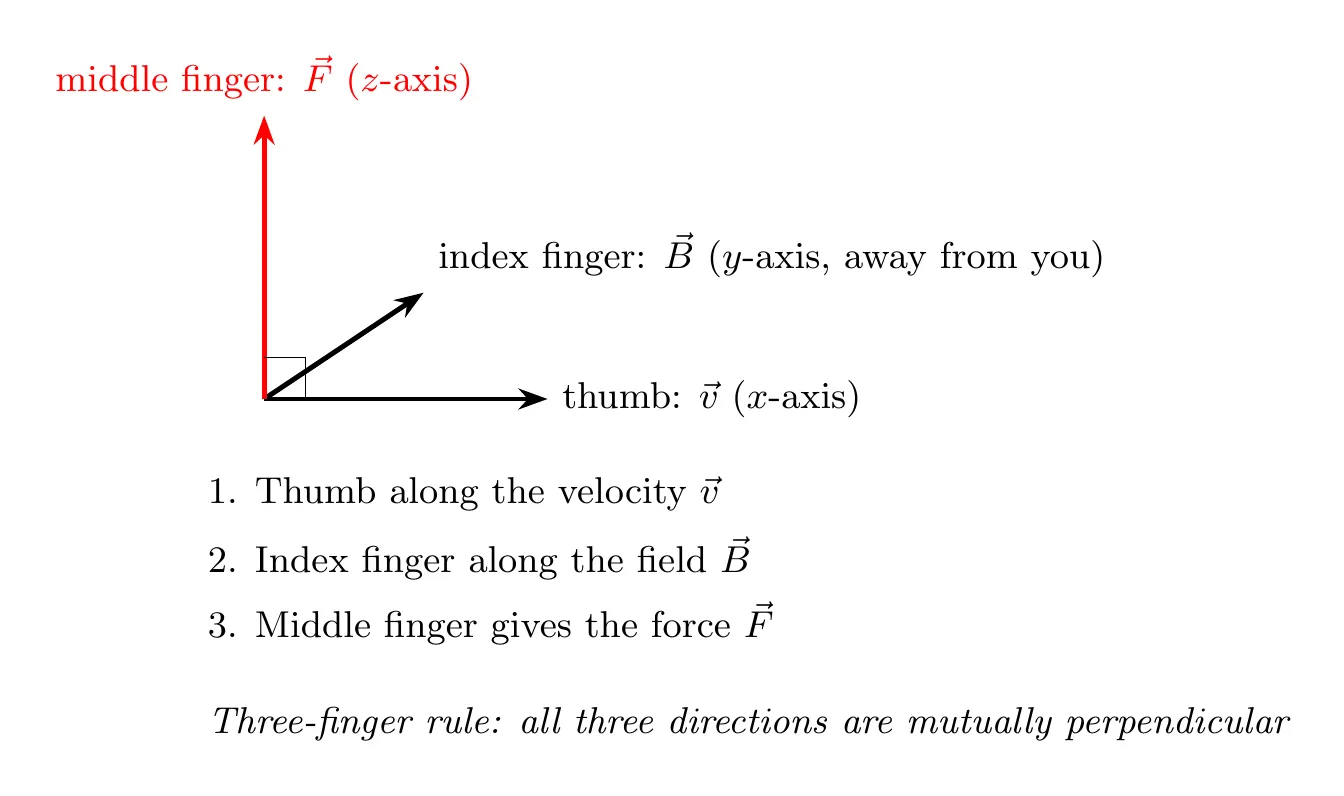
The steps:
1. Point your thumb in the direction of the velocity ().
2. Point your index finger in the direction of the magnetic field ().
3. Your middle finger points in the direction of the force ().
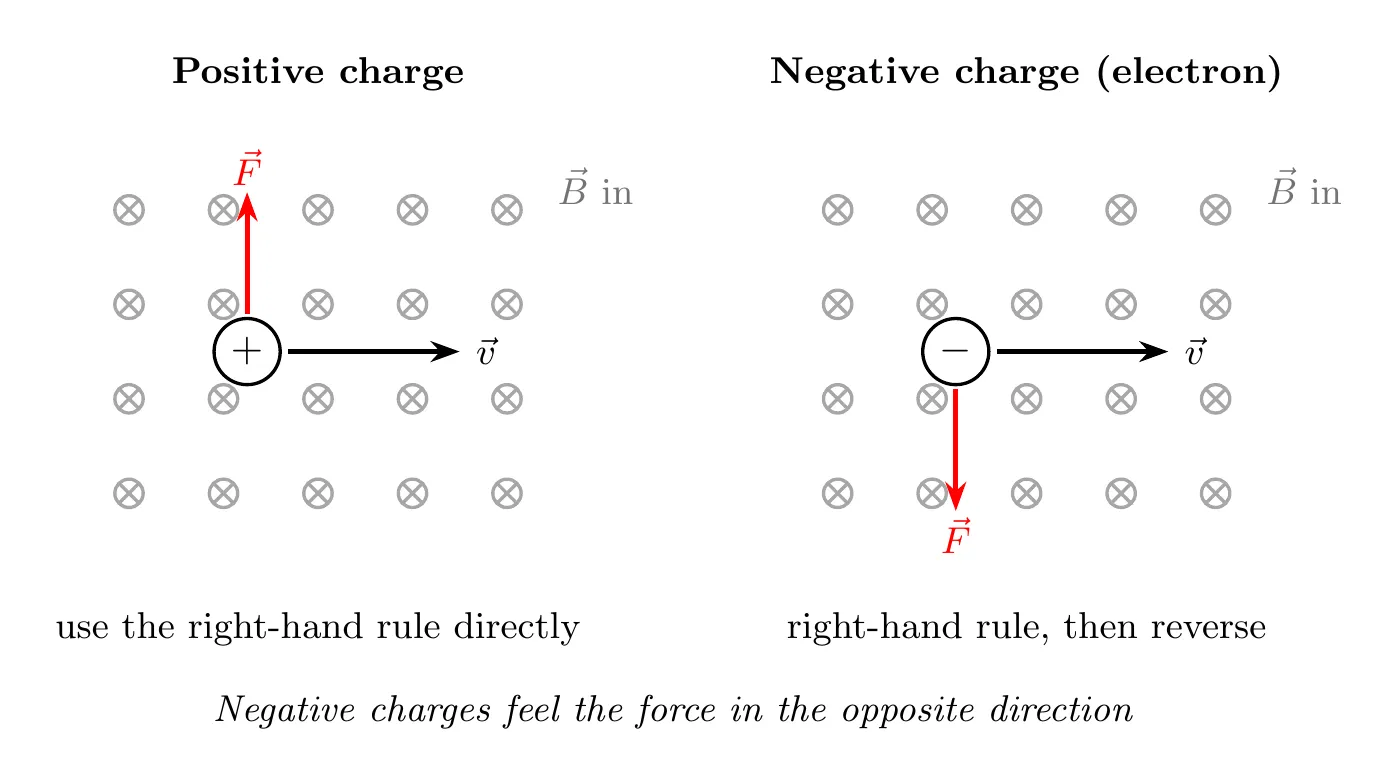
For Negative Charges
A critical modification: the right-hand rules give the force direction for positive charges.
For negative charges (like electrons):
- Apply the right-hand rule.
- Then reverse the direction, flipping it 180°.
Why? The negative sign in flips the force direction when .
3D Notation: Into and Out of the Page
Magnetic fields often point perpendicular to the plane of a diagram, so we use special symbols for that.
Symbols
⊙ (circle with a dot): the field comes out of the page, toward you. Think of looking at the tip of an arrow coming at you.
⊗ (circle with an X): the field goes into the page, away from you. Think of looking at the tail feathers of an arrow flying away.
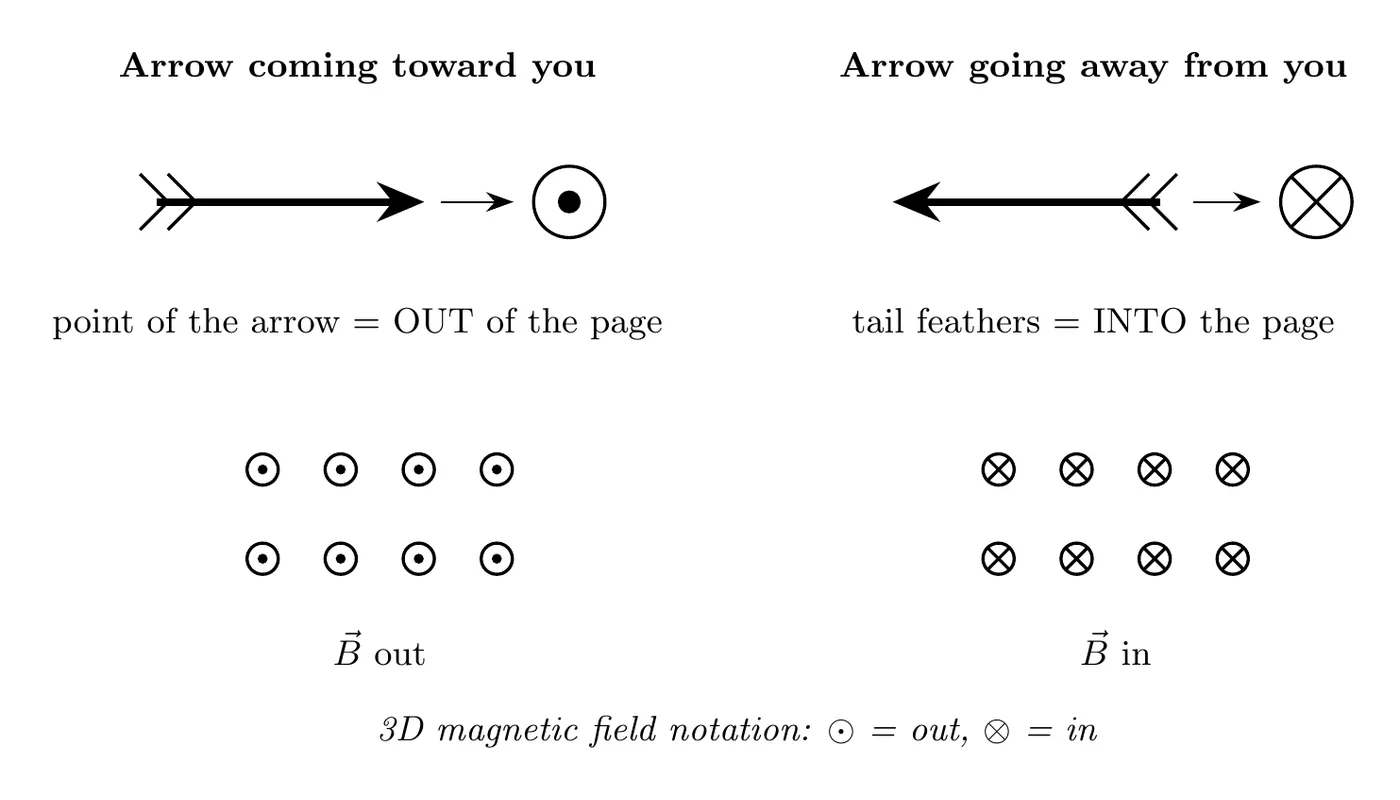
A memory aid:
- Dot = the arrow point, a sharp tip coming at you.
- Cross = the arrow fletching, the X pattern you see from behind.
Circular Motion in Magnetic Fields
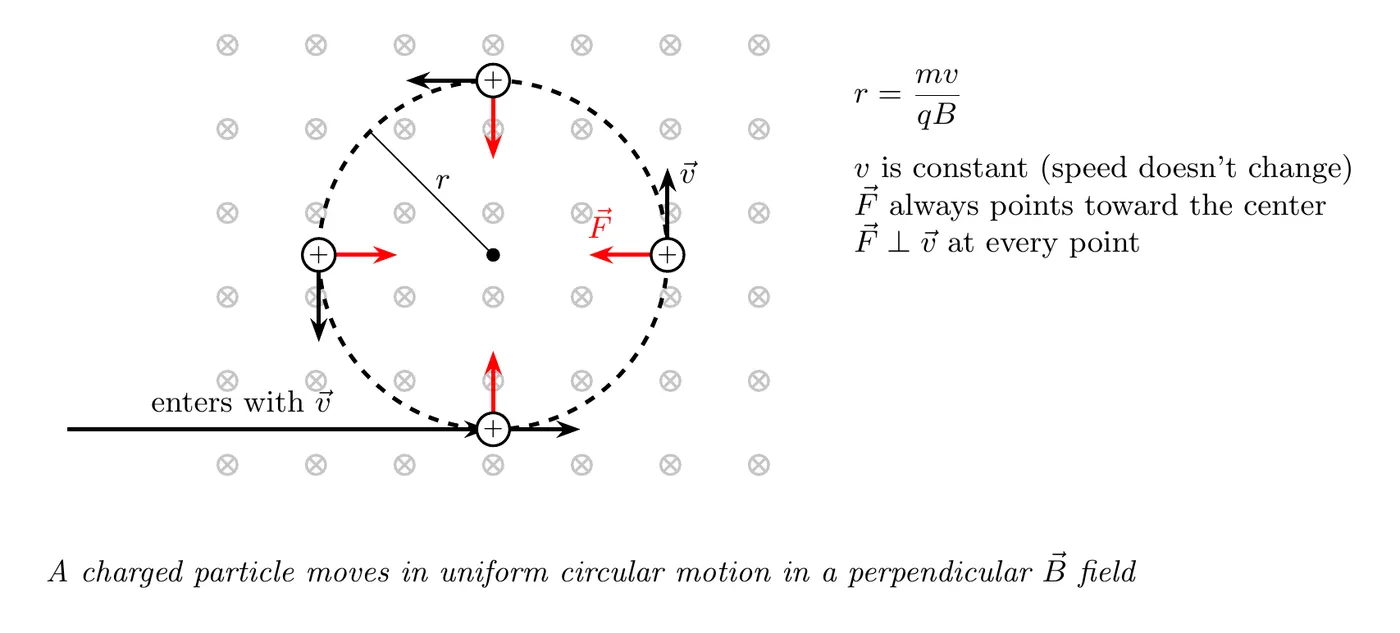
When a charged particle enters a uniform magnetic field perpendicular to its velocity, it travels in a circular path.
Why Circular Motion?
The magnetic force is always perpendicular to the velocity, which means:
- It does no work on the particle, since work needs a force component parallel to the displacement.
- The speed stays constant.
- Only the direction changes.
- The result is uniform circular motion.
The Derivation
The magnetic force supplies the centripetal force for circular motion:
Solving for the radius:
That’s the radius of curvature of the particle’s path.
Key Relationships
From , you can derive several useful forms.
Radius of the path:
Speed:
Magnetic field strength:
Momentum:
Period of revolution:
An important insight: the period is independent of both speed and radius. Every particle with the same ratio has the same period in a given field.
Example. A proton ( kg) moves at m/s perpendicular to a uniform 0.50 T field. Find the radius of its path and its period.
What if the proton goes twice as fast? , so the radius doubles to 17 cm. The period stays s, because the proton covers twice the distance at twice the speed. That’s why a cyclotron works: the particles keep the same timing as they speed up.
If the velocity isn’t perpendicular to the field: split into a part along and a part perpendicular to it. The perpendicular part makes the circle (use in ). The part along feels no force, so it carries the particle along the field at a constant speed. Put together, the path is a helix (a spiral).
Combined Electric and Magnetic Fields
When both electric and magnetic fields are present, a charged particle feels independent forces from each:
That’s the complete Lorentz Force Law.
Velocity Selector
A practical application uses crossed electric and magnetic fields to pick out particles with a specific velocity.
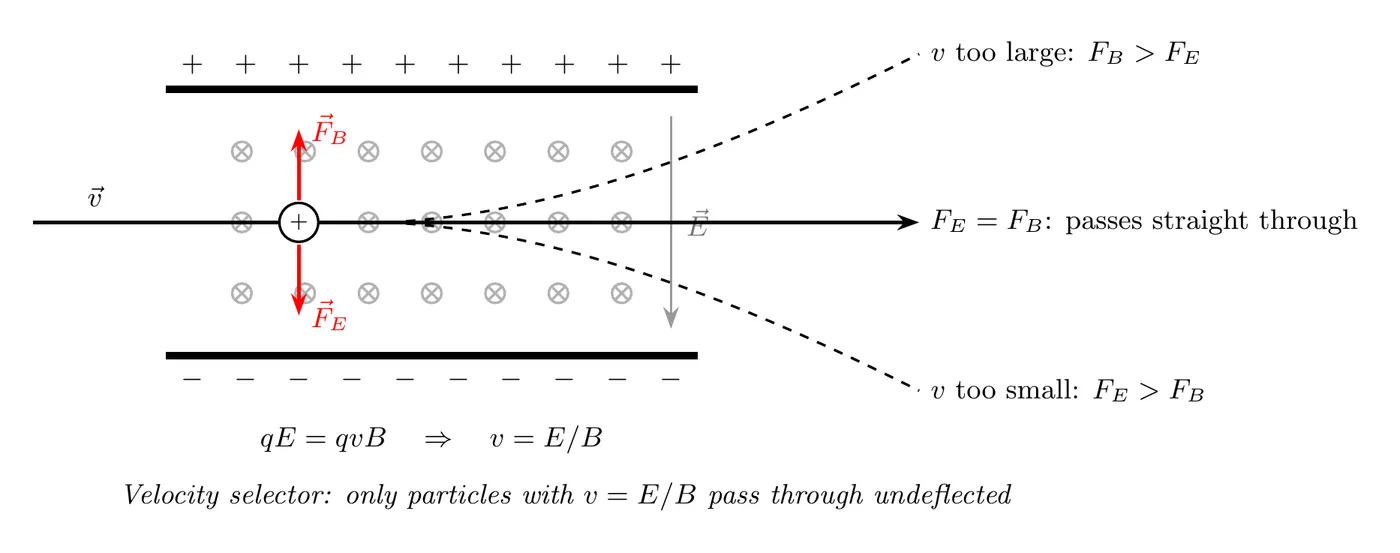
The condition for no deflection:
Only particles with that specific velocity get through without deflection. Faster or slower particles get deflected and filtered out.
The Hall Effect
The Hall effect describes the potential difference that appears across a conductor when it carries current in the presence of a perpendicular magnetic field.
The Physical Process
- Current flows through a conductor, meaning charges are moving.
- An external magnetic field is applied perpendicular to the current.
- The magnetic force pushes the charge carriers to one side.
- That charge buildup creates an electric field (the Hall field).
- Equilibrium is reached when the electric force balances the magnetic force.
- A measurable voltage appears across the conductor (the Hall voltage).
Applications:
- Measuring magnetic field strength.
- Determining charge carrier density.
- Identifying the charge carrier type (positive or negative).
- Hall effect sensors in electronics.
Direction and Sign of the Hall Voltage
Only the part of perpendicular to the moving charges makes a Hall voltage. A field along the current pushes nothing sideways, so no charge piles up on either edge. In the strips below, the current is to the right and points into the page.
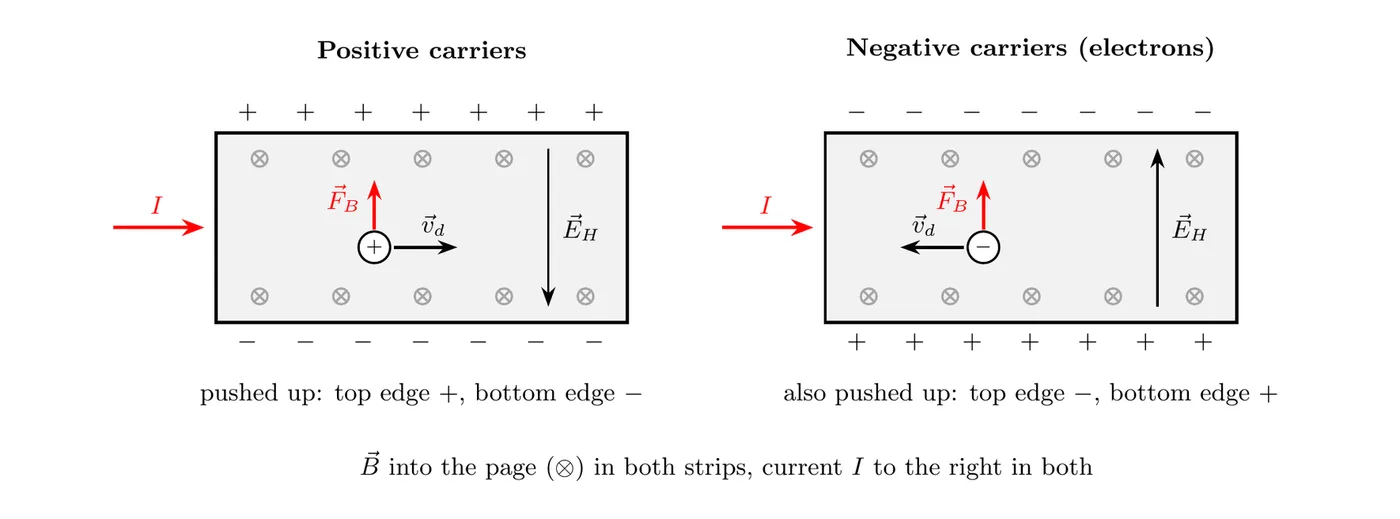
A current to the right could be positive carriers moving right or negative carriers moving left. Work out for each:
- Positive carriers moving right: , so they’re pushed up.
- Electrons moving left: both and flip sign, so the force still points up.
Either way, the carriers pile up on the top edge. If the top edge ends up positive, the carriers are positive. If it ends up negative, they’re electrons. That’s how the Hall effect identifies the sign of the charge carriers. In metals like copper, the top edge goes negative.
Example Problem: Mass Spectrometer
Problem: A mass spectrometer uses a uniform magnetic field of T perpendicular to the page. A potential difference V is applied across parallel plates L and K separated by a distance m, which acts as a velocity selector.
- Calculate the magnitude of the electric field between the plates.
- Calculate the speed of a particle that can pass between the plates without being deflected.
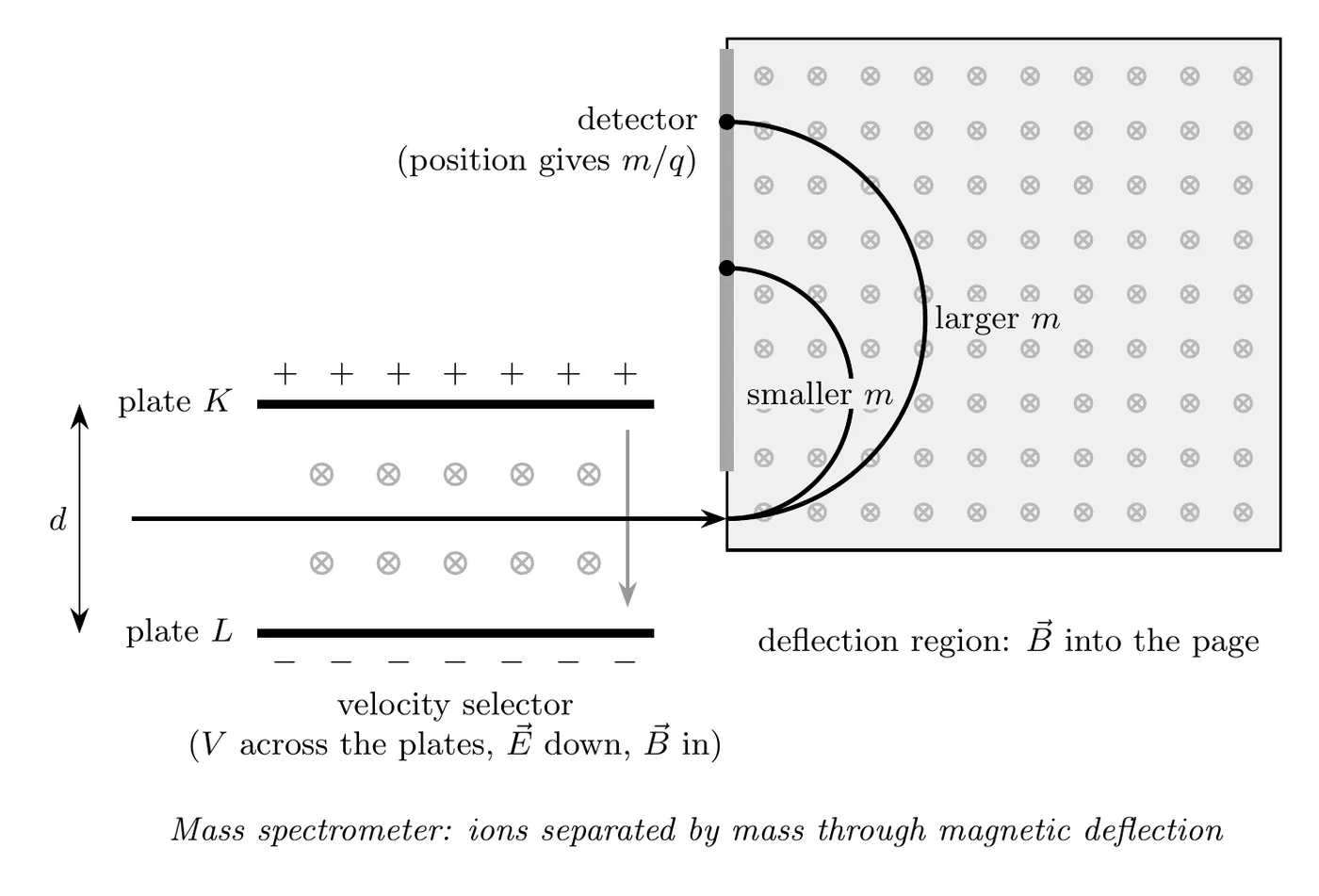
Solution
(a) The electric field between the plates
Use the relationship between voltage and electric field:
Answer (a): the electric field strength is N/C.
(b) The speed for no deflection
For a particle to pass through undeflected, the electric and magnetic forces have to balance:
The charges cancel:
Solve for velocity:
Answer (b): the speed is m/s.
The physical read:
- Only particles with this specific speed make it through the selector.
- They then enter the deflection region, where they curve based on their mass.
- Heavier particles (larger ) curve less, since .
- By measuring the radius, you determine the mass-to-charge ratio.
Applications of Magnetic Forces
1. Mass Spectrometry
- Separates ions by mass.
- Used in chemistry, biology, and forensics.
- Can identify unknown substances.
- Measures isotope abundances.
2. Particle Accelerators (Cyclotrons)
- Use magnetic fields to bend particle paths into circles.
- Accelerate particles to high energies.
- Research in nuclear and particle physics.
- Medical applications, like cancer treatment.
3. Cathode Ray Tubes (CRTs)
- Magnetic fields steer electron beams.
- Old TV and computer monitors.
- Older oscilloscopes use a CRT too, but they steer the beam with electric fields from deflection plates instead.
4. Electromagnetic Flow Meters
- Measure fluid flow rates.
- Use the same idea as the Hall effect: the field pushes positive and negative ions in a conducting fluid to opposite sides of the pipe, and the voltage across the pipe gives the flow speed.
- No moving parts.
5. Magnetic Particle Separation
- Separate magnetic particles from mixtures.
- Medical diagnostics.
- Environmental cleanup.
Summary of Key Formulas
Quantity | Formula | Notes |
Magnetic Force | Cross product | |
Force Magnitude | Maximum when | |
Circular Motion Radius | From | |
Velocity Selector | When | |
Period | Independent of and | |
Momentum | From circular motion |
Direction Rules Summary
Right-hand rule for force:
- Thumb: velocity direction ().
- Fingers: magnetic field direction ().
- Palm: force direction () for a positive charge.
For negative charges: apply the right-hand rule, then reverse the force direction.
3D notation:
- ⊙: out of the page.
- ⊗: into the page.
Common Mistakes
- Using your left hand instead of your right. Always use your RIGHT hand for right-hand rules. The left hand gives you the opposite, wrong direction.
- Forgetting to reverse for negative charges. The right-hand rule gives the force direction for positive charges. For electrons or other negative charges, you have to flip it 180°.
- Thinking magnetic force does work. The magnetic force is always perpendicular to the velocity, so it does ZERO work. It changes direction but not speed. Don’t apply the work-energy theorem to magnetic forces alone.
- Confusing the ⊙ and ⊗ symbols. Remember: dot = the arrow point coming at you (out), and X = the arrow tail feathers going away (in). Students flip these a lot.
- Forgetting θ in the force magnitude. The full formula is . Only when the velocity is perpendicular to the field () can you use directly. Parallel motion () gives zero force.