

5.1 - Magnetic Fields
Introduction to Magnetic Fields
A magnetic field is a vector field that determines the magnetic force on moving charges, electric currents, and magnetic materials. Like electric fields, magnetic fields can be represented visually and mathematically.
The key distinction from electric fields: magnetic field lines form closed loops, while electric field lines are open, starting on positive charges and ending on negative ones.
Magnetic Monopoles Do Not Exist
Unlike electric charges, which can be isolated as positive or negative, magnetic monopoles don’t exist in nature.
The fundamental principle: all magnetic materials have both a north pole and a south pole.
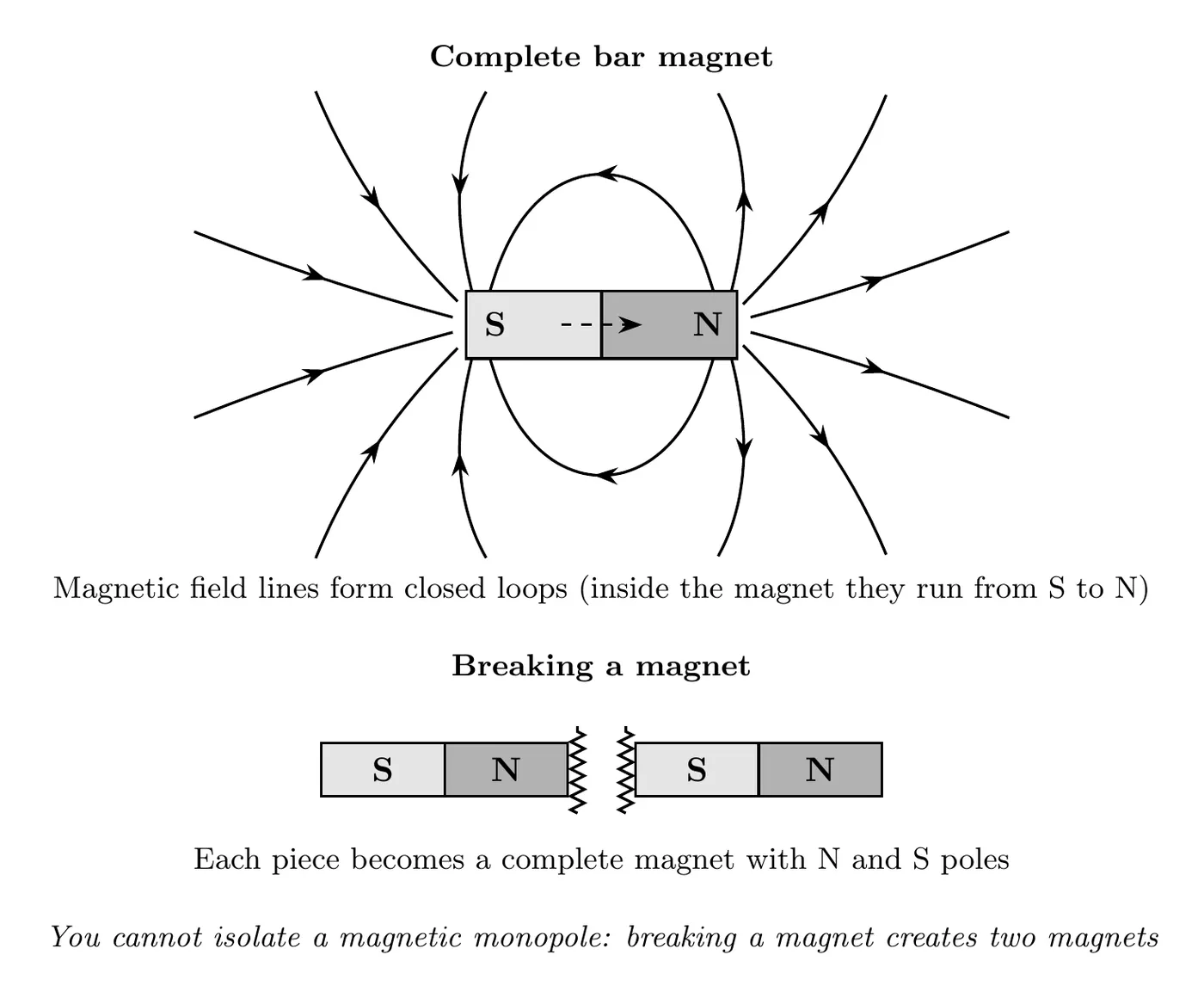
What happens when you break a magnet?
- The magnetic domains inside the material realign.
- Each piece becomes a complete magnet with both north and south poles.
- You can never get a piece with only north or only south.
Gauss’s Law for Magnetism
Gauss’s Law for Magnetism is the second of Maxwell’s four equations, and it mathematically expresses the non-existence of magnetic monopoles.
Mathematical Statement
where:
- = magnetic field vector (T, tesla)
- = infinitesimal area element vector
- = integral over a closed surface
The physical meaning: the total magnetic flux through any closed surface is zero. That’s because magnetic field lines form closed loops, so any field line entering the surface has to exit it too.
Example. A closed box sits next to a bar magnet. Magnetic flux of T·m² enters the box through its left face, and T·m² leaves through its right face. How much flux leaves through the other four faces combined?
Count flux leaving the box as positive and flux entering it as negative. Gauss’s Law for Magnetism says the total has to be zero:
So T·m² leaves through the other four faces. Every field line that goes into the box has to come back out somewhere. (Magnetic flux, the amount of field passing through a surface, gets its own topic in Unit 6.)
Comparison to Gauss’s Law for Electricity
Electric | Magnetic |
Field lines can start and end on charges | Field lines must form closed loops |
Monopoles exist (individual charges) | No monopoles exist |
Magnetic Field Lines
Magnetic fields can be visualized with field lines, also called flux lines.
Properties of Magnetic Field Lines
- They form closed loops. Lines emerge from the north pole, loop around, enter the south pole, and continue through the magnet back to north.
- Direction shows field direction. It’s defined as the direction a north pole would point if placed there.
- Density shows field strength. Closer lines mean a stronger field.
- They never cross. At any point, the field has a unique direction.
- Outside the magnet, N to S. Inside, S to N. That’s what completes the loop.
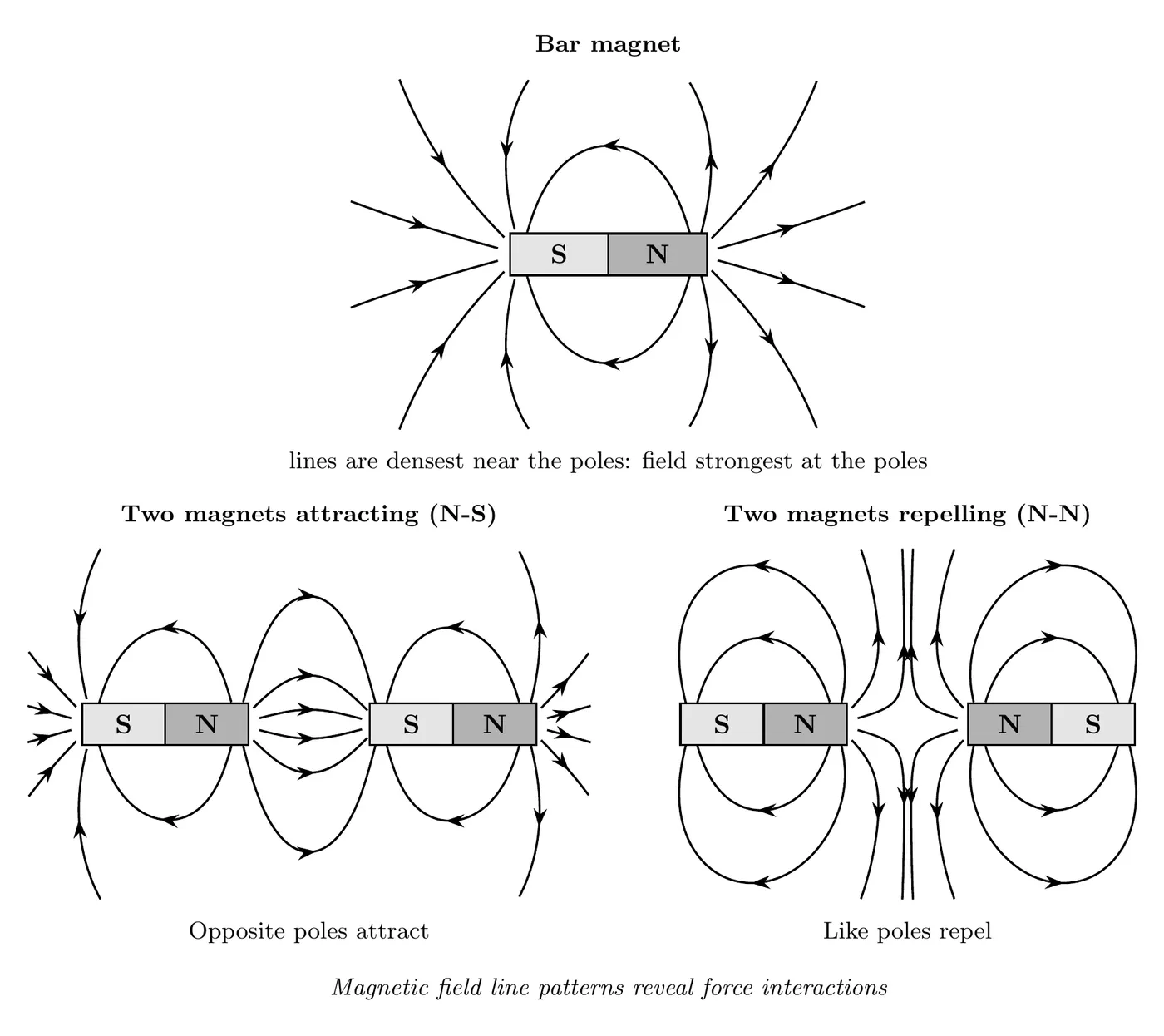
The rule:
- Opposite poles attract (N-S), and the field lines connect smoothly between them.
- Like poles repel (N-N or S-S), and the field lines bend away from each other.
Magnetic Dipoles
A magnetic dipole is a north pole and a south pole separated by some distance. All magnets are magnetic dipoles.
Where Magnetic Dipoles Come From
Magnetic dipoles come from the circular or rotational motion of electric charges.
The microscopic origin:
- Electrons orbiting atomic nuclei create tiny current loops.
- Electron spin creates intrinsic magnetic moments.
- In magnetic materials, all those tiny dipoles align to produce macroscopic magnetism.
Permanent and Induced Magnetism
Magnetism is a system property. One electron’s dipole is tiny, and in most materials the atomic dipoles point in random directions, so their fields cancel. A piece of material is only magnetic when a huge number of its dipoles line up the same way. That can happen in two ways:
- Permanent magnetism: the dipoles stay lined up on their own, even with no outside field. A bar magnet or a fridge magnet works this way.
- Induced magnetism: an outside field lines up the dipoles of an unmagnetized object, so the object becomes a magnet itself while it sits in that field.
Example. A steel paper clip hangs near the north pole of a bar magnet. The magnet’s field points away from its north pole, so the clip’s dipoles line up pointing away from the magnet too. That makes the end of the clip nearest the magnet a south pole. Opposite poles attract, so the clip gets pulled in. The clip is now a magnet itself, which is why it can hold up a second clip.
Behavior in an External Magnetic Field
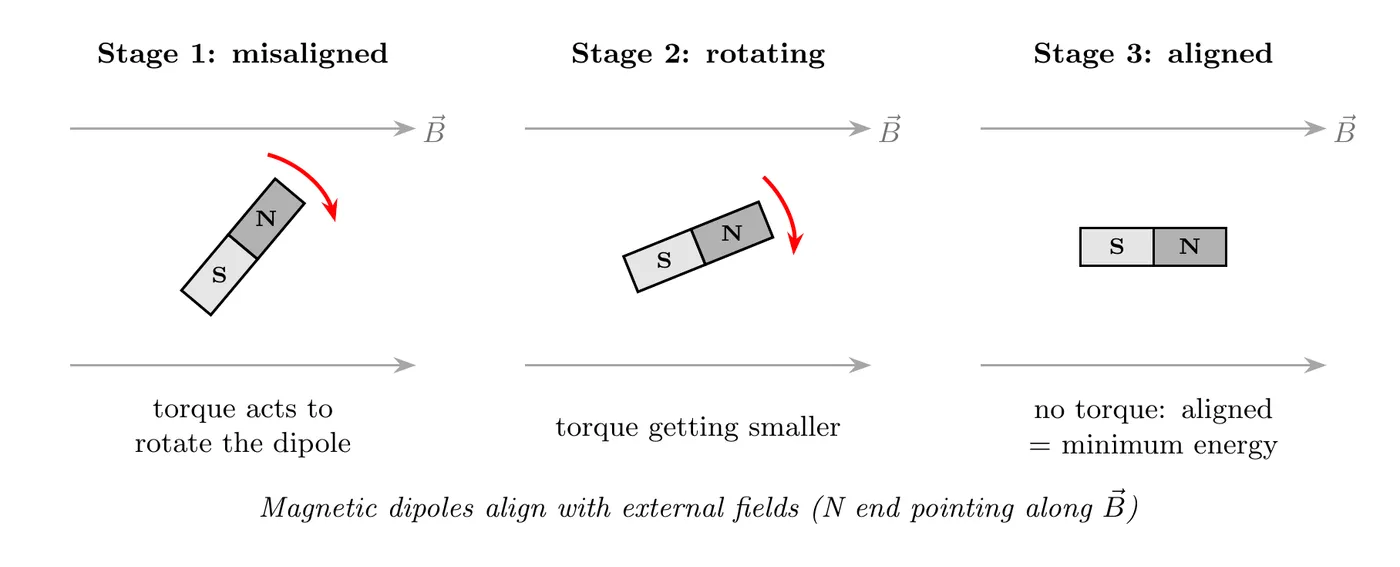
When you place a magnetic dipole in an external magnetic field:
1. Alignment: the dipole feels a torque that tends to align it with the external field.
2. North seeks south: the dipole’s north pole gets pulled toward the external field’s south pole.
3. Equilibrium: the energy is at a minimum when the dipole is aligned with the external field.
Dipole Field Strength and Distance
The field of a magnetic dipole gets weaker as you move away from it, and it drops off fast. Far from a small magnet or a current loop (several times its size away), the field along its axis falls off as . You’ll see where that comes from in Topic 5.3: the field on the axis of a current loop works out to far from the loop.
Example. A compass sits 10 cm from a small magnet, on the magnet’s axis, where the magnet’s field is 40 μT. The compass is moved to 20 cm. Doubling the distance cuts a field by :
That’s much weaker than Earth’s field (about 50 μT), so at 20 cm the compass mostly lines up with Earth’s field again.
Earth’s Magnetic Field
The Earth acts as a giant magnetic dipole, which is why compasses work.
Earth as a Magnet
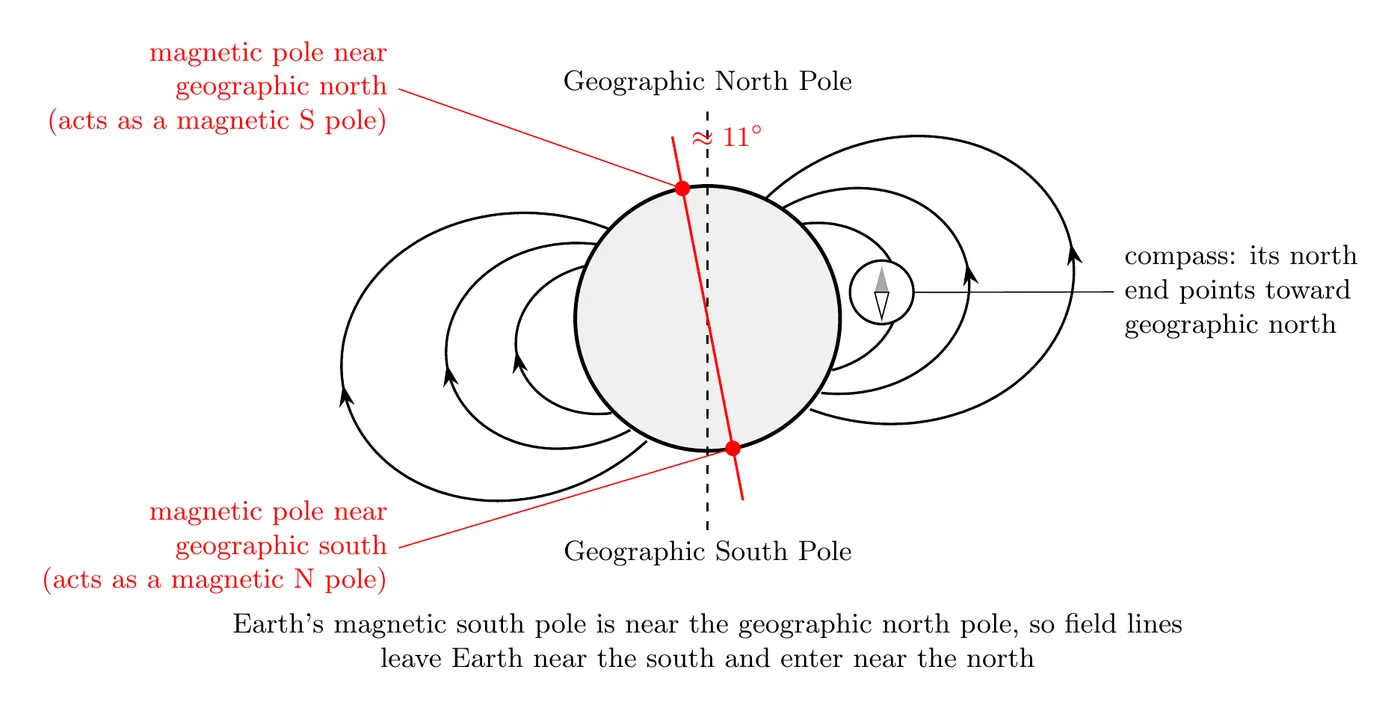
An important fact: Earth’s magnetic south pole sits near the geographic north pole. That’s exactly why the north end of a compass needle (which is a magnetic north pole) points toward geographic north. It’s attracted to Earth’s magnetic south pole located there.
Magnetic declination is the angle between geographic north and magnetic north. It varies with location and shifts slowly over time.
Magnetic Permeability
Magnetic permeability () is a material property that measures how much magnetization happens in response to an external magnetic field.
It’s analogous to electric permittivity () in electric fields.
Vacuum Permeability (μ₀)
The permeability of free space, also called vacuum permeability or the magnetic constant, is:
Or equivalently:
where:
- T = tesla (unit of magnetic field strength)
- A = ampere (unit of current)
- N = newton (unit of force)
This constant shows up in nearly every magnetic field equation you’ll meet in electromagnetism.
Material Permeability
For materials other than vacuum:
where is the relative permeability, a dimensionless number.
Types of Magnetic Materials
Material Type | Relative Permeability | Behavior |
Vacuum | Reference | |
Diamagnetic | (slightly) | Weakly repelled by magnets |
Paramagnetic | (slightly) | Weakly attracted to magnets |
Ferromagnetic | (much larger) | Strongly attracted, can be permanent magnets |
Examples:
- Diamagnetic: copper, water, most organic materials.
- Paramagnetic: aluminum, platinum, oxygen.
- Ferromagnetic: iron, nickel, cobalt.
What’s Happening Inside Each Type
A material’s magnetic behavior depends on what it’s made of, because its makeup decides how its atomic dipoles respond to an outside field.
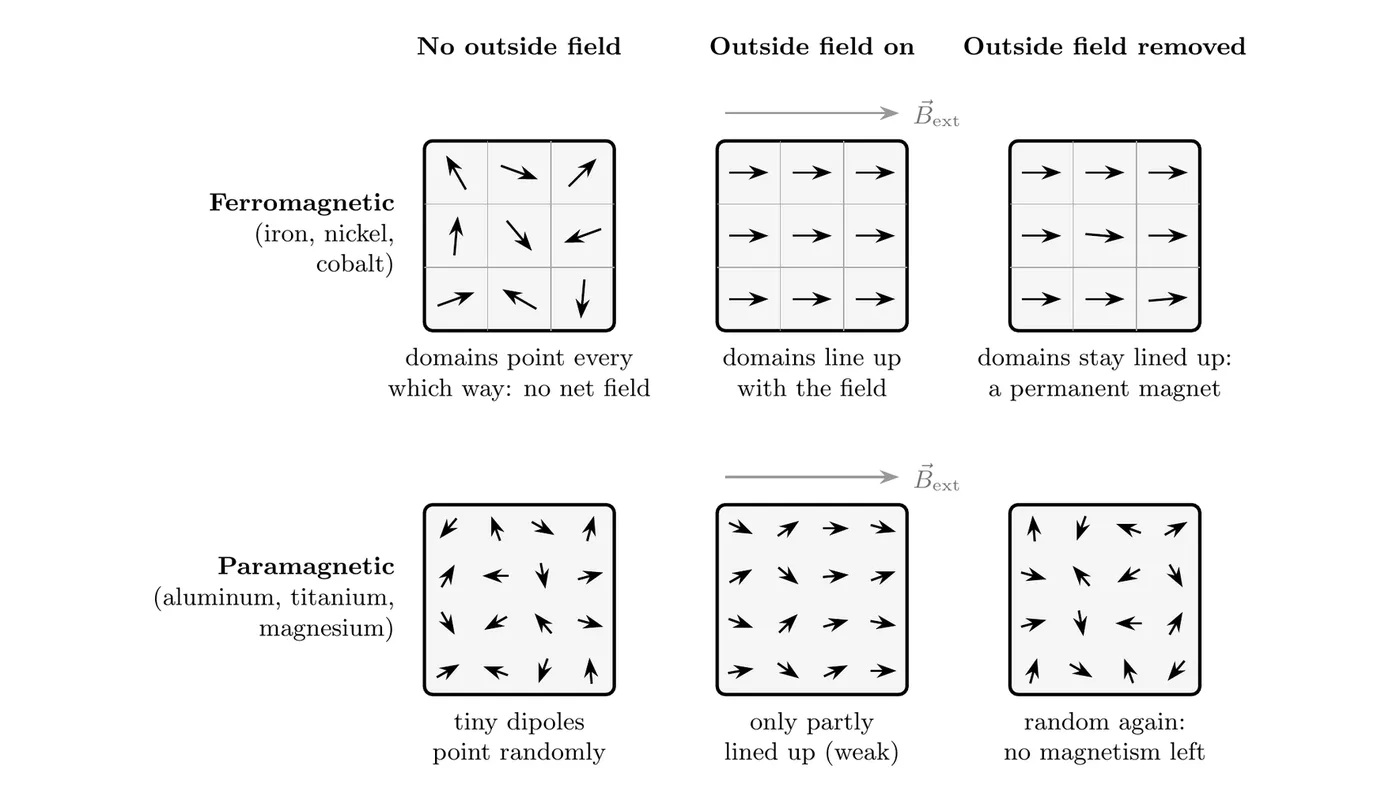
Ferromagnetic materials (iron, nickel, cobalt): neighboring atomic dipoles line up with each other in small regions called magnetic domains. In an unmagnetized piece of iron, the domains point every which way, so their fields cancel. An outside field lines the domains up: domains pointing along the field grow, and others turn toward it. A lot of that alignment stays after the field is removed, so the material can become a permanent magnet. (That’s how stroking a steel needle with a magnet magnetizes it.)
Paramagnetic materials (aluminum, titanium, magnesium): the material has tiny magnetic dipoles from its electrons, but they don’t lock together into domains. An outside field lines them up only partly, so these materials are weakly attracted to a magnet. Once the field is removed, the dipoles go back to random directions and don’t stay aligned.
Diamagnetism (copper, water, most organic materials): every material has this property. An outside field changes how the electrons move, which creates a weak alignment of the material’s dipole moments opposite the outside field. That’s why diamagnetic materials are weakly repelled. Paramagnetic and ferromagnetic materials have diamagnetism too, but their much stronger alignment along the field swamps it.
Permeability Isn’t a Fixed Number
Free space has one exact permeability, . A material’s permeability is different: it comes from the material’s makeup and how its atoms are arranged, and it isn’t a constant, even for one material. It changes with:
- Temperature: heat jostles the dipoles out of line. Iron stops being ferromagnetic above about 770°C (its Curie temperature) and acts paramagnetic.
- Strength of the outside field: once nearly all of iron’s domains are lined up, a stronger field can’t line up many more (the iron is saturated), so drops.
- Orientation: in many crystals, it’s easier to magnetize along some directions than others.
So the values in the table above are rough guides, not fixed constants.
Example. A long solenoid has 2000 turns per meter and carries 0.50 A. With air inside, use in (Topic 5.4):
Now fill the solenoid with an iron core whose relative permeability is about 400 at this current. Replace with , and the field becomes about T. That’s why electromagnets have iron cores. But turn the current way up and the iron saturates, so drops and the field stops growing in proportion to the current.
The Unit of Magnetic Field: Tesla
The SI unit of magnetic field strength is the tesla (T), named after Nikola Tesla.
Where the unit comes from: for a charge moving perpendicular to the field, , so and
(using 1 A = 1 C/s). A tesla is a big unit, which is why everyday fields are given in mT or μT.
Nikola Tesla (1856-1943) was a brilliant scientist and inventor who made fundamental contributions to electromagnetism, including:
- AC electrical systems.
- The Tesla coil (a high-voltage transformer).
- Wireless power transmission experiments.
- Radio technology development.
Magnetic Field Strengths in Context
Source | Approximate Field Strength |
Earth’s surface | about 50 μT (microtesla) |
Refrigerator magnet | about 5 mT (millitesla) |
MRI machine | 1.5 to 3 T |
Strongest lab magnets | about 45 T |
Neutron star surface | about 10⁸ T |
Visualizing Magnetic Fields
Field Vector Maps
Like electric fields, magnetic fields can be shown as vector field maps giving the direction and magnitude at various points.
How they work:
- Arrows show the field direction.
- Arrow length (or density) shows the field strength.
- Field lines connect regions of continuous field.
3D Representation Convention
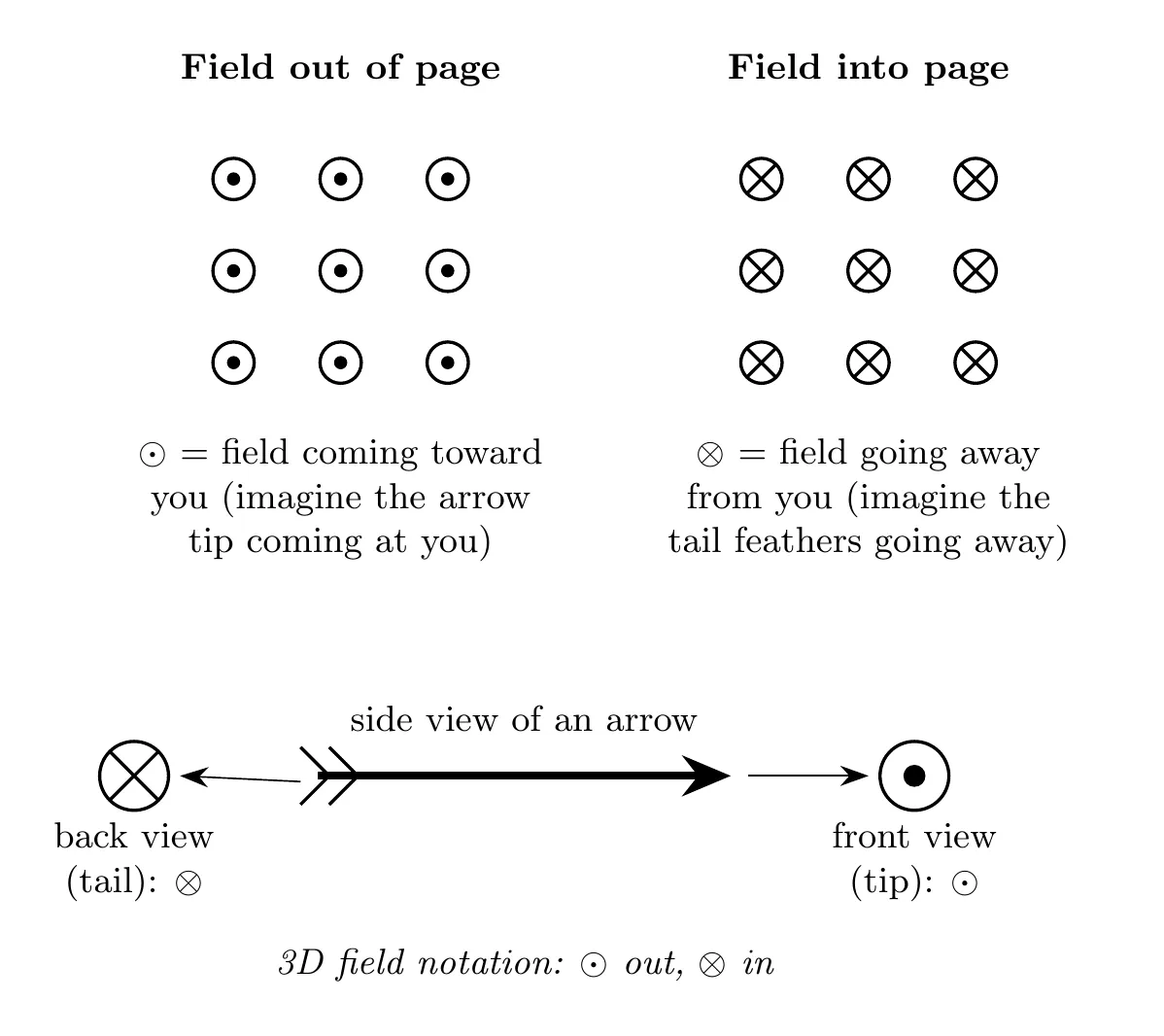
When magnetic field lines point perpendicular to the page:
Coming out of the page: ⊙ (a dot, like looking at the tip of an arrow).
Going into the page: ⊗ (a cross, like looking at the tail feathers of an arrow).
Maxwell’s Equations Preview
Gauss’s Law for Magnetism is the second of Maxwell’s four equations, which together completely describe all electromagnetic phenomena:
- Gauss’s Law (Electricity):
- Gauss’s Law (Magnetism):
- Faraday’s Law:
- Ampère-Maxwell Law:
We’ll pick up the remaining equations as we study electromagnetic induction and varying fields.
Key Concepts Summary
Fundamental Differences: Electric vs. Magnetic Fields
Property | Electric Field | Magnetic Field |
Sources | Charges (+ and −) | Moving charges (currents) |
Field lines | Start on +, end on − | Form closed loops |
Monopoles? | Yes (individual charges) | No (always dipoles) |
Gauss’s Law |
Important Constant
This shows up in virtually every magnetic field calculation.
Common Mistakes
- Thinking magnetic monopoles exist. You can’t isolate a north or south pole. Breaking a magnet creates two complete magnets, each with both poles. That’s fundamentally different from electric charges, which can exist independently.
- Confusing the field direction inside versus outside magnets. Outside a bar magnet, field lines go from N to S. But inside the magnet, they continue from S to N to complete the closed loop. A lot of students forget about the internal field direction.
- Mixing up Earth’s magnetic poles. Earth’s magnetic south pole is near the geographic north pole. It’s confusing, but it’s why compass needles (which have magnetic north poles) point toward geographic north.
- Thinking means B = 0 everywhere. It doesn’t. It means the total flux through any closed surface is zero, because the field lines entering have to exit. The fields can be very strong. They just have to form closed loops.
- Confusing magnetic permeability () with electric permittivity (). These are different constants for different fields. shows up in magnetic equations and in electric ones. They have different values and different units, so don’t mix them up.